
The right software affects everything: billing accuracy, appointment flow, patient satisfaction, and even how long your staff sticks around. Get it wrong, and you're looking at claim denials, scheduling gaps, and burned-out administrators.
The market reflects this urgency. The global practice management system market hit $14.5 billion in 2024 and is projected to reach $17.2 billion in 2026, climbing to $25.5 billion by 2030 at a 10.2% compound annual growth rate, according to Grand View Research. This guide breaks down the 11 platforms worth your attention this year.
Key Takeaways
- Practice management software now handles scheduling, billing, compliance, and records for practices of every size
- Selection should hinge on integration, scalability, and total cost of ownership, not brand name
- Pricing models range from monthly subscriptions to enterprise contracts based on provider count or collections
- The right platform reduces claim denials and speeds up reimbursement cycles
- Software is only half the equation; staffing skilled administrators to run it matters just as much
Overview of Medical Practice Management Programs in the Healthcare Industry
Medical practice management software is the operational backbone of a clinic. It automates scheduling, patient billing, insurance claims, and compliance workflows so staff aren't juggling spreadsheets and paper charts. For hospitals and outpatient centers alike, it's the layer that keeps the business side of medicine running while clinicians focus on care.
Adoption is nearly universal at this point. In 2024, 95% of office-based physicians used some form of electronic health record, and 91% used a certified EHR, according to HealthIT.gov. But that number tells only part of the story.
The adoption gap by practice size is real: solo physicians sit at 79.9% certified-EHR adoption, while groups of 51+ providers reach 98.5%.
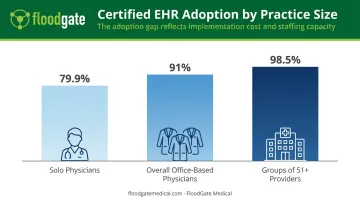
Smaller practices lag mainly due to implementation costs, training demands, and limited administrative staff to manage the rollout.
Software alone doesn't run a practice. Billing specialists, practice administrators, and MedTech-savvy operations staff make these systems work day to day.
Behind many of these platforms sit MedTech companies that need the right people to build and support them. FloodGate Medical helps fill those roles through permanent placement, contract staffing, and hiring-manager training programs.
With that context, here's how we evaluated the 11 platforms shaping practice management in 2026.
Top 11 Medical Practice Management Programs for 2026
We selected these platforms based on five criteria: reliability, feature depth, integration ecosystem, scalability, and reputation among providers and practice administrators who use them daily. Pricing varies widely, so we've flagged what's publicly disclosed versus what requires a custom quote.
Epic Systems (EpicCare)
Epic remains the dominant force in large hospital systems and health networks, with its integrated EHR and practice management suite powering some of the country's biggest health systems. It stands out for interoperability, MyChart patient engagement, and Cosmos analytics that pool de-identified data across health systems for research-grade insights.
| Best For | Large hospital systems and health networks |
| Key Features | Integrated EHR, billing, revenue-cycle automation, patient portal |
| Pricing Model | Custom enterprise pricing (contact vendor) |
athenahealth (athenaOne)
athenaOne is a cloud-native, all-in-one suite that scales from startup practices to enterprise health systems and FQHCs. Its differentiator is a network-based model. Every claim processed across athenahealth's client base feeds insights back into the system, sharpening denial prediction and billing accuracy over time.
| Best For | Mid-size to large multi-specialty practices |
| Key Features | Cloud EHR, billing, telehealth, patient engagement tools |
| Pricing Model | Aligned with practice collections; no long-term contract required |
Tebra (formerly Kareo)
Tebra, formed from the 2024 merger of Kareo and PatientPop, targets independent practices that need scheduling, billing, and marketing tools without enterprise complexity. Built-in online scheduling and reputation management help small practices compete for patients without hiring a marketing team.
| Best For | Independent and small practices |
| Key Features | Scheduling, billing, patient communication, online reviews management |
| Pricing Model | Tiered monthly subscription, priced by provider count |
AdvancedMD
AdvancedMD serves independent practices, MSOs, IPAs, and billing companies with a cloud-based suite covering EHR, PM, and managed billing. Following its December 2024 spin-off as a standalone company under Francisco Partners, it's leaned harder into customizable workflows and telehealth integration.
| Best For | Small to mid-size multi-specialty groups |
| Key Features | Practice management, EHR, telemedicine, detailed financial reporting |
| Pricing Model | Per-provider monthly subscription |
NextGen Healthcare
NextGen splits its offering into NextGen Office for small practices and NextGen Enterprise for larger specialty groups. Specialty-specific templates and population health analytics make it a strong fit for ambulatory practices managing chronic disease populations.
| Best For | Ambulatory and specialty practices |
| Key Features | EHR, PM, population health analytics, self-scheduling |
| Pricing Model | Starts around $300 per user, per month |
Oracle Health (formerly Cerner)
Oracle completed its acquisition of Cerner in June 2022, and the resulting Oracle Health platform now serves hospitals, payers, and independent practices with AI-driven analytics layered on Oracle's cloud infrastructure. It covers the full patient financial journey, from registration through bill collection.
| Best For | Large hospitals and health systems |
| Key Features | EHR, revenue cycle management, AI-powered insights |
| Pricing Model | Enterprise contract pricing (requires direct confirmation) |
DrChrono
DrChrono, now owned by EverCommerce, built its reputation on an iPad-native, mobile-first design. Small practices that want flexibility, plus a strong API for custom integrations, tend to gravitate here. No-show prediction and check-in kiosks round out the feature set.
| Best For | Small practices wanting mobile flexibility |
| Key Features | Mobile EHR, billing, claim management, patient check-in |
| Pricing Model | Tiered monthly plans (quote-based) |
eClinicalWorks
One of the most widely adopted EHR-PM combos across specialties, eClinicalWorks offers an extensive template library alongside telehealth and a patient engagement portal. Pricing here is public, which is rare in this space.
| Best For | Multi-specialty practices of varying sizes |
| Key Features | EHR, PM, telehealth, patient portal, registry reporting |
| Pricing Model | EHR: $449/provider/month; EHR+PM: $599/provider/month; RCM: 2.9% of collections |
CareCloud
CareCloud leans into revenue cycle optimization, offering RCM analytics alongside AI-powered benchmarking tools acquired through recent moves like the HFMA MAP App acquisition. Practices prioritizing collections performance over feature breadth often land here.
| Best For | Practices prioritizing revenue cycle optimization |
| Key Features | Billing, RCM analytics, patient engagement, real-time reporting |
| Pricing Model | Percentage-of-collections or flat-fee options |
Greenway Health (Intergy)
Greenway's Intergy platform is built around specialty-specific workflows for ambulatory and outpatient clinics. It's earned a reputation for strong customer support, something smaller practices without dedicated IT staff tend to value heavily.
| Best For | Ambulatory and outpatient specialty clinics |
| Key Features | EHR, PM, patient portal, in-depth reporting |
| Pricing Model | Custom quote-based pricing |
Practice Fusion
Now under Veradigm, Practice Fusion remains one of the lowest-cost entry points into cloud-based EHR and PM tools. Setup is fast, and e-prescribing comes built in, making it a common choice for solo practitioners testing the waters with digital tools.
| Best For | Solo practitioners and small clinics on a budget |
| Key Features | Cloud EHR, e-prescribing, basic PM tools, eligibility checks |
| Pricing Model | Low-cost monthly subscription with annual commitment |
How We Chose the Best Medical Practice Management Programs
The most common mistake practices make? Choosing based on price or brand recognition alone, without stress-testing whether the platform actually fits their workflow. A cheap system that doesn't integrate with your billing clearinghouse ends up costing more in denied claims than a pricier one that does.
Here's what actually drove our rankings:
- Interoperability: Can the system exchange data cleanly with labs, pharmacies, and other providers? ONC-certified health IT and USCDI support matter here
- Compliance support: Does the platform meet HIPAA Security Rule safeguards and align with CMS code-set requirements like ICD-10 and HCPCS?
- Customer support reputation: Slow support during a billing error or system outage costs real revenue
- Scalability: Will this platform still fit when you add three providers next year?
- Total cost of ownership: Implementation, training, and per-transaction fees often outweigh the sticker price
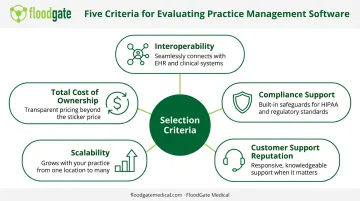
Each of these ties directly to outcomes practices care about: fewer denials, faster reimbursement, and less staff turnover from tool frustration.
Conclusion
Picking a medical practice management program in 2026 comes down to operational fit, not the biggest name or longest feature list. A platform that's perfect for a 400-provider hospital network will likely overwhelm a two-physician practice, and vice versa.
Before signing anything, pilot-test your shortlist. During the trial, watch how the system handles:
- Your actual patient volume and scheduling demands
- Your specific billing codes and claims workflow
- Your staff's daily tasks and support responsiveness
That responsiveness is usually a preview of what you'll get after the contract is signed.
Even the best-configured platform depends on the team running it. Practices and MedTech organizations that need to build out staff for these system rollouts often benefit from a specialized recruiting partner. FloodGate Medical focuses exclusively on the MedTech industry, offering permanent placement, contract staffing, and hiring-manager training to help organizations find talent that can make new software work.
Frequently Asked Questions
What is the best degree for healthcare management?
Common paths include a bachelor's or Master's in Healthcare Administration (MHA), a Business Administration degree (MBA) with a healthcare focus, or Public Health (MPH), with CAHME-accredited programs generally preferred by employers.
What are examples of medical management?
Core examples include utilization management, case management, population health management, and cost containment. These functions integrate directly with practice management software for tracking and reporting.
What is the highest paying job in healthcare management?
Roles like Chief Medical Officer, VP of Operations, and hospital CEO typically command the highest salaries, though compensation varies by organization size, region, and system complexity.
What is the difference between EHR and practice management software?
EHR software focuses on clinical documentation, such as patient charts and treatment history. Practice management software handles administrative tasks like scheduling and billing, though many modern platforms combine both.
How much does medical practice management software typically cost?
Pricing ranges from low-cost monthly subscriptions for small practices to custom enterprise contracts for hospital systems. Many vendors price by provider count or as a percentage of collections.
Can small practices benefit from practice management software?
Yes. Small practices see reduced administrative workload, faster billing cycles, and better patient communication, even with limited staff. The right platform often replaces several manual processes at once.