
That growth creates opportunity, but also confusion. Prospective students often can't tell a Clinical Research Coordinator from a Clinical Research Associate, or figure out whether a certificate, bachelor's, or master's degree fits their goals.
This guide breaks down degree types, curriculum, certifications, career paths, and salary potential, then walks through how to pick a program that actually moves your career forward.
Key Takeaways
- Programs range from certificate to master's degrees, each suited to a different career stage
- Curriculum blends compliance, biostatistics, and trial oversight, often tied to CCRP or CCRC certification
- Careers progress from Coordinator to Director of Clinical Operations, with pay rising sharply with experience
- Accreditation and career fit matter more than brand-name prestige or price tag.
What Is a Clinical Research Management Degree?
A clinical research management degree prepares professionals to oversee the safety, efficacy, and regulatory compliance of clinical trials for drugs, devices, and treatments. It's an operations and leadership credential, not a lab-science one.
That distinction matters. "Clinical research" programs tend to focus on data collection, biostatistics, and scientific methodology. "Clinical research management" programs focus on running the trial itself: budgets, timelines, site compliance, staff supervision, and sponsor relationships.
Who Actually Enrolls in These Programs?
Three groups make up most of the student population:
- Working healthcare or pharma professionals looking to move into oversight roles
- Career changers from nursing or lab science who want more structure and less bedside/bench work
- Recent life-science graduates entering the field without prior clinical experience
Trial registrations back up the demand story: ClinicalTrials.gov passed its 500,000th registered study in 2024, reflecting sustained growth in trial activity since the registry launched with roughly 1,255 studies in 2000.
How is this different from a public health or healthcare administration degree? Those programs cover population health, policy, and hospital operations broadly. A clinical research management degree stays narrowly focused on trial-specific skills: protocol design, GCP compliance, informed consent, and monitoring visits. If your goal is a CRA or CRC title, specificity wins.
Degree Levels and Program Formats
Not every career stage needs the same credential, so here's how the three main options break down.
Certificate Programs
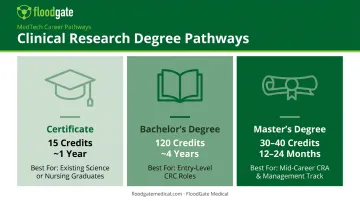
Certificates suit professionals who already hold a science or nursing degree and just need a fast, targeted credential. Arizona State University's online graduate certificate, for example, spans 15 credits and can be completed in as little as one year. These programs skip general education requirements and go straight into regulatory and trial-operations coursework.
Bachelor's Degree Programs
A bachelor's builds foundational knowledge for entry-level Clinical Research Coordinator roles. Traditional four-year tracks remain common, though some universities offer accelerated online completion paths for students transferring in associate-level credit. Campbell University's Bachelor of Applied Science in Clinical Research, for instance, uses 8-week accelerated terms across 120 credits.
Master's Degree Programs
Master's programs target mid-career professionals aiming for CRA, project management, or director-level roles. Verified examples show a consistent range:
| Program | Credits | Duration |
|---|---|---|
| Rutgers MS Clinical Research Management | 36 | 16-24 months |
| CUNY York MS Clinical Trial Management | 36 | 18 months |
| Wake Forest MS Clinical Research Management | N/A | 20 months |
| USC MS Clinical Trial Management | 32-36 | 12-24 months |
Most schools now offer online, hybrid, or on-campus formats, which matters for working professionals juggling a full-time job, family, and a degree at the same time. Weekend or evening cohorts let you keep earning while you study.
Curriculum, Coursework, and Industry Certifications
Program content varies by school, but core coursework tends to repeat across the board:
- Regulatory affairs and compliance - FDA regulations, GCP standards, IRB processes
- Biostatistics and data management - trial design fundamentals, data integrity, statistical reporting
- Trial monitoring and site management - budgeting, staffing, participant recruitment
- Research ethics - informed consent, participant protection, conflict-of-interest handling
Most master's programs also require a capstone project, practicum, or internship. This is where classroom theory meets an actual trial environment, whether that's shadowing a monitoring visit or managing a mock protocol from start to finish.
Credit Hours and Certification Alignment
Master's programs generally require 30-40 credits, with Rutgers, Drexel, and CUNY York each landing at 36. Coursework in these programs often maps directly to two certification paths:
| Certification | Issuing Body | Requirement |
|---|---|---|
| CCRP (Certified Clinical Research Professional) | SOCRA | Broader eligibility - coursework or experience plus a passing exam |
| CCRC (Certified Clinical Research Coordinator) | ACRP | 3,000 verifiable hours of coordinator-specific work experience |
These aren't interchangeable. CCRP casts a wider net across research roles, while CCRC is tied specifically to coordinator functions and demands documented hours, not just a diploma.
Accreditation matters here, too. Look for programs affiliated with the Consortium of Academic Programs in Clinical Research (CoAPCR), which bases curriculum on the Joint Task Force Core Competency Framework. Membership isn't the same as formal accreditation, so check both the institution's accreditation status and any programmatic recognition separately.
Career Paths, Job Titles, and Salary Potential
Job titles in this field confuse a lot of newcomers. Here's how the main roles actually differ.
CRC vs. CRA: Which Path Moves Faster?
| Factor | Clinical Research Coordinator (CRC) | Clinical Research Associate (CRA) |
|---|---|---|
| Employer | Trial site (hospital, clinic) | Sponsor or CRO |
| Focus | Day-to-day participant and site operations | Monitoring multiple sites for compliance |
| Typical entry point | Recent grads, career changers | Often requires prior CRC or lab experience |
| Career mobility | Strong hands-on foundation | Broader path to management roles |
CRA roles generally offer higher pay ceilings and more direct routes into management, since the job already involves overseeing multiple sites. CRC roles give you deeper day-to-day trial exposure, which is valuable groundwork even if you plan to move into a CRA seat later.
Clinical Research Manager and Director Roles
These leadership positions require several years of CRA or CRC experience plus a relevant degree. Managers and directors oversee entire trial portfolios, supervise teams, and report on budget and compliance outcomes.
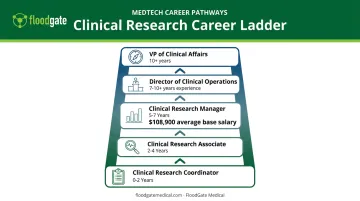
Published estimates put Clinical Research Manager average base pay at $108,900, with a 25th-75th percentile range of roughly $97,996 to $117,957. Pay shifts by region too. California and Massachusetts consistently post Director of Clinical Operations averages above the national figure, reflecting higher industry density in those states.
At the top of the ladder, a Director of Clinical Operations oversees multiple trial programs, typically after 7-10+ years of experience. A VP of Clinical Affairs sets strategic direction across an organization's entire clinical portfolio, a role usually reserved for candidates with a decade or more in progressively senior positions.
These leadership tracks exist across a wide range of employer types, not just hospitals and CROs.
Industries Hiring Graduates
Graduates land roles across:
- Pharmaceutical companies
- Biotech firms
- Contract Research Organizations (CROs) like IQVIA, Parexel, and ICON
- Academic medical centers
- Government agencies, including the NIH
Once you've earned the credential, connecting with the right employer is its own challenge. Many professionals turn to specialized MedTech recruiters like FloodGate Medical to get in front of hiring managers directly, rather than relying on cold applications alone. Their monthly newsletter also surfaces curated job openings and industry insight for candidates actively job hunting.
How to Choose the Right Clinical Research Management Program
Picking a program comes down to three practical checks.
Accreditation and Program Reputation
Confirm the institution holds regional accreditation, and check whether the program has affiliations with recognized bodies like the Association of Clinical Research Professionals (ACRP). Ask about graduate outcomes and employer partnerships, not just program marketing copy.
Cost and Format Fit
Tuition varies widely by institution type:
- Public universities often charge per-credit rates closer to $1,000
- Private programs can run $1,400+ per credit, plus additional fees
- Certificate and community college programs typically cost the least, often under $500 per credit, though they carry less industry recognition
Compare total program cost, not just per-credit price, and weigh whether an online or hybrid format actually fits your work schedule.
Career Alignment
Match the program track to your specific goal. Some programs lean toward patient-facing, site-based research; others focus on industry and regulatory operations. If you're aiming for a Clinical Research Associate (CRA) role at a sponsor company, prioritize programs with strong regulatory and monitoring coursework over general research-methods classes.
Is a Clinical Research Management Degree Worth It?
For most career changers and working professionals, yes, with a few caveats.
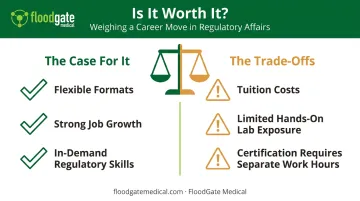
The case for it:
- Flexible formats fit around existing jobs
- Strong, sustained job growth in clinical-research hiring
- Direct alignment with in-demand regulatory and trial-management skills
The trade-offs:
- Tuition adds up, especially at private institutions
- Online formats offer limited hands-on lab exposure
- A degree alone doesn't guarantee certification eligibility; CCRC still requires documented work hours
The degree pays off most when paired with real trial experience and a professional network that can open doors. That's where career coaching and recruitment support add value beyond the classroom.
FloodGate Medical works with MedTech companies across clinical, research, and operations functions. This gives newly credentialed candidates a direct path to employers actively hiring for these roles, rather than navigating the job search alone.
Frequently Asked Questions
What is the best degree for a career in clinical research management?
A bachelor's degree suits entry-level roles like Clinical Research Coordinator. A master's or a certificate layered on top of an existing science or health degree works best for management-track advancement.
Which is better, CRC or CRA?
CRA (Clinical Research Associate) roles generally offer higher pay and broader career mobility since they involve overseeing multiple trial sites. CRC (Clinical Research Coordinator) roles provide strong entry-level, hands-on experience that many professionals use as a stepping stone.
How much do clinical research managers make in the US?
Clinical research managers in the US earn an average base salary of $108,900, typically ranging from $97,996 to $117,957. Pay varies by industry, employer type, and region, with California and Massachusetts trending higher.
What is the highest paying job in clinical research?
Director of Clinical Operations and VP of Clinical Affairs sit at the top. Both typically require a decade or more of progressively senior clinical-research experience.
Do you need certification in addition to a degree to work in clinical research management?
It's not always mandatory, but certifications like CCRP or CCRC strengthen job prospects. Many employers prefer certified candidates, especially for CRA and management-level roles.
How long does it take to complete a clinical research management degree?
Certificates can take as little as one year. Bachelor's programs typically run 3-4 years. Master's programs generally take 12-24 months, depending on full-time or part-time pacing.