Yet most people, including plenty of MedTech professionals, couldn't tell you how many AI-enabled devices the FDA has actually authorized, how they're classified, or which specialties are growing fastest. That knowledge gap matters if you're building products, writing regulatory submissions, or hiring for this space.
This article breaks down what qualifies as an AI-enabled medical device, how many the FDA has cleared, where they're showing up clinically, how the agency regulates them, and what all of this means for MedTech hiring.
Key Takeaways
- The FDA has authorized over 1,000 AI/ML-enabled devices, with growth accelerating since 2020
- Radiology leads AI adoption today, but cardiology, neurology, and pathology are catching up fast
- AI functions today focus on detection, triage, and quantification — not generative AI or LLMs
- New Predetermined Change Control Plans (PCCPs) now govern post-market algorithm updates
- Rapid AI device growth is fueling demand for regulatory, clinical, and data science talent
What Is an AI-Enabled Medical Device?
Under FDA law (21 U.S.C. 321(h)), a device is anything intended to diagnose, treat, mitigate, or prevent disease. That definition applies whether the device is a physical tool or a piece of software running an algorithm. An AI-enabled medical device is simply a device where machine learning does some or all of that clinical work.
SaMD vs. SiMD
The FDA splits AI software into two categories:
- Software as a Medical Device (SaMD): Standalone software with a clinical function, independent of any specific hardware. A mammography image-analysis app that flags suspicious masses is a classic example.
- Software in a Medical Device (SiMD): AI embedded inside hardware, where the algorithm is one function among several. A handheld ultrasound probe that uses AI to auto-optimize image quality falls here.
Predictive AI, Not Generative AI
Nearly every authorized device today runs on predictive AI — algorithms that spot patterns and forecast outcomes, such as flagging a suspicious lesion or predicting deterioration risk. Generative AI and large language models are still experimental in this space.
A taxonomy study published in npj Digital Medicine found no LLM-based device had received FDA authorization through its review period, though more than 100 devices used other generative techniques like image denoising.
That's a meaningful contrast with traditional, rule-based devices, which apply the same fixed threshold to every patient regardless of context. AI-enabled tools adapt to patient-specific data and, in some cases, improve through retraining over time.
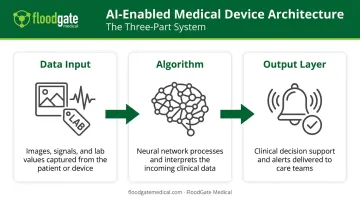
These behavioral differences trace back to a shared architecture. Most AI-enabled devices break down into three components:
- Data input: an image, signal, or lab value that feeds the model
- Algorithm: the trained model that detects patterns in that input
- Output layer: the result that informs or automates a clinical decision
How Many AI Medical Devices Has the FDA Authorized?
The FDA maintains a public AI-Enabled Medical Device List that tracks every authorization. The count has climbed from 1,180 authorizations with decision dates through March 2025 to 1,522 through March 2026 — a jump that reflects just how fast this category is moving.
That "authorization" number isn't the same as the number of distinct products on the market. The npj Digital Medicine taxonomy study mapped 1,016 authorizations through late 2024 to only 736 unique devices. Companies frequently resubmit updated versions of the same product, and each resubmission counts as a new authorization.
Most Devices Clear Through 510(k)
Regulatory pathway matters here. Among a 691-device cohort:
- 96.7% cleared through 510(k) (substantial equivalence to an existing device)
- 2.9% cleared through De Novo (novel, lower-to-moderate risk devices)
- 0.4% required full Premarket Approval (PMA)
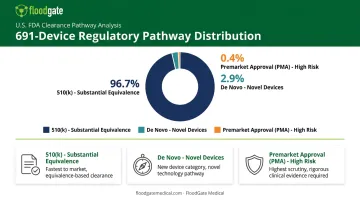
That heavy tilt toward 510(k) tells you something important. Most AI devices today are viewed as moderate-risk tools that build on established device categories, not brand-new, high-risk technology requiring the most rigorous review.
Updates Are Outpacing New Submissions
Here's a trend worth watching closely: update-authorizations averaged 34% of all filings between 2022 and 2024, up from 14% in 2017–2019. Manufacturers are refining existing algorithms faster than ever, which means regulatory and quality teams are spending more time on lifecycle management than on first-time submissions.
For historical context, authorizations were rare before 2015, with a mere 33 total between 1995 and 2015. The pace has since exploded, with 168 authorizations in 2024 alone, a new annual record.
What Medical Devices Use AI? Real-World Examples by Specialty
Not every specialty is equally represented. Some categories dominate the FDA list; others are smaller but growing quickly.
Radiology and Imaging
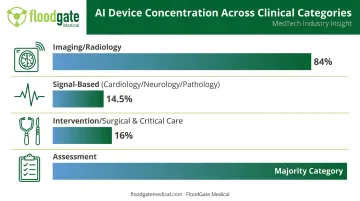
Imaging is the clear leader. Roughly 84% of authorized devices use images as their core data type, according to the npj taxonomy study. Real-world examples include:
- CT software that flags likely stroke cases for urgent radiologist review
- AI-enhanced mammography tools that highlight suspicious breast tissue
- MRI reconstruction algorithms that sharpen image quality without longer scan times
Cardiology, Neurology, and Pathology
Signal-based devices (ECG and EEG) make up the second-largest data category, at roughly 14.5% of unique devices. Examples include:
- AI-powered ECG analysis for arrhythmia detection and low ejection fraction screening
- Echocardiography tools that automate cardiac measurements
- EEG-based seizure and sleep monitoring systems
- Digital pathology software that classifies tumor tissue from slide images
Critical Care, Surgical, and Emerging Specialties
Beyond diagnostics, AI is showing up in active clinical workflows:
- Critical care: Predictive analytics for sepsis risk and patient deterioration, smart infusion pumps, and continuous glucose monitors that support insulin dosing
- Surgical/interventional: AI-guided surgical navigation, radiotherapy planning software, and robotic-assisted procedure tools
- Emerging specialties: Retinal screening in ophthalmology, skin-lesion analysis in dermatology, and fetal monitoring in obstetrics
This "Intervention" category makes up about 16% of devices, compared with the majority "Assessment" category. The breadth here matters: AI isn't confined to radiology reading rooms anymore, it's touching nearly every corner of clinical practice.
How Does the FDA Regulate AI-Enabled Medical Devices?
Regulation starts with risk classification. Class I devices carry the lowest risk, Class II requires special controls, and Class III covers life-sustaining or high-risk technology. Most AI devices land in Class II, cleared through 510(k). One study found 99.7% of a 692-device cohort fell into this category.
Total Product Life Cycle and GMLP
The FDA's approach doesn't stop at initial clearance. Its Total Product Life Cycle (TPLC) framework, currently in draft guidance, covers a device from design through postmarket monitoring. Sitting alongside it are Good Machine Learning Practice (GMLP) principles, which call for:
- Representative training data across patient populations
- Independent training and test datasets
- Clinically relevant testing before deployment
- Ongoing monitoring of real-world model performance
Predetermined Change Control Plans (PCCPs)
Algorithms that keep learning create a regulatory challenge: how do you approve updates without forcing a brand-new submission every time?
The FDA's answer is the PCCP — a mechanism, finalized in 2025 guidance, that lets manufacturers pre-approve how their AI model can change postmarket. A PCCP typically includes a description of planned modifications, a modification protocol, and an impact assessment.
This distinction carries real weight for manufacturers. As update-authorizations climb toward that 34% share mentioned earlier, PCCPs are becoming the difference between a manufacturer that can iterate quickly and one stuck resubmitting for every tweak.
What This Means for MedTech Careers and Hiring
Every one of those 1,500+ authorizations required people. That workforce includes:
- Regulatory specialists who understand AI/ML guidance
- Clinical validation scientists who design studies for adaptive algorithms
- Data scientists who document training data
- Quality engineers fluent in GMLP requirements
That demand isn't slowing down. Life-sciences companies across the US, UK, and Germany are already reporting workforce strain tied to AI adoption, with many device makers either using AI internally today or planning to within the next couple of years.
There's also a compliance angle worth noting: GMLP explicitly calls for multidisciplinary expertise and training datasets representative of the population a device will serve.
Biased training data directly affects patient safety, determining who a device works well for in real-world use. Building diverse, cross-functional teams has become a practical regulatory necessity for meeting these standards.
This is exactly the territory FloodGate Medical works in. As a recruitment firm focused exclusively on MedTech, FloodGate connects companies building AI-enabled device teams with regulatory, clinical, and data science talent.

FloodGate also helps professionals move into this fast-growing niche, matching them with the right opportunities. Its equity-driven approach to hiring lines up naturally with where FDA guidance is already headed.
Frequently Asked Questions
What is AI as a medical device?
Under FDA law, software or hardware qualifies as a medical device when it's intended to diagnose, treat, or prevent disease. AI counts whether it's standalone software (SaMD) or embedded inside hardware (SiMD).
How many AI medical devices has the FDA approved?
The FDA's public list has grown from fewer than 100 authorizations a decade ago to well over 1,000 today, with the total expected to surpass 1,500 by early 2026. Growth has accelerated sharply since 2020.
What medical devices use AI?
Radiology and imaging tools lead by a wide margin, followed by cardiac monitors, digital pathology systems, and surgical navigation devices. Emerging categories include ophthalmology, dermatology, and obstetrics applications.
What's the difference between SaMD and SiMD?
SaMD is standalone diagnostic software, like an app that analyzes mammography images independently. SiMD is AI built into a physical device's function, such as an ultrasound probe that auto-optimizes its own image quality.
Are AI-enabled medical devices safe?
FDA authorization requires evidence of safety and effectiveness plus ongoing postmarket monitoring. Research using two separate device cohorts found recalls affected only about 4.8% to 5.8% of authorized AI devices, a relatively small share.
How can MedTech professionals build a career in AI-enabled devices?
Build skills in regulatory affairs, clinical validation, or data science, since these roles drive current hiring demand. A MedTech-focused recruiter like FloodGate Medical can help you find relevant openings faster.