Introduction
In MedTech, a single mis-hire can ripple through R&D, regulatory, sales, and clinical teams for months. Resumes and traditional interviews often miss the behavioral signals that matter in these cross-functional roles.
Can this candidate navigate ambiguity during a 510(k) submission? Will they communicate clearly across engineering and commercial teams? Do they adapt when a product launch timeline shifts?
SHRM's 2022 survey of 1,688 HR professionals found that 56% of organizations now use pre-employment assessments to evaluate candidates' knowledge, skills, and abilities.
Yet many MedTech hiring managers still lean on gut feel. Interviewers often form conclusions within the first few minutes and put instinct ahead of evidence.
This guide unpacks what behavioral assessments are, the main types and frameworks in use, top tools for MedTech hiring, and how to implement them effectively alongside structured interviews to reduce costly mis-hires and build high-performing teams.
Key Takeaways
- Behavioral assessments predict how candidates communicate, decide, and collaborate, unlike technical or cognitive tests
- Common frameworks include DISC, Predictive Index, Big Five, and situational judgment tests (SJTs)
- 56% of employers use pre-employment assessments; structured tools reduce subjective bias when applied consistently
- Assessments should complement—never replace—structured interviews, technical evaluation, and job analysis
- Validity, reliability, and EEOC compliance must be verified before adoption
What Is a Behavioral Assessment Test?
A behavioral assessment is a structured tool used during hiring to observe, describe, and predict how a candidate is likely to communicate, make decisions, and work with others in a specific role.
Unlike cognitive tests that measure problem-solving speed or technical exams that verify domain knowledge, behavioral assessments focus on workplace tendencies: how someone prefers to interact, respond to pressure, or approach collaboration.
How Behavioral Assessments Differ from Personality Tests
The terms "behavioral assessment" and "personality test" are often used interchangeably. The U.S. Office of Personnel Management (OPM) defines personality tests as methods that elicit motivations, preferences, interests, emotional makeup, and interpersonal styles through self-report inventories. Behavioral assessments sit on a spectrum:
- Self-report inventories (e.g., Big Five, DISC, Hogan) ask candidates to agree or disagree with statements, inferring stable traits
- Situational judgment tests (SJTs) present job-related scenarios and ask what the candidate would do, measuring judgment without requiring actual behavior
- Work simulations and role plays observe candidates performing job-like tasks, offering the most direct behavioral evidence
The key distinction is the type of evidence: reported tendencies, judgment in hypothetical situations, or observed performance.
What Behavioral Assessments Typically Measure
Most hiring-focused behavioral assessments evaluate:
- Communication style – How a candidate prefers to share information, persuade, or listen
- Decision-making preferences – Whether they prioritize data, consensus, speed, or caution
- Adaptability – Comfort with change, ambiguity, or shifting priorities
- Teamwork tendencies – Preference for collaboration, independence, or leadership
- Motivation and drives – What energizes or drains them in a work environment
Why Behavioral Fit Matters in MedTech Hiring
MedTech roles demand more than technical competence. A regulatory affairs manager must translate FDA feedback for engineers. A clinical specialist must build trust with surgeons and hospital procurement teams. A product manager must balance R&D timelines with commercial launch pressures.
When candidates lack the behavioral fit for these interactions, regardless of their résumé, projects stall, teams fracture, and turnover accelerates. Research frequently referenced in FloodGate Medical’s hiring work points to a stark pattern: 89% of new-hire failures stem from poor culture fit rather than skill gaps.
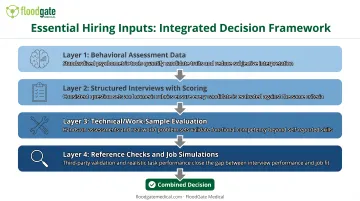
Assessments are one input, not the entire decision. No assessment should be used in isolation. Federal employment guidelines require that selection procedures be job-related, validated, and monitored for adverse impact. Effective hiring combines:
- Behavioral assessment data
- Structured interviews with standardized scoring
- Technical or work-sample evaluations
- Reference checks and job simulations
Layering these inputs cuts down on gut-feel decisions and supports fairer, more consistent MedTech hiring.
Types of Behavioral Assessments Used in Hiring
Behavioral assessments fall into three main categories based on how they collect evidence.
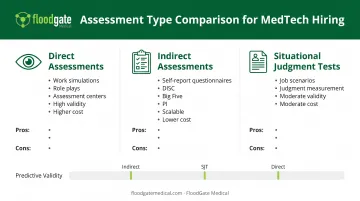
Direct Assessments (Observed Behavior)
Direct assessments require candidates to perform job-like tasks while trained assessors observe and score their behavior or task outcomes. Examples include:
- Role plays – Simulating a difficult conversation with a stakeholder or team member
- Assessment-center exercises – Group problem-solving or presentation tasks
- Work samples – Completing a realistic project deliverable (such as drafting a regulatory submission section)
According to OPM, work simulations offer high content validity because candidates actually demonstrate entry competencies. The trade-off: higher cost, longer administration time, and the need for trained assessors.
Indirect Assessments (Self-Report Questionnaires)
Indirect assessments ask candidates to rate their agreement with statements or describe their preferences. The tool infers stable traits and builds a profile that predicts performance or work satisfaction. Examples include:
- Big Five inventories – Trait measures covering Conscientiousness, Extraversion, and related dimensions
- DISC-based questionnaires – Four-style profiles focused on communication and workplace behavior
- Predictive Index (PI) – Drive-based assessment used for hiring fit and team design
- Hogan Personality Inventory – Workplace-oriented scales for performance and derailers
These tools are scalable, cost-effective, and easy to administer online. However, OPM warns that transparent items can be faked or distorted, and results should be interpreted carefully in context.
Situational Judgment Tests (SJTs)
SJTs present candidates with realistic job problems (often in text or video) and ask what they would do. Scoring compares responses to expert judgments or empirical keys. OPM classifies SJTs as low-fidelity simulations because no behavior is actually performed; instead, the test measures interpersonal judgment, problem-solving, and decision-making.
SJTs are particularly useful for roles that require frequent judgment calls under ambiguity, such as navigating a product complaint or prioritizing competing stakeholder requests. Validity depends on scenario quality, scoring key, and alignment with the target job.
Popular Frameworks Used in Practice
Several indirect frameworks show up often in hiring stacks. Three of the most common are DISC, Predictive Index, and Big Five-based tools.
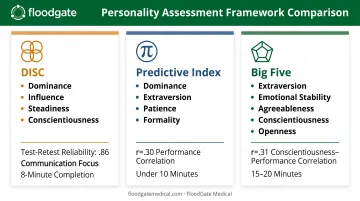
DISC (Dominance, Influence, Steadiness, Conscientiousness)
DISC measures four communication and behavioral styles through an adaptive questionnaire. Respondents rate agreement with statements, and the tool maps their profile across the four dimensions.
DISC is widely used for team development and communication training, with Everything DiSC reporting test-retest reliability of .86. Reliability (score consistency) does not automatically prove predictive validity for job performance.
Predictive Index (PI)
The PI Behavioral Assessment measures four vendor-defined drives: Dominance, Extraversion, Patience, and Formality. PI reports approximately 400 studies since 1992, with 94% finding significant performance associations and an average correlation of r=.30 among significant studies. These are vendor-reported figures, so request role-specific validation evidence before adoption.
Big Five Model
The Big Five (Extraversion, Emotional Stability, Agreeableness, Conscientiousness, and Openness to Experience) is a broad trait framework, not a single proprietary test.
Research by Schmidt and Hunter reported a correlation of r=.31 between Conscientiousness and job performance, though more recent work suggests earlier validity estimates may have been overcorrected. Big Five assessments are science-backed and widely studied, making them a defensible choice when job analysis supports their use.
Top Behavioral Assessment Tools for Hiring
No single behavioral assessment is universally best. The right choice depends on role complexity, hiring volume, and whether validity and reliability are backed by standards from the Society for Industrial and Organizational Psychology (SIOP) or the American Psychological Association (APA).
Predictive Index (PI)
What it measures: Four behavioral drives (Dominance, Extraversion, Patience, and Formality) through a short, untimed questionnaire.
Strengths: Fast administration (under 10 minutes), science-backed methodology, and dual use for hiring and team optimization. PI's vendor documentation cites 400+ studies since 1992 with an average correlation of r=.30 to performance.
Considerations: Published evidence is primarily vendor-reported. Request technical manuals and role-specific validation data during procurement.
DISC-Based Platforms (Thomas PPA, Everything DiSC)
What they measure: Communication and interaction styles across Dominance, Influence, Steadiness, and Conscientiousness.
Strengths: Strong face validity, clear profiles, and wide use in team development. Thomas PPA finishes in under 8 minutes and reports communication style, decisiveness, adaptability, and environment preferences. Everything DiSC reports .86 test-retest reliability and 90% taker-rated accuracy.
Considerations: Taker-rated accuracy reflects perceived fit, not predictive validity for job performance. DISC is better suited for communication training than high-stakes hiring decisions unless combined with other methods.
Hogan Personality Inventory (HPI)
What it measures: Seven primary Big Five-based scales and 42 subscales, completed in 15–20 minutes.
Strengths: Hogan reports validation in more than 1,000 research studies, with strong evidence for predicting workplace performance and identifying leadership derailment risks.
Considerations: Request studies matching your target job and decision use. The depth of the HPI makes it well-suited for leadership and senior roles where behavioral nuances matter.
Situational Judgment Tests (SJTs) and Simulation-Based Tools
What they measure: Interpersonal judgment, problem-solving, and decision-making through job-relevant scenarios.
Strengths: High content validity when scenarios mirror critical work. A 2020 study cited by PMC found higher SJT scores predicted performance outcomes beyond traditional exams alone.
SJTs can also surface candidates résumé screens miss. One 2019 study found only 23% of SJT-identified applicants would have been interviewed under conventional review.
Considerations: Custom development and validation are required for maximum job relevance. Off-the-shelf SJTs may not align with your organization's critical competencies. Validity depends on scenario quality, scoring key, and job match.
Applying Assessments in MedTech Hiring
Choosing a tool is only part of the decision. How you apply scores in real hiring workflows determines whether assessments improve quality of hire.
FloodGate Medical embeds behavioral assessments and customized candidate scorecards into MedTech permanent placement, with emphasis on culture fit, values alignment, and long-term potential. The firm is a certified "Hiring for Attitude" partner.
In practice:
- Structured interviews plus evidence-based scorecards (including the Interview ScoreCard)
- Less reliance on gut instinct; more consistent hiring decisions
- 450+ MedTech professionals placed annually with an 89% one-year retention rate
Benefits of Using Behavioral Assessments in Hiring
When implemented thoughtfully, behavioral assessments deliver measurable hiring advantages.
More Consistent, Less Subjective Decisions
Federal guidelines require that selection procedures be administered and scored under standardized conditions. Behavioral assessments create a common evaluation framework, reducing process variation across interviewers and hiring managers. When every candidate for a regulatory affairs role completes the same assessment and is scored using the same rubric, hiring teams can compare apples to apples, not impressions formed in the first five minutes.
FloodGate Medical's Interview ScoreCard exemplifies this principle, giving interviewers a standardized framework to score candidate competencies and record relevant evidence. This replaces unstructured "gut" judgments with consistent, documented evaluation.
Better Visibility into Communication and Working-Style Fit
Technical skills are baseline expectations in MedTech; behavioral fit often determines success. Behavioral assessments surface tendencies technical screens miss:
- A clinical specialist with deep product knowledge but poor adaptability may struggle when a hospital changes protocols mid-implementation
- A quality engineer who prefers independent work may clash with a highly collaborative team culture
Catching these patterns before hire supports better role matching. That matters in MedTech, where R&D, regulatory, sales, and clinical teams collaborate constantly.
Potential to Reduce Hiring Bias and Support DEI Goals
OPM notes that personality tests generally show few, if any, mean score differences across sex, race, or ethnicity. Structured assessments can reduce reliance on subjective impressions, such as "cultural fit" judgments that may inadvertently favor majority-group candidates.
SHRM's 2022 survey found that 23% of employers using assessments reported improved diversity. A 2020 study in PMC found that a customized SJT combined with a lower traditional cutoff increased underrepresented-minority interview invitations by 1–17% across six programs. One fellowship study within that research found a 22-percentage-point increase.
FloodGate Medical's DEI-driven recruitment approach uses structured, evidence-based evaluation to connect MedTech companies with diverse talent, rather than "culture fit" shortcuts that tend to reinforce sameness.
Important caveat: Group averages do not eliminate item bias, accessibility issues, or local adverse impact. Employers must monitor outcomes continuously, including when using vendor-operated tools.
Best Practices for Implementing Behavioral Assessments
Define the Specific Behaviors Needed for Role Success First
Before selecting an assessment tool, conduct a job analysis. Identify the critical work behaviors, competencies, and interpersonal demands of the role. Ask:
- What communication style succeeds in this team?
- How much ambiguity and change will this person face?
- What decision-making approach aligns with our processes?
- Which behavioral gaps have caused past hiring failures?
FloodGate Medical defines both hard skills and soft skills upfront. Client Joel Pickering, VP of Marketing, credited this approach with producing "perfect fit" candidates.
Use the Same Assessment Consistently Across All Candidates
Fairness requires standardization. If one candidate completes a PI assessment and another completes a DISC profile, you cannot compare their results meaningfully. Apply the same tool, administration conditions, and scoring rubric to every candidate for a given role.
Combine Assessment Results with Structured Interviews
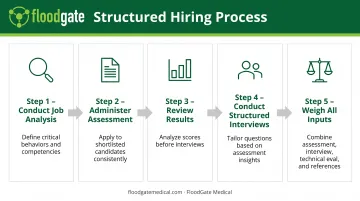
Never use assessment scores as the sole hiring criterion. Federal guidelines require that validity evidence support the intended job-related inference. The most defensible approach:
- Administer the assessment to shortlisted candidates
- Review results before structured interviews
- Use insights to tailor interview questions (for example, probe adaptability if the assessment flags rigidity)
- Score interview responses using a standardized rubric
- Weigh all inputs (assessment, interview, technical evaluation, and references) before deciding
FloodGate Medical uses this same layered approach, pairing behavioral assessments with scorecards and evidence-based interviews rather than relying on any single data point.
Be Transparent with Candidates
Inform candidates when and how assessments will be used. Transparency builds trust and reduces the risk of legal challenges. For example:
"As part of our process, we ask all finalists to complete a 15-minute behavioral assessment. Results help us understand your working style and ensure mutual fit. The assessment is one input alongside interviews and technical evaluation."
Limitations and Considerations
Assessments Should Never Be the Sole Hiring Criterion
Capability, experience, and technical fit still matter. A candidate who scores well behaviorally but lacks the required FDA regulatory knowledge is not a viable hire for a regulatory affairs role.
Conversely, a technically brilliant candidate whose behavioral profile signals poor team collaboration may struggle in a cross-functional MedTech environment. Both dimensions must be evaluated.
Results Require Careful, In-Context Interpretation
Assessment profiles are probabilistic, not deterministic. A candidate who scores low on "Extraversion" may still excel in a client-facing role if other strengths compensate. Context matters:
- Is the role fully remote or in-person?
- How structured is the work environment?
- What support and development will the new hire receive?
Avoid overgeneralizing a candidate's profile or treating scores as immutable personality verdicts.
Verify Assessment Validity, Reliability, and Compliance
Assessment quality—and legal risk—varies widely across vendors. EEOC guidance identifies disparate impact when a selection procedure disproportionately excludes a protected group and is not job-related and consistent with business necessity. Before adopting a tool, verify:
- Criterion validity: Does the assessment predict or correlate significantly with job performance?
- Content validity: Do test items represent critical job content?
- Construct validity: Does it measure a job-important characteristic?
- Reliability: Are scores stable and consistent?
- Adverse impact: Does the tool produce selection rates below 80% of the highest group's rate (the four-fifths rule)?
Request technical manuals, validation studies, and SIOP or APA backing. A vendor's "validated" label is not sufficient compliance evidence—employers remain accountable for local outcomes.
That accountability continues after rollout. A 2025 peer-reviewed review found it remains unresolved which algorithmic hiring approaches are less biased than low-tech alternatives. Fairness on a held-out test does not guarantee fairness in production, so audit subgroup outcomes continuously.
Frequently Asked Questions
What is the best personality assessment for hiring?
There's no single "best" test. Widely used, science-backed options include the Predictive Index, DISC-based tools, Hogan Personality Inventory, and Big Five inventories. The right choice depends on the role's behavioral demands, hiring volume, and whether the tool's validity evidence matches your job and decision use.
What is a behavioral assessment for employment?
A behavioral assessment is a structured hiring tool that predicts how a candidate is likely to behave, communicate, and perform in a role. It measures tendencies like communication style, decision-making, adaptability, and teamwork via questionnaires, situational judgment tests, or work simulations.
What are examples of behavioral assessments?
Common examples include DISC-based platforms (Everything DiSC, Thomas PPA), the Predictive Index, Hogan Personality Inventory, Big Five inventories, situational judgment tests (SJTs), and work simulations such as role plays or assessment-center exercises.
How accurate are behavioral assessments in predicting job performance?
Accuracy varies by tool and context. Schmidt and Hunter reported a correlation of r=.31 between Conscientiousness and job performance, though recent work suggests earlier estimates were overcorrected. Pair assessments with structured interviews, technical evaluation, and references, and request role-specific validation data before adoption.
Can behavioral assessments help reduce hiring bias?
Structured, standardized assessments can reduce reliance on subjective impressions when used correctly. Some SJTs have increased underrepresented-group interview invitations, and personality tests generally show minimal score differences by sex, race, or ethnicity. Employers must still monitor local outcomes and meet EEOC guidelines—tools alone do not eliminate bias.
Ready to build a high-performing MedTech team with the right behavioral fit? FloodGate Medical combines behavioral assessments, structured interviews, and customized scorecards to connect you with diverse, high-caliber talent aligned with your culture and goals. Explore our MedTech talent acquisition services or contact us to discuss your hiring needs.