For MedTech and healthcare organizations, that distinction isn't academic. A mis-hire in regulatory affairs or a six-month vacancy in clinical engineering can delay a product launch, stall a compliance milestone, or cost a company its competitive window. The stakes are real, and they're rising: in a 2025 Gartner survey of nearly 3,000 candidates, 35% backed out after already accepting a job offer.
This article breaks down what separates talent acquisition from recruitment, where each fits, and how MedTech companies can use both strategically.
Key Takeaways
- Recruitment fills a specific open role fast; talent acquisition builds pipelines before need exists.
- Both use ATS, job boards, and interviews, but differ in planning horizon and metrics.
- MedTech companies need both: recruitment for standard roles, talent acquisition for scarce regulatory talent.
- Layering sourcing onto reactive hiring shortens fill times for hard-to-source specialists.
Talent Acquisition vs. Recruitment: Quick Comparison
Recruitment and talent acquisition (TA) aren't competing strategies. Recruitment is a subset of the broader TA function, but the two operate on entirely different timelines and with different goals in mind.
| Dimension | Recruitment | Talent Acquisition |
|---|---|---|
| Timeframe | Short-term; starts and ends with filling one vacancy | Long-term; ongoing regardless of current openings |
| Strategic Focus | Tactical execution against a job requisition | Workforce planning aligned to business goals |
| Success Metrics | Time-to-fill, cost-per-hire, vacancy rate | Quality-of-hire, retention, pipeline conversion |
| Candidate Sourcing | Active job seekers via boards, referrals, ATS | Passive candidates via employer branding, networking |
| Resource Investment | Lower upfront cost, faster ROI | Higher upfront investment, longer-term payoff |
The takeaway: recruitment answers "who can start Monday?" Talent acquisition answers "who will we need in eighteen months, and how do we already know them?" For MedTech hiring teams, that distinction often decides whether you're filling a seat or building tomorrow's pipeline.
What is Talent Acquisition?
Talent acquisition is the proactive, ongoing process of identifying, engaging, and nurturing relationships with candidates, often well before a role even opens. It treats hiring as a long-term capability, not a one-off transaction.
Done well, TA delivers three operational payoffs:
- Stronger employer brand that attracts candidates without a job posting.
- Shorter time-to-fill for hard-to-source specialists once a role finally opens.
- Improved retention, because candidates were vetted for fit, not just availability.
Effective TA strategies now increasingly build in diversity-driven sourcing and skills forecasting rather than treating them as afterthoughts. FloodGate Medical, for instance, incorporates equity, diversity, and inclusion principles directly into how it sources candidate pipelines for MedTech clients, on the premise that broader sourcing nets stronger, more innovative teams.
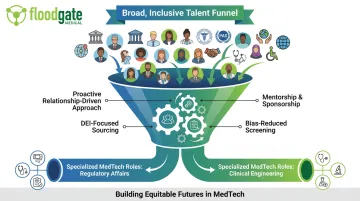
That's a meaningfully different approach than posting a job ad and waiting for applications.
Use Cases of Talent Acquisition
TA earns its keep at inflection points in a MedTech company's growth: launching a new device line, scaling an R&D team, or entering a new regulatory market where domestic talent is thin. These moments require people who don't yet know the company exists.
Roles where TA typically dominates:
- Regulatory affairs leaders who understand both FDA and international submission pathways.
- Clinical engineering specialists with device-specific technical depth.
- Senior leadership hires where a bad fit costs far more than a slow search.
These roles can take months to fill through cold outreach alone. Korn Ferry's sourcing technology research found that structured pipeline tools, such as chatbots that move candidates to interview faster, can cut that stage of the process by nearly 80%. That's why organizations with scarce-talent needs build pipelines long before the requisition opens, not after.
What is Recruitment?
Recruitment is the tactical, short-term process of sourcing, screening, and hiring someone for a specific, currently open position. Someone gave notice, a new headcount got approved, or seasonal demand spiked. Recruitment's job is to close that gap, fast.
Its core benefits are practical:
- Quick resolution of staffing gaps that threaten productivity.
- Maintained operations without lengthy vacancy stretches.
- Lower resource requirements compared to a full TA build-out.
Don't mistake "tactical" for "unsophisticated." Recruitment today still leans on applicant tracking systems, targeted job ads, and referral programs. It's simply operating on a compressed timeline with a narrower goal: fill this seat.
Use Cases of Recruitment
Recruitment carries most of the daily hiring load in HR operations, replacing a departing employee, handling a seasonal hiring spike, or staffing standardized, less specialized roles.
Industries and roles where recruitment dominates:
- High-volume manufacturing and production lines.
- Administrative and support staff.
- Entry-level sales, service, or coordinator positions.
- Medical device assembly and quality control roles.
According to SHRM's 2026 recruiting benchmarking report, drawn from 4,657 members:
- Median time-to-fill: 39 days for nonexecutive roles vs. 45 days for executive roles.
- Median cost-per-hire: $1,300 for nonexecutive positions vs. $15,000 for executive roles.
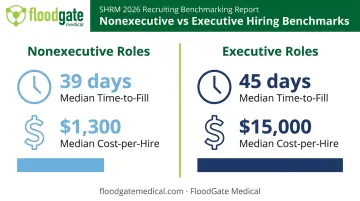
Standard recruitment simply moves faster and cheaper, because the candidate pool is deeper.
Which Approach Should You Choose?
There's no universal answer. The right approach depends on four factors:
- Role complexity — Is this a standardized function or a specialized skill set?
- Urgency — Do you need someone in two weeks or two quarters?
- Talent market scarcity — How many qualified people actually exist for this role?
- Long-term business objectives — Does this hire connect to a growth milestone or product launch?
| Approach | Best Fit When |
|---|---|
| Recruitment | Immediate vacancies, high-volume hiring, or entry-level roles with a large candidate pool |
| Talent Acquisition | Niche, specialized, or leadership roles tied to where the business is headed, not just where it stands today |
In scarce-talent fields like MedTech, most organizations end up needing both. A company might use straightforward recruitment to staff a customer service team while simultaneously running a TA pipeline for a director of quality assurance who doesn't exist yet in the active job market.
When Job Postings Alone Aren't Enough
Picture a mid-size device manufacturer that spent nine months trying to fill a clinical affairs director role through job postings alone. Every candidate who applied lacked either the regulatory depth or the specific therapeutic-area experience the role demanded.
The fix wasn't a better job ad. It was building a pipeline of passive candidates months in advance, sourced through professional networks and diversity-focused outreach, so that when the role opened, qualified people were already engaged.
That pattern tracks with broader research: McKinsey's 2023 analysis of over 1,200 companies found that organizations in the top quartile for executive-team diversity had a 39% greater likelihood of financial outperformance than bottom-quartile peers. Diverse sourcing isn't just a values statement. It widens the funnel for roles where the traditional funnel is nearly empty.
If your organization is stuck cycling through reactive job postings for roles that never seem to fill, that's usually the signal to layer a proactive strategy on top.
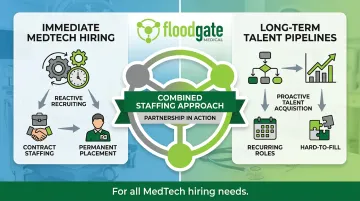
FloodGate Medical works with MedTech companies to build exactly that blend, permanent placement and contract staffing for immediate needs, paired with longer-term talent pipelines for the roles that keep reopening. If that sounds like your hiring challenge, connecting with a MedTech-focused recruiting partner is a reasonable next step.
Conclusion
Neither approach wins outright. Recruitment delivers speed for immediate needs, while talent acquisition delivers strategic depth for roles where qualified people are scarce. The skill lies in matching the method to the moment, not picking a permanent side.
For MedTech organizations, that balance produces measurable results when both approaches work together instead of competing for the same budget line:
- Faster fills for hard-to-find specialists
- Stronger retention once new hires are on board
- More diverse, innovation-ready teams
That's the model FloodGate Medical uses to help MedTech companies build talent-ready teams.
Frequently Asked Questions
What are the 7 stages of recruitment?
The typical stages are identifying the need, sourcing, screening, interviewing, assessing candidates, extending an offer, and onboarding. Some frameworks combine or expand these steps, but this sequence covers the core selection process.
What is the difference between a talent acquisition lead and a recruiter?
A talent acquisition lead focuses on strategy, workforce planning, and employer branding across the organization. A recruiter executes day-to-day sourcing and hiring for specific, currently open roles.
What is another name for talent acquisition?
It's sometimes called strategic recruiting or workforce planning, though each term carries a slightly different scope. TA generally implies a broader, longer-term view than either alternative.
Is talent acquisition or recruitment better for your business?
Both have a place. The right choice depends on how urgent the role is, how specialized it is, and whether it connects to a longer-term hiring goal.
What skills are needed for a career in talent acquisition?
Relationship-building, employer branding, data analysis, and strategic workforce planning are core skills. Strong stakeholder communication with hiring managers matters just as much as sourcing ability.
Who is responsible for talent acquisition within an organization?
Larger organizations typically have dedicated TA specialists or teams. Smaller businesses often rely on HR generalists, hiring managers, or outsourced partners like FloodGate Medical, which focuses exclusively on MedTech recruitment.