Many device teams treat naming as a late-stage branding task. That's a mistake. The name you choose interacts with your device's risk classification, international labeling rules, and the trademark landscape in ways that pure creative brainstorming can't anticipate.
This guide walks through the step-by-step naming process, what you need in place before you start, the factors that determine whether a name succeeds, common mistakes to avoid, and how to decide between naming in-house or bringing in outside help.
Key Takeaways
- Device naming balances FDA/EU MDR compliance with brand strategy and trademark clearance
- Naming requires regulatory, legal, and marketing collaboration — not just creative brainstorming
- Skipped trademark searches and look-alike names are the costliest naming mistakes
- In-house vs. outside support depends on device risk class and internal bench strength
How to Name a Medical Device: Step-by-Step Process
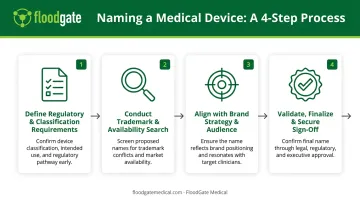
Step 1: Define Regulatory & Classification Requirements
Start with your device's FDA classification. A 510(k) submission requires you to distinguish between the trade/proprietary name, the common/usual name, and the classification name — these serve different purposes and can't be used interchangeably in labeling.
- Confirm whether a nonproprietary descriptor is required alongside your brand name
- Check EU MDR Article 7 if launching in Europe: it prohibits names that imply nonexistent functions, create false impressions about performance, or suggest uses outside your conformity-assessed intended purpose (EUR-Lex, 2017)
- Verify the name doesn't imply an unapproved indication or safety claim
- For Canadian launches, remember the device name must distinguish it from similar products and appear on the label with its identifier
Step 2: Conduct a Comprehensive Trademark & Availability Search
Skipping this step is the single most common naming failure. Search the USPTO trademark database for conflicts based on sound, appearance, meaning, or commercial impression, not just identical spelling.
USPTO's current processing averages run 4.2 months to first examining action and 9.8 months to registration or abandonment (USPTO, 2026). That's registration time, not clearance search time, so budget separately for the preliminary search your legal team runs before filing.
Also verify:
- Domain name and social media handle availability
- Existing device names in your category, to reduce look-alike/sound-alike confusion
- Trademark Class 10 (medical apparatus) filing fees, currently $350 per class
Step 3: Align the Name with Brand Strategy & Target Audience
Decide who the name needs to speak to first. Clinicians respond to different cues than patients do, and a name that impresses a surgeon might alarm a patient reading their discharge paperwork.
Consider:
- Whether the name needs to support a broader product platform or future generations
- How it sounds, spells, and translates across your target markets
- Whether a single name can serve both clinical and patient-facing materials, or whether you need separate branding layers
At ASAHI, device names like Corsair Pro and SASUKE were built to work within a recognizable naming architecture across a growing microcatheter portfolio, rather than as one-off labels for a single SKU.
Step 4: Validate, Finalize, and Secure Sign-Off
Before you lock anything in, run a formal legal review with an IP attorney alongside your regulatory affairs team. Then:
- Collect feedback from focus groups or key opinion leaders in the relevant specialty
- File the trademark application once the name clears legal and regulatory review
- Document your naming rationale for inclusion in the regulatory submission file
Skipping documentation here creates headaches later if FDA or a notified body asks why a name was chosen.
What You Need Before Naming a Medical Device
Preparation upfront prevents rebranding disasters and regulatory delays down the line. Three things need to be in place before you start generating name candidates.
Regulatory and legal readiness. You need access to regulatory affairs expertise familiar with your device's classification, labeling rules, and claims restrictions — someone who can tell you early whether a name concept is even viable.
Market and competitive intelligence. Research competitor device names and positioning within your therapeutic category. If every competing microcatheter uses a similar naming pattern, blending in might hurt differentiation.
Cross-functional talent. Naming decisions need input from marketing, legal, regulatory, and clinical teams simultaneously. Organizations that lack this bench strength often turn to specialized MedTech recruiters like FloodGate Medical. These recruiters build the regulatory and branding expertise a compliant launch requires, rather than stretching a generalist team across unfamiliar territory.
Key Factors That Affect Your Medical Device Name's Success
Naming outcomes hinge on a handful of controllable variables, not raw creativity.
| Factor | Why It Matters | Impact on Outcome |
|---|---|---|
| Regulatory compliance | FDA and international bodies restrict names that overstate efficacy or confuse products | Noncompliant names can delay clearance or trigger post-market relabeling |
| Trademark distinctiveness | Names too similar to competitors' invite legal disputes | Distinctive names protect market share and ease international registration |
| Audience clarity | Clinicians and patients respond differently to technical vs. simplified naming | Mismatched tone slows adoption in professional or consumer channels |
| Scalability across product lines | Many devices launch as part of a broader platform | Rigid names limit brand extension; flexible architecture supports growth |
Regulatory compliance sits at the top of that list for good reason. The FDA's misbranding provisions require your established or common name to appear prominently, at least half as large as your proprietary name, on labeling (FDA General Controls, 2026).
A name that overshadows or contradicts that common name creates a compliance problem before you even get to branding concerns.
Beyond regulatory hurdles, scalability deserves more attention than it usually gets. A device that launches as "V1" with no room to grow becomes a liability the moment a next-generation model ships.
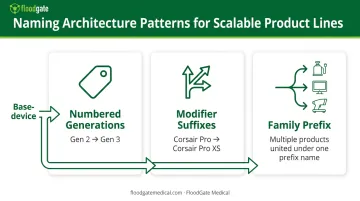
Naming architecture that anticipates line extensions saves you from renaming an entire portfolio two years in. Build in room to grow from the start:
- Numbered generations that signal evolution, like Gen 2 or Gen 3
- Modifier suffixes that differentiate variants, such as Pro or XS
- A family prefix that unifies multiple products under one brand
Common Medical Device Naming Mistakes to Avoid
Most naming failures trace back to a handful of avoidable errors:
- Skipping the full trademark search before using a name in marketing or regulatory materials, only to discover a conflict after launch
- Choosing a name too similar to an existing device, raising mislabeling or adverse-event reporting risk
- Implying unapproved therapeutic claims directly within the name itself
- Overlooking pronunciation and translation in international markets where the name will actually be spoken and read
The stakes here aren't hypothetical. In 2024, Philips issued an Urgent Medical Device Correction after incorrect labels were applied to its Tempus LS Manual Defibrillator during servicing (FDA recall record, 2024). Technicians had listed "TEMPUS LS" instead of "TEMPUS LS MANUAL," along with the wrong catalog number.
The correction affected only 18 units, but it shows how a truncated or near-identical name variant can trigger a formal FDA recall classification even without a reported patient injury.
The lesson: name, model designation, and catalog number all need to move together through servicing and relabeling controls, not just at launch.
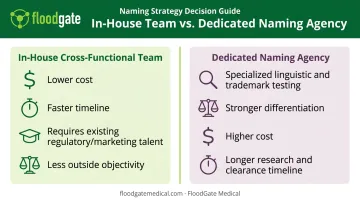
In-House Team vs. Outside Naming Agency: Which Approach Fits Your Device?
The right approach depends on your device's risk class, budget, and available internal expertise.
In-House Cross-Functional Team
When it's better: Cost-conscious launches where regulatory and marketing talent already exist on staff. If your team has named devices before and understands your classification requirements, there's no need to outsource.
Key trade-offs: You may lack outside objectivity or specialized branding experience, which matters more for first-in-class devices entering crowded categories.
Dedicated Naming/Branding Agency
When it's better: High-visibility, first-in-class, or highly competitive device categories where strong differentiation justifies the investment. Agencies bring dedicated linguistic testing and trademark screening processes that most internal teams can't replicate quickly.
Key trade-offs: Higher cost and longer timelines for research and legal clearance, sometimes stretching the process out by months.
Building the Right Internal Bench
Companies choosing the in-house route still need the right people in the room. That team should include:
- Regulatory affairs staff who understand labeling law
- Legal counsel who can run trademark clearance
- Marketing talent who understand clinical and patient audiences
FloodGate Medical works exclusively within the MedTech industry, connecting companies with the commercial, clinical, and marketing talent needed to support a launch. An in-house naming effort doesn't have to mean an under-resourced one.
Conclusion
Naming a medical device works best when regulatory, legal, and brand considerations get addressed together, starting on day one rather than bolted on at the end.
Most naming failures trace back to two things: skipped trademark or regulatory checks, and misjudging the target audience. The strongest device names balance compliance and differentiation, while leaving enough architectural flexibility to support whatever comes next in your product line.
Whether you build that capability in-house or bring in outside expertise, the goal stays the same. You want a name that clears legal review, satisfies regulators, and resonates with the people who'll actually use your device.
Frequently Asked Questions
What are examples of medical devices?
Common categories include diagnostic imaging equipment, implants, monitoring devices, surgical instruments, and interventional tools like microcatheters. Naming considerations vary by category and FDA risk class.
What are Type 3 medical devices?
"Type 3" typically refers to Class III devices under FDA classification. These carry the highest risk and require premarket approval, which means naming and labeling review will be far stricter than for Class I or II devices.
Can a medical device name be trademarked?
Yes, and it should be. Device names can be trademarked provided they clear USPTO searches and don't conflict with existing marks in the medical field, particularly within Trademark Class 10.
Does the FDA approve medical device names?
Not formally. The FDA doesn't run a separate approval program for device names the way it reviews some drug brand names, but it can object if a name is misleading, confusing, or implies unapproved claims.
What's the difference between a brand name and a generic name for a medical device?
The brand or proprietary name is used for marketing and commercial identity. The generic or common name identifies what the device actually is and appears in regulatory filings and clinical literature.
How long does it take to name and trademark a medical device?
The process generally runs several weeks to months, depending on trademark search complexity, legal review, and your device's regulatory classification. USPTO registration alone currently averages 9.8 months.