Introduction: The Critical Importance of CEO Succession Planning for MedTech Boards
Poorly managed CEO transitions drain billions in shareholder value every year. Harvard Business Review estimates that badly managed CEO and C-suite successions erase nearly $1 trillion annually across the S&P 1500.
Forced CEO exits forfeit an average of $1.8 billion per company versus planned transitions.
MedTech boards face steeper succession challenges. Unlike CEOs in many other industries, MedTech leaders need regulatory expertise, clinical credibility, R&D leadership, and reimbursement fluency—skills that take years to build.
A rushed handoff here does more than disrupt operations. It can stall FDA submissions, fracture clinical partnerships, and shake investors who expect deep sector expertise.
This guide gives boards practical succession practices that protect continuity and keep stakeholders confident through the transition.
Key Takeaways
- Planning 3+ years ahead gives boards time to develop and assess internal CEO candidates
- Clear board ownership—governance structures plus regular executive sessions—keeps succession on track
- Strong internal pipelines paired with external market intelligence reduce transition risk
- Written long-term roadmaps and emergency plans protect continuity when departures are unexpected
- CEO criteria tied to strategic direction, not only current performance, prepare the company for what’s next
Why CEO Succession Planning Matters for MedTech Boards
Business Continuity and Fiduciary Duty
CEO departures rarely arrive on convenient schedules. Spencer Stuart's 2024 research tracked healthcare CEO turnover at 11%, representing 19 transitions among 169 active S&P 1500 healthcare CEOs. When leadership changes strike without warning, they disrupt strategic initiatives, damage stakeholder confidence, and create operational uncertainty.
The financial consequences compound quickly. Strategy& reviewed 4,498 succession events and estimated $112 billion in foregone market value from forced CEO turnovers that could have been better planned. For individual companies, forced successions forfeit an average of $1.8 billion compared to planned transitions.
Those stakes make succession planning a core board duty. The National Association of Corporate Directors (NACD) identifies succession oversight as a primary board responsibility, typically led by nominating/governance or compensation committees with full-board review.
Yet only 51% of directors surveyed by NACD reported having a written CEO succession plan. That gap exposes boards to unnecessary risk and governance criticism from institutional investors who scrutinize succession readiness during proxy season.
Industry-Specific Complexity
MedTech CEO succession carries unique complications. Successful leaders need:
- Regulatory navigation expertise to manage FDA relationships, clinical trial design, and compliance frameworks
- Clinical credibility to engage physician customers and key opinion leaders
- R&D leadership to guide innovation pipelines and evaluate technical risk
- Reimbursement strategy to navigate payer relationships and market access challenges
- Commercial sophistication to scale sales organizations and manage distributor networks
These capabilities don't develop overnight. Internal candidates require years of cross-functional exposure, while external hires need thorough vetting to ensure they possess genuine MedTech depth, not just adjacent healthcare experience.
Market Confidence and Talent Retention
Markets reward planning and penalize uncertainty. Announced, orderly CEO transitions maintain valuation stability, while sudden departures trigger volatility and skeptical analyst coverage.
Well-executed succession processes signal board competence and strategic foresight. They show leadership knows where the company is headed and has cultivated the talent to get there. That transparency matters in fundraising, M&A discussions, and partnership negotiations, when counterparties evaluate organizational stability.
Succession planning also doubles as talent development. High-potential leaders stay with organizations that offer clear advancement pathways and meaningful growth opportunities. When boards invest in identifying and developing internal CEO candidates, they strengthen the entire executive bench.
The inverse also holds: organizations without visible succession plans lose ambitious leaders who see limited upward mobility. That exodus weakens the pipeline precisely when the board needs options.
7 Best Practices for Board-Led CEO Succession Planning
Best Practice 1: Establish Clear Board Ownership and Governance Structure
Define roles explicitly. The full board must own CEO succession oversight, even when delegating day-to-day work to a committee. Most boards assign primary responsibility to the nominating/governance or compensation committee, though some form dedicated succession committees for complex transitions.
Clarify what the board controls: defining future CEO requirements, evaluating candidates, making the final selection, managing the transition, and ensuring emergency plans exist. The current CEO contributes by developing internal talent, providing performance assessments, and supporting knowledge transfer, but should never control the process.
Schedule regular executive sessions without the CEO present. These confidential discussions allow directors to candidly assess succession readiness, evaluate internal candidates, discuss external market intelligence, and address concerns about the incumbent without creating awkward dynamics.
Document committee charters that specify succession responsibilities, meeting frequency, reporting relationships to the full board, and decision authority. Clear governance structures prevent confusion during high-stakes transitions.
Best Practice 2: Define the Future CEO Profile Based on Strategic Needs
Start with strategy, not resumes. Assess your company's 3-5 year direction and identify the critical capabilities the next CEO will need to execute that strategy successfully.
Distinguish between continuity and transformation scenarios. If the company is executing well on an established strategy, the next CEO may need to deepen relationships, scale operations, and drive incremental innovation. If the board anticipates strategic pivots such as entering new markets, pursuing M&A, or adopting digital business models, the successor needs change-leadership skills and comfort with ambiguity.
Balance technical and leadership competencies. MedTech CEO specifications should include:
- Technical expertise: Regulatory affairs depth, clinical trial experience, product development knowledge, quality systems understanding
- Leadership attributes: Strategic thinking, stakeholder engagement, board communication, cultural alignment, resilience under pressure
- Industry relationships: FDA contacts, clinical networks, payer connections, investor relationships
Document the ideal profile in writing and update it annually as strategy evolves. Avoid vague criteria like "strong leader" or "proven track record." Specify observable capabilities and experiences that predict success in your specific context.
Best Practice 3: Start Planning Early (2-3 Years Minimum)
NACD's 2025 benchmark recommends CEO succession planning unfold over three or more years. Strong boards treat succession as an ongoing process that never truly ends.
Why the long timeline? Effective succession requires:
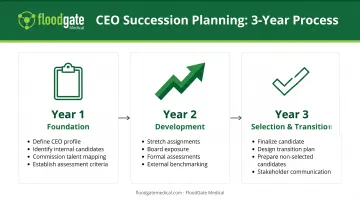
- Year 1: Define future CEO profile, identify internal candidates 2-3 levels deep, commission external talent mapping, establish assessment criteria
- Year 2: Provide stretch assignments to high-potential leaders, increase board exposure through presentations and strategy sessions, conduct formal assessments, benchmark against external talent
- Year 3: Finalize candidate selection, design transition plan, prepare internal candidates who weren't selected, communicate with key stakeholders
Many boards delay succession work when the incumbent performs well. Harvard Law School Forum research found that nearly one-third of directors cite a satisfactory CEO as the main reason for postponement. This creates unnecessary risk: talent development takes time regardless of current performance.
Normalize succession conversations from day one. The best boards discuss succession planning as standard governance practice, not crisis response. Annual CEO performance reviews should include explicit succession-readiness discussions.
Best Practice 4: Develop a Strong Internal Candidate Pipeline
Research shows external CEO hires cost 15% more and face 84% greater three-year turnover risk than internal promotions. While outsiders can add value during severe underperformance or strategic disruption, insiders generally deliver stronger returns in reasonably performing companies.
Identify high-potential leaders beyond direct reports. Look 2-3 organizational levels deep to find emerging talent who could develop into CEO candidates over a multi-year horizon. Don't limit the pool to obvious successors. Strong candidates sometimes emerge from non-traditional paths.
Implement structured development strategies:
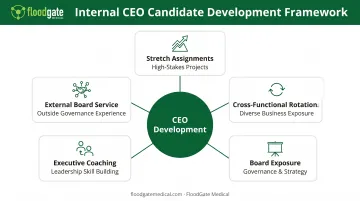
- Stretch assignments that build enterprise perspective and test leadership under pressure
- Cross-functional rotations that develop breadth beyond functional expertise
- Board exposure through strategy presentations, operational reviews, and informal settings
- Executive coaching focused on CEO-level competencies like investor relations, board management, and enterprise strategy
- External board service to gain governance perspective and broaden networks
Use objective assessment processes. Performance reviews measure functional excellence; CEO assessments evaluate strategic thinking, stakeholder management, and leadership presence. Conduct structured evaluations using behavioral interviews, 360-degree feedback, and scenario-based exercises.
Create deliberate board interaction opportunities. Invite internal candidates to present quarterly results, lead strategy deep-dives, attend board dinners, and participate in site visits. Directors need substantive exposure to evaluate candidates beyond formal presentations.
Best Practice 5: Benchmark Against External Talent
Even when developing strong internal candidates, boards should periodically assess external talent. External benchmarking provides objective comparison, reveals development gaps in internal candidates, and keeps options open if circumstances change.
When external candidates make sense:
- Strategic pivots requiring capabilities unavailable internally
- Transformation needs demanding fresh perspective
- Weak internal pipeline despite development investment
- Industry disruption requiring different experience base
Spencer Stuart's 2024 healthcare data showed 53% of incoming CEOs came from outside their organizations, reflecting boards' willingness to seek external expertise when internal options fall short.
Engaging specialized MedTech executive search firms provides market intelligence and access to passive candidates with the industry expertise boards need.
FloodGate Medical, for example, maintains a database of more than 150,000 MedTech professionals and reports that 70% of placed candidates are passive (not actively job-hunting but open to the right opportunity). Their work includes talent mapping, compensation benchmarking, and succession-planning support, which helps boards gauge the external CEO landscape without a public search.
Conduct confidential market mapping to identify external candidates with relevant MedTech experience, even if you're not actively recruiting. This intelligence informs internal development priorities and provides backup options.
Best Practice 6: Create a Documented Succession Plan
Verbal succession discussions aren't enough. Document your process, criteria, candidate assessments, development plans, and timeline.
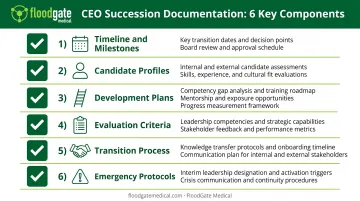
Comprehensive succession plans include:
- Timeline and milestones: Key decision points, candidate-readiness checkpoints, transition stages
- Candidate profiles: Internal and external candidates with assessment summaries, development priorities, and readiness ratings
- Development plans: Specific assignments, training, board exposure, and skill-building activities for each internal candidate
- Evaluation criteria: Weighted competencies, decision frameworks, assessment methodologies
- Transition process: Knowledge-transfer protocols, announcement strategy, onboarding plan, early-wins framework
- Emergency protocols: Interim CEO designation, immediate communication plan, expedited permanent-search process
Separate long-term and emergency planning. Long-term plans develop talent over 2-3+ years; emergency plans ensure next-day continuity if the CEO becomes incapacitated, dies suddenly, or departs immediately.
Review and update annually. Harvard Law School Forum recommends full-board succession reviews at least once yearly. More frequent updates make sense when strategy shifts, candidate circumstances change, or organizational performance deteriorates.
Documentation ensures continuity when board composition changes and provides transparency during investor due diligence or governance audits.
Best Practice 7: Plan for Transparent Communication and Seamless Transition
Succession execution matters as much as preparation. Poor communication or clumsy transitions squander years of planning.
Stakeholder communication strategy:
- Investors: Emphasize continuity, strategic alignment, and the rigorous selection process; provide new CEO background and priorities
- Employees: Announce early to prevent rumor-driven anxiety; highlight internal candidates' familiarity or external candidates' relevant experience
- Customers and partners: Reassure on relationship continuity; arrange introductions between the new CEO and key accounts
- Regulators: In MedTech, notify FDA contacts and other regulatory bodies to maintain relationship continuity on critical submissions
Structure the transition carefully:
- Knowledge transfer: Document key relationships, pending decisions, strategic priorities, and organizational nuances
- Transition overlap: Consider 30-90 day joint periods where the outgoing CEO remains available for questions and introductions
- Early wins: Help the new CEO identify 2-3 visible accomplishments for the first 90 days to build credibility and momentum
- Board support: Assign a lead independent director or committee chair as the new CEO's primary board liaison during the transition
Support internal candidates who weren't selected. Losing a CEO competition is deeply disappointing. Retain valuable leaders by acknowledging their contributions, clarifying their future role, and providing growth opportunities. Many become excellent CEO candidates elsewhere or in future internal successions.
Manage the departing CEO's ongoing relationship. Clarify whether they'll remain on the board, serve as an advisor, or exit completely. Set boundaries to prevent shadow leadership that undermines the successor.
Building a Strong Leadership Pipeline
The "build vs. buy" decision framework starts with evidence. Research shows internal promotions outperform external hires in stable environments. Strategy& found insiders generated higher median total shareholder return over their tenure in 10 of 15 tracked years.
Why Insiders Succeed More Often
Internal candidates usually hold advantages external hires must build from scratch:
- Fluency in culture, politics, and unwritten rules
- Established relationships with key stakeholders
- Shorter ramps to full productivity
- Observable, validated track records
- Credibility with employees who already know them
High-Potential Identification
Programs should score future potential, not only current performance. Use leadership assessments, behavioral interviews, and scenario exercises to test strategic thinking, adaptability, and enterprise perspective, not just functional expertise.
Succession Depth Beyond the CEO
Identify potential successors for every C-suite seat, not only the chief executive. When the CFO, COO, or R&D lead also has a ready bench, the organization can absorb more than one transition without losing momentum. FloodGate Medical supports that work through organizational design and workforce planning that help leadership teams map capability gaps and build succession depth across the executive team.
Emergency Succession Planning
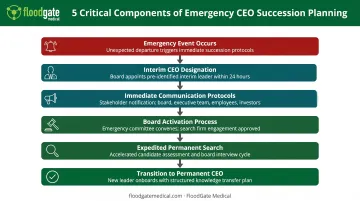
Emergency succession addresses sudden, unexpected leadership departures: death, incapacitation, immediate termination for cause, or unexpected resignation.
Only 58% of public-company directors in Spencer Stuart's 2023 survey reported having an emergency plan in place. Private companies lag further at just 25% readiness.
Emergency plans must include:
- Interim CEO designation: Name a specific executive (typically COO, CFO, or another C-suite leader) who assumes authority immediately
- Alternate interim CEO: Designate a backup if the primary interim candidate is unavailable or conflicted
- Immediate communication protocols: Templates for employee announcements, investor communications, press releases, and regulatory notifications
- Board activation process: Who convenes emergency board meetings, what decisions require immediate board action, and how quickly the board assembles
- Expedited permanent search: Whether the interim CEO will be considered for the permanent role, search firm pre-selection, and accelerated timeline parameters
Criteria for interim CEO selection:
- Sufficient operational knowledge to maintain continuity
- Credibility with employees, investors, and customers
- Willingness and availability to serve
- No obvious conflicts that would compromise objectivity
Should board members serve as interim CEOs? Generally no. Board members lack day-to-day operational familiarity and may face conflicts between fiduciary oversight and executive management. Independent board chairs or lead directors should oversee the transition process, not execute operations.
Common Pitfalls to Avoid
Pitfall 1: Starting Too Late
Waiting until succession is imminent forces rushed decisions and shrinks the candidate pool. Research shows many boards wait 2-3 years after appointing a CEO before beginning succession work, leaving inadequate development time if the CEO's tenure is shorter than expected.
Compressed timelines block thorough internal development and external market mapping. Boards scramble to choose from whoever is immediately available rather than cultivating ideal candidates.
Pitfall 2: Overreliance on the Incumbent CEO
CEOs face inherent conflicts in succession planning. They may protect their legacy, delay planning to extend their tenure, or offer assessments shaped more by personal relationships than objective capability.
Board-led succession planning counters these risks through:
- Independent oversight and confidential executive sessions
- Objective assessment processes
- Direct board relationships with internal candidates
The CEO contributes valuable input but doesn't control candidate selection or transition timing.
Pitfall 3: Insufficient Board Exposure to Candidates
Boards need regular, meaningful interaction with potential successors beyond formal presentations. A Stanford/Heidrick study found boards spent an average of only two hours per year on CEO succession—far too little to make informed decisions.
Create structured opportunities for directors to observe candidates in action:
- Strategy deep-dives and operational reviews
- Customer visits and site tours
- Board dinners and other informal settings
These less-scripted moments often reveal leadership presence, communication style, and strategic thinking more clearly than formal presentations.
Frequently Asked Questions
What are the best practices for CEO succession planning?
Seven practices matter most: clear board ownership, a CEO profile tied to 3–5 year strategy, planning 2–3 years ahead, internal pipeline development, external talent benchmarking, documented annual plans, and structured transition communication.
What are the 5 steps of CEO succession planning?
Define future CEO requirements from strategy, assess internal and external candidates, and develop internal talent through stretch roles and board exposure. Then document the plan—including emergency protocols—and execute a structured transition with clear stakeholder communication.
Why do leaders not have a succession plan?
Boards often avoid the topic with a strong sitting CEO, treat planning as non-urgent, lack succession expertise, or get stuck in politics and competing priorities. Many wait until succession feels imminent, which leaves no time for real candidate development.
Who becomes CEO if the CEO dies?
Emergency plans name an interim CEO, typically the COO, CFO, or another senior executive, who takes authority immediately. The board then follows its documented process to choose a permanent successor through internal promotion or an expedited external search.
What are the key trends in CEO succession planning for 2026?
Spencer Stuart's 2025 data shows 60% internal and 40% external appointments, with 84% of new CEOs first-time enterprise leaders. Boards are prioritizing digital-transformation skills, longer development timelines, greater stakeholder transparency, and hybrid internal-external candidate strategies.
Can you give me an example of a CEO succession plan?
A MedTech three-year plan might set a CEO profile around regulatory and commercial strength and map internal plus external talent in Year 1, put finalists through stretch assignments and board exposure in Year 2, then name a CEO-designate with a six-month transition and clear investor and employee communication in Year 3.