That growth sounds promising until you consider the mismatch it creates. Patient volumes swing by the hour. Staffing structures, by contrast, tend to be rigid — built around fixed shifts and annual budgets, not real-time demand. The gap between the two shows up in two places: care quality and clinician wellbeing.
This article breaks down the major healthcare staffing models, ties each to measurable outcomes, and offers a framework for choosing the right blend for your organization.
Key Takeaways
- Resilient healthcare organizations blend permanent, flexible, and partnership-based staffing models
- Understaffing and heavy reliance on temp labor lower patient safety and satisfaction scores
- Staff burnout and turnover are core drivers of poor patient outcomes
- Equity-driven hiring boosts retention and innovation across healthcare and MedTech organizations
What Are the Typical Healthcare Staffing Models?
A staffing model is the framework a facility uses to balance full-time employment, contingent labor, and outside partnerships against patient care needs and budget constraints. The American Hospital Association's workforce research points to a clear pattern: blended models consistently outperform rigid, single-source approaches on both cost and quality metrics.
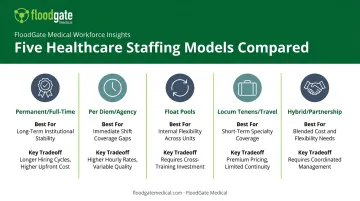
Here's how the main models compare:
| Model | Best For | Key Tradeoff |
|---|---|---|
| Permanent/Full-Time | Continuity, culture, institutional knowledge | Higher fixed costs |
| Per Diem/Temporary/Agency | Census surges, short-term gaps | Premium pricing, less continuity |
| Float Pools | Real-time internal flexibility | Requires scale and scheduling infrastructure |
| Locum Tenens/Travel | Rural or specialty coverage | Onboarding time, variable quality control |
| Hybrid/Partnership | Balancing stability with flexibility | Requires strong systems and vetted partners |
Permanent/Full-Time Staffing
Full-time employees anchor continuity of care and organizational culture. Patients see familiar faces. Teams build institutional memory. But this stability comes at a fixed price: benefits alone made up 33.9% of total hospital compensation as of mid-2024, according to federal wage data. Add overtime driven by chronic short-staffing, and permanent headcount becomes an expensive lever to pull too far in either direction.
Per Diem, Temporary & Agency Staffing
Agency and per diem staff fill acute gaps: a maternity leave, a flu-season census spike, a sudden resignation. The problem is cost creep. Hospital contract-labor expense jumped 258% between 2019 and 2022 during the height of the workforce shortage, per AHA data. Once you factor in credentialing, onboarding, and orientation time for staff who may leave in weeks, the true cost often exceeds the invoice.
Float Pools & Internal Resource Pools
Internal float pools let facilities redeploy their own clinicians across units instead of calling an agency. Mercy Health built an app-based internal gig workforce of roughly 1,100 nurses across 45+ hospitals. The result: an 86% fill rate, a 50% cut in agency spending, and more than $5 million saved. Float pools require investment in scheduling technology, but they reduce dependence on external labor markets that can dry up overnight.
Locum Tenens, Travel & Contract-to-Hire
Locum tenens and travel clinicians remain essential for rural hospitals and specialty coverage where local talent pools are thin. Contract-to-hire arrangements (where a facility and clinician trial the fit before committing to permanent employment) are gaining traction as a way to reduce first-year mismatches. Hard data isolating turnover reduction from this specific mechanism is still limited, but the logic tracks with broader retention research: structured evaluation periods reduce surprises on both sides.
Hybrid & Strategic Partnership Models
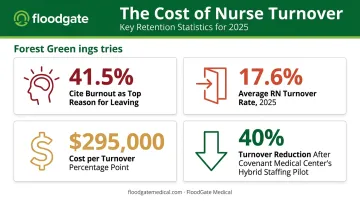
Blending a permanent core with vetted external partners is fast becoming the default for 2025 and beyond. Providence's Covenant Medical Center piloted a co-caring model combining virtual nurses, bedside RNs, and support staff. After just 16 weeks, the unit reported a 40% drop in turnover, near-zero vacancies among support staff, and an expected $500,000 in annual cost avoidance.
How Staffing Models Directly Shape Patient Outcomes
Staffing decisions aren't just an HR problem — they show up in clinical charts.
Nurse-to-patient ratios matter more than most budgets admit. A prospective study of Queensland hospitals found that each one-patient improvement in nurse workload was associated with 7% lower mortality, 7% fewer readmissions, and 3% shorter length of stay.
The avoided costs from reduced readmissions and shorter stays were more than double the added staffing expense. Safe staffing delivers a measurable return, functioning as a clinical intervention rather than a cost center.
Beyond ratios, three mechanisms connect staffing structure to patient results:
- Continuity breakdown: High turnover and heavy temp reliance increase handoff errors, since rotating staff have less familiarity with patient history
- Satisfaction erosion: A study spanning 341 hospitals and nearly 1,000 hospital-years found licensed-nurse staffing levels positively associated with all seven HCAHPS satisfaction measures tracked
- Communication fragmentation: Excessive short-term labor weakens care-team communication and safety culture, since trust and shared protocols take time to build
The Covenant Medical Center pilot mentioned earlier illustrates the flip side. By pairing virtual nurse oversight with a stable bedside team structure, the unit saw decreased length of stay alongside its turnover improvements. This dual result shows patient and staff outcomes moving together.
How Staffing Models Shape Staff Outcomes & Retention
Ask any nurse manager what drives burnout, and inflexible scheduling paired with chronic understaffing tops the list almost every time.
The National Council of State Boards of Nursing surveyed roughly 800,000 nurses across 53 jurisdictions in 2024. Among those planning to leave the profession within five years for reasons unrelated to retirement, 41.5% cited stress and burnout as the primary driver. Nearly 40% of RNs surveyed intended to leave or retire by 2029.
Flexible models offer a counterweight:
- Self-scheduling programs show mixed but generally positive effects on job satisfaction, according to a review of 23 empirical studies
- On-demand internal platforms, like Mercy's gig-style float pool, report improved work-life balance alongside the fill-rate and cost gains already noted
- Structured retention programs reduce the churn that drains both morale and budgets
That last point carries real financial weight. The 2026 NSI National Health Care Retention Report pegs 2025 RN turnover at 17.6%, with every one-percentage-point shift costing or saving the average hospital roughly $295,000 annually.
Covenant Medical Center's 40% turnover reduction after its hybrid pilot translated directly into budget savings, not just improved morale.
Permanent and hybrid roles built around training pipelines add another layer: clear paths for growth keep ambitious clinicians from job-hopping. Inclusive, psychologically safe teams consistently show up in retention data as a differentiator, a pattern that holds well beyond bedside roles. FloodGate Medical applies this same DEI-driven approach when placing talent across the broader MedTech workforce, matching device manufacturers and health systems with clinicians and technical staff who fit their culture.
How to Choose the Right Staffing Model for Your Organization
There's no universal formula here, but the decision hinges on a few consistent factors.
Facility type and patient volume patterns set your flexibility-to-permanence ratio. A Level I trauma center with unpredictable census swings needs more contingent capacity than a long-term care facility with stable, predictable staffing needs. Outpatient clinics fall somewhere in between.
Budget realities matter just as much, though the true costs aren't always visible upfront. A tight budget looks appealing on paper, but understaffing's real price often dwarfs the visible savings, driven by:
- Turnover, which costs roughly $295,000 per percentage point lost
- Burnout-driven attrition that compounds over time
- Adverse events tied to chronic understaffing
Weigh those numbers against the over $5 million Mercy saved through internal float pools before defaulting to the cheapest short-term option.
Once facility type and budget point you toward a blend, three operational factors determine whether that model actually works in practice:
- Credentialing speed: How quickly can contingent or float staff be verified and deployed?
- Scheduling technology: Does your system support real-time visibility across permanent, float, and contract labor?
- Compliance infrastructure: Are you tracking license status, competency checks, and orientation requirements consistently across staffing types?
Get these three right, and almost any staffing blend becomes executable.
Why Strategic Talent Partnerships & DEI-Driven Recruitment Improve Long-Term Outcomes
Clinical staffing isn't the only place workforce strategy shapes patient outcomes. MedTech and healthcare device companies face parallel pressure: building teams capable of designing the tools clinicians rely on. Slow, mismatched hiring in that world eventually shows up as delayed product innovation or lower-quality devices reaching the cath lab.
Deloitte research, drawing on Korn Ferry data, found that inclusive organizations are 75% more likely to see ideas turn into products and 87% more likely to report better decision-making. That's cross-industry evidence, not a MedTech-specific study, but it lines up with what specialized recruiters see on the ground: diverse, well-matched teams solve problems faster.
FloodGate Medical, a recruitment firm built specifically for the MedTech industry, operates on that premise. Its stated mission, "improving lives by uniting great people with great companies," centers equity and inclusion as core hiring values rather than afterthoughts. In practice, that means:
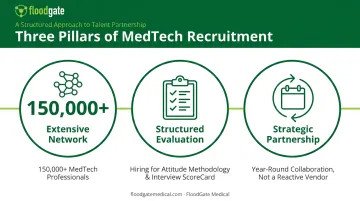
- Drawing from a network of 150,000+ MedTech professionals to widen the candidate pool beyond the usual referral circuit
- Using a certified Hiring for Attitude methodology alongside structured tools like an Interview ScoreCard, which standardizes evaluation criteria to reduce subjective bias
- It functions as a strategic, year-round partner, not a reactive vendor that only appears once a role is vacant
Reactive hiring, scrambling to fill a role after someone quits, tends to produce mis-hires because urgency crowds out careful evaluation. Partnering with specialized recruiters who already understand a sector's technical and cultural demands shortens that gap. It's the same lesson clinical staffing teaches: thoughtful, structured talent strategy pays dividends in stability. That holds whether the team in question is at the bedside or building the next generation of interventional devices.
Frequently Asked Questions
What are the typical healthcare staffing models?
The main models are permanent/full-time, per diem and temporary/agency, internal float pools, locum tenens/travel/contract-to-hire, and hybrid partnership approaches. Most resilient organizations combine several rather than relying on just one.
How do nurse staffing levels affect patient safety?
Higher nurse staffing ratios are linked to lower mortality, fewer readmissions, and shorter hospital stays. Research on ratio legislation found each one-patient improvement in nurse workload cut mortality and readmission odds by 7%.
What is a float pool in healthcare staffing?
A float pool is a group of internally employed clinicians who move between units or facilities based on real-time need. It gives organizations flexibility similar to agency staffing without the premium cost or continuity loss.
How can hospitals improve staff retention amid shortages?
Effective strategies include flexible or self-scheduling options, structured retention and engagement programs, and clear career growth pathways. Facilities that combine these approaches, like Covenant Medical Center's hybrid model, have reported turnover drops of 40% in months.
Why is diversity important in healthcare staffing decisions?
Inclusive hiring correlates with stronger innovation and decision-making, according to cross-industry research. In MedTech specifically, diverse teams tend to build better products and retain talent longer, indirectly improving downstream patient care.
What is the difference between temporary and permanent staffing in healthcare?
Temporary staffing offers speed and flexibility for short-term gaps, but at a higher cost and weaker care continuity. Permanent staffing anchors culture and familiarity, though its fixed costs, including benefits, often exceed 30% of total compensation.