Many regulatory and quality professionals struggle just to keep track. Updates land across FDA guidance pages, EU Commission decisions, Health Canada bulletins, and a handful of APAC agencies, often within days of each other.
This roundup pulls together the most consequential global updates from late 2025 and early 2026. We'll also cover what these shifts mean for hiring, compliance readiness, and career planning across MedTech.
Key Takeaways
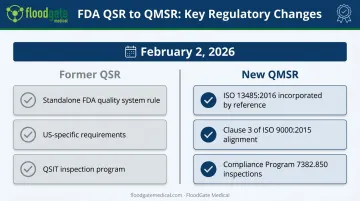
- QMSR replaces QSR effective February 2, 2026, aligning FDA rules with ISO 13485:2016
- EUDAMED's four core modules go mandatory May 28, 2026, forcing full digital compliance
- The UK's mandatory PMS regime, live since June 2025, marks its biggest device overhaul
- Rising compliance complexity is fueling strong demand for regulatory affairs and quality talent
US FDA Regulatory Updates
QMSR Transition Takes Effect
The QMSR became effective February 2, 2026, amending 21 CFR Part 820 by incorporating ISO 13485:2016 and Clause 3 of ISO 9000:2015 by reference. This represents a realignment that brings US requirements much closer to the standard most global manufacturers already follow, rather than a wholesale rewrite of the old quality system rule.
Alongside the regulation itself, FDA retired its older QSIT-era inspection programs and moved to Compliance Program 7382.850. That's the framework investigators now use during facility inspections.
No agency or industry survey has published a hard readiness percentage for how many manufacturers were fully prepared by the deadline. RAPS and Emergo/UL have flagged qualitative concerns instead, warning that smaller, US-only manufacturers and combination product makers face steeper transition challenges than larger multinational firms already operating under ISO 13485.
What this means for teams: expect sustained hiring pressure around ISO 13485 implementation, risk management documentation, supplier controls, and internal audit readiness.
FDA's TEMPO Pilot for Digital Health Devices
FDA launched its Technology-Enabled Meaningful Patient Outcomes (TEMPO) pilot in partnership with the CMS Innovation Center's ACCESS model. Statements of interest opened January 2, 2026, targeting chronic disease digital health technologies.
The pairing matters because it links FDA authorization directly to CMS reimbursement testing. Digital health teams increasingly need staff who understand regulatory strategy, outcomes measurement, and payer evidence simultaneously, not as separate disciplines.
Real-World Evidence (RWE) Final Guidance
FDA's December 2025 final guidance on real-world evidence supersedes the agency's 2017 version. It expands recommendations on data relevance, reliability, and study design, and it now permits certain submissions to rely on RWE without identifiable patient-level data.
A few other 2025 housekeeping updates round things out: draft UDI guidance for combination products addressing labeling and GUDID submissions for device constituent parts, and a 510(k) clearance transfer Q&A guidance clarifying documentation requirements when ownership changes hands.
EU MDR/IVDR Updates
EUDAMED Goes Live
Commission Decision (EU) 2025/2371, published November 27, 2025, confirmed that four EUDAMED modules are now fully functional: actor registration, UDI/device registration, notified bodies and certificates, and market surveillance.
Mandatory use began May 28, 2026, following a six-month transition window. Devices already registered before that date have until November 28, 2026, to be fully added to the system.
For manufacturers, this means:
- Treat master data governance across actor and device records as non-negotiable
- Allocate dedicated resourcing for certificate reconciliation with notified bodies
- Keep market surveillance data feeds accurate and current, not retroactively cleaned up
New MDCG Guidance Documents
Two guidance documents deserve attention. MDCG 2025-10, published December 2025, makes clear that post-market surveillance must be woven into the quality management system itself, not treated as a bolt-on activity. PMS data needs to actively feed risk management files, clinical evaluations, and technical documentation on an ongoing basis.
MDCG 2025-6 tackles overlap between MDR, IVDR, and the AI Act. Medical device AI becomes high-risk under AI Act Article 6(1) when it's a safety component requiring third-party conformity assessment. That classification means data governance, logging, and traceability requirements now stack on top of existing MDR obligations.
Separately, new eIFU rules entered into force in July 2025, allowing electronic instructions for use instead of paper for devices intended for professional users. Lay users still require printed instructions.
A Major MDR Overhaul on the Horizon
In December 2025, the Commission published a legislative proposal aimed at simplifying what regulators themselves now call an overly complex MDR framework. The package addresses conformity assessment, notified body fee predictability, and orphan device pathways, alongside related Biotech Act and Safe Hearts Plan initiatives.
It's still a proposal, not adopted law. But the direction of travel is unmistakable: Brussels knows the current framework created bottlenecks, and change is coming.
UK & Global Regulatory Updates
The UK's mandatory Post-Market Surveillance requirements took effect June 16, 2025, marking Britain's first significant device regulation overhaul since leaving the EU system. Every device placed on the GB market now needs a formal PMS system, with reporting timelines that are considerably tighter than before:
| Incident Type | Reporting Window |
|---|---|
| Serious public health threat | 2 days |
| Death or unanticipated serious deterioration | 10 days |
| Other serious incidents | 15 days (down from 30) |
PSUR (Periodic Safety Update Report) frequency also varies by class: Class IIa devices need updates at least every two years, while Class IIb, Class III, and active implantables require annual reporting.
Beyond the UK, several other markets are moving:
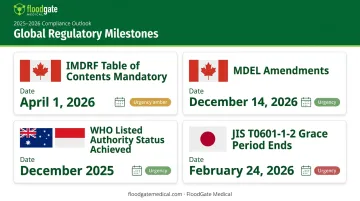
- Health Canada finalized Phase II amendments to its Medical Devices Regulations, making the IMDRF Table of Contents format mandatory April 1, 2026
- MDEL modernization amendments follow on December 14, 2026, updating establishment licensing requirements
- Australia and Indonesia both achieved WHO Listed Authority status in December 2025, a designation that streamlines mutual recognition of regulatory decisions
- Japan's grace period for the JIS T0601-1-2:2018 EMC standard ends February 24, 2026, after which the 2023 revision becomes mandatory for active medical devices
What These Regulatory Shifts Mean for MedTech Hiring & Talent
Every one of these frameworks, QMSR, EUDAMED, UK PMS, adds new lifecycle documentation and compliance workload. None of it runs on autopilot. Someone has to own it, and that someone is increasingly hard to find.
A 2025 MedTech Talent Trends survey from Skills Alliance found regulatory affairs among the hardest roles to fill industry-wide, at 29%, with regulatory and compliance skill shortages reported at 36%. Clinical and post-market roles ranked even higher on the difficulty scale.
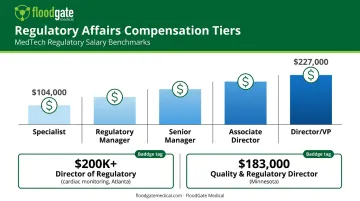
RAPS' 2024 workforce data puts the global regulatory affairs profession at nearly 125,000 people across pharma, biotech, and devices combined. Average total compensation ranges from roughly $104,000 for specialists up to $227,000 at director and VP levels.
We see this pressure directly in our own search work. One Atlanta-based cardiac monitoring company recently offered $200K+ for a Director of Regulatory role built specifically to establish a QMS from scratch and lead FDA submissions.
A publicly traded device manufacturer in Minnesota offered $183,000 for a Quality & Regulatory Director overseeing everything from supplier quality to design assurance.
Companies that can't fill these roles quickly face real consequences:
- Submission delays that push product launches back by months
- Missed QMSR or EUDAMED compliance deadlines
- Increased inspection and audit risk from thin regulatory bench strength
At FloodGate Medical, our DEI-driven recruitment approach helps MedTech companies build regulatory and quality teams that bring varied perspectives to increasingly complex compliance challenges. Diverse teams tend to catch blind spots that homogeneous teams miss, particularly when interpreting ambiguous guidance across multiple jurisdictions at once.
For professionals already in these roles, the upskilling priorities are clear. Three areas will separate competitive candidates from the rest of the applicant pool over the next two years:
- ISO 13485 implementation experience
- Hands-on familiarity with EUDAMED data entry and reconciliation
- Working knowledge of RWE study design
How MedTech Companies & Professionals Can Stay Ahead
Staying current doesn't require checking six agency websites daily. It requires a system.
For companies:
- Subscribe to FDA, EU Commission, and Health Canada update feeds directly, rather than relying on secondhand summaries
- Build cross-functional teams that bridge quality, regulatory, and clinical functions so new guidance gets acted on fast, not siloed
- Treat compliance hiring as a continuous pipeline, not a reactive scramble when a deadline hits
For professionals:
FloodGate Medical's monthly newsletter delivers curated regulatory insights alongside career opportunities, helping both companies and candidates track hiring trends tied to these compliance shifts. It's a low-effort way to stay ahead of a landscape that changes faster than most job descriptions get updated.
Frequently Asked Questions
What is the most significant medical device regulation change happening in 2026?
The QMSR transition and EUDAMED's full functionality are the two biggest shifts. QMSR reshapes US quality system requirements, while EUDAMED's mandatory modules affect every EU manufacturer's registration and surveillance obligations.
How does the QMSR differ from the previous QSR?
QMSR incorporates ISO 13485:2016 by reference directly into FDA's quality system requirements. This aligns US expectations much more closely with the global standard most manufacturers already follow elsewhere.
What is EUDAMED and why does it matter?
EUDAMED is the EU's central database for medical device information, now confirmed functional across four core modules. It's essential for UDI registration, certificate tracking, and market surveillance compliance.
What's the difference between the 510(k), PMA, and De Novo pathways?
Risk classification determines which pathway applies. Lower-risk devices with a predicate typically use 510(k), high-risk devices require PMA, and novel low-to-moderate risk devices without a predicate go through De Novo.
How is UK medical device regulation changing after Brexit?
The UK introduced mandatory Post-Market Surveillance requirements in June 2025, its first major regulatory overhaul since leaving the EU system. This includes new PSUR obligations and tighter incident reporting timelines.
Why is regulatory affairs talent so hard to find in MedTech right now?
Global compliance requirements are expanding faster than the supply of experienced regulatory and quality professionals. Industry surveys rank regulatory affairs and quality assurance among MedTech's hardest roles to fill, a gap specialized recruiters like FloodGate Medical help close daily.