After several years of pandemic-driven whiplash, this market is finding its footing. Travel nurse revenue has declined for two straight years, yet locum tenens keeps growing and allied health is rebounding. Staffing Industry Analysts (SIA) now forecasts the total U.S. healthcare staffing market moving toward stabilization heading into 2027.
Many healthcare organizations, staffing firms, and MedTech companies are struggling to plan workforce strategy amid this uneven recovery. Some segments are contracting while others expand. Technology adoption is accelerating, but ROI remains unproven in many cases. This article breaks down the five trends shaping the market through 2027, what's driving them, and what signals to watch next.
Key Takeaways
- Contingent staffing is stabilizing, with locum tenens and allied specialties leading the rebound
- AI-driven matching and automated credentialing are becoming standard as recruiter capacity struggles to keep pace
- Clinician shortages and burnout remain the core structural demand driver through 2027 and beyond
- DEI-focused hiring is becoming a competitive lever for filling scarce, specialized roles
- Telehealth and digital health growth are merging clinical and MedTech talent needs
Key Healthcare Staffing Trends Shaping the Industry Through 2027
Five distinct patterns are defining how healthcare organizations and staffing partners will operate through 2027. Each reflects a market shifting from emergency-mode hiring toward more deliberate, cost-conscious workforce planning.
Trend 1: Stabilization and Selective Rebound in Contingent Staffing
The freefall is over, but the market hasn't fully recovered either. Travel nurse revenue fell 37% in 2024 and another 12.1% in 2025, driven mostly by fewer billed hours rather than lower bill rates. That's the second consecutive year of decline for travel nursing specifically.
The bigger picture looks different. SIA's latest total-market forecast shows healthcare staffing stabilizing at roughly $38.7 billion in 2026, with modest improvement to $39.6 billion by 2027. This marks a new baseline for the industry, well below pandemic-era demand levels.
Hospitals are shifting behavior to match:
- Building internal float pools instead of relying on premium-rate travel contracts
- Negotiating planned, budgeted contingent labor spend rather than reactive crisis staffing
- Prioritizing quality and fit over sheer headcount when filling temporary roles
This signals a maturing buyer base. Health systems now treat contingent staffing as a strategic lever, not a last resort.
Trend 2: Locum Tenens and Specialized Physician/APP Growth
Locum tenens is the standout performer. Revenue grew 17% in 2023, with SIA forecasting 12% growth in 2024 and 5% in 2025. The segment is projected at roughly $9.6 billion for 2025 alone.
Nearly 90% of U.S. hospitals, medical groups, and facilities now use locum physicians or advanced practice providers, according to AMN Healthcare's 2024 provider survey. That level of usage reflects baked-in workforce planning rather than occasional stopgap coverage.
Two forces keep fueling this. Expanding Nurse Licensure Compact participation (now 43 jurisdictions) makes cross-state placements far easier for both nurses and mobile clinicians. Meanwhile, the Association of American Medical Colleges projects a shortage of up to 86,000 physicians by 2036, driven partly by population growth and a 34% jump in residents age 65 and older.
Locums have moved from a temporary patch to a permanent piece of physician workforce architecture, especially in surgery and specialties tied to aging-population demand.
Trend 3: AI, Automation, and Digital Platforms in Recruitment
Staffing platforms already account for more than 20% of travel, per diem, and allied health revenue, up from a market that grew 340% between 2020 and 2022. Health systems and agencies are layering AI on top of these platforms to handle matching, forecasting, and compliance tasks that used to eat up recruiter hours.
There's real pressure behind this shift. Healthcare job openings hit 1.8 million in 2023, up 48% from 1.2 million in 2019.
Credentialing remains stubbornly manual, though. A 2025 survey of more than 500 healthcare organizations found application verification still 65% manual and payer follow-up 63% manual, with 51% of credentialing teams experiencing turnover in the past year.
A few real examples show where this is heading. Aya Healthcare acquired Winnow AI in 2023 to build predictive physician recruitment insights, while Providence uses an algorithm weighing patient volume and acuity to forecast staffing needs before shortages hit.
Manual credentialing bottlenecks combined with rising openings make technology adoption the only viable way to compete on speed.
Trend 4: DEI as a Strategic Differentiator in Healthcare and MedTech Hiring
Representation gaps in clinical roles remain wide:
- Men make up just 10.4% of registered nurses
- RNs overall are 76.6% White, 8.6% Black, and 7.9% Asian
- Active physicians break down to 56.1% White, 19.8% Asian, 6.7% Hispanic or Latino, and 5.3% Black
- Women represent 38.7% of the physician workforce
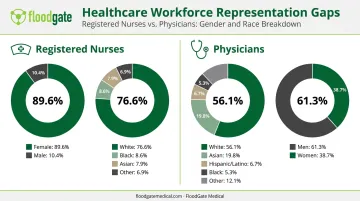
These numbers matter because talent pools are already tight. Organizations that widen their sourcing lens simply have more candidates to draw from.
FloodGate Medical, which focuses exclusively on MedTech recruitment, has built its approach around diversity, equity, and inclusion as a core sourcing principle rather than an afterthought. That kind of intentional pipeline-building gives employers access to candidates that generalist staffing models often miss.
As specialized talent gets scarcer, DEI-forward recruiting stops being a nice-to-have. It becomes a genuine edge in filling roles that would otherwise sit open for months.
Trend 5: Convergence of Clinical Staffing and MedTech/Health-Tech Talent Demand
The line between "clinical staffing" and "MedTech recruiting" is blurring fast. U.S. digital health startup funding hit $14.2 billion in 2025, up 35% from $10.5 billion the year before. McKinsey expects overall MedTech revenue growth to run 100 to 150 basis points above prepandemic rates.
Job growth is following, though more modestly on the engineering side. The Bureau of Labor Statistics projects 5% growth for biomedical engineers from 2024 to 2034, roughly 1,300 openings a year.
What this means in practice:
- Hospitals need staff comfortable with virtual care platforms and remote monitoring tools
- MedTech companies need R&D, clinical affairs, regulatory, and commercial talent who understand bedside workflows
- Both sides are now competing for the same pool of tech-savvy, clinically-literate professionals
Staffing strategies built only around bedside coverage will miss a growing share of the workforce equation. The two talent markets are merging.
What's Driving These Healthcare Staffing Trends
Several forces unique to healthcare are converging to reshape both demand and supply through 2027.
- RN shortage looming. HRSA projects an 8% national RN shortage by 2028, equal to roughly 267,000 full-time RNs.
- Burnout fueling turnover. 72% of hospital nurse leaders report burnout, and 31% plan to leave within a year; NSI's 2025 data puts RN turnover at 17.6%.
- Technology adoption pressure. Platform revenue already exceeds 20% of key segments, and job openings are up 48% since 2019, leaving firms without automated tools behind on time-to-fill.
- Cost containment priorities. Health systems are redirecting pandemic-era travel-labor spend toward internal float pools, retention bonuses, and permanent hires.
- Demographic and regulatory shifts. The population age 65 and older hit 61.2 million in 2024 (up 3.1%), while Nurse Licensure Compact adoption across 43 states eases clinical talent mobility.
How These Trends Are Impacting the Healthcare Industry
These shifts are reshaping operations, business strategy, and workforce composition simultaneously.
Operational Impact
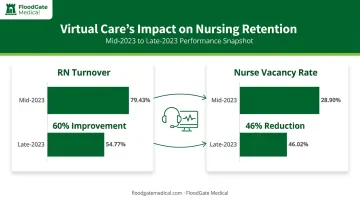
Health systems are blending core full-time staff with flexible, platform-sourced talent rather than choosing one model exclusively. Virtual nursing is a big part of this stretch strategy. Advocate Health deployed virtual nurses to handle admissions, discharges, and ongoing patient support. The results were notable: RN turnover improved by 60%, and nurse vacancy rates dropped 46% between mid- and late 2023.
Business Impact
M&A activity is picking back up. SIA counted 19 healthcare staffing deals in 2024, driven largely by private equity interest and firms chasing scale and technology capability. Not every deal closes, though: Aya Healthcare announced a $615 million acquisition of Cross Country Healthcare in December 2024, then terminated the agreement a year later.
Budgets tell a similar story of caution. Spending is shifting away from premium travel pay toward retention programs, recruiting technology, and permanent placement investment.
Workforce Impact
Burnout-driven attrition is pushing health systems to invest more in upskilling and flexible career pathways rather than simply backfilling open roles. On the MedTech side, DEI-aligned hiring is becoming central to building resilient teams. FloodGate Medical, for instance, supports MedTech job seekers with career coaching, compensation benchmarking guides, and resume tools designed to help candidates navigate a shifting hiring landscape.
Future Signals for Healthcare Staffing in 2027 and Beyond
Near-term trends are fairly clear. What happens next depends on a handful of emerging signals worth tracking.
- Agentic AI adoption is accelerating. Deloitte's late 2025 survey found 61% of U.S. healthcare technology executives already building or funding agentic AI, with most projecting 10%+ cost savings within three years—forecasts, not proven results yet.
- Credentialing automation has real headroom. With verification still 65% manual across many organizations, expect continued investment here as firms chase faster time-to-fill.
- Virtual care staffing models keep expanding. Expect continued growth if systems show measurable turnover and cost benefits, like those seen at Advocate Health.
By 2027, expect modest overall market growth led by locum tenens and allied specialties, deeper convergence between clinical and MedTech talent pools, and DEI shifting from differentiator to baseline expectation.
Conclusion
Healthcare staffing is moving past pandemic-era volatility. What comes next is more strategic: technology-enabled, specialty-driven, and increasingly focused on the overlap between clinical care and MedTech innovation. Organizations that combine AI-driven hiring tools with DEI-forward, specialty-focused talent strategies will hold a real advantage as the market stabilizes through 2027.
For MedTech companies navigating this shift, partnering with a specialized recruiter like FloodGate Medical can help you stay ahead of where clinical and technical talent needs are heading next.
Frequently Asked Questions
What is the healthcare staffing industry trend?
The industry is stabilizing after a multiyear post-pandemic contraction. Locum tenens and allied health are leading the rebound, while AI adoption and diversity, equity, and inclusion (DEI) practices are reshaping how organizations recruit.
What are the trends for healthcare staffing in 2026?
Expect modest growth across most segments, continued strength in locum tenens, and wider use of AI-powered platform staffing models as firms push to close time-to-fill gaps.
Will the healthcare staffing market grow by 2027?
Yes, though gradually. Forecasts show growth from roughly $38.7 billion in 2026 to $39.6 billion in 2027, led by locum tenens and specialized allied roles after a period of contraction.
What is causing the ongoing healthcare staffing shortage?
Clinician burnout, an aging population, limited training pipeline capacity, and rising patient complexity are the primary drivers. HRSA and AAMC both project persistent shortages through the mid-2030s.
How is AI changing healthcare staffing and recruitment?
AI is automating credentialing checks, candidate matching, and administrative workflows. This helps agencies and health systems fill roles faster even as job openings continue climbing.
Why does diversity, equity, and inclusion (DEI) matter in healthcare hiring?
DEI-focused hiring helps close longstanding representation gaps among nurses and physicians. MedTech recruiters like FloodGate Medical build this into their placement process, giving employers an edge in attracting scarce, specialized talent as pipelines tighten.