These chips have quietly become the engine behind modern remote patient monitoring, chronic disease management, and minimally invasive diagnostics. But as MEMS-based devices move from research labs into mainstream clinical use, MedTech companies are running into a different kind of bottleneck: finding engineers who can design, fabricate, and validate systems this small and this complex.
This article breaks down what MEMS technology actually is, where it's making the biggest impact in healthcare today, and why building the right engineering team has become just as critical as the science itself.
Key Takeaways
- MEMS chips combine sensors, actuators, and electronics on one device, enabling glucose monitors and implantable heart sensors.
- Medical-grade MEMS demand biocompatibility and hermetic sealing standards far beyond automotive or consumer-grade components.
- CardioMEMS cut heart failure hospitalizations by 57% in a 1,200-patient study, though broader trials show mixed results.
- FDA pathways, ISO 13485 compliance, and costly microfabrication processes create real barriers to scaling BioMEMS products.
- Cross-disciplinary talent shortages mean companies need recruiting partners fluent in microfabrication, regulatory affairs, and life sciences.
What Is MEMS Technology in Biomedical Applications?
Microelectromechanical systems are micro-fabricated chips that pack electronic circuitry and mechanical structures onto one surface. Sizes range from sub-micron features to devices roughly the size of a grain of rice. When applied to healthcare, these chips are often called BioMEMS — a category that layers on biological interfaces, microfluidics, and strict medical-use constraints that standard MEMS design doesn't have to account for.
The operating principle is straightforward: a MEMS device converts one form of energy into another. Pressure becomes an electrical signal, motion turns into measurable data, and chemical reactions trigger detectable currents. This conversion happens through semiconductor-based fabrication techniques such as photolithography, bulk micromachining, and surface micromachining, where thin films get deposited, etched, and patterned layer by layer.
Main Components of a MEMS Medical Device
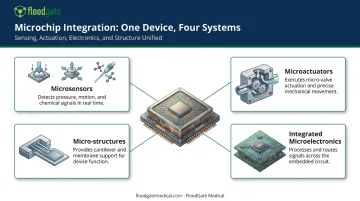
A functioning MEMS medical device typically includes four building blocks:
- Microsensors that detect pressure, motion, or specific chemical markers
- Microactuators that produce physical movement, such as opening a micro-valve
- Integrated microelectronics that process signals and act as the device's "brain"
- Micro-structures like cantilevers, membranes, and microchannels that give the device its physical form
Assembling these four components into a working device is only half the challenge for medical use. Biocompatibility separates medical MEMS from anything used in a car dashboard or a smartphone. Implanted electronics need a hermetic, bidirectional barrier: one that keeps bodily fluids out and prevents any leachable substances from reaching surrounding tissue. Materials must resist corrosion over years, not months, and survive sterilization without degrading.
All of this combines into a single chip capable of sensing, computing, and acting at the same time, often while sitting inside the human body indefinitely.
Key Applications and Examples of MEMS in Medical Devices
MEMS technology now shows up across nearly every category of modern medical device, though adoption maturity varies widely by application.
| Application | Example | Where It Stands |
|---|---|---|
| Implantable pressure sensors | CardioMEMS (heart failure), Camino ICP monitor | FDA-approved; strong outcome data in some studies, mixed in others |
| Continuous glucose monitoring | FreeStyle Libre, Dexcom | Large and growing commercial market |
| Wearables & prosthetics | MEMS accelerometers, IMU gait sensors | Widely used for fall detection and motion tracking |
| Lab-on-a-chip diagnostics | Abbott i-STAT, Cepheid GeneXpert | Rapid, low-volume point-of-care testing |
| Drug delivery | MEMS micropumps, JewelPump | Mostly preclinical and early-stage |
Implantable diagnostics are where MEMS has produced some of the clearest clinical evidence. CardioMEMS uses a wireless, battery-free capacitive sensor implanted in the pulmonary artery to track heart failure progression remotely. A 2020 post-approval study of 1,200 patients found a 57% reduction in heart-failure hospitalizations one year after implantation.
A later FDA review of the GUIDE-HF trial found no significant benefit across the full patient population, a reminder that component-level innovation doesn't always guarantee universal clinical outcomes.
Beyond implantable sensors, chronic disease monitoring through CGM systems has scaled dramatically. The U.S. CGM device market was valued at $1.62 billion in 2024 and is projected to reach $2.39 billion by 2030, according to Grand View Research. Not every CGM architecture relies on MEMS specifically, but microfabricated biosensor concepts are central to next-generation designs.
Outside chronic monitoring, wearables and prosthetics lean on MEMS accelerometers for fall detection and gait analysis, while lab-on-a-chip platforms like GeneXpert shrink entire diagnostic workflows onto disposable cartridges. Drug delivery is the least mature category here — most MEMS micropump research remains preclinical, though companies like Debiotech are pushing implantable insulin delivery closer to commercial reality.
Why MEMS Is Transforming Healthcare Innovation
The appeal of MEMS in medicine comes down to a handful of practical advantages:
- Miniaturization that allows sensors to fit inside catheters, implants, or wearable patches
- Low power consumption, which extends battery life or eliminates the need for a battery entirely
- High sensitivity and accuracy in detecting subtle physiological changes
- Lower fabrication costs at scale compared to traditional macro-scale sensor assemblies
These advantages open the door to minimally invasive procedures and at-home monitoring that previously required a hospital stay. A patient with heart failure can now have their pulmonary artery pressure checked from a couch instead of an ER waiting room. That shift matters for both patient quality of life and hospital capacity.
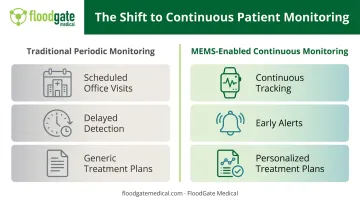
This monitoring shift reflects a broader trend: MEMS is becoming a foundational layer for connected health. Sensors paired with IoT platforms transmit data continuously, feeding algorithms that flag problems before they escalate into emergencies. That steady data stream enables capabilities periodic checkups cannot match:
- Continuous tracking replaces snapshots taken only during scheduled office visits
- Early alerts flag abnormal readings before they become emergency visits
- Personalized treatment plans built on a patient's actual data, not population averages
Challenges in Developing and Scaling MEMS Medical Devices
Getting a MEMS device from prototype to hospital shelf is not simple. Two obstacles dominate.
Regulatory complexity is the first. Depending on novelty and risk classification, a MEMS device may follow one of three pathways:
- FDA 510(k): proves substantial equivalence to an existing device
- De Novo: covers genuinely new device types with no direct predecessor
- Premarket Approval (PMA): the most rigorous route, used by CardioMEMS in 2014
Manufacturers must also meet ISO 13485 quality management standards, covering everything from design controls to supplier oversight.
Manufacturing scalability is the second hurdle, and it's often underestimated. Packaging alone can account for more than 70% of total manufacturing cost in MEMS production, according to a 2018 industry analysis. Foundries compound the problem with steep minimum order volumes:
| Factor | Typical Constraint |
|---|---|
| Packaging cost | >70% of total manufacturing cost |
| Foundry MOQ | ~5,000 wafers/year at 200-mm facilities |
This volume mismatch leaves medical programs needing lower volumes but higher precision than standard foundry runs are built to deliver.
Clearing both hurdles requires people who understand microelectronics, biomedical engineering, and regulatory affairs at the same time. That's a rare combination, and it sets up the talent problem MedTech companies are increasingly running into.
The Rising Demand for Specialized MEMS and Biomedical Engineering Talent
MEMS applications are expanding across diagnostics, wearables, and implants faster than the talent pipeline can keep pace. The U.S. Bureau of Labor Statistics projects 5% growth in bioengineering and biomedical engineering employment from 2024 to 2034, with roughly 1,300 openings per year, faster than the average across all occupations. That figure doesn't isolate MEMS-specific roles, but it reflects the broader hiring pressure companies in this space are already feeling.
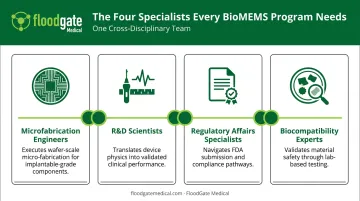
MedTech companies scaling BioMEMS programs typically need to hire for several distinct roles at once:
- Microfabrication engineers who understand photolithography, etching, and wafer-level processing
- R&D scientists who can bridge device physics with clinical application
- Regulatory affairs specialists fluent in FDA pathways and ISO 13485 requirements
- Biocompatibility experts who evaluate materials for long-term implant safety
The real difficulty is finding people who genuinely blend electrical engineering, mechanical design, and life sciences knowledge in a single résumé. A brilliant semiconductor engineer might have zero exposure to biocompatibility testing. A strong biomedical engineer might not know how to troubleshoot a wafer fabrication defect. That gap is exactly where searches stall out for months.
This is where a recruiting partner with deep MedTech focus earns its place. FloodGate Medical works exclusively within medical technology, offering both permanent placement and contract or interim staffing.
Companies can build a core R&D team from scratch or bring in fractional expertise for a specific project phase. Its recent partnership with Talencio expanded that flexibility further, adding fractional staffing capabilities for companies that need specialized hands without a full-time headcount commitment right away.
FloodGate Medical also applies a diversity, equity, and inclusion-driven methodology to how it sources candidates, aiming to build engineering teams that bring varied perspectives to genuinely hard technical problems. For companies scaling BioMEMS research or manufacturing, that combination (MedTech-specific expertise plus a deliberate approach to team diversity) matters as much as speed does. Moving fast on hiring only pays off if the resulting team can actually solve the cross-disciplinary problems these devices present.
Frequently Asked Questions
What is a MEMS medical device?
A MEMS medical device is a micro-fabricated chip that combines electronic circuits and mechanical elements to sense, diagnose, or treat conditions within the body. Examples range from implantable pressure sensors to wearable motion trackers.
What are examples of MEMS medical devices?
Common examples include CardioMEMS pressure sensors for heart failure, continuous glucose monitors, wearable accelerometers used in fall detection, and lab-on-a-chip diagnostic cartridges like the Abbott i-STAT system.
What are the main components of a MEMS medical device?
Core components include microsensors, microactuators, integrated microelectronics, and micro-structures such as membranes or cantilevers. These work together on a single chip to sense, process, and respond to physiological signals.
How are MEMS medical devices regulated?
MEMS medical devices must clear FDA pathways such as 510(k), De Novo, or Premarket Approval, depending on classification and novelty. Manufacturers must also comply with ISO 13485 quality management standards before commercialization.
What skills are needed for a career in MEMS or biomedical device engineering?
This field requires a blend of microelectronics, mechanical design, materials science, and regulatory knowledge. Professionals who combine two or more of these disciplines are in especially high demand across MedTech companies.
Which industries and companies hire MEMS engineers for medical applications?
MedTech device manufacturers, diagnostic companies, and healthcare technology startups all hire for these roles. Specialized recruiters like FloodGate Medical help connect this niche talent pool with companies developing BioMEMS devices and technology.