
Introduction
A 2013 Glassdoor survey found that 61% of employees experienced aspects of their new job that differed from interview-process expectations, often stemming from unclear job descriptions.
In medical technology, where specialized skills and regulatory knowledge are essential, poorly written job descriptions create real hiring friction:
- Attract mismatched candidates who lack FDA compliance expertise or clean room experience
- Extend time-to-hire as teams sort through unqualified applicants
- Discourage diverse talent through coded language or overly restrictive requirements
This guide walks MedTech hiring managers and HR professionals through essential job description components, a step-by-step writing process, common recruitment pitfalls, and industry-specific considerations. You’ll stay aligned with FDA quality system expectations while attracting the right talent.
TL;DR
- Define essential functions, required qualifications, and role expectations—and strip out discriminatory language
- Balance specificity with accessibility, use action-oriented language, and meet ADA and DEI goals
- Cover title, purpose, time-allocated responsibilities, required vs. preferred quals, reporting line, and working conditions
- Update when duties shift significantly, at annual review, or when hiring stalls
- Keep descriptions to 400–800 words and focus on outcomes, not rigid task lists
How to Write a Job Description: Step-by-Step Process
Creating a job description that attracts qualified candidates requires systematic analysis and clear documentation. Follow these five steps to build descriptions that support both recruitment success and legal compliance.
Step 1: Conduct a Job Analysis
Job analysis is the foundation of every defensible job description. Document what work people actually perform, not what you assume happens.
Gathering Current-State Information:
- Observe employees currently performing the role during typical work periods
- Interview both the hiring manager and team members who interact with the position
- Document actual tasks, not idealized versions, including frequency and consequences of non-performance
- Review equipment used, environmental conditions, and accessibility requirements
Identifying Essential Functions:
Under 29 CFR 1630.2(n), essential functions are fundamental duties of the position—not marginal tasks that could be reassigned. A function may be essential if:
- The position exists specifically to perform that function
- Few employees are available to perform it
- The function requires highly specialized expertise
The ADA recognizes seven evidence categories, and job descriptions prepared before advertising or interviewing are one of them. Complete your analysis before posting to establish a defensible record.
Documenting Work Environment:
- Physical layout and space configuration
- Equipment, tools, and technology required
- Environmental conditions (temperature, noise, contamination controls)
- Physical demands and accessibility considerations
For MedTech roles, document quality-impacting responsibilities that trigger FDA competency requirements and any controlled-environment work that necessitates gowning, aseptic behavior, or environmental monitoring.
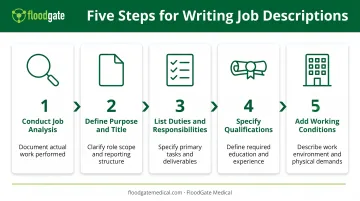
Step 2: Define the Job Purpose and Title
Craft a Clear Job Purpose:
Write 2-3 sentences explaining why the role exists and how it contributes to organizational goals. Focus on outcomes and value delivered, not just tasks.
Example: "The Quality Systems Specialist ensures medical devices meet FDA regulatory requirements and ISO 13485 standards. This role maintains the company's Quality Management System, conducts internal audits, and supports CAPA investigations to protect patient safety and maintain commercial distribution approval."
Select Searchable Job Titles:
Job titles are search terms. According to Indeed's 2026 guidance, use clear, industry-standard titles that candidates actually search for:
✅ Use:
- Standard terminology: "Clinical Specialist" not "Product Champion"
- Clear level indicators: "Senior," "Manager," "Director"
- Recognizable function names: "Regulatory Affairs Associate"
Titles that hurt search visibility belong on the avoid list:
❌ Avoid:
- Internal codes or acronyms
- Promotional language: "Rockstar," "Ninja," "Guru"
- Symbols or all caps
- Combined multi-job titles
Consider SEO and candidate search behavior. "Quality Engineer" will surface in more searches than "Quality Systems Excellence Coordinator."
Step 3: List Duties and Responsibilities
Organize Core Responsibilities:
List 4-7 primary responsibilities in order of importance, with each assigned a percentage of time that totals 100%. This time allocation becomes evidence of essential functions.
Example Structure:
- Conduct product validations and verification testing (30%) – Lead IQ/OQ/PQ protocols for new device introductions and design changes
- Maintain Quality Management System documentation (25%) – Update and control SOPs, work instructions, and quality records per ISO 13485
- Investigate and resolve quality events (20%) – Lead CAPA investigations, root cause analysis, and corrective action implementation
- Support regulatory submissions (15%) – Prepare technical documentation for 510(k), PMA, and international regulatory filings
- Conduct supplier quality audits (10%) – Evaluate contract manufacturers and critical suppliers for compliance
Writing Effective Responsibility Statements:
- Use strong action verbs in present tense: "Develops," "Conducts," "Manages," "Coordinates"
- Focus on outcomes, not methods: "Reduces complaint cycle time" rather than "Attends complaint meetings"
- Be specific about scope: "Manages team of 5 technicians" not "Oversees staff"
- Distinguish essential from marginal duties using your job analysis evidence
Supervisory Responsibilities:
If the role includes management duties, specify:
- Number of direct reports
- Budget authority
- Hiring and performance evaluation responsibilities
- Span of control across locations or functions
Step 4: Specify Qualifications and Requirements
Required vs. Preferred Qualifications:
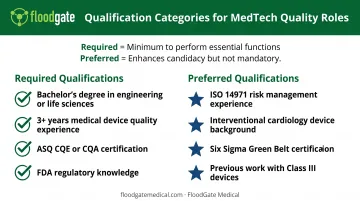
Indeed recommends keeping qualification lists concise to encourage more applications. Separate must-haves from nice-to-haves.
Required qualifications are minimum capabilities needed to perform essential functions:
- Education: "Bachelor's degree in engineering, life sciences, or related field"
- Experience: "3+ years in medical device quality or regulatory affairs"
- Certifications: "ASQ CQE or CQA certification"
- Technical skills: "Proficiency with statistical process control and risk analysis tools"
Preferred qualifications improve candidacy but aren't mandatory:
- "Experience with ISO 14971 risk management"
- "Previous work in interventional cardiology devices"
- "Six Sigma Green Belt certification"
MedTech-Specific Requirements:
The FDA's Quality Management System Regulation (QMSR) takes effect February 2, 2026, and incorporates ISO 13485:2016. It requires personnel who perform quality-impacting work to demonstrate competence through appropriate education, training, skills, and expertise.
For MedTech roles, document:
- Regulatory knowledge: FDA 21 CFR 820, ISO 13485, ISO 14971, Medical Device Regulation (MDR)
- Quality system experience: CAPA, complaint handling, design controls, process validation
- Technical certifications: ASQ quality certifications, clinical specializations, software validation
- Controlled environment experience: Clean room protocol, aseptic technique, environmental monitoring (only when the role actually requires them)
According to FDA's October 2025 draft guidance, work-environment controls vary by product, process, sterility requirements, and environmental contact risk. Include clean room or gowning requirements only when the specific role and manufacturing process demand them.
Education Requirements:
State whether equivalent experience can substitute for formal degrees. "Bachelor's degree in engineering or 5+ years of equivalent hands-on medical device development experience" opens the door to non-traditional candidates with proven skills.
Step 5: Add Working Conditions and Additional Details
Document Physical Demands and Environmental Conditions:
ADA qualification standards can include physical, medical, and safety requirements, but criteria that screen out individuals with disabilities must be job-related and consistent with business necessity.
Document the function and conditions, not assumed abilities:
✅ Describe the work: "Lifts and positions equipment up to 50 lbs, moves between lab stations for 4-6 hours daily, distinguishes color-coded wiring"
❌ Avoid: "Must be able-bodied," "Requires perfect vision," "Needs physical stamina"
Additional Details to Include:
- Schedule: Standard hours, shift work, on-call expectations
- Travel requirements: Frequency, duration, geographic scope (e.g., "25% travel to customer sites within the Western region")
- Remote/hybrid arrangements: On-site requirements vs. remote flexibility
- Work environment: Office, clean room, lab, clinical setting, or mixed
Company Culture and Benefits:
Briefly highlight what makes your organization distinctive:
- Mission and values alignment
- Growth and development opportunities
- Unique benefits or workplace attributes
Equal Opportunity Statement:
Include language affirming your commitment to equal opportunity and inviting accommodation requests. While no single EEOC-mandated template exists, a standard approach is:
[Company] is an equal opportunity employer. We celebrate diversity and are committed to creating an inclusive environment for all employees.
Qualified applicants will receive consideration without regard to race, color, religion, sex, national origin, disability status, protected veteran status, or any other characteristic protected by law. If you require reasonable accommodation to participate in the application process, please contact [email/phone].
Key Components of an Effective Job Description
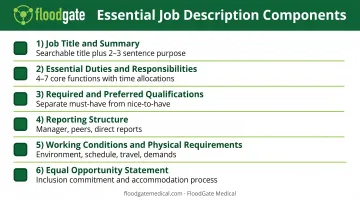
Every strong job description includes these core elements, organized for easy scanning and candidate decision-making:
Essential Structural Components
- Job title and summary – Clear, searchable title plus 2-3 sentence overview of the role's purpose
- Essential duties and responsibilities – 4-7 core functions with time allocations, listed by importance
- Required and preferred qualifications – Separate must-have from nice-to-have credentials
- Reporting structure – Manager, peers, direct reports, and cross-functional relationships
- Working conditions and physical requirements – Environment, schedule, travel, physical demands
- Equal opportunity statement – Commitment to inclusion and accommodation process
According to Indeed's 2015 analysis, job postings of 700-2,000 characters (roughly 140-400 words of body content) averaged 30% more applications. That range is a strong target for the role itself. Full posts that add company context often land between 400-800 words total—still concise, just complete.
Best practices for readability:
- 400-800 words total, with core role content kept tighter
- Short paragraphs of 3-4 sentences
- Bullet points for duties, qualifications, and requirements
- Clear section headings
- Active voice and action verbs
- Simple, jargon-free language
Once structure and length are solid, word choice shapes who feels welcome to apply.
Inclusive Language and Company Context
Research by Gaucher, Friesen, and Kay (2011) found that masculine-coded wording in job ads reduced women's anticipated belonging and appeal for those roles. The study didn't track application rates, but it shows how wording alone can create barriers.
Strategies that improve inclusivity:
- Audit for gendered language: Replace "competitive," "dominant," "ninja," "rockstar" with neutral alternatives
- Focus on skills rather than pedigree: "3+ years of regulatory submissions experience" vs. "Ivy League degree required"
- Avoid coded age language: "Digital native," "young and energetic," "seasoned professional"
- Replace "culture fit" with "culture add" to signal you value diverse perspectives
- Limit required qualifications to true essentials—long lists discourage women and underrepresented candidates
Add a brief (2-3 sentence) company description highlighting:
- Your mission and the patient populations you serve
- Organizational values that guide decision-making
- What makes your workplace distinctive (innovation focus, collaborative culture, growth trajectory)
This context helps candidates judge mission alignment and cultural compatibility beyond the role itself.
When Should You Write or Update a Job Description
Before Advertising a New Position:
Under the ADA, a job description written before you advertise or interview counts as evidence of essential functions. Create or update it before you post so you have a defensible compliance record and hiring managers agree on the requirements.
During Organizational Changes:
Update immediately when:
- Reporting relationships change
- Supervisory responsibilities are added or removed
- The role's essential functions shift due to restructuring
- Technology or process changes alter how work is performed
- Quality system responsibilities change under FDA requirements
When Recruitment Challenges Arise:
If you're seeing persistent problems attracting qualified candidates, the job description may be the culprit. Warning signs include:
- High volume of unqualified applicants who missed key requirements
- Qualified candidates dropping out after reviewing the full description
- Diverse candidates not applying despite outreach efforts
- Hiring managers reporting that interview candidates don't match expectations
Annual Review Cycle:
Tie job description reviews to annual performance evaluation periods. SHRM's 2026 guidance recommends reviewing when job requirements, organizational structure, market expectations, or hiring needs change. If a role's actual duties have evolved 20% or more from the written description, update the document so your compliance record matches how the work is done today.
What You Need Before Writing a Job Description
Requirements Gathering
Identify and Involve Stakeholders:
Gather input from everyone who shapes or depends on the role:
- Hiring manager who will supervise the position
- Current employees doing similar work
- HR or compliance for legal review
- Cross-functional partners who work with the role
Stakeholder alignment prevents mismatched expectations and keeps the description tied to real job demands.
Research Industry Benchmarks and Salary Data:
- O*NET OnLine: U.S. Department of Labor database with 900+ occupations and 19,000+ task statements for benchmarking titles, duties, skills, and knowledge areas
- BLS Occupational Employment and Wage Statistics: Annual wage estimates for ~830 occupations at national, state, and metro levels (adjust for MedTech location and seniority)
- MedTech-specific compensation guides: Industry recruitment firms publish salary surveys that reflect device-specific roles and regulatory requirements
Documentation and Tools
Gather Internal Context:
- Department structure and org chart with reporting relationships
- Existing job descriptions for similar or adjacent roles
- Performance evaluation criteria for the current position
- Competency frameworks or skill matrices used in your organization
Research Legal and Regulatory Requirements:
- ADA essential functions (29 CFR 1630.2): How to document fundamental vs. marginal duties
- EEOC preemployment guidance: Rules on disability-related questions and medical exams
- FDA QMSR competency requirements: For quality-impacting MedTech roles, tie education, training, skills, and experience to FDA quality system expectations
Common Mistakes to Avoid When Writing Job Descriptions
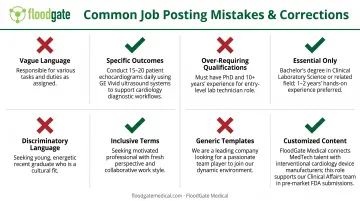
Even careful hiring teams ship job descriptions that quietly shrink the candidate pool. These four patterns show up most often in MedTech postings—and each one is fixable.
Using Vague, Unmeasurable Language
Phrases like "handles various tasks," "assists with projects," or "supports the team" tell candidates nothing about the work. Use specific, outcome-oriented statements instead:
❌ Vague: "Supports quality initiatives"
✅ Specific: "Leads root cause investigations for customer complaints, implementing corrective actions that reduce recurrence by 30%"
Over-Requiring Qualifications
Listing too many required qualifications, especially degrees, screens out strong candidates who built skills through alternative paths.
❌ Over-restrictive: "Master's degree required; 10+ years of experience in medical device sales; previous cardiology experience mandatory"
✅ Accessible: "Bachelor's degree or equivalent experience; 5+ years medical device sales; cardiology experience preferred"
Separating required from preferred qualifications makes clear what is essential versus nice-to-have.
Using Discriminatory or Coded Language
Certain language patterns discourage protected groups from applying, even when no harm is intended. Common examples include:
- Age-coded: "Digital native," "recent graduate," "young and energetic," "seasoned professional"
- Gender-coded: "Aggressive," "dominant," "competitive," "ninja," "rockstar"
- Exclusionary: "Culture fit," "native English speaker," "no accent"
Review your language through an inclusion lens. If a qualification isn't directly job-related, remove it.
Copying Generic Templates Without Customization
Templates give useful structure, but pasting one in without adapting it to the real role creates problems:
- Attracts mismatched candidates who don't understand the work
- Fails to highlight what makes your opportunity unique
- Misses MedTech-specific regulatory, technical, or clinical requirements
- Wastes time for candidates and hiring teams during screening
Customize every template with your job analysis, real responsibilities, must-have competencies, and org context.
Frequently Asked Questions
What are the key components of a job description?
Six essentials cover it: job title and summary; duties and responsibilities with time allocations; required vs. preferred qualifications; reporting structure; working conditions and physical requirements; and an equal opportunity statement with accommodation language.
What is the recommended format for a job description?
Use clear section headings, bullets for scanning, and 400-800 words total. Lead with the most important information (inverted pyramid), and keep paragraphs short with active voice and plain language.
What are the best practices for writing a job description?
Use specific action verbs, focus on outcomes over methods, and avoid jargon or discriminatory language. Separate required from preferred qualifications, finish job analysis before you write, and update descriptions as roles change.
What are good job description examples?
Strong examples state the role’s purpose with concrete metrics (team of X, budget of $Y), note growth paths, and reflect culture without losing professionalism. They stay specific on essential functions while remaining accessible to diverse candidates.
How many pages should a job description be?
Aim for one page, or about 400-800 words. Indeed’s 2015 research found postings of 700-2,000 characters drew about 30% more applications. Longer posts hurt completion; shorter ones don’t give candidates enough to self-select.
Effective job descriptions balance legal compliance, org needs, candidate clarity, and inclusive language. For MedTech hiring teams, a clear job analysis and scannable structure help you attract the right talent—whether that’s a quality engineer with FDA knowledge or a clinical specialist in a sterile environment.