

Introduction
Traditional promotion criteria in MedTech organizations often fail to predict leadership effectiveness. Technical expertise, past performance, and operational success remain the default filters.
A 2024 Wharton analysis found that many new managers struggle during the transition to leadership roles. Organizations still promote high-performing technical contributors without assessing future leadership capability.
The consequences are measurable. According to SHRM, replacing an employee costs 50% to 200% of annual salary, depending on level and role complexity. That figure escalates dramatically for executive positions.
In MedTech, regulatory complexity, cross-functional coordination, and innovation cycles demand sophisticated leadership. Poor promotion decisions compound costs through delayed product launches, quality system gaps, team turnover, and weakened competitive positioning.
Key Takeaways
- Effective assessment separates current performance from future leadership capacity with validated methods
- MedTech leaders need technical credibility plus strategic judgment, regulatory fluency, and cross-functional influence
- Structured interviews, assessment centers, and validated personality measures reduce bias and improve prediction
- Embed assessment in talent strategy and succession planning, not one-time hiring screens
- Keep development tools (360° feedback, DiSC, MBTI) separate from high-stakes promotion decisions
Why Leadership Potential Assessment Matters for MedTech Companies
The Technical Excellence Trap
MedTech organizations routinely promote outstanding scientists, engineers, and clinical specialists into management roles based on technical achievement. However, a foundational 1972 study of engineering design group leaders found a significant negative correlation between technical competence and managerial effectiveness. Domain expertise alone does not translate to leadership success.
A 2019 field study of 303 employees reinforced this pattern: job-knowledge interview questions failed to predict later performance, while past-behavior and situational questions showed meaningful predictive validity.
In MedTech, the risk intensifies. Top catheter designers, 510(k) specialists, and clinical affairs pros often lack the emotional intelligence, strategic thinking, and people-development skills management demands.
MedTech Leadership Demands Unique Capabilities
Leadership in medical device companies requires simultaneous mastery of:
- Regulatory fluency: Quality-system oversight, risk management under ISO 13485 and FDA QMSR requirements, and traceable decision-making during audits and inspections
- Cross-functional coordination: Aligning R&D, clinical, regulatory, quality, manufacturing, and commercial functions around product lifecycle milestones
- Strategic business judgment: Connecting technical decisions to reimbursement landscapes, competitive positioning, and commercial outcomes
- Innovation under constraint: Balancing speed with compliance, managing risk in regulated environments, and making decisions with incomplete data
An FDA analysis of approximately 1.2 million medical-device adverse event records and interviews with 45 device-company and FDA leaders found that design and manufacturing-process-control failures caused more than half of recalls. The analysis identified cross-functional quality ownership, quality-linked performance management, and regular management visibility into quality metrics as critical operating-system features. All of these depend on effective leadership.
The Business Case for Rigorous Assessment
Poor leadership decisions carry measurable consequences:
- Replacement costs: SHRM benchmarks replacement at 50% to 200% of annual salary, escalating for executive roles
- Team impact: Leadership gaps increase team turnover, reduce productivity, and delay critical projects
- Quality and regulatory risk: Weak governance and decision-making contribute to quality system failures, regulatory observations, and recall risk
- Innovation delays: Leaders who cannot coordinate cross-functional teams or balance technical and commercial priorities slow product development cycles
A 2019 MDIC/FDA Case for Quality pilot involving 46 sites and 236 survey respondents found that 85.4% of participants reported the quality appraisal directly improved product quality. Selected sites implemented manufacturing changes 21 days faster.
The pilot also flagged senior management governance and commitment to quality as central maturity practices. These studies did not isolate leadership assessment as the cause, but they define the outcomes effective MedTech leaders must deliver: faster cycle times, lower defect rates, and quicker manufacturing changes.
Critical Leadership Competencies to Evaluate
Understanding Potential vs. Performance
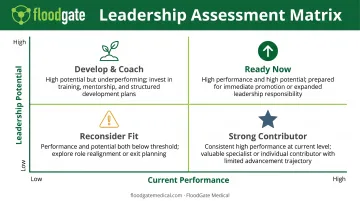
Leadership potential is not a stand-alone trait. It is a judgment about someone's capacity to take on greater scope, complexity, and responsibility in a defined next role. Potential always points to a future context—not only how someone performs today.
Performance measures demonstrated behavior and results in the current role. Assessed potential still adds predictive value beyond performance ratings alone. Strong results today do not automatically mean someone will succeed in a larger leadership role.
MedTech organizations must evaluate both. Current performance may serve as a gatekeeper—leaders who cannot deliver results in their present role are unlikely to succeed in larger ones—but potential requires separate evidence.
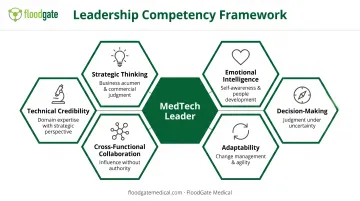
Six Core Competencies for MedTech Leadership
1. Strategic Thinking and Business Acumen
MedTech leaders must connect technical and regulatory decisions to commercial outcomes. That means reading reimbursement models, competitive positioning, market dynamics, and the business impact of product-development trade-offs.
2. Emotional Intelligence and People Development
Leader emotional intelligence drives team performance beyond personality or cognitive ability alone. In high-pressure MedTech environments, self-awareness, empathy, conflict resolution, and coaching skill directly affect retention and results.
3. Decision-Making Under Uncertainty
Device development and commercialization require leaders who can make sound decisions with incomplete data, manage risk within regulatory constraints, and balance speed with compliance.
4. Adaptability and Change Management
Technology disruptions, organizational restructuring, regulatory changes (such as the February 2026 QMSR transition to ISO 13485:2016), and market shifts demand leaders who can guide teams through ambiguity and transformation.
5. Cross-Functional Collaboration and Influence
MedTech product success depends on alignment across R&D, clinical, regulatory, quality, manufacturing, and commercial functions. Leaders must influence without formal authority and navigate matrix structures.
6. Technical Credibility with Strategic Perspective
Leaders in device companies need enough technical depth to earn team respect while building broader business and strategic range. An R&D director needs deeper technical fluency than a commercial VP, but both need domain credibility paired with organizational judgment.
Types of Leadership Assessment Tools and Methods
Effective assessment combines multiple methods to reduce bias and increase predictive accuracy. No single tool provides sufficient evidence for high-stakes leadership decisions.
Structured Behavioral Interviews
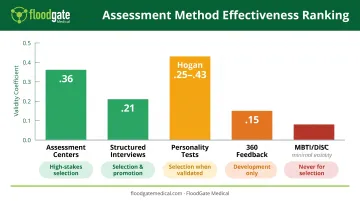
A 2019 predictive field study found that structured interview scores correlated r = .21 with later performance. Past-behavior questions ("Describe a time when...") and situational questions ("What would you do if...") predicted performance, while job-knowledge questions did not.
Best practice: Use standardized, MedTech-specific scenarios with anchored scoring rubrics and trained interviewers. Probe scenarios such as:
- Cross-functional conflict resolution
- Regulatory decision-making under time pressure
- A major design-control finding during an FDA audit
Assessment Centers and Leadership Simulations
Assessment centers use standardized, multiple exercises rated by trained judges. A recent meta-analysis found operational validity of .36 for overall job performance.
MedTech application: Role-specific simulations show how candidates perform under real pressure. Useful scenarios include:
- Managing a product recall escalation
- Resolving design-review conflict between R&D and regulatory
- Allocating constrained quality resources
- Navigating a commercial launch governance decision
Personality and Behavioral Assessments
Hogan Assessment Suite (HPI, HDS, MVPI): Meta-analytic true-scale validities for normal personality traits range from .25 to .43. The suite covers:
- HPI — normal personality traits linked to day-to-day leadership performance
- HDS — derailment risks that surface under stress
- MVPI — motives and values that signal culture fit
Critical requirement: Hogan explicitly recommends demonstrating relationships between its scales and performance in the target job. Organizations must validate personality measures against MedTech-specific leadership criteria—not assume universal accuracy.
Everything DiSC: Publisher data show strong internal consistency (alpha .79-.90) and test-retest reliability (.85-.88), but no criterion validity for hiring or leader performance. DiSC is appropriate for communication style awareness and development, not high-stakes selection.
Myers-Briggs Type Indicator (MBTI): The publisher states MBTI was not designed or validated for hiring and does not predict job performance. A 2023 study found MBTI personality explained approximately 1% of variance in leadership practices. Use only for voluntary development, never for promotion or selection decisions.
360-Degree Feedback
360° assessments gather input from managers, peers, direct reports, and cross-functional partners to reveal leadership strengths, blind spots, and organizational reputation.
Evidence: A 2005 meta-analysis of 24 longitudinal studies found small behavior-change effects: corrected mean effects of .15 for direct reports, .05 for peers, and .15 for supervisors. Development-only use averaged .25 versus .08 for administrative (promotion/pay) use.
Recommendation: Use 360 feedback for development and behavior triangulation, not as the primary promotion screen. Combining developmental feedback with high-stakes decisions reduces effectiveness and increases defensiveness.
Cognitive Ability and Emotional Intelligence Tests
Cognitive ability tests measure problem-solving capacity and learning agility. Emotional intelligence assessments can add supplemental evidence when the model is clear and results are validated against your local leadership criteria.
Key principle: Use scientifically validated instruments with published reliability, validity, and normative data. Tools should meet EEOC standards, show job relevance, and sit alongside—not replace—the multi-method evidence above.
How to Implement an Effective Assessment Process
Build a MedTech-Specific Competency Framework First
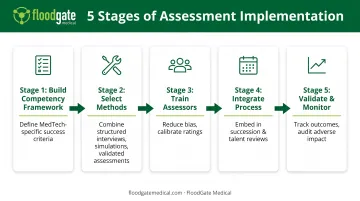
Before assessing anyone, define the leadership competencies required for success in your organization. Map competencies to device risk class, regulatory complexity, product lifecycle stage, and actual decision situations leaders will face.
Example framework dimensions:
- Quality-system leadership and governance
- Regulatory and risk judgment under QMSR/ISO 13485
- Cross-functional integration across device lifecycle
- Strategic business acumen and commercial judgment
- People leadership and team development
- Learning agility and role-transition capacity
Use Multiple Independent Assessment Methods
Recommended core approach:
- Structured behavioral interview with MedTech scenarios
- Assessment-center simulation exercise
- Locally validated personality/derailer measure (such as Hogan)
Supplemental development evidence:
- 360° feedback (development stream only)
- Cognitive ability or emotional intelligence test (if job-relevant)
Avoid: Combining developmental tools (DiSC, MBTI, unvalidated 360 feedback) into a single promotion score.
Separate Performance and Potential Evidence
Current results may serve as a gatekeeper, but future-role potential requires its own criteria. High performance does not automatically signal high potential—each needs its own evidence. Treat them as related but distinct inputs.
Establish Assessment Governance and Cadence
Define who gets assessed, when, by whom, and how you review and act on results. Integrate assessment into annual talent reviews, succession planning, and development planning, not just hiring.
Train Assessors and Calibrate Ratings
Ensure evaluators receive training to:
- Recognize and reduce unconscious bias
- Use behavioral anchors and evidence-based scoring
- Provide constructive developmental feedback
- Calibrate ratings across multiple candidates
That discipline matches SHRM guidance: base promotions on behaviors and results, use external assessments to challenge perception bias, and keep evaluation structured so succession calls stay objective.
Monitor for Adverse Impact and Validate Outcomes
EEOC guidance states that employment tests must be validated for the positions and purposes for which they are used. The Uniform Guidelines clarify that validity studies are not required where no adverse impact occurs, so ongoing demographic monitoring is essential.
Define validation criteria up front:
- Quality-system effectiveness
- Decision quality under audit
- Team retention and schedule adherence
- Defect escape rates and CAPA effectiveness
- Regulatory observations
Do not claim predictive validity until your organization's own data support it.
Best Practices and Common Pitfalls
Best Practices
- Combine multiple methods: A multi-modal approach increases accuracy and reduces reliance on any single data source. No tool is enough alone.
- Separate potential from performance reviews: Confusing current results with future capability undermines both. Use different conversations, criteria, and timing.
- Include candidate self-assessment: Confirm high-potential people want leadership responsibility before you invest heavily in development. Not every strong contributor wants to manage people or navigate organizational complexity.
- Validate tools locally: Generic norms and benchmarks help, but MedTech organizations need proof their assessments predict success in their roles and culture.
Common Pitfalls to Avoid
- Over-relying on unvalidated tools or manager intuition: Subjective judgments introduce bias and weaken prediction accuracy. Require evidence, not just opinions.
- Assuming high performers have high leadership potential: Excellence in a technical or functional role does not automatically transfer to management success. Performance and potential are distinct capabilities.
- Neglecting DEI in assessment design: Unstructured processes perpetuate homogeneous leadership and miss diverse high-potential candidates. Use behavior- and result-based criteria, standardized scoring, and demographic outcome audits.
- Treating assessment as a one-time event: Fold assessment into succession planning, development, promotion decisions, and hiring. One-time snapshots are not longitudinal evidence.
- Using developmental tools for high-stakes decisions: Keep 360 feedback, DiSC, and MBTI in the development stream. Use structured interviews, assessment centers, and criterion-validated personality measures for promotion and hiring.
Strategic Partnership
MedTech organizations that need specialized support can partner with recruitment and talent advisory firms experienced in both technical competencies and leadership assessment.
FloodGate Medical, for example, combines more than 25 years of MedTech experience with a consultative approach covering organizational assessments, succession planning, talent mapping, and structured methods such as "Hiring for Attitude." DEI-driven evaluation and a reported 89% one-year retention rate across more than 450 annual placements can complement internal processes and reduce costly leadership mismatches.
Frequently Asked Questions
What does leadership potential mean?
Leadership potential is the capacity to take on greater scope, complexity, and responsibility in a future role. Unlike current job performance, it is role-specific and depends on what the next position demands.
What are the seven key leadership competencies?
While competency models vary, seven commonly assessed dimensions include:
- Strategic thinking: Connecting decisions to business outcomes and long-term positioning
- Emotional intelligence: Self-awareness, empathy, and interpersonal effectiveness
- Decision-making: Sound judgment under uncertainty and time pressure
- Adaptability: Navigating change, ambiguity, and organizational transformation
- Communication and influence: Leading without formal authority and building cross-functional alignment
- People development: Coaching, feedback, and building high-performing teams
- Results orientation: Delivering outcomes while maintaining quality and compliance standards
What are some leadership assessments?
Common scientifically validated assessment types include:
- Structured behavioral interviews: Past-behavior and situational questions using standardized scoring
- Assessment centers: Realistic simulations rated by trained judges
- Personality assessments: Hogan Assessment Suite (validated for selection when locally criterion-validated)
- 360-degree feedback: Multi-rater input (developmental use only)
- Cognitive ability tests: Problem-solving and learning agility measures
Avoid using DiSC or MBTI for selection; both lack criterion validity for hiring and leadership prediction.