That gap is exactly why the U.S. healthcare staffing market is booming. It hit $45.48 billion in 2025 and is projected to reach $89.71 billion by 2033, growing at a 6.98% CAGR, according to Grand View Research. An aging population and persistent clinical workforce shortages are driving that growth, and they aren't slowing down.
That's why interest in launching a healthcare staffing agency is climbing among clinicians, HR veterans, and first-time entrepreneurs alike. Demand is predictable, margins often beat generalist staffing, and the business model lets you build something that actually solves a problem.
But healthcare staffing isn't a copy-paste version of general staffing. It comes with licensing, insurance, and credentialing hurdles that catch founders off guard. This guide walks through exactly what you need to launch, step by step.
Key Takeaways
- Healthcare staffing requires far more capital, licensing, and insurance than generalist staffing
- Licensing and insurance rules vary by state—optional in Ohio may be mandatory in Illinois
- Credentialing speed determines how fast you place candidates and win repeat business
- Cash flow, not demand, is usually the first real bottleneck founders hit
- Niching down beats trying to serve every healthcare specialty at once
What Is a Healthcare Staffing Agency?
A healthcare staffing agency recruits, vets, and places clinical professionals, think RNs, LPNs, CNAs, and allied health workers, into temporary, contract, or permanent roles at hospitals, clinics, and care facilities.
The core value lies in solving workforce shortages and covering shift gaps that would otherwise leave patients without adequate care. Facilities don't hire staffing agencies because they enjoy paying markup rates. They hire agencies because they're short-staffed and the alternative is worse.
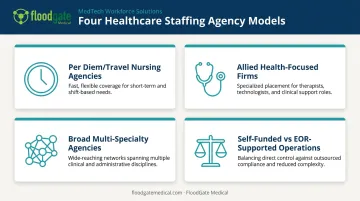
That need for reliable coverage shapes how agencies organize themselves. Most fall into one of a few common formats, distinguished by clinical focus or funding structure:
- Per diem or travel nursing agencies focused on short-term clinical coverage
- Allied health-focused firms placing PTs, radiology techs, respiratory therapists, and similar roles
- Broad multi-specialty agencies covering nursing, allied health, and locum tenens
- Self-funded operations versus those supported by an Employer-of-Record (EOR) partner who handles payroll, licensing, and insurance on the agency's behalf
Understanding which model fits your resources and risk tolerance matters before you write a business plan. A self-funded agency carries more control but also more exposure. An EOR-supported model reduces some startup complexity but comes with fees that eat into margin.
What to Know Before You Start a Healthcare Staffing Agency
Setting realistic expectations for cost, timeline, and complexity matters more than gut-checking whether you're "cut out" for staffing — you need a clear-eyed view before you commit capital.
Startup Costs Run Higher Than Generalist Staffing
Expect to budget for:
- Incorporation and business registration fees
- State-specific healthcare staffing licenses (often $750-$1,000+ per state, plus per-branch fees)
- Insurance premiums (professional liability, general liability, workers' comp, EPLI)
- Credentialing and compliance software
- Initial payroll funding to cover the gap before client payments arrive
The SBA recommends budgeting at least one year of operating expenses before launch. Healthcare staffing tends to land on the higher end of that range, thanks to the licensing and insurance stacking that generalist staffing agencies simply don't face.
Cash Flow Is the Real Bottleneck
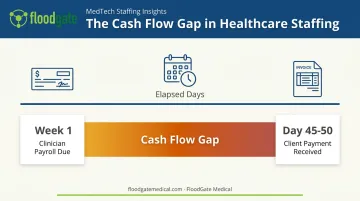
Here's the part that surprises most first-time founders: your clinicians expect weekly paychecks, but your healthcare clients don't pay that fast.
General staffing benchmarks show average Days Sales Outstanding (DSO) sitting between 45 and 50 days, according to Staffing Industry Analysts. Late timesheets and billing disputes can push that even further.
That means you're often paying staff weekly while waiting six-plus weeks to collect from clients. Without a plan to bridge that gap, whether through savings, a line of credit, or invoice factoring, you can run out of cash even while your business is technically profitable on paper.
How to Start a Healthcare Staffing Agency – Step by Step
Launching breaks down into six practical stages, from picking a niche to going to market. The most common mistakes founders make: skipping state-specific licensing checks, underinsuring the business, and launching without a plan for payroll cash-flow gaps.
Here's the sequence that actually works.
Step 1: Choose Your Niche and Validate Demand
Don't try to staff every specialty on day one. Pick a lane where you already have relationships, credibility, or hands-on experience, whether that's travel nursing, allied health, long-term care, or locum tenens.
Specializing deeply beats spreading thin. FloodGate Medical, for example, focuses exclusively on MedTech recruitment rather than trying to serve every healthcare vertical. That focus lets its Talent Directors build genuine domain expertise: one specializes in cardiovascular and vascular MedTech, another in neurotechnology, and another in urology and GI. Clients trust specialists over generalists because specialists already speak the language.
Before you spend a dollar on incorporation or licensing, talk directly to facility hiring managers in your target niche. Ask what they're struggling to fill and how they currently source coverage. Their answers will tell you more than any market report.
Step 2: Choose Your Business Structure and Incorporate
Most founders choose between an LLC and a C-corporation:
| Factor | LLC | C-Corp |
|---|---|---|
| Liability protection | Owners generally shielded | Strongest liability separation |
| Fundraising | No stock mechanism | Can sell stock, attractive to investors |
| Formalities | Fewer reporting requirements | More extensive recordkeeping |
| Taxation | Flexible, pass-through options | Corporate tax, plus shareholder tax on distributions |
If you're planning to bring in outside investors down the road, a C-corp often makes that easier. If you want simplicity and flexibility while you're small, an LLC usually wins.
A quick note on incorporating in Delaware or Wyoming: it's common practice for some businesses, but it's not a universal requirement or automatic advantage for staffing agencies specifically. If you incorporate outside the state where you'll actually operate, you'll need to register as a foreign entity in your home state, which adds paperwork and fees. Many founders use an incorporation service to handle entity setup, EIN registration, and business banking in one pass.
Step 3: Secure the Right Licenses and Insurance
This is where healthcare staffing diverges hardest from generalist staffing. Many states require a dedicated nurse or healthcare staffing agency license, separate from your standard business registration, each with its own renewal cycle and reporting rules.
Two examples show how much this varies:
- Illinois requires nurse agencies to hold a one-year license through the Illinois Department of Labor, renewed at least 90 days before expiration, with proof of workers' compensation and professional liability coverage.
- Massachusetts registers temporary nursing service agencies through its Department of Public Health, with a $750 per-location registration fee under 105 CMR 157.000.
Insurance requirements vary too, but plan for four core policies:
- Medical Professional Liability: covers claims of negligence or errors during clinical placements
- General Liability: protects against bodily injury or property damage claims
- Workers' Compensation: legally mandatory in most states for employers with staff
- Employment Practices Liability Insurance (EPLI): often required by client contracts, even where not legally mandated
Operating without proper licensing or insurance risks fines, lawsuits, or a forced shutdown. That's why some founders partner with an Employer of Record (EOR) that holds licenses and insurance on the agency's behalf while they focus on recruiting and client relationships.
Step 4: Build Your Credentialing and Onboarding Process
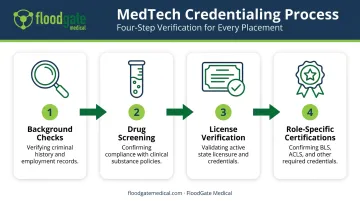
Credentialing forms the backbone of your compliance posture and your speed to placement. At minimum, build a process covering:
- Background checks: criminal history, sex offender registry, and OIG/SAM exclusion list screening
- Drug screening: standard for most facility contracts
- License verification: confirming active, unrestricted status through sources like Nursys
- Role-specific certifications: BLS, ACLS, or other credentials tied to the specialty
The tension here is real: thorough credentialing takes time, but slow credentialing pushes qualified candidates toward agencies that move faster. Build a standardized checklist so nothing gets missed, and consider credentialing software or an EOR partner to keep the process consistent and audit-ready as you scale.
Step 5: Secure Startup Capital and Plan for Cash Flow
Common funding sources for a new agency include:
- Personal savings
- SBA loans (the 7(a) program covers amounts up to $5 million, with CAPLines designed for short-term working capital needs)
- Private investors
- Business lines of credit
But funding the launch is only half the equation. Remember the pay-bill gap from earlier: your clinicians want weekly pay, while your clients pay on 30-60+ day terms.
Many agencies bridge this gap with invoice factoring or payroll funding, where a finance partner advances most of your invoice value quickly. You're not left personally floating payroll while waiting on client checks. An EOR partnership can serve a similar function, absorbing some of that timing risk in exchange for a service fee.
Step 6: Build Your Tech Stack and Go to Market
You'll need software across four categories:
- ATS/CRM for recruiting and client relationship management
- Credential management to track certifications, licenses, and expiration dates
- Time and payroll tracking for accurate weekly pay
- VMS integration if you plan to work with larger health systems that require vendor management system compatibility
On the marketing side, think two-sided:
- Candidate acquisition through referrals, job boards, and relationships with nursing schools
- Client acquisition through direct outreach and healthcare industry conferences
A differentiated hiring approach can be a genuine trust-builder with clients. FloodGate Medical's DEI-driven recruitment methodology in MedTech recruiting is one example: it gives client companies access to a broader, higher-quality talent pool rather than the same narrow candidate pipeline every competitor pulls from. Whatever your differentiator is, lead with it in client conversations.
Common Risks and Mistakes to Avoid
Even well-funded launches stumble over a handful of predictable mistakes:
- Underestimating combined compliance costs. Licensing, insurance, and credentialing costs compound quickly, often blowing budgets that treat them as separate line items instead of one bundle.
- Over-relying on one or two large clients. If a major contract ends, revenue can collapse overnight. Diversifying your client base early protects against this.
- Scaling placements faster than systems can handle. Growing headcount faster than your cash flow or compliance systems can support invites trouble fast.
These risks aren't hypothetical. In 2022, the Department of Labor ordered US Medical Staffing to pay $9.3 million in back wages and damages to 1,756 workers after finding intentional misclassification and overtime violations.
Worker classification and overtime rules deserve a documented review before your first payroll run, not after a complaint lands.
Conclusion
Starting a healthcare staffing agency comes down to getting licensing, insurance, credentialing, and cash flow right from day one. Any one of those gaps can shut you down, regardless of how strong client demand is.
Beyond covering these fundamentals, niching down and building trust through compliance rigor, plus a differentiated hiring approach, consistently outperforms trying to compete broadly across every specialty. That's true whether you're staffing ICU nurses or MedTech professionals, the specialty FloodGate Medical has built its practice around.
Once you're operating, ongoing review of your compliance posture, client mix, and margins is what separates agencies that scale from those that stall out in year two.
Frequently Asked Questions
How much does it cost to start a healthcare staffing agency?
Costs vary widely by state and specialty, but expect to budget for incorporation, state licensing fees, insurance premiums, credentialing software, and enough payroll funding to cover the gap before client payments arrive.
How do I start a healthcare staffing agency?
Choose a niche, incorporate your business, secure the right state licenses and insurance, build a credentialing process, and plan for cash flow before you start marketing to clients.
What licenses or permits do I need to start a healthcare staffing agency?
Requirements vary by state. Many states require a dedicated healthcare or nurse staffing agency license beyond standard business registration, often with ongoing reporting obligations.
Do I need a nursing or medical background to start a healthcare staffing agency?
Clinical experience helps with credibility and client relationships, but it's not required. Strong compliance, recruiting, and operational skills matter just as much to running a successful agency.
How long does it take for a healthcare staffing agency to become profitable?
Profitability depends on how fast you land clients and manage cash flow, since slow payments can delay profits even with a full client book. Model your own breakeven point instead of relying on generic industry timelines.
What insurance do I need to run a healthcare staffing agency?
At minimum, plan for Medical Professional Liability, General Liability, Workers' Compensation, and Employment Practices Liability Insurance (EPLI), though specific legal requirements vary by state.