Now stack a specialized field like MedTech on top of that. Regulatory affairs specialists, clinical affairs experts, and R&D engineers are in short supply, and the same small pool of candidates gets courted by every device maker in the region.
This is where talent acquisition earns its keep. Unlike everyday recruiting, which reacts to an open seat, talent acquisition builds the pipeline before you need it. This guide covers the definition, five core elements, the step-by-step process, team roles, modern strategies, and why the stakes climb even higher in MedTech.
Key Takeaways
- Talent acquisition is a long-term, strategic practice spanning the entire employee lifecycle
- The 5 core elements are workforce planning, employer branding, sourcing, candidate experience, and retention
- Cost-per-hire averages $5,475 for nonexecutive roles, per SHRM's 2025 data
- MedTech hiring demands specialized sourcing because of regulatory and technical skill shortages
- Proactive pipelining beats reactive job posting, especially for hard-to-fill roles
What Is Talent Acquisition?
Talent acquisition is the ongoing, strategic process of identifying, attracting, hiring, and retaining people whose skills align with a company's long-term business goals. SHRM defines it as the strategies, tactics, and processes organizations use to identify, recruit, and retain the human resources they need, not just the people needed to fill today's vacancy.
That distinction matters. Filling a requisition is a transaction. Talent acquisition is a discipline that anticipates growth, maps future skill gaps, and keeps candidates warm long before a job posting exists.
This distinction plays out unevenly across organizations. Research involving more than 130 HR executives shows where talent acquisition actually sits inside most companies today:
- Nearly 80% of existing TA functions operate tactically, filling seats rather than shaping strategy
- Only about one in eight have been elevated into a truly strategic function
- Just 32% are involved in strategic workforce planning at all
Most companies, in other words, still treat TA as a subset of HR administration rather than a growth lever.
Talent Acquisition vs. Recruitment: What's the Difference?
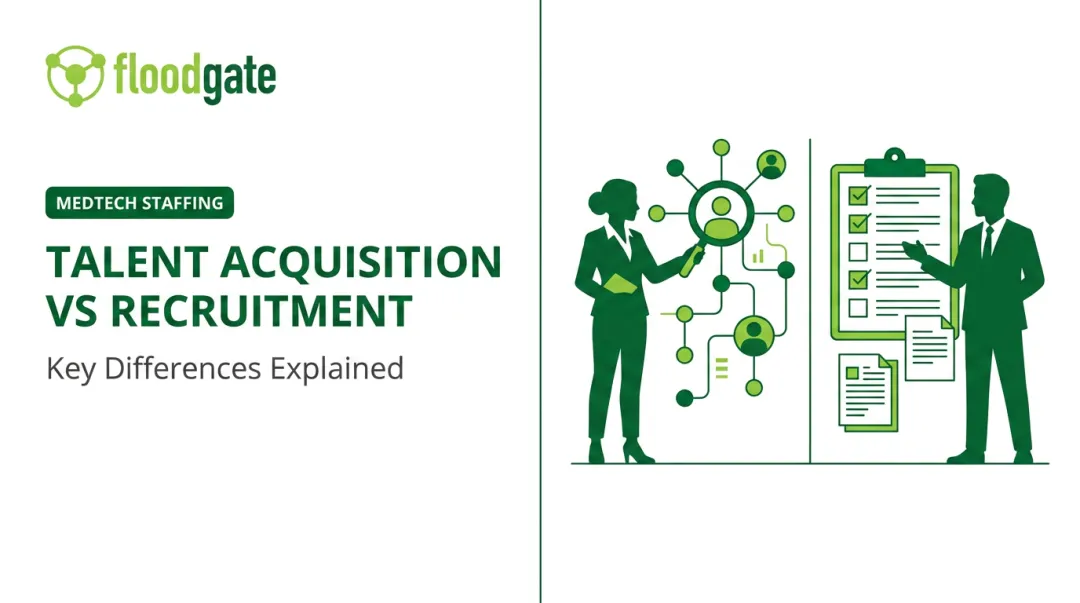
Recruitment is reactive. A role opens, someone needs to fill it, and the clock starts. Talent acquisition is proactive and cyclical, meaning pipelines get built long before a business need becomes urgent.
Here's how the two compare:
| Comparison Point | Recruitment | Talent Acquisition |
|---|---|---|
| Time Horizon | Short-term, tied to a current opening | Long-term, tied to future capability needs |
| Approach | Reactive, starts from a vacancy | Proactive, starts from a business plan |
| Focus Area | Filling the seat quickly | Building pipelines for hard-to-fill, strategic roles |
Many companies use these terms interchangeably in casual conversation. That's fine until you're hiring for a MedTech R&D, regulatory, or clinical affairs position where there simply aren't enough qualified candidates sitting on the sidelines waiting for a job ad.
The 5 Key Elements of Talent Acquisition
Strong talent acquisition rests on five interconnected practices. Skip one, and the whole system weakens.
Workforce Planning & Forecasting Analyze where the business is headed, then map hiring needs against that trajectory. This means anticipating a product launch's staffing requirements six to twelve months out, not scrambling once the launch date is locked.
Employer Branding In niche talent markets, the same specialists get recruited by three competitors at once. A strong employer reputation, built through content, culture visibility, and candidate testimonials, tips the scale before a candidate even applies.
Sourcing & Talent Pipelining This is where TA teams identify and nurture both active job seekers and passive candidates who aren't looking yet, but might be persuaded by the right opportunity.
Candidate Experience & Assessment Structured interviews, consistent communication, and skills-based assessments keep evaluation fair and give candidates a clear sense of what working with the company would actually be like.
Onboarding & Retention The process doesn't end once an offer letter is signed. Setting new hires up for early wins reduces turnover, and turnover is expensive to fix twice.
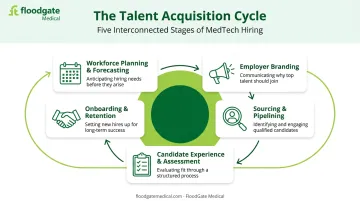
FloodGate Medical's Talent Excellence Education program brings these five elements together, walking hiring managers through workforce planning, employer branding, sourcing, candidate experience, and onboarding as a connected system rather than five separate tasks.
The Talent Acquisition Process: From Sourcing to Onboarding
Talent acquisition follows a repeatable rhythm. Here's how it typically unfolds:
- Align with hiring managers. Hold intake meetings to define role requirements, the ideal candidate profile, and what success looks like in the first 90 days.
- Source candidates. Pull from job boards, employee referrals, passive outreach, and specialized industry networks, especially important for niche technical roles.
- Screen and evaluate. Review resumes, run structured interviews, and administer skills or competency assessments to reduce guesswork.
- Extend an offer and negotiate. Present a compensation package designed to close the candidate, not just meet a budget line.
- Onboard and integrate. Welcome the new hire, set clear expectations, and begin tracking performance from week one.
Here's the part that trips people up: this process is cyclical, not linear. Every hire generates insights — better sourcing channels, sharper interview questions, a clearer read on what "culture fit" means for this team.
Those insights feed directly into the next search. Treating each hire as a one-off event wastes that accumulated knowledge; firms like FloodGate Medical use it to refine searches for future MedTech roles.
What Does a Talent Acquisition Team Do? Roles & a Real-World Example
Day to day, a TA team develops sourcing strategies, manages candidate pipelines, collaborates closely with hiring managers, and tracks metrics through an applicant tracking system (ATS). The exact roles vary by company size:
- TA Manager – owns strategy, budget, and cross-team alignment
- Sourcer – focuses purely on finding and engaging candidates, especially passive ones
- Recruiter – manages the interview-to-offer stages for specific roles
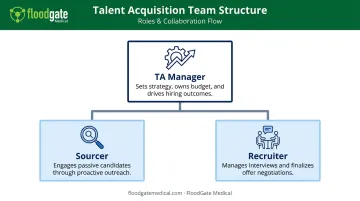
In smaller companies, one person often wears all three hats. FloodGate Medical takes a different approach, organizing its team around MedTech subspecialties rather than functional layers.
Talent Directors like Brittany Erickson, who focuses on urology, GI, and OB-GYN, handle end-to-end recruiting within their niche. This ownership, from client strategy to final placement, lets each person build deep domain knowledge instead of spreading thin across unrelated fields.
A Real-World Example of Talent Acquisition in Action
Picture a mid-size medical device company preparing to launch a new interventional cardiology product in 18 months. A reactive approach waits until the current regulatory affairs lead resigns, then scrambles to post a job and interview whoever applies within a tight deadline.
A talent acquisition approach looks different. The company starts building relationships with regulatory affairs specialists a year ahead of launch, attending industry conferences and engaging passive candidates who aren't actively job hunting.
By the time the role opens, there's already a pipeline of vetted, interested candidates instead of a blank slate.
That warm pipeline, built long before the need arises, is what separates talent acquisition from plain recruitment.
Talent Acquisition Strategies & Best Practices
Modern TA teams have moved past posting a job and waiting. The strategies gaining traction now include:
- Skills-based hiring – evaluating actual competency over degree pedigree
- Internal mobility – filling roles from within before searching externally
- DEI-focused sourcing – widening the candidate pool deliberately rather than defaulting to familiar networks
- Data-driven decision-making – using ATS metrics to spot bottlenecks before they cost a hire
AI is accelerating all of this. SHRM's 2025 Talent Trends survey found that 43% of HR professionals now use AI in HR tasks, up from 26% just a year earlier. Over half use it specifically for recruiting: drafting job descriptions, screening resumes, and managing candidate communications.
None of this works as a one-size-fits-all playbook, though. FloodGate Medical builds its methodology around DEI-driven sourcing specifically for the MedTech sector, arguing that diverse teams produce better innovation outcomes in an industry where the end users—patients—are themselves diverse. The tactic that works for a general staffing firm rarely translates cleanly to a clinical affairs search.
Why Talent Acquisition Matters — Especially in MedTech
Getting this wrong is costly anywhere, but MedTech raises the stakes further. SHRM's 2025 benchmarking data puts average cost-per-hire at $5,475 for nonexecutive roles and $35,879 for executive roles. A bad hire in a regulatory or clinical role doesn't just cost that figure, it can delay a product launch entirely.
MedTech hiring faces three compounding challenges:
- Deep regulatory expertise that takes years to build and can't be shortcut
- Specialized technical skills, particularly in hardware engineering and complex algorithm work
- A limited talent pool split across device, diagnostics, and biotech companies all competing for the same people
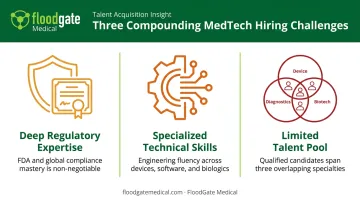
This is precisely the gap FloodGate Medical is built to close. As ASAHI's MedTech-focused talent acquisition division, FloodGate combines a DEI-driven recruitment methodology with deep sector specialization to help companies build innovative, diverse teams.
Candidates benefit too, gaining career coaching and industry insight through resources like FloodGate's monthly newsletter. In an industry where a mis-hire can stall a product the market is waiting for, that specialization matters.
Frequently Asked Questions
What does a talent acquisition professional do?
They identify, attract, and hire talent while building long-term candidate pipelines. Beyond hiring, they manage employer branding and shape the candidate experience across every touchpoint.
What are the 5 elements of talent acquisition?
Workforce planning, employer branding, sourcing and pipelining, candidate experience and assessment, and onboarding and retention. Each element feeds the next, forming a continuous cycle rather than isolated steps.
What is an example of talent acquisition?
A medical device company builds relationships with regulatory affairs specialists months before a product launch, rather than posting a job only after someone resigns.
Is talent acquisition the same as recruiting?
Not quite. Talent acquisition is the broader, strategic umbrella, while recruiting is the tactical, day-to-day process of filling a specific vacancy within it.
How long does the talent acquisition process typically take?
Timelines vary by seniority and role complexity. SHRM's benchmarking puts median time-to-fill at roughly 39 days for nonexecutive roles and 45 days for executive roles, though specialized technical searches often run longer.
What skills are needed for a career in talent acquisition?
Strong communication, data analysis, and relationship-building top the list. Industry-specific knowledge, understanding what a regulatory affairs role actually requires, for instance, separates good TA professionals from great ones.