This matters most for MedTech company leaders, device startups, and healthcare device manufacturers trying to scale production while managing FDA and ISO compliance under speed-to-market pressure. Despite how often the term gets used, contract manufacturing is frequently misunderstood at the operational level. What's actually outsourced versus retained, and how that split affects staffing and compliance, rarely gets explained clearly.
This article breaks down what contract manufacturing is, why companies use it, how the process actually works, where it applies, and when it's not the right fit.
Key Takeaways
- Contract manufacturers handle production, assembly, testing, and packaging, but OEMs always retain regulatory ownership
- The medical device contract manufacturing market will grow from $83.77 billion in 2025 to $140.84 billion by 2030
- Core benefits include capital efficiency, faster launches, and built-in regulatory/quality expertise
- The process moves through design transfer, prototyping/validation, and full-scale manufacturing with ongoing quality oversight
- Early-stage prototyping, ultra-low volumes, or highly proprietary IP often call for in-house control instead
What Is Contract Manufacturing for Medical Devices?
At its simplest, contract manufacturing is an arrangement where a specialized manufacturer handles production, assembly, testing, and/or packaging of a medical device on behalf of the device company that owns it. The device company designs and markets the product. The contract manufacturer builds it.
The goal is straightforward: consistent, compliant, market-ready devices without the OEM having to build and maintain its own regulated manufacturing infrastructure. That infrastructure is expensive, slow to build, and requires specialized quality talent most startups simply don't have yet.
It's easy to confuse contract manufacturing with adjacent models. Here's how they differ:
| Model | What It Includes | Who Owns the Design |
|---|---|---|
| Pure contract manufacturer | Builds the device to the OEM's exact specifications | OEM |
| Full-service CDMO | Design, prototyping, manufacturing scale-up, sometimes post-market support | Shared or CDMO-led |
| Component-only outsourcing | Supplies a single part, not a finished device | OEM |
| OEM/private-label arrangement | Brand owner sells a device it didn't design or manufacture | Original manufacturer |
The market itself spans a wide range of players. Some large, diversified manufacturers handle Class III implantables with multi-site cleanroom operations. Others are boutique shops focused entirely on single-use consumables or a handful of device families.
Whichever type a company works with, two compliance frameworks define the relationship:
- ISO 13485: Governs quality management systems for organizations involved in device design, production, and servicing
- FDA 21 CFR Part 820: Now folded into the Quality Management System Regulation (QMSR), which incorporates ISO 13485 by reference
These aren't optional extras. They define what "contract manufacturing" actually means in a regulated MedTech context.
This outsourcing shift keeps accelerating. MarketsandMarkets projects the global medical device contract manufacturing market will grow from $83.77 billion in 2025 to $140.84 billion by 2030, a 10.9% CAGR. It's now the operating norm for a large share of the industry.
Why Contract Manufacturing Is Used in MedTech
Device companies don't outsource manufacturing because it's trendy. They do it because building regulated production in-house is capital-intensive, slow, and requires expertise that takes years to develop internally.
The core reasons companies adopt contract manufacturing:
- Capital efficiency — avoiding upfront investment in tooling, cleanrooms, automation, and specialized manufacturing teams
- Faster time-to-market — using an established, validated production environment instead of building one from zero
- Regulatory and quality expertise — tapping into a partner that already runs a mature QMS
- Scalability — flexing production volume up or down without carrying fixed overhead
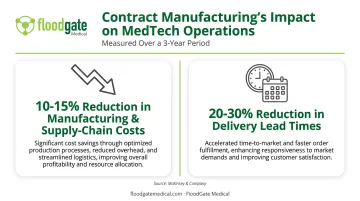
The cost impact is real, even if it's hard to isolate to manufacturing alone. McKinsey found that medtech companies redesigning their manufacturing and distribution networks, often through contract manufacturer relationships, cut manufacturing and supply-chain costs by 10% to 15% within three years. The same companies reduced delivery lead times by 20% to 30%.
MedTech demands a lot from any manufacturing operation: consistent quality systems, compliance across multiple regulatory markets, and the ability to handle everything from Class I disposables to Class III implantables. Few startups can build all of that at once.
Without a contract manufacturing partner, the common failure pattern looks like this:
- Overinvestment in capital equipment before demand is proven
- Compliance gaps that surface during FDA inspection or ISO audit
- Delayed launch timelines as the company learns manufacturing from scratch
Here's the important nuance: contract manufacturing is largely a strategic and operational choice, not a regulatory mandate. Nothing in FDA or ISO rules forces a company to outsource. But rising regulatory complexity makes doing it all in-house increasingly impractical for most device companies, especially at seed to Series B stage.
Outsourcing production doesn't remove the need for strong internal oversight. Someone on the OEM side still has to manage the contract manufacturer relationship, review batch documentation, and own supplier quality decisions.
That's where specialized MedTech recruitment partners like FloodGate Medical come in. They help companies build the internal regulatory, quality, and supply chain teams needed to manage these partnerships, rather than simply signing a contract and hoping for the best.
How the Contract Manufacturing Process Works
The process moves from design specification to a finished, validated device through a series of controlled stages. Each stage represents a structured transfer of responsibility, backed by documentation at every step.
What goes into it:
- Device specifications and engineering drawings
- Material and component requirements, including biocompatibility data where relevant
- Volume forecasts for tooling and staffing decisions
- Regulatory documentation supporting design controls and traceability
With those inputs finalized, the core transformation begins, and it depends heavily on device type. It might involve assembly, injection molding, machining, packaging, or sterilization, sometimes all of them for a single product. Every step happens under quality management system oversight (ISO 13485), with inspection and testing protocols and batch documentation tracking each unit produced.
The result: raw materials and components become validated, market-ready finished devices, supported by documentation ready for regulatory submission.
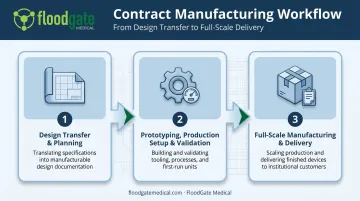
Step 1: Design Transfer and Planning
The OEM shares complete specifications with the manufacturer, who conducts a design-for-manufacturability (DFM) review. This step establishes cost, timeline, and risk parameters before anyone commits to tooling or production equipment. Skipping this step is one of the most common sources of downstream delay.
Step 2: Prototyping, Production Setup, and Validation
The manufacturer develops tooling, launches pilot runs, and conducts verification and validation testing. This confirms the device meets design inputs (verification) and actually serves its intended use (validation) before scale-up starts.
Step 3: Full-Scale Manufacturing and Delivery
Production ramps to volume with in-process quality control at every stage. Packaging and sterilization happen according to validated protocols, followed by shipment. Most manufacturers also provide ongoing post-market production support as demand shifts or design changes occur.
Where It's Applied and Key Factors That Affect It
Where Contract Manufacturing Is Applied
Contract manufacturing shows up across nearly every device category, though the intensity varies:
- Diagnostics — IVD consumables and equipment
- Wearables — health monitoring and connected devices
- Surgical instruments — high-volume disposables and robotic-adjacent tools
- Implantables — orthopedic and cardiovascular platforms
- Drug delivery devices — autoinjectors, pen injectors, infusion sets
Companies typically turn to contract manufacturing at specific lifecycle points: launching a new product, scaling capacity beyond what internal lines can handle, or entering a new regulatory market that requires local production expertise. Common triggers include capacity constraints, cost pressure, or needing a technical capability, such as laser machining or cleanroom molding, that the OEM doesn't have in-house. A company moving from prototype to full-scale production, for instance, often outsources catheter shaft extrusion or electronics assembly to a partner with established cleanroom capacity rather than building that infrastructure from scratch.
Key Factors That Affect the Process
A handful of variables shape how the manufacturing relationship actually runs:
- Materials and components: biocompatible materials and electronics introduce added validation requirements
- Cleanroom conditions: Class II and III devices often require controlled environments, though the specific classification depends on contamination sensitivity, not device class alone
- Equipment dependencies: injection molding, laser machining, and automation availability shape what a manufacturer can realistically produce
- Volume and throughput: low volumes reduce cost efficiency; high volumes demand tighter scheduling
- Regulatory constraints: device classification and target market both influence documentation and testing burden
Common Misconceptions and When It May Not Be the Right Fit
Common Issues and Misconceptions
The biggest misunderstanding in this space: outsourcing manufacturing does not outsource regulatory responsibility. The OEM remains legally accountable for compliance no matter who physically builds the device.
The FDA treats the specification developer, meaning the brand owner, as a manufacturer even if it never touches a production line. That party still has to register and list its devices accordingly.
Other recurring confusion points include the contract manufacturer vs. OEM/brand owner distinction and the "cheaper labor" oversimplification.
In private-label arrangements, the party whose name appears on the box isn't automatically the one with manufacturing obligations — actual design and production activity determines the FDA role, not the label. Similarly, treating contract manufacturing as just a cost play misses the point: it's a compliance and technical expertise partnership first.
When Contract Manufacturing May Not Be Appropriate
In-house control still makes sense in certain situations:
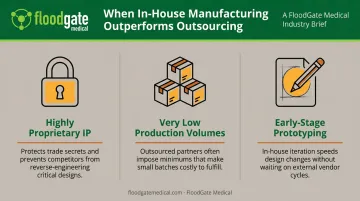
- Highly proprietary IP where protecting trade secrets outweighs outsourcing efficiency
- Very low production volumes where setup costs never get amortized
- Early-stage prototyping where design changes are still frequent and fast iteration matters more than scale
Watch for signals that a company is defaulting to contract manufacturing without real evaluation, like skipping due diligence on whether a manufacturer has actual experience with that specific device type.
Reduced direct control over quality and timeline, plus IP exposure, are real tradeoffs. They don't disqualify contract manufacturing, but they deserve honest evaluation before signing anything.
Conclusion
Contract manufacturing is a strategic outsourcing model spanning everything from design transfer through final delivery for medical devices. It gives device companies a path to consistent, compliant production without building regulated infrastructure from the ground up.
That outcome depends on two things: choosing the right manufacturing partner and building the internal team capable of managing that relationship well. FloodGate Medical works with MedTech companies on exactly that second piece, helping them build the regulatory, quality, and operations talent needed to oversee manufacturing partnerships and scale with confidence.
Frequently Asked Questions
What is a medical device contract manufacturer?
A medical device contract manufacturer is a third-party company that produces, assembles, tests, or packages devices on behalf of an original equipment manufacturer (OEM). It operates under a regulated quality system, typically ISO 13485 and FDA 21 CFR Part 820.
What's the difference between a contract manufacturer and a CDMO?
A CDMO offers integrated design and development services alongside manufacturing. A pure contract manufacturer focuses solely on production execution, working from specifications the OEM already finalized.
How much does medical device contract manufacturing typically cost?
Cost depends on device complexity, materials, regulatory requirements, and production volume. Align on cost and timeline expectations with the manufacturer early, ideally during the design transfer stage.
Is contract manufacturing regulated by the FDA?
Yes. Contract manufacturers producing devices for the U.S. market must comply with FDA 21 CFR Part 820, now the QMSR, and typically hold ISO 13485 certification as well.
Can a startup use contract manufacturing before FDA clearance?
Yes. Startups commonly use contract manufacturers for prototyping and pilot production ahead of clearance, provided proper design controls and documentation are already in place.
How long does it take to launch production with a contract manufacturer?
Timelines vary widely, from several months to over a year, depending on device class, validation requirements, and how manufacturing-ready the design already is.