Startups that succeed in 2026 are those that build proactive talent pipelines, leverage AI-driven sourcing tools, embed DEI practices into every hiring decision, and deliver candidate experiences that win over top performers. This guide covers the strategies, tools, and partnerships that separate winning startups from those left scrambling to fill critical roles.
Key Takeaways
- Build your talent pipeline proactively; reactive job postings fall short in competitive MedTech markets
- AI automates sourcing, screening, and scheduling so founders can focus on relationship-building
- DEI-driven hiring correlates with stronger innovation and retention, especially in specialized fields
- Niche recruiters accelerate time-to-hire for hard-to-fill technical and regulated roles
- Candidate experience (speed, transparency, and structured feedback) directly impacts offer acceptance
Building a Scalable Talent Pipeline Before You Need It
Reactive hiring is expensive and slow. When you post a job after someone quits or a project deadline looms, you're already behind. Proactive pipeline-building—maintaining relationships with qualified candidates before you have an open role—reduces time-to-hire and gives you first access to top talent.
Why Founder and Employee Networks Are Your Highest-ROI Channel
Your personal network and your employees' connections represent the most effective sourcing channel available. Research shows that referred workers have 45% lower attrition than comparable non-referred hires, and referral programs can reduce total labor costs by nearly 3%.
At organizations with strong referral cultures, 1 in 10 referrals converts to a hire, and those hires tend to stay longer than candidates sourced through other channels.
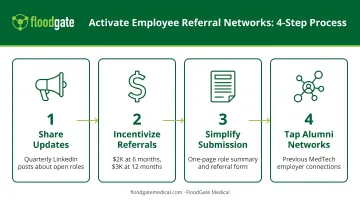
How to activate your network:
- Share quarterly updates on roles you're filling with your LinkedIn network and ask connections to introduce qualified people
- Offer referral bonuses tied to retention milestones (e.g., $2,000 at 6 months, $3,000 at 12 months)
- Make it easy: create a simple referral form and one-page role summary employees can share
- Tap alumni networks from previous employers, especially in MedTech where specialized experience matters
Maintain a "Silver Medalist" Database for Future Roles
Strong candidates who didn't get the job—often called silver medalists—represent an untapped pipeline. They've already been screened, interviewed, and expressed interest in your company. Track them in a simple CRM or spreadsheet:
- Name, contact info, role applied for, interview date
- Key strengths and why they were a finalist
- Skills gaps or reasons they weren't selected
- Notes on roles they'd be a better fit for
Reach out every 6 months with company updates, new openings, or just to check in. When a relevant role opens, you'll have pre-vetted candidates ready to move fast.
Source Talent at Niche Industry Events and Communities
MedTech conferences, professional meetups, and industry-specific communities (online and offline) surface specialized talent you won't find on LinkedIn. Attend events where regulatory affairs professionals, quality engineers, clinical specialists, and R&D leaders gather. Bring business cards, talk about your mission, and collect contact information. Follow up within 48 hours.
High-value MedTech talent sources:
- AdvaMed regional events and working groups
- FDA public workshops and regulatory conferences
- University biomedical engineering and medical device programs
- LinkedIn groups focused on interventional cardiology, diagnostics, or device development
Working with Specialized Recruiters
For startups hiring in regulated MedTech roles (quality assurance, regulatory affairs, clinical research, specialized engineering), speed and compliance matter. Niche recruitment firms bring pre-vetted candidate networks and industry-specific processes most internal teams do not have in-house.
When Partnering with a Recruiter Makes Sense
Consider working with a specialized recruiter when:
- You're hiring for a role requiring FDA regulatory knowledge, ISO 13485 experience, or clinical trial management
- Your internal team lacks MedTech recruiting experience or bandwidth
- Time-to-hire is critical (product launch, investor milestone, resignation of a key role)
- You've posted the role for 60+ days without qualified applicants
- You need to build an entire function (e.g., stand up a quality team from scratch)
The average cost per hire in 2025 was $5,475 for non-executives and $35,879 for executives. A specialized recruiter typically charges 20-25% of first-year salary but can surface vetted candidates in weeks and lower mis-hire risk.
FloodGate Medical: A MedTech-Focused Recruitment Partner
FloodGate Medical is a MedTech-only recruitment firm built for this kind of hiring. With 25+ years of industry focus, it places more than 450 MedTech professionals a year and reports an 89% one-year retention rate.
Services cover the full early-stage need set:
- Permanent placement
- Contract, interim, and fractional staffing
- Executive and critical-hire search
- Organizational design and workforce planning
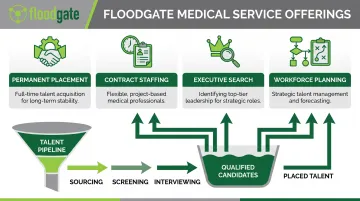
The firm pairs recruiter expertise with a proprietary Talent Portal across 150,000+ MedTech candidates—about 70% passive. Vetting uses behavioral assessments and role-specific scorecards to judge technical fit and cultural alignment, not résumé keywords alone. DEI practices are built into every search, so startups can hire for regulated roles without defaulting to the same narrow networks.
Leveraging AI and Modern Recruiting Technology in 2026
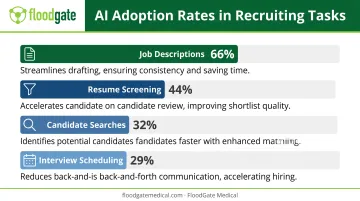
AI-powered recruiting tools now handle the repetitive, time-consuming tasks that used to eat up founder and HR time. In 2025, 51% of organizations used AI to support recruiting, and among those users, 89% reported time savings or increased efficiency.
How AI Accelerates Startup Hiring
AI applications in recruiting:
| Task | Adoption Rate | Impact |
|---|---|---|
| Job descriptions | 66% of AI users apply it here | Faster posting creation, inclusive language |
| Resume screening | 44% use AI for this | Scan hundreds of resumes in minutes, rank by fit |
| Candidate searches | 32% automate searches | Surface passive candidates on LinkedIn, GitHub, niche boards |
| Interview scheduling | 29% use AI for communication | Auto-schedule interviews, send reminders, reduce no-shows |
AI-driven skills assessments are replacing resume-only screening as credential inflation rises. 56% of employers now use pre-employment assessments, and 79% consider assessment scores at least as important as traditional credentials.
High assessment scores can advance candidates who lack minimum experience (36% very likely) or education (28% very likely). For startups that cannot win every pedigree battle against larger employers, that shift opens a real hiring path.
Bias Risks and the Need for Human Oversight
AI tools can perpetuate bias if trained on non-diverse datasets or designed without fairness controls. In 2023, the EEOC secured a $365,000 settlement from iTutorGroup after its software automatically rejected women aged 55+ and men aged 60+.
Similar patterns show up beyond U.S. enforcement cases. A 2024 study found that job-recommendation algorithms on major Chinese job boards steered women toward lower-paying, smaller-firm roles based on gender-tagged profiles.
Best practices to reduce AI bias:
- Use tools that undergo regular third-party bias audits
- Pair automated screening with human review at every stage
- Anonymize resumes during initial screening (remove names, schools, demographics)
- Monitor pass-through rates by demographic group and adjust if disparities appear
Making DEI a Core Recruitment Strategy, Not an Afterthought
DEI-driven hiring links directly to measurable business results. Companies in the top quartile for gender and ethnic diversity on executive teams were 39% more likely to outperform bottom-quartile peers financially.
For MedTech startups building products that serve diverse patient populations, diverse teams surface unmet needs and shape more inclusive solutions.
Practical Steps to Embed DEI in Hiring
Remove biased language from job descriptions:
- Use tools like Textio or Gender Decoder to flag gendered or exclusionary wording
- Replace "ninja," "rock star," "aggressive" with neutral terms like "skilled," "experienced," "results-driven"
- List required vs. preferred qualifications separately. Industry research often finds women apply when they meet roughly 100% of listed requirements, while men apply closer to 60%
Use anonymized résumé screening:
- Strip names, addresses, schools, and graduation dates before initial review
- Focus evaluation on skills, achievements, and relevant experience
- Advance candidates to phone screens based on demonstrated capability, not credentials alone
Partner with diverse professional networks:
- Source candidates through organizations like National Society of Black Engineers, Society of Women Engineers, Out in Science, Technology, Engineering, and Mathematics (oSTEM)
- Sponsor diversity-focused conferences and offer free recruiter office hours at events
- Build relationships with historically Black colleges and universities (HBCUs) and Hispanic-serving institutions (HSIs) with biomedical engineering programs

Transparent DEI Commitments Differentiate Startups
While some companies have scaled back DEI efforts amid economic pressure (S&P 500 annual filings averaged just 4 DEI mentions in 2024, down from 12.5 in 2022), startups that keep visible, authentic commitments stand out. Candidates, especially younger professionals, increasingly favor employers whose values match their own.
FloodGate Medical's DEI-first methodology shows how niche recruiters help startups put these commitments into practice. By sourcing from a database of 150,000+ MedTech candidates and engaging passive talent with diverse backgrounds, the firm helps healthcare and device companies build teams that reflect the patients they serve.
Crafting a Candidate Experience That Wins Top Talent
In competitive talent markets, candidate experience decides whether top performers accept your offer or ghost you.
Research covering 240,000 candidates found that 61% completed applications in under 15 minutes, but 36% of U.S. candidates heard nothing one to two months after applying. At the highest-rated employers, candidates were typically advanced or rejected within 3-5 days.
Speed and Transparency Win Offers
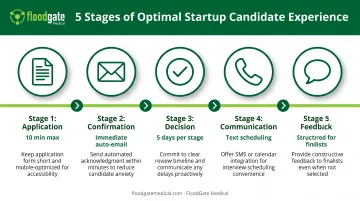
Best practices for startup candidate experience:
- Keep applications to 10 minutes or less: request resume, LinkedIn, and 2-3 screening questions max
- Send an automated confirmation email immediately upon application with clear next steps and timeline
- Commit to a decision (advance or reject) within 5 business days of each interview stage
- Use text messaging for scheduling and reminders—61% of top-rated employers use text recruiting
- Provide structured feedback to finalists, even those you don't hire
Rejection communication matters. Candidates who get a timely, respectful no are more likely to reapply, refer others, and stay customers. A cold silence does the opposite: it damages employer brand and shrinks your referral pipeline.
A simple note is enough:
We've decided to move forward with another candidate whose [specific skill] more closely matches our immediate need. We were impressed by your [specific strength] and would love to stay in touch for future roles.
Structured Interview Processes Improve Outcomes and Perception
Standardized interview questions and scoring rubrics keep the process fair and help candidates feel it is objective. Build a simple system:
- Create a scorecard with 4-6 key competencies such as technical skill, adaptability, collaboration, and communication
- Rate each competency on a 1-5 scale and note behavioral evidence
- Require every interviewer to submit scores before discussing candidates, which reduces groupthink and anchoring bias
FloodGate Medical's Talent Excellence Education program offers startups a model: 14 video tutorials covering search planning, interviewing, candidate validation, and onboarding, plus hiring SOPs, interview scorecards, and candidate submission checklists. These structured processes help early-stage companies deliver professional, repeatable candidate experiences even without a dedicated HR team.
Competing on Compensation and Flexibility Without Big Budgets
Startups can't always match the $150,000 base salaries large MedTech companies offer, but they can compete through a smarter mix of pay and flexibility.
Carta's H2 2025 data shows median equity grants to individual contributors rose 11% over two years while median salary rose just 6.4%. For AI/ML engineers, grants jumped 31% and salaries 9.1% from January 2024 to February 2026.
Blend Fair Base Pay with Equity and Perks
Four levers that punch above a lean budget:
- Benchmark first: Use FloodGate Medical's MedTech compensation guides or tools like Pave, Carta Total Comp, or Radford to set salary ranges by role and geography
- Offer meaningful equity: Explain vesting and upside with real scenarios ("if we exit at $100M, your 0.5% stake is worth $500,000")
- Provide flexible work: Offer remote or hybrid options; 83% of in-person employers struggled to recruit vs. 43% of fully remote employers
- Add high-value perks: Unlimited PTO, remote stipends ($100–$300/month), learning budgets, and wellness benefits cost less than raises and still lift satisfaction
Communicate Total Compensation Transparently
Candidates evaluate offers holistically. Present a total compensation breakdown in your offer letter:
| Component | Value |
|---|---|
| Base salary | $95,000 |
| Equity (0.5%, 4-year vest) | Est. $200,000-$500,000 |
| Health insurance (employer-paid) | $12,000/year value |
| Remote work stipend | $3,600/year |
| Unlimited PTO | Market value ~$5,000 |
| Total estimated value | $315,600-$615,600 |
That breakdown helps candidates compare offers fairly, especially against larger companies that pay a higher base but offer less equity or flexibility.
Frequently Asked Questions
What are the five recruitment strategies or methods?
The five core methods are employee referrals (highest ROI, 45% lower attrition), employer branding, AI-powered sourcing (89% report time savings), niche recruiter partnerships, and a structured candidate experience with fast, transparent feedback.
What do startups look for in employees?
Startups prioritize adaptability, accountability, and cultural fit alongside technical skill. Candidates who can wear multiple hats, own outcomes, and align with the mission usually beat pure credentials.
How can a startup develop an effective hiring process?
Start with referrals, clear job requirements, and interview scorecards. Use AI for sourcing and scheduling, bring in specialized recruiters for hard-to-fill roles, and run a repeatable path: application → phone screen → structured interviews → references → offer.
Do startups use recruiters?
Yes. Many partner with niche recruiters for specialized or regulated MedTech roles such as regulatory affairs, quality, clinical, and technical positions. Recruiters open access to vetted passive candidates and cut time-to-hire when internal teams lack bandwidth.
What qualities should a startup look for when hiring?
Score for learning agility, problem-solving, and resilience more than pedigree. Favor ownership, collaboration, and real excitement about your mission. Skills can be taught; values alignment cannot.