
Many care teams struggle with unwarranted variation, where two patients with the same condition receive noticeably different treatment depending on which provider they see. A rigorous review of specialised mental health care found that guideline-based approaches produced measurable improvements in patient outcomes compared with usual care, alongside better provider adherence to recommended protocols (PMC, 2021).
This article breaks down what CPGs actually are, the four pillars behind sound clinical decisions, the types of guidelines and practice settings you'll encounter, how guidelines get built, and what it takes to put them into practice.
Key Takeaways
- CPGs translate systematic evidence review into actionable, gradable recommendations, not rigid mandates.
- Trustworthy guidelines require transparency, conflict-of-interest disclosures, and a defined update schedule.
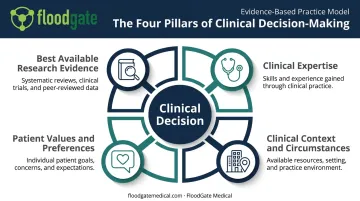
- Four pillars—research evidence, clinical expertise, patient preferences, and clinical context—guide how guidelines are applied.
- Implementation succeeds only when education, workflow tools, and the right talent all work together.
What Are Clinical Practice Guidelines?
The National Academy of Medicine (formerly the Institute of Medicine) defines CPGs as statements that include recommendations. These recommendations are "intended to optimize patient care that are informed by a systematic review of evidence and an assessment of the benefits and harms of alternative care options" (National Academies Press, 2011).
That's the formal definition. In plain terms: CPGs are the codified, evidence-backed rulebook that sits behind day-to-day clinical practice.
Clinical Practice vs. Clinical Practice Guidelines
These terms get used interchangeably, but they're not the same thing.
Clinical practice is the direct, hands-on work of caring for patients, meaning assessment, diagnosis, treatment, and follow-up. Clinical practice guidelines, on the other hand, are the written, evidence-based recommendations that inform how that work should be done.
Think of clinical practice as the action and CPGs as the playbook. A good clinician still calls the plays based on the situation.
Who Writes the Playbook
CPGs typically come from one of three sources:
- Medical specialty societies such as the American Academy of Family Physicians (AAFP) or American College of Physicians (ACP)
- Government task forces, most notably the U.S. Preventive Services Task Force (USPSTF), an independent panel that issues preventive care recommendations
- Joint collaborations, where multiple organizations pool expertise on a single guideline
Why They Matter
CPGs serve as a decision-support framework, not a substitute for clinical judgment. They also form the backbone of performance measures and quality improvement programs, giving healthcare organizations a consistent yardstick for evaluating care.
The National Academy of Medicine's trustworthiness standards require guidelines to demonstrate transparency, disclosed conflicts of interest, multidisciplinary development, systematic evidence review, and a defined plan for future updates (National Academies Press, 2011). Guidelines missing these elements are far less reliable, no matter how polished they look.
The Four Pillars of Clinical Practice
Evidence-based medicine didn't start as guideline writing. It started as a framework for individual decision-making, one built on four interlocking components. Sackett, Haynes, Devereaux, and Guyatt refined this into a model where clinical expertise integrates the other three inputs (Haynes, Devereaux & Guyatt, 2002).
Pillar 1: Best Available Research Evidence
Systematic review is the backbone of any credible guideline. Researchers assess study quality, weigh conflicting findings, and rate how confident clinicians should be in a given recommendation. Without this rigor, a "guideline" is really just opinion dressed up in medical language.
Pillar 2: Clinical Expertise
Training and hands-on experience let clinicians spot when a textbook scenario doesn't match the patient sitting in front of them. For example, a clinician may recognize that a patient's declining kidney function makes a standard-dose guideline unsafe, prompting a necessary dosage adjustment.
Pillar 3: Patient Values and Preferences
Shared decision-making means the patient's goals, fears, and circumstances shape the final call. A guideline might recommend a screening test, but a patient's personal risk tolerance or life stage can change whether that test makes sense right now.
Pillar 4: Clinical Context and Circumstances
Available resources, care setting, and practical constraints all affect how a guideline gets applied. A recommendation built around a well-staffed academic medical center may need real adjustment in a rural clinic with limited specialist access.
None of these pillars work alone: a guideline that ignores clinical judgment becomes a checklist, and a clinician who ignores the evidence risks repeating outdated habits.
Types of Clinical Practice and Practice Guidelines
Not every guideline serves the same purpose, and not every practice setting can apply one the same way.
Guideline Categories
| Type | What It Covers |
|---|---|
| Disease-specific | Diagnosis and management of a defined condition |
| Preventive service | Screening and counseling for asymptomatic patients |
| Jointly developed | Built through collaboration between organizations |
| Endorsed | Reviewed and formally adopted by another body |
| Affirmation of value | Useful but doesn't meet every endorsement criterion |
| Not endorsed | Reviewed and rejected after evaluation |
Practice Settings Guidelines Must Fit
- Solo practice: independent, no partnership affiliations
- Group practice: two or more physicians, single or multispecialty
- Employed physician model: clinician works for a hospital, health system, or medical group
- Direct primary care: membership-based, typically bypasses insurance billing
- Concierge medicine: retainer-based, smaller patient panels, often still bills insurance for covered services
A guideline written with a large hospital system in mind might need real adaptation for a two-physician direct primary care clinic with a fraction of the staff and technology. Patient population, resources, and practice model all shift how, or whether, a recommendation gets adopted.
How Clinical Practice Guidelines Are Developed: Standards & Methodology
Building a trustworthy guideline is closer to running a clinical trial than writing a policy memo. It follows a defined, auditable process.
Grading the Evidence
The GRADE framework (Grading of Recommendations, Assessment, Development and Evaluation) rates evidence certainty as high, moderate, low, or very low. USPSTF applies its own related scale:
| Grade | Meaning |
|---|---|
| A | High certainty of substantial net benefit |
| B | High certainty of moderate benefit |
| C | Selectively offer based on patient preference |
| D | Recommend against; harms outweigh benefits |
| I | Insufficient evidence to assess |
Source: USPSTF Grade Definitions
AAFP uses a comparable Level A through D scale for its own guideline manual, running from "further research unlikely to change confidence" down to "estimate is highly uncertain."
Strength of Recommendation
Guidelines don't just rate evidence; they also rate how strongly clinicians should act on it:
- Strong recommendation: clear net benefit, most informed patients would choose this path
- Weak or conditional recommendation: benefit exists, but preferences or uncertainty warrant individualized discussion
- Good practice point: used sparingly when direct evidence is thin but the benefit is essentially self-evident
The Guideline Lifecycle
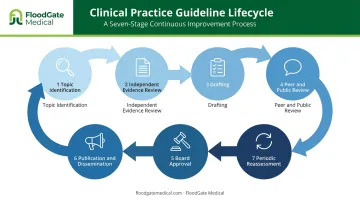
- Topic identification: scope and clinical questions get defined
- Independent evidence review: a multidisciplinary panel evaluates the literature
- Drafting: recommendations get written and graded
- Peer and public review: stakeholders comment before finalization
- Board approval: the sponsoring organization signs off
- Publication and dissemination
- Periodic reassessment: AAFP schedules formal review roughly every five years, sooner if urgent new evidence emerges
Every stage above depends on one safeguard: independence. Collaboration between professional organizations, along with strict conflict-of-interest controls, keeps this process free of financial or intellectual bias. A guideline funded or written entirely by one interested party doesn't meet the trustworthiness bar.
Best Practices for Implementing Clinical Practice Guidelines
A guideline sitting in a PDF changes nothing. Implementation is where the real work happens, and it takes more than a memo to staff.
Education Has to Be Ongoing
New guidelines and periodic updates require active clinician training, not a one-time email blast. Research on continuing education suggests it can shift practice behavior, though the effect tends to be modest on its own. Education alone rarely closes the gap between publication and adoption.
Workflow Integration Makes Guidelines Stick
Embedding guideline-based protocols directly into EHR systems and practice management workflows helps close that gap. A 2020 study published in The BMJ analyzed computerized clinical decision support systems across more than a million patients and found they increased the share of patients receiving guideline-recommended care by 5.8 percentage points.
That's a meaningful process improvement. The researchers noted patient-outcome gains were smaller and more variable, a reminder that workflow tools support adherence but don't guarantee results alone.
The Talent Behind the Rollout
Here's the piece that gets overlooked: guideline adoption is only as strong as the people implementing it. MedTech companies and healthcare organizations need staff who understand:
- Evidence grading and how recommendation strength should shape practice
- Regulatory nuance tied to guideline adoption and device use
- How to translate a Level A recommendation into an actual clinical workflow
That's the gap FloodGate Medical works to close. As a recruitment partner focused exclusively on the MedTech industry, FloodGate Medical helps companies build out the clinical, regulatory, and quality-focused talent needed to move guidelines from paper into practice.
Whether that means a permanent hire or contract support during a rollout, pairing solid clinical evidence with the right people on the ground is what actually moves adherence numbers.

Frequently Asked Questions
What does clinical practice mean?
Clinical practice refers to the direct, hands-on activities clinicians perform with and for patients, including assessment, diagnosis, and treatment. Clinical judgment and evidence-based standards guide it.
What are the different types of clinical practice?
Common models include solo practice, group practice (single or multispecialty), employed physician arrangements, and alternative models like direct primary care and concierge medicine. Each affects how care is delivered and billed.
What are the four pillars of clinical practice?
The four pillars are research evidence, clinical expertise, patient values and preferences, and clinical context and circumstances. Sound decisions balance all four rather than relying on any single input.
Is clinical medicine the same as being a doctor?
Not exactly. Clinical medicine involves direct patient diagnosis and treatment, and physicians perform much of this work. Nurse practitioners, physician assistants, and clinical social workers also engage in clinical practice within their scope.
Who develops clinical practice guidelines?
Guidelines typically come from medical specialty societies, government task forces like USPSTF, or joint collaborations between multiple organizations. Each follows a structured, evidence-based development process.
How often are clinical practice guidelines updated?
Update timelines vary by organization and urgency. Many groups, including AAFP, target formal reassessment roughly every five years, but guidelines get revised sooner if significant new evidence emerges.