Introduction
When a MedTech company needs specialized talent, such as a VP of Regulatory Affairs who understands 510(k) submissions or a field clinical engineer with hands-on device experience, hiring teams often issue a formal Request for Proposal (RFP).
A poorly structured RFP invites generic proposals, mismatched vendors, and months of wasted effort. Generic templates also miss what makes MedTech hiring different: regulatory knowledge, niche technical skills, and a measurable commitment to diversity, equity, and inclusion (DEI).
This guide covers what an RFP is, how to structure one for recruitment services, common mistakes that derail the process, and what to look for when evaluating proposals from specialized partners like FloodGate Medical.
Key Takeaways
- An RFP formalizes vendor comparison, reducing selection bias and clarifying expectations before you commit
- Build each RFP around hiring goals, clear scope, realistic budget, timeline, and weighted evaluation criteria
- Prioritize vendors with MedTech specialization and documented DEI methodologies, not just polished presentations
- Avoid vague requirements, stakeholder misalignment, and missing budgets: these gaps produce irrelevant proposals
What Is an RFP for Recruitment Services and Why It Matters
A Request for Proposal (RFP) is a formal document that invites recruitment vendors to explain their approach, capabilities, and pricing so you can compare options objectively. According to the National Institute of Governmental Purchasing (NIGP), an RFP supplies a general scope and asks vendors how they will meet the need, why they should be selected, and what it will cost.
Proposals are scored against criteria stated in the solicitation. Price is typically not the primary factor.
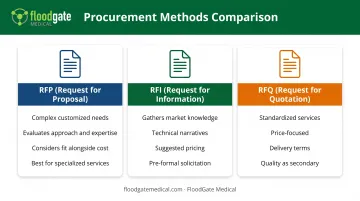
RFP vs. RFI vs. RFQ:
- RFP (Request for Proposal): Best for complex, customized needs where you evaluate approach, expertise, and fit alongside cost
- RFI (Request for Information): Gathers technical narratives and suggested pricing before a formal solicitation; useful when you need market knowledge
- RFQ (Request for Quotation): Focuses on price and delivery for standardized services, with quality and past performance as secondary checks
In MedTech recruitment, an RFP is especially valuable because roles demand specialized knowledge (FDA regulatory expertise, biocompatibility testing, quality-system audits) that generalist staffing firms rarely possess. A well-crafted RFP surfaces which vendors understand your industry and which are copying answers from a template library.
That evaluation work has a real cost on both sides, even when the document itself is free to issue.
Does an RFP Cost Money?
Issuing an RFP is free for the buyer, though it requires internal time for drafting, stakeholder alignment, and evaluation. Vendors typically invest unpaid effort responding without guaranteed payment. NIGP's 2025 white paper reports supplier proposal costs of $6,000–$30,000 per RFP.
How to Structure an RFP for Recruitment Services
A clear structure helps vendors respond consistently and gives you apples-to-apples comparisons. Include these core sections:
Company Background and Hiring Objectives
Describe your organization, stage of growth, and the roles you need to fill. Be specific:
- Role titles and volume: "3 Senior Clinical Affairs Managers and 1 Director of Regulatory Affairs by Q3"
- Context: "Launching our first 510(k) submission for a Class II neurovascular catheter"
- Timeline: "First hire onboarded by June 1; full team in place by September 30"
This detail allows vendors to tailor sourcing strategies and pricing rather than guessing your priorities.
Scope of Services Required
Define which recruitment activities you need:
- Sourcing and screening: Initial candidate identification and qualification
- Full-cycle recruiting: Job posting, interview coordination, offer negotiation, onboarding support
- Executive search: Retained or contingency-based C-suite and VP-level placements
- Contract/interim staffing: Project-based or fractional leadership roles
- Recruitment Process Outsourcing (RPO): Embedded team managing your entire talent pipeline
Call out exactly which models you want vendors to price. Firms focused on MedTech, including FloodGate Medical, often provide permanent placement, contract and fractional staffing, executive search, workforce planning, and talent optimization. Naming the mix you need prevents inflated, hard-to-compare bids.
Diversity and Inclusion Expectations
DEI is increasingly a differentiator in vendor selection. Request specific, measurable commitments:
- Diverse candidate slates: "Provide at least two qualified candidates from underrepresented groups for every final-round slate"
- Outreach strategy: "Describe partnerships with professional organizations, HBCUs, and diversity-focused job boards"
- Reporting: "Monthly demographic data on candidate pipelines (voluntary self-identification)"
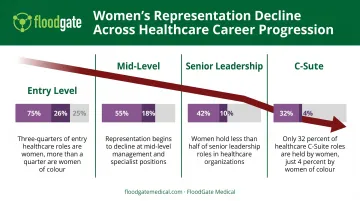
McKinsey's 2023 healthcare analysis found that while women represent 75% of entry-level healthcare roles, they hold only 32% of C-suite positions. Women of color decline from 26% at entry level to just 4% at the C-suite.
A recruitment partner committed to DEI will outline concrete steps to reverse these trends rather than generic statements of support.
Vendor Qualifications and Industry Expertise
Ask for proof of MedTech specialization:
- Recruiter credentials: Certifications, years in medical devices or life sciences
- Past engagements: "Provide two references from MedTech companies with $50M–$200M revenue"
- Role examples: "Describe recent placements for regulatory affairs, clinical operations, or quality assurance roles"
- Sector knowledge: Understanding of FDA pathways, ISO 13485, EU MDR, or other compliance frameworks
Budget and Pricing Structure
Always specify a realistic budget range. Staffing Industry Analysts (SIA) recommends supplying enough program information for accurate pricing. Without a budget, vendors guess, and you'll receive proposals ranging from $15,000 to $75,000 for the same search—making comparisons impossible.
Include:
- Fee structure: Contingency percentage, retained fee, or flat rate
- Payment terms: Upfront retainer, milestones, or success-based
- Replacement guarantees: "90-day free replacement if candidate leaves or is terminated"
Timeline and Evaluation Criteria
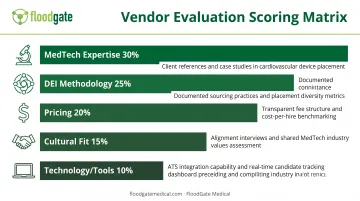
Set clear submission deadlines, decision dates, and a scoring matrix:
| Criterion | Weight | Evaluation Method |
|---|---|---|
| MedTech expertise | 30% | References, case studies, recruiter bios |
| DEI methodology | 25% | Documented processes, reporting capabilities |
| Pricing | 20% | Total cost per hire, payment terms |
| Cultural fit | 15% | Onboarding process, communication style |
| Technology/tools | 10% | Applicant tracking, candidate portal, reporting |
This transparency helps vendors prioritize their responses and reduces subjective decision-making on your end.
Common RFP Mistakes to Avoid
Poorly designed RFPs waste time on both sides. Avoid these pitfalls:
Being too vague about goals and priorities
When you write "seeking a recruitment partner for ongoing hiring needs," vendors can't tailor their approach. SIA warns that vague questions invite reusable, irrelevant answers from vendor template libraries. Instead, state: "We need 12 device engineers and 3 quality managers for our product-launch pipeline over the next nine months."
Asking too many questions
Quality beats quantity. A 40-question RFP with overlapping requests for "company overview," "organizational structure," and "team background" dilutes focus. Ask essential questions tied to your scoring criteria, and make vendors quantify added value rather than recite generic capabilities.
Failing to include a budget
Omitting a budget produces mismatched proposals. One vendor quotes $25,000 assuming retained search; another quotes $8,000 assuming high-volume contingency. You can't compare. SIA recommends defining desired outcomes and supplying enough operating detail for accurate pricing, not leaving vendors to guess.
Skipping internal stakeholder alignment
SIA flags skipping a thorough gap analysis and failing to define the desired future state as a common RFP mistake. Before you release the RFP, align hiring managers, HR, procurement, finance, and legal on priorities, budget, and must-haves versus nice-to-haves.
Basing selection purely on the most polished pitch
A slick slide deck doesn't guarantee execution. Use your weighted scoring matrix and check references. Ask: "Can you describe a similar MedTech placement that didn't go as planned, and how you recovered?"
The 7 Stages of the Recruitment Process
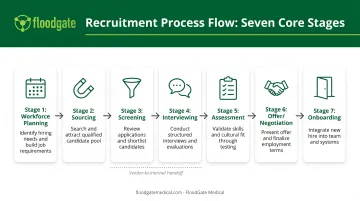
Understanding recruitment stages helps you write a more precise scope of work. The SHRM Foundation's 2016 model describes four stages—establish objectives, develop strategy, carry out activities, and measure results—but many practitioners break execution into seven operational steps:
- Workforce planning – Identify roles, headcount, and hiring timeline
- Sourcing – Attract candidates through job posts, referrals, and outreach
- Screening – Review applications, conduct phone screens, assess qualifications
- Interviewing – Conduct structured interviews with hiring managers and teams
- Assessment – Administer skills tests, reference checks, or behavioral evaluations
- Offer and negotiation – Extend offers, negotiate compensation, finalize terms
- Onboarding – Coordinate start dates, paperwork, orientation, and ramp-up
In your RFP, specify which stages the vendor will own. Full-cycle recruiting covers all seven; sourcing-only partnerships stop at stage two. Hybrid models are common as well. For example, the vendor may source and screen while your team runs final interviews and extends offers—clear stage ownership prevents overlap with internal HR.
Evaluating Proposals: What to Look for in a MedTech Recruitment Partner
Once proposals arrive, use evidence-based criteria to compare vendors objectively.
Specialized MedTech Industry Expertise
Look for recruiters who attend industry conferences, understand regulatory pathways, and have placed candidates in similar roles. The American Staffing Association recommends narrowing the field to firms specializing in your industry, operation, or employee types. Ask vendors:
- How many MedTech placements have you completed in the past 12 months?
- Which regulatory or technical roles do you recruit for most frequently?
- Can you provide references from companies at our stage and size?
Commitment to Equity, Diversity, and Inclusion
DEI should show up in the vendor's measurable methodology. Request evidence of:
- Documented steps that reduce bias in sourcing, screening, and interview coordination
- Skills-based assessments or AI tools that screen without demographic data
- Pipeline reporting that tracks and shares demographic data with your team
SHRM reports that 81% of executives believe recognizing alternative credentials makes employment easier for diverse candidates—worth confirming your vendor supports that approach.
FloodGate Medical centers its recruiting model on DEI practices for MedTech hiring teams. Its AI-assisted search evaluates job-related criteria without demographic characteristics, which helps reduce conscious and unconscious bias.
References and Case Examples
Require at least two client references with similar hiring needs. Ask those references:
- How many candidates were submitted before a successful placement?
- What was the average time to fill?
- Did the placed candidates meet or exceed performance expectations at the one-year mark?
Documented success stories—like a vendor placing a full salesforce in 21 days or achieving an 89% one-year retention rate—demonstrate execution capability beyond marketing promises.
Ongoing Value-Adds
Strong partners provide resources beyond a single placement:
- Market salary data, competitor hiring trends, and emerging skill requirements
- Monthly candidate updates on open roles and job-search tools
- Complimentary training that sharpens internal interview and selection practices
- Downloadable frameworks hiring teams can reuse (interview guides, resume checklists, transition resources)
FloodGate Medical offers a monthly candidate newsletter, a Resource Center with guides such as a Career Transition Guide, STAR interview framework, and resume checklist, plus Talent Excellence Education to help hiring teams attract and retain strong hires.
Best Practices for a Smooth RFP Process
A well-run recruitment RFP raises proposal quality and builds early rapport with the partners you may hire.
Engage with Vendors Before Finalizing the RFP
NIGP recommends early supplier engagement and transparent evaluation criteria. Consider hosting a brief Q&A call or pre-RFP meeting to clarify your goals, discuss industry challenges, and answer vendor questions. This reduces misunderstandings and shows vendors you want a collaborative search partnership.
Set a Realistic Timeline and Single Point of Contact
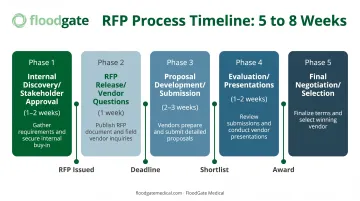
Build enough time into each phase:
- Internal discovery and stakeholder approval: 1–2 weeks
- RFP release and vendor questions: 1 week
- Proposal development and submission: 2–3 weeks
- Evaluation, presentations, and negotiation: 1–2 weeks
Designate one internal contact for vendor inquiries to ensure consistent messaging and avoid conflicting guidance.
Share Existing Context and Materials
If you have an established Employee Value Proposition (EVP), employer-brand materials, or past job descriptions, share them. SIA advises supplying enough program information so vendors can build on what's already established rather than starting from scratch. This shortens onboarding and improves candidate messaging from day one.
Use Weighted Scoring, Not Gut Feel
Score each proposal against your published criteria. If MedTech expertise is weighted at 30%, assign points from documented evidence: recruiter certifications, similar placements, and reference feedback, not subjective impressions from a presentation.
Frequently Asked Questions
Does an RFP cost money?
There's no direct fee to issue an RFP, but it requires internal time for drafting, stakeholder alignment, and evaluation. Vendors invest unpaid resources responding, often $6,000–$30,000 per proposal, without guaranteed payment.
What are the 7 stages of the recruitment process?
The stages are workforce planning, sourcing, screening, interviewing, assessment, offer/negotiation, and onboarding. Clarify which stages your vendor will manage to prevent overlap with internal HR.
What are common RFP mistakes to avoid?
The top mistakes are vague scope and priorities, missing budget ranges, too many low-value questions, and lack of stakeholder alignment before finalizing requirements.
How long should an RFP process take for recruitment services?
Plan for 5–8 weeks total: 1–2 weeks for internal discovery, 1 week for vendor questions, 2–3 weeks for proposal development, and 1–2 weeks for evaluation and negotiation.
What's the difference between an RFP and an RFQ for recruitment vendors?
An RFP is for complex, customized solutions where you evaluate approach, expertise, and fit alongside cost. An RFQ (Request for Quotation) suits standardized pricing requests focused primarily on cost and delivery.
How does FloodGate Medical differentiate itself in a recruitment RFP response?
FloodGate Medical differentiates through an exclusive MedTech focus and DEI-centered recruiting that includes AI-assisted unbiased screening. It delivers 450+ annual placements with 89% one-year retention, plus monthly newsletters and complimentary hiring-manager training.
Ready to build a recruitment RFP that attracts the right MedTech partner?
Start with clear hiring goals, measurable DEI expectations, and a realistic budget. Then score proposals on evidence of results, not polish.
A well-structured RFP saves months of misalignment and connects you with specialists who know your industry and the talent you need.