Without a formal roadmap, national health systems fall into predictable traps: duplicated studies, fragmented data, and priorities set by whoever has the loudest voice rather than by evidence of actual disease burden. Vulnerable populations tend to lose out first.
Low-income countries received just 0.2% of global health-research grant funding from major international funders in 2020, according to WHO's Global Observatory on Health R&D. That kind of imbalance doesn't fix itself.
This guide breaks down what a national health research agenda actually is, the components that make one work, a step-by-step build framework, and the workforce realities that determine whether any of it translates into results.
Key Takeaways
- National health research agendas align researchers, funders, and policymakers around shared priorities
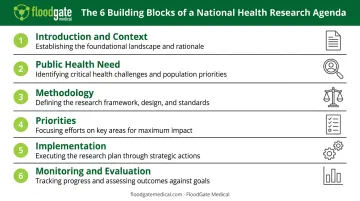
- Strong agendas follow six components: context, need, methodology, priorities, implementation, and evaluation
- WHO's PIPE framework (Plan, Implement, Publish, Evaluate) offers a repeatable structure for priority-setting
- Workforce capacity, not funding alone, determines whether an agenda produces real results
What Is a National Health Research Agenda and Why Does It Matter?
The World Health Organization frames a national health research agenda as a strategic roadmap: a document specifying goals, priorities, and areas of investigation for a country's health research over a defined period. It exists to solve one core problem: disconnected effort.
Without an agenda, researchers chase personal interests or easy grants, developers build products nobody asked for, and funders bankroll overlapping studies. An agenda forces alignment across all three groups.
Why Countries Can't Afford to Skip This Step
The best agendas build equity in from the start. They specify how research reaches the most vulnerable populations, not just the easiest ones to study. That's often the difference between research that changes policy and research that sits in a drawer.
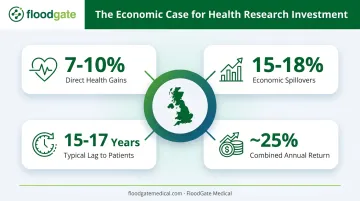
The economic case is measurable, too. A peer-reviewed analysis of UK public and charitable medical research found annual returns of 7-10% in direct health gains and 15-18% in economic spillovers, for a combined return near 25% (Sussex, Feng, and Mestre-Ferrandiz et al.). Investment that reaches patients 15-17 years later still needs to start today.
The Funding Gap That Makes Prioritization Non-Negotiable
The disparity in where research dollars land is stark:
- High-income countries have roughly 56 times more health researchers per million people than low-income countries
- Major funders allocated just 0.2% of 2020 health-research grants to low-income countries
- The long-cited "10/90 gap" (about 10% of research resources addressing 90% of disease burden) remains a cautionary benchmark, though the underlying data is dated
For a country without unlimited resources, a research agenda decides which studies get funded and which don't. A published agenda also gives governments something concrete to point to when defending sustained public investment, instead of arguing for research funding in the abstract.
Core Components of a Strategic National Health Research Agenda
Every functioning national health research agenda, regardless of country, tends to include the same six building blocks. Skip one, and the whole structure gets shakier.
The Six Elements Every Agenda Needs
- Introduction and context: establishes why the agenda exists and how it fits national health strategy
- Public health need: defines specific disease outcomes, risk factors, or system gaps, plus the desired change and time frame
- Methodology: documents how priorities were chosen and which value judgments (cost-effectiveness, feasibility, inclusivity) were weighed
- Priorities: a short, actionable list, usually grouped by time frame or theme
- Implementation: names who executes each priority and how stakeholders coordinate
- Monitoring and evaluation: tracks progress and sets triggers for re-evaluating priorities
Why Methodology Is the Component Most Agendas Get Wrong
Good-practice frameworks for health research priority-setting emphasize transparency above nearly everything else: disclosing how stakeholders were selected, what criteria were used, and how disagreements were resolved.
Agendas that skip this step tend to produce priority lists that look objective but reflect whoever had the most influence in the room.
| Component | Weak Execution | Strong Execution |
|---|---|---|
| Methodology | Priorities chosen informally by a small committee | Published criteria, named stakeholders, documented scoring |
| Priorities | Long inventory of 100+ topics | Short list grouped by time frame or theme |
| Implementation | No named owner or funding link | Specific institutions and funders assigned per priority |
Priorities need to stay short. A national agenda listing 200 research questions functions as a wish list rather than a strategy.
A Step-by-Step Framework for Building Your National Research Agenda
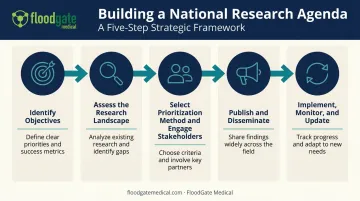
Building an agenda from scratch follows a fairly consistent sequence, whether you're a health ministry or a national research council.
Identify objectives. Articulate the specific public health need the agenda must address: not "improve health outcomes," but "reduce maternal mortality in underserved regions" or "close diagnostic gaps for resistant infections."
Assess the research landscape. Before setting new priorities, catalog:
- Ongoing studies and funded initiatives
- Existing policy and system evidence
- Data gaps and unanswered questions
The Partnership for Health System Sustainability and Resilience applies a shared qualitative framework across seven health-system domains and has synthesized findings across 18 countries, keeping new agendas from duplicating work already underway.
Select a prioritization method and engage stakeholders. Choose a transparent method (Delphi consensus, CHNRI scoring, or a combined approach matrix) and convene a group representing everyone who'll use the research.
Scale is possible here. Saudi Arabia's national process involved 2,252 participants with a 90% response rate, producing separate agendas for health-system and disease priorities (Al-Mandhari et al.). Service delivery topped their system list at 40.9%, followed by workforce at 14.4%.
Publish and disseminate. A finalized agenda sitting in an internal folder helps nobody. Publish the priorities, participant list, methodology, and implementation plan so outside researchers can act on it.
Implement, monitor, and update. Track funding allocation against each priority and schedule periodic revisions. WHO's PIPE approach (Plan, Implement, Publish, Evaluate) builds this review cycle in from the start rather than treating it as an afterthought.
Common Priority Areas and Themes in National Health Research Agendas
Across countries, national health research agendas keep returning to a similar set of themes, even when local context differs sharply.
Four domains show up in nearly every national agenda:
- Workforce development: training, retention, and distribution of researchers and clinical staff
- Health system financing and structure: how care is paid for and organized
- Health information and technology: data systems and their use in decisions
- Disease- and population-specific priorities: noncommunicable diseases, maternal and child health, mental health
Cross-Cutting Themes Gaining Ground
Several themes now appear across national and global agendas that weren't standard a decade ago:
- Antimicrobial resistance: WHO's global AMR research agenda names 40 specific topics targeted for policy-relevant evidence by 2030
- Urban health: WHO's 2022-2032 agenda covers housing, environmental risk, and healthy aging
- Migration and displacement
- Pandemic and infodemic preparedness
These emerging themes reflect shifting global priorities, but one thread cuts across nearly every agenda: the data needed to act on them.
Real-World Data as Its Own Priority
Health systems increasingly treat routine data, generated daily in clinics and hospitals, as a distinct research priority rather than a byproduct of care delivery. The catch: availability, completeness, and analytical capacity often limit how lower-resource settings use this data. Naming it as a priority means funding the systems and skills to actually use it.
Key Challenges and Best Practices for Turning Agendas Into Impact
Even a well-built agenda can stall in execution. A few failure patterns show up again and again.
Where Agendas Break Down
- Fragmented stakeholder buy-in — priorities set without genuine input from those expected to act on them
- Funding volatility — political and budget cycles that don't match multi-year research timelines
- Slow translation — prioritized questions that never reach a funded study
These three problems share a root cause that's easy to overlook.
The Overlooked Bottleneck: Workforce Capacity
Even a technically sound agenda goes nowhere without people to execute it. The same imbalance that shows up in funding distribution shows up in researcher headcount — skilled, diverse professionals are what turn a prioritized question into a completed study, a new device, or a policy change.
This is where specialized recruitment matters, particularly for agendas tied to health technology and device innovation. Organizations building out research execution teams — clinical affairs, R&D, regulatory, medical affairs — often compete for a narrow pool of qualified talent.
Recruiters who specialize in a single sector understand this pool better than generalists do. FloodGate Medical, for instance, focuses exclusively on MedTech and prioritizes diverse candidate pipelines when connecting research-focused organizations with clinical, R&D, and commercial talent. Building a team that reflects the populations an agenda is meant to serve shapes which questions get asked in the first place.

Best Practices That Hold Up Over Time
- Keep stakeholder engagement continuous, not a one-time consultation before publication
- Publish your methodology and criteria, including where reviewers disagreed
- Schedule reviews on a fixed calendar — most agendas need revisiting every few years, sooner if a new health threat emerges
- Fund the workforce alongside the research — a great agenda with no one to execute it is just a document
Frequently Asked Questions
What is the purpose of the health research and development agenda?
Its purpose is to align researchers, funders, and policymakers around a country's most pressing public health priorities. This ensures limited resources target high-impact questions instead of duplicative or disconnected studies.
What are common topics for health research and development agendas?
Recurring themes include workforce development, health system financing, health information and technology, and priority diseases or population health issues. Cross-cutting topics like antimicrobial resistance and urban health increasingly appear too.
How does the 8-point DOH agenda improve healthcare?
The Philippines' DOH 8-Point Action Agenda sets overall health-sector policy direction, separate from the country's research-specific NUHRA. Structured, multi-point agendas like this improve healthcare by organizing investment around clearly defined priorities and accountability structures.
Who should be involved in developing a national health research agenda?
Effective agendas require broad stakeholder involvement: policymakers, researchers, clinicians, funders, and patient or community representatives. Saudi Arabia's process, for example, involved over 2,000 participants across these groups.
How often should a national health research agenda be updated?
Most agendas are reviewed every few years, though significant shifts in disease burden or emerging health threats can trigger earlier updates. WHO's PIPE framework builds this evaluation step into the process from the start.
How is a national health research agenda different from a global research agenda?
National agendas reflect one country's context, resources, and population needs. Global agendas, like WHO's, set cross-country priorities and standards that individual nations then adapt to their own circumstances.