
Introduction
MedTech hiring is uniquely hard. Specialized technical skills take years to build, FDA frameworks demand domain expertise, and innovation cycles move in months—not years. Workforce needs can double during a product launch, then shrink just as quickly.
According to a 2024 MedTech skills report, hiring managers' greatest acquisition challenge is securing technical and specialist talent, particularly in digitalization, data analytics, and automation.
Contract staffing is more than a cost play in this environment. It gives you faster access to niche regulatory and quality expertise, lower compliance risk through pre-vetted professionals, and the agility to keep product timelines on track without permanent headcount overhead. This guide breaks down those benefits and when they matter most.
Key Takeaways
- Flexible access to specialized MedTech talent without long-term employment commitments
- 30%+ lower total talent costs by cutting benefits, payroll taxes, and recruiting overhead
- Faster deployment of pre-vetted pros fluent in ISO 13485, FDA submissions, and device workflows
- Scalable coverage across clinical, regulatory, and post-market phases without headcount risk
What Is Contract Staffing (Brief Context)
Contract staffing is a talent solution in which a specialized recruiting firm provides skilled professionals to work on temporary assignments, with the staffing agency serving as the employer of record. The client company gains immediate access to expertise; the agency handles payroll, benefits, compliance, and employment liabilities.
In MedTech, contract staffing is commonly used for roles that need deep domain knowledge:
- Quality engineers familiar with the FDA Quality Management System Regulation (QMSR)
- Regulatory affairs specialists who navigate 510(k) and PMA submissions
- Validation professionals who understand design verification and validation protocols
- R&D engineers with experience in ISO 13485 environments
- Clinical operations staff supporting trial execution
Contract staffing is a strategic workforce model that meets immediate project demands while building a vetted talent pipeline for future permanent hires. Companies use it to:
- Test cultural and technical fit before making long-term offers
- Scale teams for product launches without raising fixed costs
- Bring in compliance expertise when internal teams lack regulatory depth
Key Advantages of Contract Staffing
The advantages below focus on measurable operational impact: cost control, access to specialized talent, and workforce scalability. Each one ties to outcomes MedTech companies already track, including project timelines, regulatory submission readiness, quality metrics, innovation velocity, and total talent acquisition cost.
Cost Reduction and Financial Flexibility
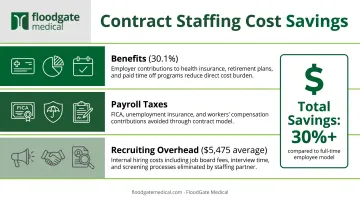
Contract staffing eliminates employer costs for benefits, payroll taxes, and recruiting overhead. Benefits represented 30.1% of total compensation for private-industry employees in March 2025, covering health insurance, retirement contributions, paid time off, and other perks.
Payroll taxes add FICA, unemployment insurance, and workers' compensation. Recruiting expenses (job postings, interview time, background checks, and onboarding) averaged $5,475 per nonexecutive hire in 2025, with recruiting consuming 20-26% of HR budgets.
The staffing agency absorbs all employment-related liabilities and administrative burdens, allowing MedTech companies to convert fixed labor costs into variable project-based expenses. Instead of carrying a full-time quality engineer year-round, a company pays only for the weeks or months needed during Design Verification/Validation phases or FDA submission preparation.
Why this matters:
- Creates budget predictability for project-based work: development phases, clinical trial support, FDA submissions, and post-market surveillance
- Eliminates sunk costs when projects complete or timelines shift
- Frees capital for R&D investment rather than fixed headcount
KPIs impacted:
- Total talent acquisition cost
- Fully burdened labor cost per project
- Recruiting cycle time and budget variance
- Workforce flexibility ratio
When this advantage matters most:
During product launches with defined timelines, clinical trials with phased enrollment, FDA submissions requiring surge capacity, or when specialized regulatory or validation expertise is needed temporarily without increasing permanent payroll.
Access to Specialized MedTech Talent and Faster Time-to-Productivity
MedTech staffing firms maintain pre-vetted pools of professionals with industry-specific credentials. That includes quality system experience under ISO 13485 and 21 CFR Part 820, regulatory knowledge across 510(k), PMA, and De Novo pathways, and hands-on medical device development expertise. These candidates already understand FDA expectations, quality management system requirements, and design control workflows.
Contract professionals can be deployed in days rather than the lengthy hiring cycles typical for permanent MedTech roles. The median time to fill nonexecutive positions was 39 calendar days in 2026, and specialized technical roles in highly regulated industries often take longer.
Specialized MedTech recruiters also maintain deeper networks than general corporate HR teams, with relationships built over years across regulatory affairs, quality engineering, and clinical operations.
Why this matters:
- Faster deployment directly accelerates product development timelines and reduces time-to-market for new devices
- Prevents project delays that could impact regulatory submission deadlines or competitive positioning
- Eliminates months of onboarding when candidates arrive with domain knowledge already in place
KPIs impacted:
- Time-to-fill and time-to-productivity
- Project timeline adherence
- Product development cycle time
- Regulatory submission readiness
When this advantage matters most:
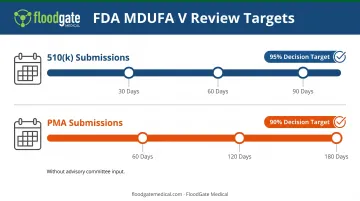
It matters most under tight FDA submission deadlines. MDUFA V targets a decision within 90 days for 95% of 510(k)s and 180 days for 90% of original PMAs without advisory-committee input. The same advantage applies during launch surge periods, specialized validation or compliance work, and projects where permanent staff lack the required regulatory or technical depth.
Scalability and Workforce Agility
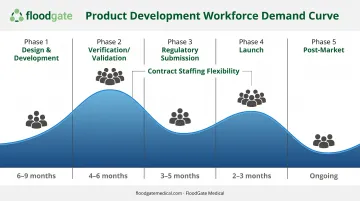
Contract staffing lets MedTech companies scale capacity up or down with product development phases, clinical trial stages, regulatory cycles, and market demand, without the commitment of permanent hiring.
A device manufacturer can bring in three validation engineers for a six-month Design Verification/Validation sprint, then release them when the work completes. That avoids carrying those roles through slower post-launch phases.
This model also offers try-before-you-hire evaluation of talent fit, technical capability, and cultural alignment before a permanent offer. Gallup estimated that replacing an employee costs one-half to two times annual salary, so fewer mis-hires in specialized roles protect a large share of that cost.
Why this matters:
- Workforce flexibility prevents overstaffing during slower periods while ensuring adequate capacity during critical phases
- Contract-to-hire models reduce risk by allowing real-world performance evaluation before permanent commitment
- Eliminates severance liability and termination friction when project needs change
KPIs impacted:
- Workforce utilization rate
- Labor cost as a percentage of revenue
- Employee turnover rate
- Project resource allocation efficiency
When this advantage matters most:
During product development phases with fluctuating resource needs, when testing contract-to-permanent arrangements for hard-to-fill specialized roles, in response to unexpected regulatory feedback requiring rework, or when managing seasonal fluctuations in clinical operations or post-market surveillance.
What Happens When Contract Staffing Is Overlooked
Relying solely on permanent hiring strategies creates measurable risks in MedTech environments where speed, compliance, and specialized expertise determine product success.
- Project delays: Wait 60-90 days to fill a regulatory affairs role and FDA submission timelines slip. Miss a planned 510(k) date and launch can slide a full quarter, handing competitors the market window.
- Cost overruns: Three full-time validation engineers hired for a six-month Design Verification/Validation phase leave two years of salary, benefits, and overhead on the books after the project ends—waste that compounds when the next launch is 12-18 months away.
- Compliance gaps: Staff without deep QMSR or post-market surveillance expertise operate beyond their capabilities. Audit findings, quality events, and regulatory risk on later submissions follow.
- Innovation lag: Permanent hiring pipelines rarely keep pace with needs like AI in diagnostics, digital health connectivity, and advanced biomaterials, so peers who use flexible talent pull ahead.
- Competitive disadvantage: A 2020 Harvard Business School and BCG study found that users of high-skill digital talent platforms reported greater speed to market, productivity, and capacity to innovate. In fast-moving MedTech markets, flexible workforce strategies have become a competitive necessity.
How to Get the Most Value from Contract Staffing
Contract staffing works best when organizations treat it as a strategic workforce solution integrated with talent planning, not just an emergency gap-filler.
Partner with specialized MedTech recruiters: General staffing firms lack the domain expertise to evaluate regulatory knowledge, quality system experience, or technical competencies specific to medical device development.
Firms like FloodGate Medical maintain pre-vetted networks of professionals ready for regulated environments, including people with:
- ISO 13485 experience and FDA submission backgrounds
- Fluency in compliance frameworks such as 21 CFR Part 820 and the new QMSR
- Hands-on work writing Design History Files and managing validation protocols
Develop clear project scopes and success metrics: Treat contract professionals as integrated team members with defined deliverables, timelines, and success criteria. A validation engineer should arrive on day one with a clear scope: which test protocols to run, which documentation standards to follow, and which quality metrics to hit. That clarity drives productivity from the start and cuts the ambiguity that slows ramp-up.
Establish contract-to-permanent evaluation criteria upfront: If a role may convert to permanent, define the performance benchmarks, cultural-fit indicators, and timeline for evaluation before the contractor starts. You build a vetted talent pipeline and reduce mis-hire risk through real-world assessment before any long-term commitment.
Conclusion
Contract staffing's value in MedTech lies in cost control, access to specialized expertise, compliance risk reduction, and workforce agility that accelerates innovation. Used well, contract talent speeds product development, improves quality outcomes, and lowers talent costs so more capital can go to R&D.
Organizations should view contract staffing as an integrated workforce strategy, partnering with specialized MedTech recruiters who understand the industry's unique talent requirements and compliance landscape. When a regulatory deadline looms, a clinical trial scales up, or a validation sprint begins, pre-vetted experts can be in place in days rather than months. That speed is often what keeps a product launch on schedule.
Frequently Asked Questions
How does contract staffing reduce hiring costs compared to permanent employees?
Contract staffing eliminates employer costs for benefits (health insurance, retirement contributions, PTO), payroll taxes (FICA, unemployment insurance, workers' compensation), and recruiting overhead. The staffing agency handles all employment liabilities, converting fixed labor costs into variable project expenses.
What is the difference between contract staffing and permanent hiring?
Contract staff are temporary employees of the staffing agency assigned to client projects for defined periods, with no long-term employment commitment. Permanent employees are direct hires with ongoing obligations, full benefits packages, and severance liability if the role is eliminated.
How quickly can contract staff with MedTech expertise be onboarded?
Specialized MedTech firms like FloodGate Medical maintain pre-vetted talent pools and can often deploy professionals within days to a few weeks. That is far faster than permanent specialized hiring, since candidates already hold industry credentials and regulatory knowledge.
Is contract staffing suitable for highly specialized MedTech roles like regulatory affairs and quality engineering?
Yes. MedTech-focused firms maintain networks with regulatory knowledge (510(k), PMA, MDR), quality system experience (ISO 13485, QMSR), and technical depth general recruiters rarely reach—so specialists can contribute immediately.
What happens if a contract worker isn't a good fit for the role?
Staffing agencies typically provide replacement guarantees and can quickly source alternative candidates from their talent pools, minimizing disruption. This eliminates the lengthy performance-management and termination processes required for permanent employees, allowing faster course correction when fit issues arise.
Can contract workers transition to permanent employees?
Yes. Contract-to-hire lets you evaluate performance, technical skill, and cultural fit on real projects before making a permanent offer. That extended assessment reduces mis-hire risk compared with a standard hiring process.