Introduction
MedTech innovation stalls when every hire looks, thinks, and problem-solves the same way. Companies keep recruiting the same profile for the same roles, then wonder why their devices fail to serve diverse patient populations.
Many MedTech leaders want inclusive teams. Few know where to start beyond a mission statement on their careers page.
This guide breaks down what diversity recruitment actually means and why it matters for medical device and healthcare technology companies. Then it covers the concrete strategies that move hiring practices from performative to genuinely inclusive.
Key Takeaways
- Diverse leadership teams report 45% innovation revenue vs. 26% for less diverse peers (BCG)
- Dropping "100% qualified" job requirements widens your applicant pool, especially among women
- Blind screening, structured interviews, and diverse panels cut bias at every stage
- Tracking retention and promotion of diverse hires matters as much as who you hire
What Is Diversity in Recruitment?
Diversity in recruitment means designing hiring processes that attract, evaluate, and select candidates across a genuinely wide range of backgrounds. That includes race, gender, age, disability status, sexual orientation, and socioeconomic background.
It also includes traits that aren't immediately visible.
What is considered a diverse candidate? At FloodGate Medical, we sort candidates into two categories:
- Visible characteristics: ethnicity, gender presentation, age, physical disability
- Invisible characteristics: veteran status, neurodiversity, socioeconomic background, mental health history, sexual orientation
Expanding the candidate pool this way raises a common misconception: that diversity hiring means lowering the bar. It doesn't.
Genuine diversity recruitment stays merit-based, focusing on removing barriers that unfairly filter out qualified candidates before they ever get a fair look rather than relying on quotas or lowered standards. The goal is a bigger, better applicant pool, not a smaller bar to clear.
Why Diversity in Recruitment Matters for MedTech Companies
MedTech isn't a generic industry. It designs products that go inside human bodies, and those bodies come in every shape, background, and physiology imaginable.
Innovation and Patient Outcomes
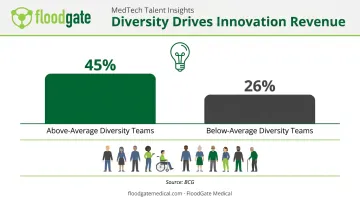
Diverse teams solve problems differently, and the data backs this up. Companies with above-average diversity on management teams report innovation revenue of 45%, compared to just 26% for companies with below-average diversity, according to BCG.
For device manufacturers, that innovation gap translates directly into product design. A homogenous engineering team is more likely to miss usability issues for elderly patients, left-handed clinicians, or patients with darker skin tones (pulse oximetry accuracy issues are a well-documented example). Diverse product teams catch these gaps earlier.
The Business Case
The financial argument is just as strong:
- Top-quartile companies for executive gender diversity are 39% more likely to financially outperform bottom-quartile peers, per McKinsey's diversity research
- 56% of employed U.S. adults view workplace DEI initiatives as a positive, per Pew Research
- Workplace belonging correlates with a 56% increase in job performance and a 50% reduction in turnover risk, according to BetterUp research
In a talent market as competitive as MedTech, where specialized engineering and clinical roles take months to fill, retention isn't optional. Inclusive workplaces keep the specialized talent you already fought hard to recruit. It's the same principle behind FloodGate Medical's DEI-driven placements: build a diverse pipeline from the first search, and retention follows.
Proven Strategies for Building Inclusive Teams
Building an inclusive team requires action at every stage of the funnel, not a single fix. Here's where to focus.
Audit and Rewrite Job Descriptions for Inclusive Language
Job postings quietly filter out qualified candidates before anyone submits an application.
- Remove gender-coded words like "aggressive," "dominant," or "ninja" from postings
- Research from Harvard Business Review found that women often only apply to jobs when they meet 100% of listed qualifications, while men apply after meeting roughly 60%
- Trim requirement lists down to true must-haves, not wish lists
- State your DEI commitment explicitly and highlight flexible policies (remote options, parental leave, accommodations) directly in the posting
Expand Sourcing Channels to Reach Underrepresented MedTech Talent
If you're only posting on the same three job boards, you're recruiting from the same limited pool every time.
- Partner with diversity-focused job boards and professional associations, such as women-in-STEM networks or Black-in-tech communities
- Build direct relationships with universities, community colleges, and HBCUs/HSIs that graduate strong engineering and life sciences talent
- Attend industry conferences that specifically showcase underrepresented MedTech professionals
Standardize and De-Bias the Screening and Interview Process
Unconscious bias creeps in fastest during initial screening and unstructured interviews.
- Implement blind resume reviews — strip names, photos, and graduation dates before the first read
- Use structured, behavior-based questions asked identically to every candidate for a given role
- Train interview panels to recognize affinity bias (favoring people similar to yourself) and the halo/horn effect (letting one trait color your whole impression). Structured hiring-manager training, like the programs FloodGate Medical runs for MedTech leadership teams, turns this from a one-time workshop into an ongoing practice
A French pilot study found that anonymous resumes actually widened the interview gap for minority candidates by 10.7 percentage points, likely because reviewers lost context that would have otherwise prompted careful evaluation. Blind screening works best paired with structured interviews, not as a standalone fix.
Build Diverse Interview Panels and Shortlists
A Rooney Rule-style approach, borrowed from NFL hiring practices, requires diverse candidate slates and diverse interviewers for every open role.
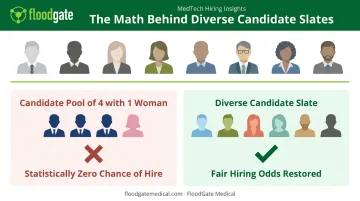
Why this matters beyond optics: statistically, if only one woman sits in a candidate pool of four, Harvard Business Review research shows her odds of being hired are effectively zero. Diverse shortlists change that math. Diverse interview panels also increase candidate confidence and reduce the risk of "culture fit" becoming a proxy for "looks like us."
Invest in Internships, Mentorships, and Employee Referral Incentives
Long-term pipeline building beats last-minute scrambling.
- Create paid internship programs with diverse institutions to build technical talent access years before you need to hire
- Offer enhanced referral incentives for diverse hires, while ensuring every referred candidate goes through the identical evaluation process as anyone else
Set Measurable DEI Goals and Track Metrics Through the Hiring Funnel
You can't improve what you don't measure.
- Track applicant pool diversity at the top of the funnel
- Monitor interview-to-offer conversion rates by demographic group
- Measure retention of diverse hires at 6, 12, and 24 months
- Report these numbers to leadership quarterly, and adjust sourcing or screening tactics based on exactly where diverse candidates drop out
Common Challenges in Diversity Hiring (and How to Overcome Them)
Even well-intentioned DEI efforts hit predictable roadblocks.
Resistance or lack of leadership buy-in. Tie DEI goals directly to business outcomes leadership already cares about: innovation, revenue growth, retention costs, and competitive positioning. Secure an executive sponsor who reports on progress publicly instead of leaving accountability solely with an HR owner.
Limited candidate pipelines in niche technical roles. MedTech engineering and regulatory roles are narrow by nature. Broaden screening criteria toward skills-based hiring rather than pedigree-based hiring. A candidate who transitioned from a manager role and meets the core competencies deserves consideration for a director-level opening, even without the "expected" title history. FloodGate Medical often surfaces such candidates by weighing competencies over title history.
Performative DEI. Public commitments without substance erode trust fast. Back every statement with:
- Real internal data (not just aspirational targets)
- Actual employee testimonials, not scripted marketing copy
- Visible follow-through on retention and promotion, not just hiring announcements
Sustaining Diversity Beyond the Hire
Hiring diverse talent means nothing if those employees leave within eighteen months.
Track retention and promotion rates of diverse employees with the same rigor you apply to hiring metrics. A team that hires diverse candidates but promotes only from one demographic group has a leadership pipeline problem, not a hiring win.
Practical steps that sustain inclusion:
- Inclusive onboarding that goes beyond paperwork to actively integrate new hires into team culture
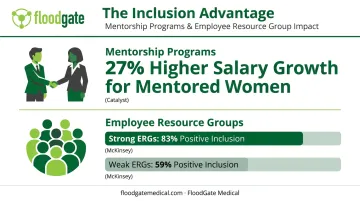
- Mentorship programs pairing new hires with established employees (women with mentors see 27% higher salary growth, per Catalyst research)
- Employee Resource Groups (ERGs) — employees report 83% positive inclusion scores in strong ERGs versus 59% in weak ones, according to McKinsey
- Regular engagement surveys that surface real experiences and feed directly back into DEI strategy adjustments
Mentorship alone often isn't enough. Active sponsorship, where a senior leader spends personal credibility advocating for someone's promotion, closes advancement gaps that mentorship alone leaves open.
Partner with a DEI-Focused MedTech Recruiter
Building diversity infrastructure internally takes years most MedTech companies don't have. Specialized recruitment partners already maintain the diverse talent networks that take internal teams a long time to build from scratch.
This is where a dedicated MedTech search partner earns its value. FloodGate Medical built its recruiting approach around equity, diversity, and inclusion from day one.
That focus shows up in the numbers:
- A candidate database of more than 150,000 MedTech professionals
- A network reaching over 4 million people annually
- Roughly 70% of placements coming from passive candidates who weren't actively job hunting but were the right fit once identified
That's a different, wider pool than what most internal recruiting teams can access through job boards alone.
For companies trying to fill technical roles quickly without sacrificing candidate diversity, working with a recruiter who already thinks this way from search to placement saves months of trial and error. FloodGate Medical's content hub and monthly newsletter also give hiring managers and candidates ongoing industry insight beyond any single search.
Frequently Asked Questions
What is considered a diverse candidate?
A diverse candidate brings visible or invisible differences, such as race, gender, age, disability, veteran status, or socioeconomic background, that broaden the perspectives represented on a team.
How to recruit diverse candidates?
Recruiting diverse candidates requires inclusive job descriptions, expanded sourcing channels, blind screening, structured interviews, and measurable DEI goals tracked throughout the hiring funnel.
What is the difference between diversity hiring and affirmative action?
Diversity hiring focuses on removing bias and broadening candidate pools based on merit. Affirmative action, by contrast, involves specific legal frameworks and quotas tied to historical discrimination remedies, with regulations shifting in recent years.
How do you measure diversity in recruitment?
Companies track applicant pool demographics, interview-to-offer conversion rates by group, and retention rates of diverse hires to gauge real progress, not just intent.
What are the benefits of a diverse workforce in MedTech specifically?
Diverse MedTech teams design more inclusive, patient-centric products and better anticipate the needs of varied patient populations, which directly improves healthcare outcomes.
How can smaller MedTech companies build diverse teams with limited resources?
Smaller companies can partner with specialized DEI-focused recruiters such as FloodGate Medical, alongside diversity job boards and university programs, to access diverse talent pools without building extensive internal infrastructure from scratch.