
Introduction
MedTech companies face a complex hiring landscape: demand for specialized clinical, regulatory, and engineering talent continues to outpace supply. Top candidates increasingly prefer remote or hybrid work arrangements.
According to recent Gallup data, 52% of US remote-capable employees now work hybrid schedules, 26% work fully remote, and six in ten prefer hybrid arrangements.
For MedTech employers competing for scarce regulatory affairs specialists or post-market surveillance experts, location flexibility has shifted from perk to requirement.
Traditional full-time hiring models struggle when you need a submission expert for four months or interim quality leadership during a product launch. This guide covers why flexible workforce strategies matter in MedTech, the contract and project-based arrangements that widen your talent pool, and how to recruit and retain flexible workers while managing compliance risk.
Key Takeaways
- Flexible hiring expands access to specialized MedTech talent and converts fixed headcount into variable project spend
- Contract, fractional, or remote setups each fit a different need: submission deadlines, leadership gaps, or geographic reach
- Classification compliance requires task-level analysis of control, permanence, and integration under DOL and IRS tests
- Clear role expectations, structured onboarding, and regular check-ins prevent early attrition among flexible hires
Why a Flexible Workforce Matters in MedTech
AdvaMed reports nearly 519,000 direct US jobs in the medical device industry, yet companies continue to struggle filling specialized roles.
A 2025 global MedTech network survey named Clinical/Post-Market (38%), Regulatory Affairs (29%), and R&D/Engineering (18%) the hardest-to-fill roles. Regulatory/Compliance and Clinical Trial/Post-Market skills were each cited as difficult to source by 36% of respondents.
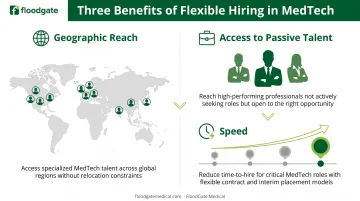
Flexibility widens your talent pool in three ways:
- Geographic reach: Remote and hybrid options let you recruit regulatory specialists or quality engineers nationwide instead of within commute distance of your facility
- Access to passive talent: Experienced professionals who won't relocate for a full-time role often accept contract or fractional engagements, especially when juggling family or consulting work
- Speed: Contract and interim hires bypass lengthy approval cycles for new headcount, letting you start a remediation project or fill a maternity leave within weeks
Financial benefits matter most for early-stage and scaling MedTech companies. Flexible arrangements convert permanent salary, benefits, and equity costs into variable project spend—so a six-month contract regulatory writer costs less than a full-time hire when your 510(k) timeline is finite.
Fractional quality leadership gives you senior expertise part-time without the overhead of a full VP salary while your device is still in design verification.
Flexible staffing also protects retention of your core team. When short-term needs (post-market surveillance, audit prep, design-control documentation) land on already-stretched full-time staff, burnout and turnover risk climb. Contract or project-based pros let permanent employees stay on high-value strategic work.
Types of Flexible Workforce Arrangements
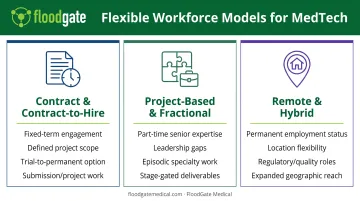
Contract & Contract-to-Hire
Contract hiring engages an experienced professional for a fixed term or a defined operational need, such as a product launch, regulatory submission, leave coverage, or remediation work.
The worker may be employed by a staffing agency, engaged directly, or structured as an independent contractor. The "contract" label alone does not determine legal classification (see Key Considerations below).
Contract-to-hire adds a conversion option: you evaluate the hire during a trial period, then decide whether to extend a permanent offer. That "try before you buy" path lowers risk in specialized MedTech roles, where interviews alone rarely prove technical fit or cultural alignment.
Typical MedTech use cases:
- Regulatory submission workload for a defined deadline
- Interim quality or clinical leadership during a search
- Short-term manufacturing or validation support during scale-up
- Project-specific engineering or design-control documentation
In one 2025 global MedTech survey, 26% of organizations said they primarily use contractors or interim experts, and another 21% reported a blended permanent-and-flexible model.
Project-Based & Fractional Roles
Project-based and fractional arrangements bring senior expertise for part-time or bounded engagements instead of filling a full-time seat.
A fractional VP of Quality might work 15 hours a week to build your quality management system and prep for an FDA audit, then step back once the system is running. A project-based regulatory strategist can own a De Novo submission from kickoff through clearance, then move to the next client.
Best for:
- Leadership or functional gaps you can't justify as full-time hires
- Episodic specialty work (biocompatibility strategy, cybersecurity risk, reimbursement pathways)
- Stage-gated work with clear deliverables, handoffs, and completion milestones
The fractional model works particularly well for startups and growth-stage companies that need executive-level guidance without permanent C-suite overhead.
Remote & Hybrid Employment
Remote and hybrid employment separate location flexibility from employment status. These are permanent or long-term employees who work from home full-time (remote) or split time between home and office (hybrid).
A 2024 MD+DI survey of 226 medical device and diagnostics professionals found nearly 50% work fully remote, 40% hybrid, and only 10% full-time in the office.
Remote and hybrid options expand your reach for:
- Regulatory documentation, submissions, and intelligence work
- Quality systems documentation, CAPA review, and audit preparation (with controlled system access)
- Software, data, cybersecurity, and design documentation roles
- Some engineering and advisory functions, paired with periodic on-site design reviews or testing
They also match how candidates want to work. Gallup's US data show about six in ten remote-capable workers prefer hybrid schedules, and roughly one-third prefer fully remote. At the same time, you can reach talent in markets where you have no office.
How to Recruit Flexible MedTech Talent
Communicate flexible policies early and explicitly. Job descriptions, career pages, and outreach messages should state location model (remote, hybrid, on-site), schedule expectations (core hours, time zones), and autonomy level. Ambiguity about flexibility is a top reason qualified candidates decline to apply or drop out mid-process.
Set expectations upfront to avoid early attrition. Contract and project-based candidates need clarity on:
- Deliverables, milestones, and success criteria
- Decision authority and escalation paths
- Availability requirements (hours per week, response times, travel)
- Duration, renewal terms, and conversion possibilities (if contract-to-hire)
- Systems access, confidentiality, IP ownership, and QMS training obligations
Build a DEI-centered sourcing strategy. Diverse candidate pipelines improve hiring outcomes and drive innovation in regulated product development. FloodGate Medical's DEI-driven approach combines MedTech specialization, a network of more than 150,000 professionals, and structured screening for regulatory, clinical, and engineering roles.
Proactive outreach to passive talent, behavioral assessments, and customized scorecards keep decisions consistent and reduce bias when you hire flexible talent.
Move quickly. Top contract and fractional candidates field multiple offers and rarely wait longer than two weeks for a decision. Shorten your process by:
- Pre-approving contract budgets and classification pathways before posting roles
- Conducting one- or two-stage interviews instead of four-round marathons
- Scheduling all decision-makers within a concentrated window
- Extending offers verbally within 24–48 hours of final interviews
Use a specialized MedTech recruiting partner. Generalist job boards surface active applicants, but the best regulatory, clinical, and quality specialists are often passive candidates already employed or consulting.
A recruiter with deep MedTech expertise, such as FloodGate Medical, maintains relationships with pre-vetted professionals, understands device-class requirements, and matches technical skills to your compliance and product needs faster than internal teams alone.
How to Retain and Manage a Flexible Workforce
Hiring flexible talent is only half the job. Keeping contract, remote, and project-based MedTech hires productive takes deliberate onboarding, communication, and recognition—not hallway osmosis.
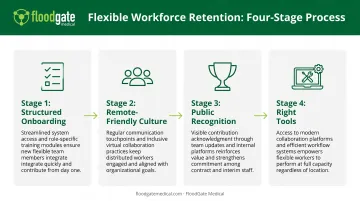
Build a structured onboarding process. Remote and flexible hires need fast access to tools, projects, documentation, and culture. Effective onboarding includes:
- Pre-start system provisioning (email, VPN, QMS, design-control platforms)
- Role-specific training on FDA regulations, quality procedures, and device/indication background
- Introduction to key stakeholders, project timelines, and communication norms
- Clear deliverable roadmap for the first 30, 60, and 90 days
FloodGate Medical's Talent Excellence Education program provides hiring managers with onboarding templates, guidelines, and SOPs to make this process repeatable.
Invest in a remote-friendly culture. Flexible workers feel disconnected when communication happens only in hallway conversations or ad hoc office meetings. Maintain engagement through:
- Weekly 1:1 check-ins with the direct manager
- Regular team meetings with video-on norms
- Periodic in-person or virtual social touchpoints
- Transparent project updates via shared dashboards or collaboration tools
Recognize contributions publicly. Contract and project-based professionals often can't see how their work supports broader company goals. Close that gap in plain language: "Your design-control documentation enabled our 510(k) clearance two weeks ahead of schedule." Call out wins in team meetings, emails, or company updates so flexible hires stay connected to outcomes.
Provide the right tools. Ensure flexible workers have:
- Secure access to necessary systems, controlled documents, and design files
- Real-time communication channels (Slack, Teams, or equivalent)
- Project-management visibility (Jira, Asana, or shared roadmaps)
- Video conferencing and screen-sharing capability for collaboration
Isolation and poor communication are the top reasons flexible hires disengage early. Manager outreach, clear tools, and deliberate inclusion prevent both.
Key Considerations Before Adopting Flexible Hiring
Not every MedTech role is flexible. Hands-on work—hardware prototyping, laboratory testing, manufacturing, cleanroom operations, in-process inspection, clinical-site procedures, and field service—requires physical presence.
Even within "flexible" functions like regulatory affairs or quality assurance, specific tasks (floor audits, equipment validation, specimen handling) demand on-site time. Evaluate flexibility task by task, not by job title alone.
Consult legal and tax experts on worker classification. The Department of Labor applies a six-factor economic-reality test to determine whether a worker is an employee or independent contractor:
- Opportunity for profit or loss
- Investment
- Permanence
- Control
- Whether the work is integral to the business
- Skill plus initiative
The IRS considers behavioral control, financial control, and relationship type. Remote location, a "consulting" title, contract language, or issuing a Form 1099 do not override these tests. Misclassification triggers back taxes, penalties, and potential employee-benefit liability.
If your company sets the work schedule, provides equipment, integrates the person into core operations, and expects ongoing availability, that relationship likely constitutes employment regardless of what the contract says.
Document scope, duration, decision authority, ability to serve other clients, and who bears financial risk. When in doubt, classify as an employee or engage through a staffing agency that serves as the employer of record.
Survey current staff before rolling out flexible policies. Resentment grows when some employees have flexibility while others—doing comparable work—do not. Before announcing new remote or hybrid arrangements, survey your team to understand which options matter most and which roles genuinely require on-site presence.
Transparent criteria ("roles that do not require physical device access or lab equipment may be eligible for hybrid schedules") prevent perceptions of favoritism.
Frequently Asked Questions
What does flex mean for a job?
"Flex" means flexibility in when, where, or how work gets done. Common arrangements include flexible hours, remote or hybrid work, compressed workweeks, and part-time or job-share models.
What are the seven stages of recruitment?
A practical framework covers planning need and budget, defining the role, sourcing candidates, screening and interviewing, assessing finalists, extending the offer, and onboarding. Flexible hiring adapts each stage for remote talent pools, contract urgency, and project-based onboarding.
How is hiring a contractor different from hiring a full-time flexible employee?
A contractor is hired for a defined project or term and usually handles their own taxes and benefits. A flexible employee is a permanent or long-term hire with schedule or location flexibility, paid on a W-2 with withholding and benefit eligibility. Classification depends on legal tests of control, permanence, and integration, not contract language alone.
Can a flexible workforce model work for clinical or regulated MedTech roles?
Yes, when the work allows it. Regulatory submissions, medical writing, quality documentation, CAPA review, and audit prep often work remotely with secure access, and remote regulatory roles show up often on specialized boards. Roles that need device interaction, lab work, manufacturing oversight, or patient contact still require on-site or field presence.
How do I know if flexible hiring is right for my MedTech company?
It fits when you face specialized talent scarcity, project-based or cyclical workload, limits on permanent headcount, or strong candidate demand for remote work. Start with roles that have clear deliverables and little need for physical presence, then pilot in one function (regulatory, quality, or software) before expanding.
How can a specialized recruiter help with flexible MedTech hiring?
A MedTech-focused recruiter like FloodGate Medical maintains relationships with pre-vetted regulatory, clinical, quality, and engineering professionals, including passive candidates not on job boards. That industry fluency speeds screening and improves matches for contract, fractional, and permanent roles tied to device-class and compliance requirements.
Flexible workforce strategies matter in MedTech. Companies that set clear expectations, move quickly on hiring decisions, and invest in structured onboarding access specialized talent faster, control costs, and compete for the clinical, regulatory, and engineering expertise that drives device innovation.