This is the hidden cost of getting hiring strategy wrong in MedTech. Gallup estimates that replacing a technical professional costs roughly 80% of their salary — and that figure climbs even higher for specialized regulatory and clinical roles (Gallup, 2024).
Permanent recruitment is the long-term fix for this exact problem. This guide breaks down what it is, how it differs from temporary staffing, and why specialized industries like MedTech need a fundamentally different hiring approach than generic staffing can offer.
Key Takeaways
- Permanent recruitment establishes open-ended employment, unlike temporary or contract placements with fixed end dates
- Technical role turnover costs approximately 80% of annual salary, making retention-focused hiring a financial priority
- Specialized MedTech roles require industry-specific screening that generalist staffing firms often can't provide
- Long-term hires build institutional knowledge and succession pipelines that temporary staff cannot replicate
- Partnering with a specialized MedTech recruiter improves candidate fit and retention as much as the hiring decision itself
What Is Permanent Recruitment?
Permanent recruitment is the process of sourcing, vetting, and hiring employees for full-time, open-ended roles with no predetermined end date. According to the American Staffing Association, this qualifies as direct placement: a relationship where the client company, not a staffing agency, employs the worker directly.
Key characteristics that define permanent roles:
- Employer-provided benefits like healthcare, PTO, and retirement contributions
- Formal termination and notice procedures (though specifics vary by state and contract)
- An expectation of ongoing employment, not a fixed project timeline
- Mutual long-term investment between employer and employee
More Than a "Position Filled" Transaction
Permanent recruitment focuses on aligning a candidate's skills and career trajectory with a company's long-term strategic needs and culture, not simply closing a requisition as fast as possible.
Consider a Field Clinical Specialist role. A temporary contractor might handle a product launch surge. A permanent hire, however, develops deep relationships with physicians, learns the nuances of your device portfolio, and becomes a trusted resource cath lab teams call by name. That kind of institutional value takes years to build, and it disappears the moment someone walks out the door.
Who typically initiates the process? In-house HR teams and hiring managers often start the search internally. But for specialized functions, such as regulatory affairs, clinical development, and technical sales, many organizations bring in external recruiting partners with deeper networks and industry-specific vetting capabilities from day one.
Types of Recruitment: Where Does Permanent Fit In?
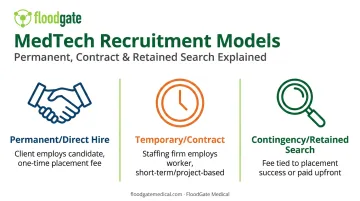
Recruitment breaks into three types, though one describes a payment structure rather than an employment type:
- Permanent/direct hire: The client employs the candidate in an ongoing relationship, typically with a one-time placement fee.
- Temporary/contract: A staffing firm employs the worker (or places an independent contractor) to fill short-term or project-based needs.
- Contingency or retained search: Fees are tied to successful placement (contingency) or paid upfront regardless of outcome (retained, often used for executive roles).
Permanent recruitment is the right fit when a role requires stability, deep institutional knowledge, and long-term strategic value. Think leadership positions, core R&D functions, or regulatory roles where continuity directly affects compliance.
Most mature MedTech organizations use a blended approach. They bring in temporary staff to absorb short-term surges, such as a product launch or a seasonal sales push, and rely on permanent recruitment for the mission-critical roles that keep the business running.
Permanent vs. Temporary Recruitment: Key Differences
The two models solve different problems. Here's how they compare:
| Factor | Permanent Recruitment | Temporary/Contract |
|---|---|---|
| Contract duration | Open-ended, no set end date | Fixed term or project-based |
| Benefits eligibility | Standard (healthcare, retirement) | Limited or none in most cases |
| Cost structure | One-time placement fee (commonly ~20% of salary) | Recurring bill rate |
| Employer commitment | Long-term, culture-invested | Transactional, task-focused |
The benefits gap is significant. Federal data shows that just 19.9% of contingent workers had employer-provided health insurance in 2023, compared to 51.2% of noncontingent employees (U.S. Bureau of Labor Statistics). That gap alone explains why many candidates and companies favor permanent arrangements when the role calls for it.
Temporary staffing wins on speed and flexibility. It's ideal for seasonal demand or short-term projects. But it lacks the continuity and cultural investment permanent roles provide, and workers under contract arrangements have less reason to build the deep, tenure-based loyalty companies need in core technical positions.
Choose permanent recruitment for:
- Leadership and executive positions
- Regulatory, quality, and clinical roles requiring institutional knowledge
- Core R&D and engineering functions
Choose temporary staffing for:
- Seasonal production surges
- Short-term project coverage
- Interim leadership during a transition
FloodGate Medical works both sides of this equation, placing permanent hires and contract talent so MedTech companies get the right model for each role.
Key Benefits of Permanent Recruitment
Permanent recruitment is a two-sided investment: companies gain stability and continuity, while candidates gain security and career growth. Neither side benefits without the other.
Benefits for Companies
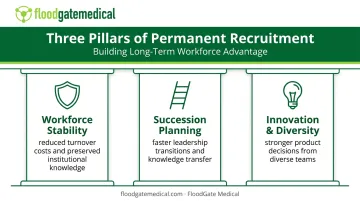
Workforce stability cuts real costs. With technical replacement costs running around 80% of salary, every retained hire in R&D, regulatory, or clinical roles protects the bottom line (Gallup). Beyond dollars, permanent teams preserve institutional knowledge, the kind that takes years to rebuild after a departure.
Permanent hiring also strengthens succession planning. SHRM notes that structured succession efforts help transfer tacit, experience-based knowledge and shorten a new leader's learning curve (SHRM). In a field like MedTech, where domain expertise in areas like FDA compliance or complex PCI devices takes years to build, that pipeline matters enormously.
There's also an innovation angle. FloodGate Medical builds its recruitment philosophy around diversity, equity, and inclusion because diverse teams drive stronger outcomes. MedTech companies building permanent, diverse teams position themselves for the varied perspective that fuels better product decisions and clinical insight.
Benefits for Candidates
Permanent roles offer job security, consistent income, and access to benefits that contract work often lacks. That matters: federal data shows only 23.5% of contingent workers were eligible for an employer retirement plan, versus 47.7% of noncontingent workers (BLS).
Beyond security, permanent positions open up real career paths:
- Promotion opportunities within an established organization
- Employer-funded training and certification programs
- Long-term skill development tied to career advancement
These advantages are far less available to contract workers moving between short-term assignments.
The Permanent Recruitment Process: Step by Step
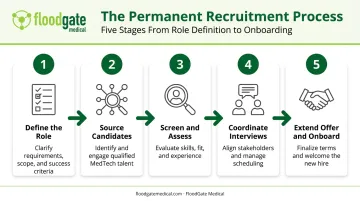
A structured process separates a successful placement from a costly mismatch. Here's how it typically unfolds:
Define the role — Hiring managers and recruiters align on responsibilities, required skills, and team fit before sourcing even begins. Skipping this step is the fastest way to end up with a poor match six months later.
Source candidates: Active outreach and targeted advertising reach both job seekers who are actively applying and passive, high-caliber talent who aren't job hunting. FloodGate Medical taps a network of over 150,000 MedTech professionals to widen this pool.
Screen and assess — Resume review, skills evaluation, and reference checks narrow the pool to genuinely qualified candidates. Structured tools like standardized interview scorecards help keep evaluations consistent across multiple interviewers.
Coordinate interviews: Multiple interview rounds and structured feedback collection move the process forward, with hiring managers weighing in at each step to reach a confident decision without dragging things out.
Extend the offer and support onboarding — Competitive offer negotiation and post-hire check-ins help the placement stick. FloodGate Medical reports an 89% one-year retention rate across more than 450 annual MedTech placements.
How long does this take? According to SHRM's 2026 recruiting benchmarking report, median time-to-fill sits at 39 calendar days for nonexecutive roles and 45 days for executive positions. Specialized MedTech roles (think Quality & Regulatory Director or Strategic Account Manager) often land on the longer end given the narrower talent pool.
Why Partner with a Specialized Permanent Recruitment Agency
Generic staffing agencies often lack the technical depth to evaluate specialized MedTech talent properly. A recruiter who doesn't understand the difference between a CTO device specialist and a general capital equipment sales rep will struggle to vet candidates for either role, let alone assess cultural fit.
This is where niche expertise earns its keep. FloodGate Medical combines MedTech-specific industry knowledge with a DEI-driven methodology, giving client companies access to curated talent pools and candidates access to opportunities they wouldn't find through a generalist firm.
Talent directors on the team, for instance, work directly with clinical development and commercialization leaders to align hiring strategy with product milestones and growth plans, rather than simply filling a seat.
What to look for when choosing a permanent recruitment partner:
- Industry specialization: Do they understand your specific vertical, whether that's interventional cardiology, regulatory affairs, or clinical operations?
- Screening rigor: Ask about their assessment process. Skills testing, structured interviews, and reference verification should all be part of it.
- Retention track record: A firm's one-year retention rate tells you more about placement quality than a fast fill ever could.
- Cultural-fit capabilities: Strong partners dig into your organizational culture, not just the job description, before presenting candidates.
- Tools for hiring managers: Some firms, FloodGate Medical among them, offer complimentary training and downloadable resources like interview SOPs to strengthen your internal hiring process too.
Frequently Asked Questions
What is the meaning of permanent recruitment?
Permanent recruitment is the process of hiring employees for full-time, open-ended roles with no predetermined end date. It typically includes standard employment benefits like healthcare and retirement plans.
What are the three types of recruitment?
The three primary categories are permanent/direct hire, temporary/contract staffing, and contingency or retained search. The first two describe employment models; the latter describes payment and search structures.
What is the difference between permanent and temporary recruitment?
Permanent recruitment creates an ongoing employment relationship with full benefits eligibility. Temporary recruitment offers a fixed-term arrangement, faster placement, and typically limited or no benefits access.
How long does the permanent recruitment process typically take?
Timelines vary by role complexity and seniority. Industry benchmarks show a median of 39 days for nonexecutive roles and 45 days for executive positions, with specialized MedTech roles often taking longer.
Is permanent recruitment more expensive than using a staffing agency for temporary workers?
Permanent placement involves an upfront fee, commonly around 20% of salary. However, it often reduces long-term costs by lowering turnover, vacancy time, and the recurring markup costs built into temporary bill rates.
Why is permanent recruitment especially important in the MedTech industry?
MedTech roles in regulatory affairs, clinical development, and R&D require specialized expertise that takes years to build. Permanent hiring protects that institutional knowledge and reduces costly, compliance-risking turnover.