Introduction
MedTech companies face relentless innovation cycles in AI-powered diagnostics, digital health platforms, and surgical robotics. Too often, they discover critical talent shortfalls only after missing product deadlines or market-launch windows.
In a 2024 survey of 411 Irish MedTech professionals, 55% rated digitalization as a high-urgency upskilling need, followed by data analytics (53%), automation (46%), and AI (36%). These gaps don't just slow development. They erode quality of hire, stretch time-to-fill for specialized roles, and hold back innovation in a sector where regulatory precision and clinical outcomes depend on workforce capability.
A structured skills gap analysis turns that reactive scramble into a proactive, data-backed strategy. This article walks through the complete process—from scoping objectives and inventorying current capabilities to building an action plan that sharpens recruitment, targets training dollars, and strengthens succession planning.
Key Takeaways
- Skills gap analysis maps current team capabilities against the competencies needed to hit business goals
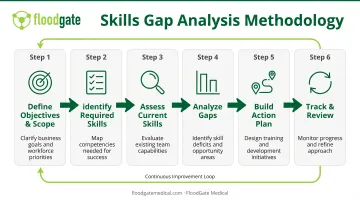
- A six-step cycle (define, identify, assess, analyze, intervene, review) keeps talent strategy tied to demand
- Results include faster hiring, higher training ROI, stronger retention, and tighter business alignment
- Specialist MedTech roles in regulatory, quality, R&D, and engineering all top 40% hard-to-fill rates
- Reassess at least quarterly, or after major strategy shifts, to stay ahead of tech and regulatory change
What Is a Skills Gap Analysis?
A skills gap analysis compares your workforce's current capabilities against the competencies required to meet business or role objectives. It inventories what your team can do today, defines what they need tomorrow, and identifies what's missing.
That gap may be technical expertise, underdeveloped soft skills, or entire capability categories your organization lacks.
Where it's used:
- Learning and development (L&D) planning to prioritize training investment
- Workforce and succession planning to forecast hiring needs
- Recruitment strategy to sharpen job requirements and candidate profiles
- Role redesign when business models or technology stacks shift
Three levels of analysis:
- Individual: Assesses one employee's proficiency against role expectations, often during performance reviews or career-development discussions
- Team/Departmental: Evaluates a functional unit (such as regulatory affairs or R&D) to identify collective strengths and weaknesses
- Organizational: Maps whether the company has the talent enterprise-wide to execute strategic initiatives, enter new markets, or adopt emerging technologies
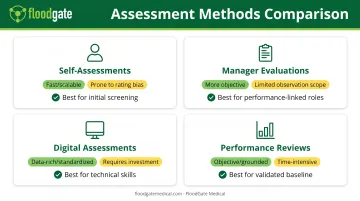
Common assessment methods:
- Self-assessments (fast but prone to over- or under-rating)
- Manager evaluations (more objective but limited by observation scope)
- Digital skills assessments or simulations (data-rich but require upfront investment)
- Performance data and work-product reviews (grounded in actual output)
Why a Skills Gap Analysis Is Critical in MedTech
Closing skills gaps directly impacts innovation speed, product quality, regulatory compliance, and competitive differentiation in healthcare technology. McKinsey reports that MedTech R&D spending is rising approximately 10% annually, yet average time-to-market still exceeds four years, a window where workforce capability becomes a rate-limiting factor.
Core benefits:
- Pinpoints where your team excels and where capability gaps put projects or launches at risk
- Directs L&D dollars to skills that close real performance gaps, not generic professional development
- Surfaces future leadership or specialist shortages early enough to build internal pipelines or plan strategic hires
- Translates vague "experienced engineer" requests into specific technical and soft-skill profiles recruiters can target
- Links capability building to commercial results: companies with top-quartile innovation scores achieve 40% higher revenue growth and twice the total shareholder return of lower quartiles
- Shows where broadening the talent pool (by geography, education path, or non-traditional careers) can close gaps faster
MedTech-specific stakes:
Those stakes show up clearly in hiring data. The 2024 Irish MedTech skills report documented which skill categories were hardest to fill across key functions—patterns US MedTech employers will recognize:
| Function | Specialist skills | Technical skills | Power skills |
|---|---|---|---|
| R&D and innovation | 44% | 38% | 18% |
| Regulatory | 48% | 36% | 16% |
| Quality | 48% | 35% | 17% |
| Engineering/manufacturing | 42% | 33% | 25% |
Regulatory-process knowledge enables early product de-risking, while manufacturing urgently needs automation, digitalization, cybersecurity, and AI capabilities. R&D professionals increasingly require hospital-workflow understanding, patient insight, and digital integration skills, not technical expertise alone.
Proof of impact: Freudenberg Medical deployed VR training for complex manufacturing roles and cut overall training time by 75%. VR-trained operators produced fewer defects, and the program scaled from Irish pilots to US sites.
How to Conduct a Skills Gap Analysis – Step by Step
These six stages draw on SHRM's workforce-planning framework and ATD's needs-assessment process. Common mistakes (skipping stakeholder alignment, relying solely on self-assessments, or assuming every gap requires training) are flagged at each step.
Step 1 – Define Objectives and Scope
What to do: Align with leadership on the business goals driving the analysis. Decide whether you're assessing an individual role, a department, or the entire organization. Clarify the timeline (current needs vs. 12–24 month horizon) and secure stakeholder buy-in from affected teams.
Why it matters: Vague scope produces vague results. A regulatory team preparing for EU MDR compliance needs different capabilities than a sales team launching a digital-health product line. Early business participation keeps implementation from stalling over surprise findings or misaligned priorities.
Metrics impacted: Strategic clarity, stakeholder buy-in, execution speed
Common mistake: Launching the analysis as an HR or L&D solo project without line-manager or executive input, then discovering the findings don't match actual business priorities.
Step 2 – Identify Required Skills and Competencies
What to do: Build a comprehensive inventory of technical and soft skills required to meet your defined objectives. Include emerging competencies tied to industry trends:
- AI/machine learning
- Digital health integration
- Automation
- Cybersecurity
- Cross-functional collaboration
- Patient-outcome literacy
Why it matters: If you only inventory today's job descriptions, you'll miss tomorrow's capability needs. MedTech R&D roles increasingly demand hospital-workflow knowledge and patient understanding alongside engineering expertise. Regulatory teams need digital documentation and early-stage product-development input, not just submission-package execution.
Metrics impacted: Completeness, future-readiness
Common mistake: Copying last year's competency list without validating against current strategy, technology roadmaps, or regulatory shifts.
Step 3 – Assess Current Workforce Skills
What to do: Establish a baseline by collecting evidence of current proficiency. Methods include:
- Performance data and work-product reviews: Objective but time-intensive
- Manager evaluations: More reliable than self-ratings but limited by observation scope
- Self-assessments: Fast and scalable but prone to over- or under-rating
- Digital skills assessments or simulations: Data-rich and standardized but require upfront investment
Use multiple methods where feasible. Cross-check self-assessments with manager input or performance outcomes.
Why it matters: Inaccurate baseline data produces false positives (training people who don't need it) or false negatives (missing critical skill deficits). Quality assessment data is the foundation of every downstream decision.
Metrics impacted: Accuracy, reliability, intervention effectiveness
Common mistake: Relying exclusively on self-assessments, which research shows are weakly correlated with actual performance, especially at lower proficiency levels.
Step 4 – Analyze and Identify the Gaps
What to do: Compare current proficiency against required benchmarks for each skill or competency. Quantify the delta (e.g., "3 of 8 engineers proficient in automation integration; 5 require upskilling"). Prioritize gaps by business impact, urgency, and breadth (individual vs. team-wide).
Why it matters: Not all gaps are equal. A regulatory knowledge deficit that puts submission timelines at risk outweighs a secondary soft-skill gap. Prioritization ensures limited training or hiring resources address the highest-value needs first.
Metrics impacted: Insight quality, prioritization accuracy, ROI of interventions
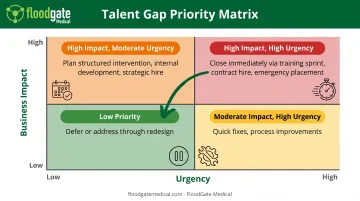
Example prioritization criteria:
- High impact, high urgency: Close immediately (training sprint, contract hire, or emergency placement)
- High impact, moderate urgency: Plan structured intervention (internal development program or strategic hire)
- Moderate impact: Defer or address through job redesign or process improvement
Common mistake: Treating every identified gap as equally urgent, diluting focus and stretching budgets across low-value training or hiring.
Step 5 – Build and Implement an Action Plan
What to do: Translate findings into specific workforce interventions. Options include:
- Training or upskilling when the capability exists internally but proficiency is insufficient
- Mentoring or job rotation to accelerate skill transfer from high performers
- Targeted hiring when the skill is absent or the timeline is too short for development
- Role redesign or process change when the gap reflects inefficient workflows rather than missing capability
- Contract or fractional staffing to bridge short-term or project-based needs
Most gaps require a blended response. Document owners, timelines, and success metrics for each initiative.
Why it matters: Analysis without action wastes time and credibility. A clear, accountable plan turns insight into measurable workforce improvement.
Metrics impacted: Decision confidence, execution speed, business-outcome improvement
Common mistake: Defaulting to training as the universal solution. Many performance gaps stem from unclear role expectations, inadequate tools, or misaligned incentives—none of which training can fix.
Step 6 – Track, Review, and Repeat
What to do: Set a formal review cadence. SHRM recommends at least quarterly workforce-planning discussions with the business, plus event-driven updates after major strategy, technology, or regulatory changes. Monitor whether interventions closed the identified gaps and whether new gaps have emerged.
Why it matters: Static plans fail. Technology evolves, regulations shift, business priorities change, and workforce composition turns over. Regular reassessment keeps your talent strategy aligned with real demand.
Metrics impacted: Long-term performance improvement, agility, ongoing alignment with business demand
Review triggers:
- Scheduled quarterly or annual reviews
- Launch of new product lines or market entries
- Adoption of new technology platforms or regulatory standards
- Organizational restructuring or leadership changes
- Persistent hiring or retention challenges in specific roles
Common mistake: Treating the skills gap analysis as a one-time project, then wondering why findings become stale within 12 months.
Skills Gap Analysis – Example Case Walkthrough
Scenario: A 120-person MedTech company is expanding its digital health product line and needs its regulatory team to support software-as-a-medical-device (SaMD) submissions alongside traditional device filings.
Scoping the goal
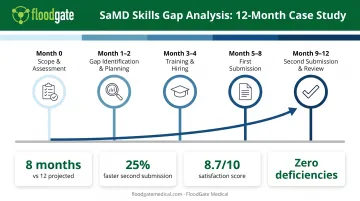
Leadership sets a 12-month objective: achieve FDA clearance and EU MDR conformity for two SaMD products. The scope is team-level (regulatory affairs, six people) with organizational implications (cross-functional collaboration with software engineering and clinical teams).
Mistake to avoid: Analyzing only the regulatory team without assessing whether software engineering or clinical can provide the inputs regulatory needs.
Listing required skills
The team inventories required competencies:
- Technical: SaMD regulatory pathways (FDA guidance, EU MDR Annex VIII), cybersecurity and software documentation (IEC 62304, FDA premarket cybersecurity guidance), software risk management, agile/DevOps process literacy
- Soft skills: Cross-functional collaboration with engineering, iterative review cycles, communicating clinical and patient impact
Mistake to avoid: Omitting soft skills. The regulatory team may understand SaMD rules but lack the collaboration cadence or technical vocabulary to work effectively with software engineers.
Assessing current abilities
The company uses:
- Manager evaluation of past submission work
- Self-assessment survey on SaMD-specific knowledge
- Review of recent project timelines and bottlenecks
Results show three of six team members have basic SaMD familiarity; none have led a full SaMD submission. Collaboration friction with engineering is documented in post-project retrospectives.
Mistake to avoid: Accepting self-ratings without cross-checking performance data or manager input.
Identifying the gap
High-priority gaps:
- SaMD regulatory pathway expertise (3 people need training; 1 strategic hire recommended for lead role)
- Cybersecurity and risk-management documentation (team-wide upskilling required)
- Cross-functional collaboration skills (process redesign plus soft-skills workshop)
Moderate-priority gap: Agile/DevOps literacy—addressed through an embedded engineering liaison rather than formal training.
Action taken
- Targeted training: Two-day SaMD regulatory workshop for entire team, followed by quarterly lunch-and-learns with engineering
- New hire: Senior regulatory specialist with prior SaMD submissions at a digital-health company
- Process redesign: Weekly touchpoint between regulatory, software engineering, and clinical; shared documentation repository
- Mentoring: New hire mentors three team members through first SaMD submission
Measurable outcomes
- First SaMD submission timeline: 8 months vs. projected 12 months
- Second submission: 6 months (25% faster than first)
- Cross-functional satisfaction scores improved from 6.2/10 to 8.7/10
- Zero submission deficiencies related to cybersecurity or risk-management documentation
Run in this order—scope, required skills, current state, gaps, then action—and the same pattern can cut months off first submissions while removing entire classes of documentation defects.
How FloodGate Medical Can Help
When a skills gap analysis shows hiring is faster or more effective than training, FloodGate Medical partners with MedTech companies on specialized talent needs.
Why MedTech companies choose FloodGate Medical:
- Deep MedTech specialization: Exclusive focus on medical technology talent across regulatory, quality, R&D, clinical, sales, marketing, and executive roles
- DEI-driven methodology: Widens the candidate pool by sourcing from non-traditional backgrounds, geographies, and career paths
- Professional network: 150,000+ pre-vetted MedTech professionals reached through a monthly industry newsletter
- Proven track record: 450+ MedTech placements annually, 89% one-year retention, and clients such as PolyMedics Innovations
- Faster time-to-fill: Human expertise plus proprietary talent technology to fill hard-to-find specialized roles
- Advisory services: Workforce planning, org design, talent audits, interview training, leadership development, and compensation benchmarking
Service options include:
- Permanent placement for strategic hires
- Contract and fractional staffing for short-term or project-based gaps
- Executive search for leadership and critical roles
- Talent strategy advisory to align hiring roadmaps with business growth
When your analysis points to a hiring need, FloodGate Medical brings MedTech-specific expertise, candidate relationships, and recruitment infrastructure to close the gap.
Conclusion
A skills gap analysis turns vague hiring instincts and training requests into data-backed workforce decisions. For MedTech companies dealing with rapid innovation cycles, regulatory complexity, and cross-functional demands, it is how you keep talent strategy aligned with business strategy.
Make it a repeated practice, not a one-time project. Technology changes, regulations shift, and product lines expand. Quarterly reviews and event-driven updates keep your workforce matched to real demand so you can move faster without giving up quality or compliance.
Frequently Asked Questions
Can you provide an example of a skills gap analysis?
A MedTech company launching a new interventional device found that only two of nine quality engineers were proficient in ISO 13485 and design-control documentation. The analysis drove targeted training for five engineers and two hires with device QA experience, closing the gap in four months.
What are the four types of gap analysis?
Four common categories are:
- Individual — one employee’s current vs. required skills
- Team or departmental — a functional unit’s collective capabilities
- Organizational — enterprise-wide capability review
- Strategic / future-focused — skills needed for planned initiatives or market shifts
How often should a skills gap analysis be conducted?
SHRM recommends at least quarterly workforce-planning reviews with the business, plus updates after major strategy changes, new technology, regulatory shifts, or ongoing hiring trouble. For most organizations, a formal reassessment at least annually is the practical minimum.
What's the difference between a skills gap analysis and a training needs analysis?
A skills gap analysis identifies the difference between current and required capabilities and can support hiring, role redesign, or process changes. A training needs analysis asks whether training is the right fix and, if so, what kind of training will close the gap.
What tools can help with a skills gap analysis?
Common tools include employee surveys, performance-review data, manager interviews, digital skills-assessment platforms, competency matrices, and skills-management software. Many teams blend methods, such as pairing self-assessments with manager evaluations for better accuracy.
How does a skills gap analysis improve recruitment?
It sharpens job requirements with the exact technical and soft skills needed, so recruiters target candidates who close real gaps (for example, in clinical, quality, or commercial MedTech roles) instead of generic “experienced” profiles. It also ranks which roles to fill first by business impact and urgency.