Introduction
U.S. employers posted 7.7 million job openings in January 2025 alone, according to the Bureau of Labor Statistics' JOLTS report. With that kind of hiring pressure, every interview counts more than it used to.
Yet most hiring managers walk into interviews with zero formal training. They ask whatever questions feel natural, score candidates on gut instinct, and hope for the best. Untrained interviewers create inconsistent, legally exposed hiring decisions — a risk HR compliance experts have flagged for years.
This guide breaks down the legal and behavioral practices that turn interviewing from a guessing game into a repeatable skill. You'll get a training curriculum outline, common pitfalls to avoid, and ways to measure whether your training actually sticks.
Key Takeaways
- Structured training cuts legal risk and shrinks bias in hiring decisions
- Combine legal grounding, bias awareness, and tools like scorecards and STAR
- Treat training as ongoing, not a one-time onboarding checkbox
- Track hiring metrics and feedback to prove training is working
Essential Topics Every Hiring Manager Training Program Should Cover
Any solid curriculum needs three pillars: legal compliance, bias awareness, and process consistency. Skip one, and the whole program develops blind spots.
Legal Compliance and EEOC Guidelines
The EEOC prohibits discrimination based on race, color, religion, sex, national origin, age 40+, disability, and genetic information. Questions that reveal this information aren't automatically illegal, but they can be used as evidence of discriminatory intent if a candidate is rejected.
Common missteps hiring managers make without realizing it:
- Asking about marital status or "How many kids do you have?" (both can suggest sex-based bias, per EEOC guidance)
- Asking whether a candidate has a disability before extending a conditional offer
- Asking about age or date of birth, which invites scrutiny even though it's not categorically banned
- Asking about religious affiliation or citizenship status instead of work authorization
Don't rely on managers to figure this out through "common sense." Give them an approved question bank tied to the actual job requirements. It removes guesswork and keeps every interview defensible.
Recognizing and Reducing Unconscious Bias
Every interviewer has blind spots. The usual suspects are first-impression error (deciding within minutes and spending the rest of the interview confirming that snap judgment), groupthink on panels, and the halo-horn effect, where one strong or weak trait colors everything else.
Bias doesn't disappear because someone means well. It has to be engineered out of the process. Research from Harvard Business School found that masking identifying information during resume screening narrowed gender and age gaps by roughly 25%.
Practical mitigation tactics:
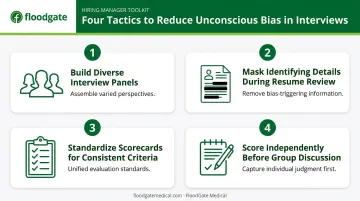
- Build diverse interview panels, not single-evaluator decisions
- Mask identifying details during initial resume review
- Standardize scorecards so every candidate is judged against the same criteria
- Have interviewers score independently before any group discussion
Structuring the Interview Process and Candidate Experience
Consistency isn't just about legal protection. It's the difference between a candidate feeling respected and one who ghosts your offer.
Every candidate for the same role should move through:
- The same interview stages, in the same order
- The same core questions, with room for role-specific follow-ups
- Clear timelines and proactive communication at each step
Remote interviews are here to stay. 93% of employers expect to keep using virtual interviews long-term, per SHRM's survey of over 1,100 U.S. employers.
Train managers to test their tech beforehand, minimize distractions, and offer an alternative format when video isn't accessible. Candidates increasingly resent recorded video interviews that feel impersonal. Build in a live touchpoint somewhere in the process.
Best Practices for Training Hiring Managers to Interview Effectively
Knowing the rules is one thing. Applying them under pressure, mid-interview, is another. This is where training needs to move from lecture to practice.
Build an Ideal Candidate Profile Together
Before anyone writes an interview question, HR and the hiring manager should co-create a candidate profile covering:
- Must-have hard skills (the non-negotiables)
- Soft skills that matter for the specific team
- "Culture-add" factors: what the team is missing, not just what it already has
Skipping this step is how you end up with interview questions that don't actually predict job success.
Use Mock Interviews and Role-Play
Have managers interview each other. Swapping sides of the table builds empathy fast; most people don't realize how a rushed, unclear question feels until they're the one answering it. It also surfaces bad habits, like leading questions or interrupting, before they show up with real candidates.
Teach the STAR Method and Scoring Rubrics
The STAR framework (Situation, Task, Action, Result) pushes candidates toward specific examples instead of vague generalities. The OPM's Structured Interview Guide recommends pairing this with anchored rating scales: five to seven proficiency levels, each labeled with example behaviors.
Anchored scorecards reduce the "gut feel" trap. Instead of asking "did I like them?" managers ask "did their answer match the benchmark response for a strong hire?"
Conduct Pre-Interview Briefings
A short briefing before each interview loop keeps everyone aligned. It should cover:
- A quick review of the job description and key competencies
- The rationale behind each interview question
- A walkthrough of the scorecard and rating scale
- Guidance on note-taking (specific, behavioral notes, not impressions)
Reinforce Training on a Recurring Cadence
One session doesn't create lasting skill. Learning researchers have long documented the "forgetting curve": retention drops sharply after training ends unless it's reinforced. Set a recurring cadence, whether that's quarterly refreshers, embedded scorecard reminders, or short retraining tied to scoring drift you catch during audits.
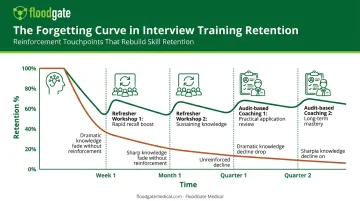
FloodGate Medical builds this cadence directly into its hiring-manager training programs, pairing an initial workshop with quarterly refreshers and audit-based coaching until the scoring habits stick.
Common Mistakes That Undermine Interview Training
Even well-intentioned programs fail in predictable ways.
- Treating it as a one-time event. A single onboarding session doesn't survive contact with a busy hiring season. Skills fade without reinforcement.
- Teaching mechanics without the "why." Managers who don't understand why structured questions matter will improvise the moment they feel confident, undoing the whole system.
- Relying on bias awareness alone. Telling managers "bias exists" doesn't change behavior. Pair that awareness with concrete tools, such as evidence-based scoring and structured debriefs, or it's just a lecture that changes nothing.
FloodGate Medical's hiring-manager training programs are built to close each of these gaps directly.
How to Measure the Success of Your Training Program
Training programs succeed or fail based on what you measure. Track these metrics before and after rollout:
| Metric | What It Tells You |
|---|---|
| Time-to-hire | Whether structured interviews speed up or slow down decisions |
| Quality-of-hire | New-hire performance, retention, and engagement post-hire |
| Offer-acceptance rate | Whether candidates feel respected through the process |
| Scorecard consistency | Whether managers are actually using the rubric, not just checking a box |
Beyond the numbers:
- Send short post-interview surveys to both candidates and hiring managers
- Periodically audit scorecards and interview notes across teams for consistency and bias red flags
- Segment metrics by interviewer to spot who needs a refresher
FloodGate Medical builds this measurement loop into every hiring-manager training program from day one.
Why Partnering with a Specialized MedTech Recruiter Strengthens Your Hiring Process
Even well-trained hiring managers have limited hours in the week. That's where a recruiting partner earns its keep: reducing the volume of unqualified candidates that ever reach an interview slot, without replacing the internal training itself.
FloodGate Medical works exclusively within the MedTech industry, so candidate pre-screening reflects the technical and cultural realities of cardiovascular devices, diagnostics, and interventional cardiology roles. Recruiters take time to understand a client's actual team gaps before presenting anyone.
That focus translates into three concrete advantages for hiring managers:
- Fewer mismatches: pre-screening filters out candidates who don't fit the technical or cultural bar before they reach your calendar
- A broader, more diverse slate: DEI-driven sourcing surfaces qualified candidates from the start, rather than correcting a narrow pipeline later
- Free hiring-team resources: the complimentary Talent Excellence Education program offers guides and tools for attracting and retaining strong talent
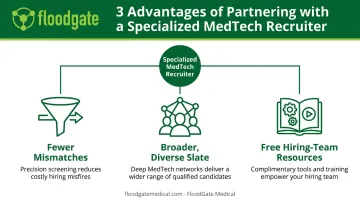
Pairing internal training with a specialized recruiting partner adds a critical layer: it ensures the structured process your managers just learned has quality candidates to apply it to.
Frequently Asked Questions
How often should hiring managers receive interview training?
Start with a comprehensive initial session, then follow up with quarterly or biannual refreshers. This keeps skills active instead of fading between hiring cycles.
What should you do if a hiring manager resists interview skills training?
Tie the training directly to hiring quality and business goals they already care about. Address their specific objections and offer flexible formats, like short video modules instead of full workshops.
How do you know if your interview training is actually working?
Watch hiring metrics like time-to-hire and quality-of-hire, gather feedback surveys from managers and candidates, and audit scorecards for consistency across teams.
What's the difference between structured and unstructured interviews?
Structured interviews use the same pre-set questions and rating rubric for every candidate. Unstructured interviews vary by conversation and are far more prone to bias. A meta-analysis by McDaniel et al. puts structured interview validity at .44 versus .33 for unstructured formats.
Who should conduct interview training for hiring managers?
HR or Talent Acquisition teams typically lead training internally. Many companies supplement this with external recruiting partners, such as FloodGate Medical, or specialized trainers who bring industry-specific context.
What legal topics are most important to cover in interview training?
Focus on EEOC-protected characteristics, including race, age, disability, sex, national origin, and religion, plus specific questions to avoid, like marital status or medical history before a conditional offer.