
Introduction: Why MedTech Companies Need a Proactive Talent Pipeline Strategy
The MedTech industry supports nearly 3 million U.S. jobs across 16,000 manufacturing facilities. Job growth has run at three times the overall manufacturing rate since 2018.
Yet companies still struggle to access specialized talent fast enough for innovation cycles, regulatory compliance, and device launches. Reactive hiring makes that gap worse.
When specialized roles—regulatory affairs professionals, clinical specialists, quality engineers—sit vacant for months, product launches stall and quality systems weaken. Competitors move first.
The regulatory workforce alone includes 124,436 professionals worldwide. Only 21% work in medical devices, and just 25% were actively seeking new roles in 2024. Competition for this limited pool is fierce.
A strategic talent pipeline identifies and nurtures qualified candidates before positions open. Companies that build one cut time-to-hire, raise candidate quality, and keep steady access to the skills behind medical technology innovation. This guide walks through how to build that pipeline—from workforce planning and sourcing channels to nurturing, metrics, and common pitfalls.
Key Takeaways
- Proactive talent pipelines identify and engage candidates before roles open, reducing hiring cycles
- MedTech teams gain faster regulatory submissions, uninterrupted quality operations, and competitive product launches
- Balancing internal development with external sourcing secures specialized regulatory, clinical, and engineering talent
- DEI-focused pipelines expand access to underrepresented talent and drive innovation in healthcare technology
Why Talent Pipeline Strategy Matters for MedTech Companies
MedTech hiring presents unique challenges that make reactive recruiting especially costly. Specialized skill requirements (FDA regulatory expertise, ISO quality system knowledge, clinical procedure understanding) limit the candidate pool significantly.
The RAPS 2024 workforce report confirms that only 21% of global regulatory professionals work in medical devices. Demand keeps rising as AI-enabled devices and digital health solutions call for new regulatory skillsets.
The cost of vacant specialized positions extends far beyond recruiter hours:
- Delayed regulatory submissions when regulatory affairs roles remain unfilled
- Compromised quality systems without experienced quality engineers and managers
- Lost competitive advantage as rivals launch similar devices first
- Stalled clinical programs when clinical specialists aren't available to support procedures
- Weakened innovation pipelines when R&D teams lack critical expertise
Ready pipelines turn those risks into speed. Companies that keep pre-vetted candidates close can staff new product teams right after FDA clearance and scale commercial operations as soon as reimbursement is secured. That same bench also supports more diverse teams—people who understand varied patient populations and clinical needs.
What is a Talent Pipeline Strategy?
A talent pipeline strategy is a proactive approach to identifying, attracting, engaging, and nurturing potential candidates for future roles before positions become vacant. Rather than starting from zero when a resignation or business need creates an opening, pipeline-focused companies maintain ongoing relationships with qualified professionals who can step into roles quickly.
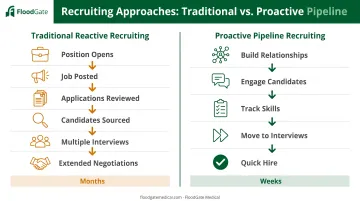
Traditional reactive recruiting follows a predictable pattern:
- Position opens
- Job description posted to boards
- Applications reviewed
- Candidates sourced from scratch
- Multiple interview rounds
- Extended negotiations stretch the timeline to months before the role is filled
Proactive pipeline recruiting operates differently:
- Build relationships with qualified professionals on an ongoing basis
- Engage candidates through useful content and regular touchpoints
- Track skills and interests as they develop
- Move pre-qualified candidates into interviews as soon as a role opens
- Compress hiring cycles from months to weeks
Talent pool vs. talent pipeline: A talent pool is a static database of resumes and contact information from people who once applied or expressed interest. A talent pipeline is dynamic and relational: active engagement, staged progression, and two-way communication.
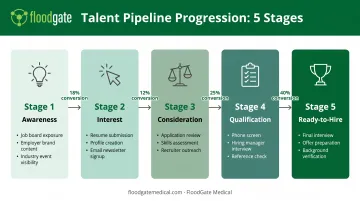
Pipeline stages in practice:
- Awareness: Candidates learn about your company and opportunities
- Interest: They engage with your content, attend events, or join your network
- Consideration: They explore specific roles and assess cultural fit
- Qualification: You assess their skills, experience, and readiness
- Ready-to-hire: They can interview and accept offers when positions open
MedTech companies need stronger pipelines than most industries. The specialized candidate pool is small, and certification and experience bars are high. A bad hire in quality or regulatory roles can affect patient safety and business viability.
Step 1: Forecast Future Talent Needs Through Strategic Workforce Planning
Building an effective pipeline starts with understanding which roles you'll need and when. This requires translating business strategy into talent requirements.
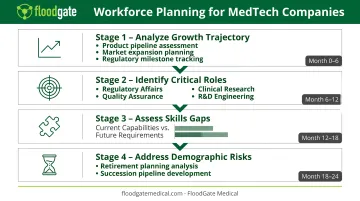
Analyze your MedTech company's growth trajectory:
- Review your product development pipeline: which devices will reach clinical trials, regulatory submission, or launch in the next 12-24 months?
- Identify planned market expansions, new service lines, or facility openings
- Consider regulatory milestones that will trigger hiring needs (510(k) clearances, PMA submissions)
- Assess technology shifts that change hiring needs, such as FDA's AI device guidance on validation, cybersecurity, and lifecycle management
Identify critical roles with the highest impact and longest time-to-fill:
- Regulatory affairs managers with FDA 510(k) or PMA experience
- Quality engineers familiar with ISO 13485 and design controls
- Clinical specialists who can support physicians during procedures
- R&D scientists with specific material science or biocompatibility expertise
- Commercial leaders who understand complex hospital procurement
Assess skills gaps:
- Compare current workforce capabilities against future requirements
- Factor in emerging needs like digital health integration, AI/ML in medical devices, and cybersecurity
A 2024 Deloitte survey of 85 MedTech leaders found 42% already seeing AI/GenAI benefits in product development and 35% in IT/cybersecurity. That points to rising demand for data science and validation talent.
Address demographic risks:
- Identify retirement risks in specialized technical roles where knowledge transfer is critical
- Develop succession plans for key experts whose departure would create major knowledge gaps
- Build internal development pathways for high-potential employees
When workforce planning flags a critical need 12 months out, you have time to build a qualified pipeline. Wait until the need is urgent, and you're hiring under pressure with far fewer options.
Step 2: Build Detailed Success Profiles for Target Roles
Job descriptions list requirements. Success profiles define what actually drives performance in your organization.
Define Competencies Beyond the Basics
For each critical role, document:
- Technical skills: Specific regulatory pathways (510(k), De Novo, PMA), quality standards (ISO 13485, ISO 14971), clinical procedures, engineering disciplines
- Experience types: Years in MedTech vs. adjacent industries, company size and stage, product categories
- Behavioral attributes: Attention to detail for quality roles, empathy and communication for clinical roles, strategic thinking for regulatory leadership
- Cultural factors: Work style (autonomous vs. collaborative), pace preference (startup vs. established), values alignment
Validate with top performers:
Interview your most successful employees in each role. What skills do they use daily? What experiences prepared them? What personality traits help them thrive? These conversations reveal the real success drivers, not just the credential checklist.
Integrate DEI Considerations From the Start
Review profiles to eliminate bias:
- Challenge traditional requirements that aren't truly necessary, such as "Must have Big 5 MedTech experience," which artificially limits the pool
- Replace degree requirements with skills-based criteria where appropriate (Medtronic recredentialed 122 roles in 2024 to allow equivalent experience)
- Remove biased language that discourages diverse applicants
- Ensure "culture fit" means values alignment, not demographic homogeneity
Research shows diverse teams drive better outcomes. A 2021 Science study of U.S. biomedical patents found all-female inventor teams were 35% more likely than all-male teams to focus on women's health, demonstrating how representation shapes innovation toward underserved patient populations.
Step 3: Source Candidates from Internal and External Pools
Effective pipelines balance internal development with external sourcing—you need both working together.
Internal Pipeline Development
Identify high-potential employees systematically:
- Use performance reviews, manager recommendations, and succession planning to spot future leaders
- Look beyond current performance to learning agility and growth potential
- Consider technical specialists who could move into regulatory, quality, or clinical roles with training
Create clear career pathways:
- Show employees how they can progress from quality associate to quality manager to director
- Map lateral moves that build broader expertise (clinical to regulatory affairs, R&D to product management)
- Make advancement criteria transparent
Implement cross-training programs:
- Expose quality engineers to regulatory submissions
- Give clinical specialists insight into R&D and product development
- Rotate high-potential employees through different functions
Medtronic's MAPS program pays 100% of tuition upfront for eligible U.S. and Puerto Rico employees. Participation rose 50% in 2024, a clear signal that tuition support strengthens the internal pipeline.
External Pipeline Development
Re-engage silver medalists:
- Mine your ATS for candidates who interviewed well but weren't hired
- Prioritize runners-up and applicants who hit bad timing on a prior role
- Reconnect with pre-qualified talent that already knows your company
Leverage specialized MedTech networks:
- Engage passive candidates on LinkedIn (RAPS 2024: 25% of regulatory professionals are open to new roles)
- Attend MedTech conferences like Medical Device Manufacturers Association events and AdvaMed gatherings
- Participate in online communities specific to regulatory affairs, quality, and clinical specialties
Build university partnerships:
- Establish relationships with biomedical engineering programs
- Connect with regulatory affairs certificate programs (RAPS offers academic partnerships and mentoring)
- Sponsor capstone projects or internships (Stryker engaged 200+ students via Stryker Day; Career Right Here interns converted to full-time hires in 2024)
Partner with specialized MedTech recruiters:
When internal mobility and open networks still leave gaps, a MedTech-focused search partner can widen the pool fast. FloodGate Medical, for example, draws on a network of more than 150,000 MedTech professionals and a DEI-centered process to reach regulatory, clinical, and quality talent that rarely shows up in public job boards.

Step 4: Engage and Nurture Your Candidate Pipeline
Sourcing builds the pipeline. Engagement keeps it alive.
Develop a Valuable Content Strategy
Create content that educates and engages:
- Industry trend newsletters highlighting regulatory changes, reimbursement updates, or technology developments
- Webinars on career development in MedTech specialties
- Facility tours or virtual open houses that show your labs, products, and teams
- Employee testimonials and day-in-the-life stories
Match that content to where each candidate is in their career:
- Early-career professionals want growth opportunities and mentorship
- Mid-career specialists want challenging technical work and patient impact
- Senior leaders want strategic influence and organizational mission
Maintain Regular, Non-Pushy Touchpoints
Check in quarterly through:
- Personalized emails referencing their interests or career goals
- Event invitations (conferences, webinars, networking meetups)
- Informal coffee chats or informational interviews (no immediate job pitch required)
Provide genuine value without pressure. Respect candidates' time and current employment. When they're ready to move, you'll be top of mind.
Showcase Culture, Values, and Patient Impact
Demonstrate what makes your company different:
- Share patient outcome stories that show the real-world impact of your devices
- Highlight diversity initiatives and employee resource groups
- Feature innovation work and R&D breakthroughs
- Show commitment to quality and regulatory excellence
Candidates want to work where their skills make a difference. Make that connection visible.
Step 5: Assess and Qualify Pipeline Candidates Continuously
Not every candidate in your pipeline is ready to hire today. Continuous assessment helps you segment and prioritize.
Implement Lighter-Touch Assessments
For candidates not yet ready to apply:
- Informal conversations about their career goals and interests
- Skills assessments or portfolio reviews to gauge technical capability
- Values and working-style discussions to gauge team alignment
Keep these interactions low-pressure and development-focused. You're building a relationship first. In MedTech, that might mean reviewing a regulatory portfolio or talking through a recent product launch rather than running a scored interview loop.
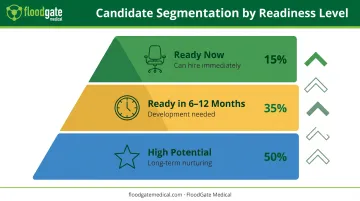
Segment Your Pipeline Into Tiers
Organize candidates by readiness:
- Ready now: Can interview immediately if a matching role opens
- Ready in 6-12 months: Need development, timing, or life circumstances to align
- High potential: Longer-term prospects worth nurturing
- Not ready: Not qualified or poor fit—remove from active pipeline
For internal candidates:
- Create individual development plans with clear milestones
- Offer mentorship from senior leaders
- Provide stretch assignments that prepare them for future roles
- Track progress quarterly
Track Candidate Progression
Monitor how candidates move through pipeline stages. If many candidates stall at the "consideration" stage, your messaging or employer brand may need work. If "ready-now" candidates decline interviews, compensation or role clarity may be the issue.
Step 6: Leverage Technology to Scale Your Pipeline Efforts
Step 6: Use Technology to Scale Your Pipeline Efforts
Manual pipeline management works for 20 candidates. For 200, you need technology.
Choose the Right Tools
Evaluate whether your ATS supports pipeline management:
- Can you tag candidates by readiness tier, skill set, and interests?
- Does it allow automated nurture campaigns with personalization?
- Can you track engagement and progression through stages?
If your ATS is designed only for active requisitions, consider a dedicated recruitment CRM (candidate relationship management system) built for long-term relationship building.
Automate Engagement Workflows
Set up email sequences for different pipeline segments:
- Quarterly check-ins for passive candidates
- Monthly updates for active job seekers
- Event invitations based on role interests
- Content delivery based on career stage
Maintain personalization through dynamic fields and segmentation. Automation should feel helpful, not robotic.
Use AI for Candidate Matching
Use AI to identify internal employees with transferable skills or external candidates who match success profiles. These tools can surface people you might otherwise miss. Always validate recommendations with human judgment, especially for cultural fit and specialized technical expertise.
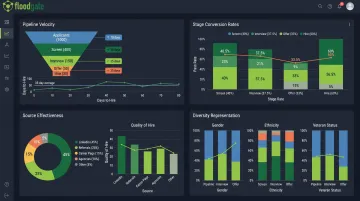
Track Pipeline Metrics in Real-Time
Build dashboards that show:
- Pipeline velocity: How quickly candidates move through stages
- Conversion rates: Percentage advancing from awareness to ready-to-hire
- Source effectiveness: Which channels produce the best candidates
- Diversity metrics: Representation at each pipeline stage
Real-time visibility enables proactive adjustments. If your regulatory affairs pipeline is thin, you can increase sourcing efforts before a vacancy creates urgency.
Common Talent Pipeline Challenges in MedTech (and How to Overcome Them)
MedTech talent pipelines hit structural hurdles that generic recruiting playbooks rarely cover. These four show up most often, along with practical ways to work through each one.
Challenge 1: Limited qualified candidate pools for specialized roles
Only 21% of regulatory professionals work in medical devices. With demand still rising, the pool stays tight.
- Start pipeline development earlier by building relationships with students and early-career professionals through university partnerships and internships
- Expand geographic search to include remote or relocation candidates
- Consider adjacent industries (pharma, healthcare IT, clinical research) where transferable skills exist
- Invest in skills-based hiring to expand the pool beyond traditional credential requirements
Challenge 2: Candidates aren't responsive over long periods
Passive candidates rarely engage when outreach feels generic or self-serving.
- Provide genuine value through content, networking opportunities, and career insights
- Respect their time with quarterly touchpoints, not weekly sales pitches
- Personalize communication based on their interests and career goals
- Make it easy to engage (simple RSVP links, mobile-friendly content, brief surveys)
Challenge 3: Balancing diversity goals with specialized skill requirements
Underrepresented groups often have less access to MedTech networks and traditional career pathways.
- Expand sourcing channels to include HBCUs, Hispanic-Serving Institutions, women in STEM programs, and veteran transition organizations
- Remove biased language from success profiles and job postings
- Form diverse interview panels to reduce unconscious bias in assessments
- Use skills-based assessments that focus on capability rather than pedigree
- Build relationships with diverse professional associations such as the Society of Women Engineers and the National Society of Black Engineers
Challenge 4: Internal resistance to pipeline investment when immediate hiring needs exist
Leadership may question the ROI of long-term relationship building when open roles are costing the business today.
- Demonstrate ROI through metrics: time-to-hire reduction, cost-per-hire savings, and quality-of-hire improvements
- Start small with a pilot program for 1-2 critical roles where hiring difficulty is highest
- Show quick wins: silver medalist re-engagement often produces hires within 30-60 days
- Frame pipeline development as risk management, not just efficiency. What happens when your lead quality engineer resigns tomorrow?
Measuring Your Talent Pipeline Success
A pipeline only pays off if you can prove it. Track these metrics to show ROI and spot where candidates drop off:
- Time-to-hire: Compare how fast you fill roles from an active pipeline versus starting from scratch. Internal before-and-after data shows value even without industry benchmarks.
- Quality of hire: Compare performance ratings, retention, and promotion rates for pipeline versus non-pipeline hires at 6, 12, and 24 months. Do pipeline candidates onboard faster, perform better, and stay longer?
- Conversion rates: Measure what share of pipeline candidates get hired and which stages see the highest drop-off. Heavy stalling at qualification often means your assessment process needs work.
- Diversity representation: Track women, minorities, and other underrepresented groups in your pipeline versus hires versus workforce demographics. Pipeline diversity should meet or exceed workforce diversity; if it doesn't, fix sourcing.
- Cost savings: Tally lower spend from fewer job postings, lower agency fees, and less recruiter time per hire. Add the business impact of faster fills: revenue protected in open sales territories and product launches that stay on schedule because regulatory talent is ready.
Frequently Asked Questions
What is a talent pipeline strategy?
A talent pipeline strategy proactively identifies, engages, and nurtures qualified candidates before roles open. You build a continuous flow of ready-to-hire talent for critical positions instead of starting from zero when a vacancy appears.
What are the five C's of talent?
The five C's evaluate candidates on Culture fit, Competence (skills and knowledge), Capacity to grow, Commitment (engagement and stay potential), and Compatibility with team dynamics and goals.
What is the 70/30 rule in hiring?
The 70/30 rule suggests 70% of hires come from internal candidates or referrals (known quantities with proven fit), and 30% from external sources to add new skills and diverse perspectives.
How long does it take to build an effective talent pipeline?
Building a pipeline for critical roles typically takes 3–6 months to produce ready-now candidates. Ongoing nurturing and engagement keep a healthy flow of qualified talent over time.
What's the difference between a talent pipeline and a talent pool?
A talent pool is a static database of past applicants or people who once expressed interest. A talent pipeline is dynamic: you actively nurture candidates through relationship stages with regular touchpoints until they are ready to hire.
How do you measure talent pipeline success?
Track a short set of outcomes:
- Time-to-hire vs. reactive recruiting
- Quality-of-hire scores and retention
- Stage conversion rates and source effectiveness
- Diversity across the funnel and cost-per-hire savings