Introduction
MedTech hiring managers aren't just competing for talent — they're searching for it in a pool that barely exists. A qualified medical device sales rep, clinical application specialist, or regulatory affairs professional needs product knowledge, clinical fluency, commercial instincts, and often hospital access credentialing before they can do the job at all.
That's why reading healthcare staffing agency reviews through a general lens fails. A five-star rating earned for placing travel nurses tells you nothing about whether an agency can source a capital equipment sales rep or a field clinical specialist for a product launch.
This article breaks down how to interpret staffing agency reviews specifically for MedTech roles: what signals matter, which patterns to avoid, and how to tell agencies built for this industry apart from those simply claiming healthcare expertise.
Key Takeaways
- MedTech roles demand clinical knowledge, technical depth, and commercial skills — generalist agencies rarely reach that candidate pool
- Review specificity beats star ratings: look for named MedTech roles filled, not vague praise
- Strong reviews mention passive sourcing, retention outcomes, and recruiter MedTech knowledge
- Compliance in MedTech staffing includes vendor credentialing and hospital access requirements — not just background checks
- DEI-focused recruitment methodologies correlate with stronger innovation outcomes in healthcare technology
Why MedTech Hiring Is Different from General Healthcare Staffing
MedTech roles sit at an unusual intersection. A field clinical specialist needs enough clinical knowledge to stand in an OR, enough product expertise to troubleshoot a device mid-procedure, and enough commercial awareness to support the sales team. That combination doesn't exist in general nursing candidate pools.
According to AdvaMed's 2024 Economic Impact Report, the U.S. MedTech sector supports nearly 519,000 direct jobs and close to 3 million direct and indirect positions. Manufacturing employment has grown at three times the rate of overall U.S. manufacturing since 2018.
That scale creates real recruiting pressure — and it falls on role families that require very specific combinations of clinical, regulatory, and commercial knowledge.
The specific role families in demand look like this:
| Role | Complexity Driver |
|---|---|
| Medical device sales rep | Territory management, clinical selling, device-specific training |
| Clinical/field application specialist | Procedural knowledge, product troubleshooting, clinical credentialing |
| Regulatory affairs specialist | FDA 21 CFR familiarity, submission experience, audit coordination |
| Biomedical/R&D engineer | Device design, ISO standards, testing protocols |
| Quality assurance | QMS, ISO 13485, CAPA processes |
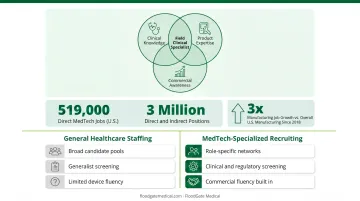
A generalist healthcare staffing agency — even a well-reviewed one — lacks the candidate network, recruiter domain knowledge, and role-specific screening frameworks to fill these positions reliably. That gap is exactly what MedTech-specialized firms are built to close.
What Healthcare Staffing Agency Reviews Actually Reveal for MedTech Hiring
Reviews function as a proxy for an agency's real capability. The challenge is reading them correctly.
What Authentic MedTech Reviews Look Like
Useful MedTech reviews are specific. Compare these two:
- "Helped us hire a clinical specialist for our orthopedic line — candidate cleared hospital credentialing and was productive within 60 days"
- "Great communication, very responsive, highly recommend"
The first tells you something. The second tells you nothing about MedTech capability. When reading reviews, filter for role specificity, therapy area mentions, and measurable outcomes post-placement — ramp time, retention, or credentialing success.
The Value of Reading Both Sides
Client reviews reveal recruiter responsiveness, candidate quality, and industry knowledge. Candidate reviews reveal something equally important: whether the recruiter actually understood the role.
A recruiter who can't distinguish a medical device sales rep from a pharma rep will submit mismatched candidates. Candidates recognize this immediately — and their reviews will say so.
Both perspectives together give you a fuller picture than either side alone. ### Volume and Consistency Signal Reliability
Single glowing reviews mean little. Cross-platform consistency is what matters. When evaluating an agency's review profile, look for:
- Breadth: 50+ reviews across Google, LinkedIn, and ClearlyRated carry more weight than two polished testimonials
- Consistency: A 4.9-star average across platforms signals reliability; a single five-star spike does not
- Tenure: A client noting three years of consistent MedTech hires is far more predictive than a one-time placement review
Long-term partnership reviews are the strongest signal. They demonstrate an agency's ability to deliver repeatedly — not just once under favorable conditions.
Key Criteria to Evaluate When Reading MedTech Staffing Agency Reviews
Sector Specificity
The single clearest signal in any review is whether the agency clearly understands MedTech — not just "healthcare." Look for reviewers who mention:
- Specific device categories (capital equipment, IVD, neuromodulation, cardiovascular)
- Therapy area knowledge (orthopedics, urology, interventional cardiology)
- Commercial MedTech terminology (OTE structures, territory management, product launch hiring)
Agencies with genuine MedTech expertise have recruiters who understand FDA 21 CFR, field clinical specialist roles, and the meaningful difference between device and pharma sales. Reviews referencing that depth of knowledge are a strong green flag.
Candidate Quality and Retention
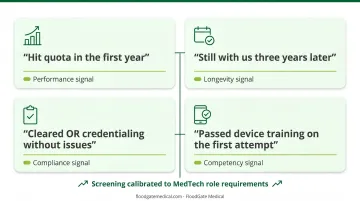
Reviews mentioning what happened after placement are among the most valuable. Look for language like:
- "Hit quota in the first year"
- "Still with us three years later"
- "Cleared OR credentialing without issues"
- "Passed device training on the first attempt"
These signals indicate the agency's screening process is actually calibrated to MedTech role requirements — not just resume filtering.
DEI-Driven Hiring Practices
Diverse teams produce measurably different outcomes in healthcare technology. A 2021 study published in Science found that all-woman inventor teams were 35% more likely than all-man teams to focus their biomedical patents on women's health — a direct connection between team composition and the direction of innovation.
Reviews that praise an agency for surfacing diverse candidate pools in device sales and clinical roles signal a recruitment process built around outcomes, not optics. FloodGate Medical, for example, centers its entire hiring methodology on equity, diversity, and inclusion — treating DEI as a driver of better placements and stronger team performance rather than a reporting requirement.
Communication and Speed on Specialized Roles
MedTech hiring often runs on tight timelines — product launches, territory expansions, sales cycle starts. Reviews mentioning fast response times and proactive recruiter communication matter more in this sector than most.
Watch for the opposite signals too: repeated complaints about ghosting, delayed candidate slates, or generic profiles submitted without customization are warning signs that an agency is recycling active job seekers rather than sourcing from a warm passive network.
Compliance and Credentialing Awareness
Speed and communication mean little if an agency stumbles on compliance. Field representatives need facility-specific vendor credentialing — platforms like IntelliCentrics SEC3URE (serving over 10,000 healthcare facilities), GHX Vendormate, or Reptrax — and requirements vary by hospital system, access area, and representative type.
Reviews that reference an agency's familiarity with credentialing portals, OR badge requirements, or NDA handling for sensitive product launches reflect genuine MedTech operational knowledge. Agencies that treat all healthcare placements the same way will create compliance gaps their clients discover after placement.
Red Flags and Green Flags in MedTech Staffing Agency Reviews
Green Flags to Look For
- Reviews mention specific MedTech roles filled — not just "found us great candidates"
- Candidate retention references beyond 12 months post-placement
- Repeat business mentioned explicitly ("we've used them for five roles across three product lines")
- Passive candidate sourcing noted ("they reached out to someone not actively looking")
- Recruiter demonstrated knowledge of compensation benchmarks (OTE, device sales incentive structures)
- Reviewers affiliated with recognizable MedTech companies — device manufacturers, diagnostics firms, health IT companies
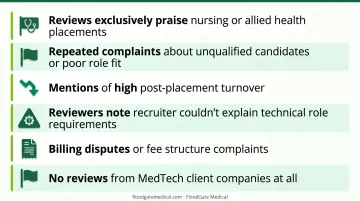
Red Flags to Watch For
- Reviews exclusively praise nursing or allied health placements
- Repeated complaints about unqualified candidates or poor role fit
- Mentions of high post-placement turnover
- Reviewers note recruiter couldn't explain technical role requirements
- Billing disputes or fee structure complaints
- No reviews from MedTech client companies at all
How Agencies Respond to Negative Reviews
Once you've scanned the review content itself, look at how the agency responds to it. Agencies that acknowledge issues, describe corrective action, and maintain a professional tone demonstrate accountability — the same accountability you'd expect when a placement doesn't land. Agencies that ignore criticism or respond defensively are showing you their client service culture before you've signed anything. Review their Google and Glassdoor response history; it's a reliable preview of how they'll handle problems during your engagement.
Where to Find Reliable Reviews for MedTech Staffing Agencies
Key review platforms:
- Google Business Profile offers the highest review volume. Prioritize agencies with substantial review counts, not just high averages — a 5-star rating from 8 reviewers means less than a 4.7 from 80
- ClearlyRated is the most rigorous option for staffing firms, using Net Promoter Score with a minimum response threshold (15 responses, roughly 10% response rate) for its Best of Staffing awards — and it measures client and candidate satisfaction separately
- Glassdoor surfaces internal culture signals worth tracking. Agencies with consistently unhappy employees tend to deliver inconsistent client service
- LinkedIn provides company-level recommendations and recruiter credibility signals, though no standardized review methodology applies — treat it as directional, not definitive
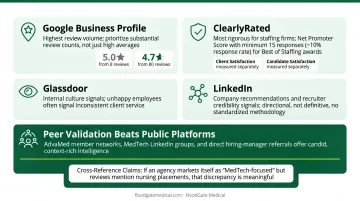
Peer validation often beats any public platform for MedTech-specific intelligence. Feedback from AdvaMed member networks, MedTech LinkedIn groups, and direct referrals from hiring managers at device companies tends to be candid and context-rich. Asking a trusted contact what outcomes they actually experienced with an agency is hard to replicate online.
Always cross-reference agency website claims against what reviewers actually describe. If an agency markets itself as "MedTech-focused" but all its reviews mention nursing placements, that discrepancy is meaningful.
How to Choose the Right MedTech Recruitment Partner
The decision framework comes down to three questions:
- Does the agency have verifiable MedTech placement history? Not healthcare broadly — device sales, clinical specialists, regulatory, R&D, quality.
- Do reviews from MedTech client companies specifically support that history? Not just high star ratings from general healthcare employers.
- Do the agency's recruiters speak the language? Territory management, hospital access, FDA knowledge, device compensation structures.
Before committing to any agency, request a discovery consultation and evaluate the quality of their questions. A MedTech-capable recruiter asks about therapy area, device category, call point complexity, and ramp-up timeline — not just headcount and target start date. Agencies that ask intelligent discovery questions have the industry knowledge to source intelligently.
What this looks like in practice: FloodGate Medical, focused exclusively on MedTech talent acquisition, offers a concrete reference point. Their sourcing methodology centers on proactive passive candidate engagement — reaching MedTech professionals while they're still employed and building relationships before a role opens. Recruiters cover cardiovascular, urology, GI, OBGYN, quality, regulatory, and commercial functions, with specialists like Morgan Mills in cardiovascular and vascular devices.
Their 2026 MedTech Compensation Guide reflects active tracking of OTE structures and pay benchmarks across specialties, the kind of market intelligence that produces better hiring conversations from the start.
Treat agency evaluation as an ongoing process. Track post-placement retention, assess whether the agency continues to deliver relevant candidates as your product lines evolve, and reassess partnerships annually. A strong first placement is a starting point; consistent performance across roles and years is what earns a long-term partnership.
Frequently Asked Questions
What is the difference between a general healthcare staffing agency and a MedTech-specialized recruitment firm?
General healthcare agencies primarily fill clinical roles — nurses, allied health, travel positions. MedTech-specialized firms recruit for device sales, clinical specialists, regulatory affairs, and R&D roles, requiring an entirely different candidate network, screening criteria, and industry knowledge base — one that generalist agencies don't maintain.
What should MedTech companies look for in staffing agency reviews?
Prioritize reviews that mention specific MedTech roles filled, post-placement retention, recruiter familiarity with device categories or therapy areas, and repeat business. Generic praise like "great communication" or a high star rating without role-specific detail tells you almost nothing about MedTech capability.
Can a high-rated healthcare staffing agency still be a poor fit for MedTech hiring?
Yes. An agency rated highly for nursing or travel healthcare placements may have no meaningful MedTech candidate network or recruiter expertise. Review context and role specificity matter far more than star ratings when evaluating fit for device, clinical, or regulatory roles.
Do DEI practices in MedTech recruitment affect hiring outcomes?
Diverse inventor teams consistently produce more representative biomedical innovation — the research is clear on this. Agencies that deliberately surface diverse candidate pools help MedTech companies build stronger teams, with measurable effects on both product outcomes and patient care. DEI methodology is a functional hiring strategy, full stop.
How long does it typically take to fill a MedTech role through a specialized agency?
SHRM's 2025 data puts the cross-industry median at roughly six weeks, but MedTech searches vary — a field clinical specialist role fills faster than a VP of Sales search. Agencies with existing passive candidate pipelines outpace generalist firms considerably. Ask any prospective agency for their average time-to-fill on comparable roles.
What review platforms are most reliable for evaluating MedTech-focused staffing agencies?
Google Business Profile, ClearlyRated, LinkedIn, and Glassdoor are the most useful public platforms. ClearlyRated offers the most structured methodology for staffing firms specifically. That said, peer referrals within MedTech industry networks — from hiring managers at device companies who've actually used the agency — often provide the most role-relevant and trustworthy validation.