
Introduction: Why Succession Planning Is Critical for MedTech Companies
Imagine a MedTech company weeks before submitting a 510(k) application when its regulatory affairs director accepts an offer from a competitor. No successor has been identified. Regulatory expertise is specialized, timelines are unforgiving, and external recruitment for such a role typically takes months.
This scenario plays out far too often. Succession planning is the strategic process of identifying and developing internal talent to fill critical leadership and technical roles before they become vacant.
For MedTech organizations facing complex regulations, specialized technical roles, and shifting patient needs, proactive succession planning is a competitive necessity.
This guide walks you through why succession planning matters in MedTech, how to build a practical plan with a seven-step framework, and the best practices that separate real succession strategy from checkbox exercises.
Key Takeaways
- Succession planning ensures business continuity and reduces costly leadership gaps in highly regulated MedTech environments
- Internal development delivers higher retention and lower costs than external executive recruitment
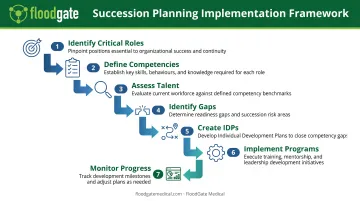
- A seven-step framework, from identifying critical roles to monitoring progress, provides a structured roadmap
- Diversity in leadership pipelines drives better innovation and decision-making outcomes
- Ongoing executive commitment and transparent communication prevent common succession failures
What Is Succession Planning?
Succession planning is the proactive process of identifying and developing employees to fill key leadership and critical positions when they become vacant. Unlike replacement planning, a reactive short-term scramble to fill an open role, succession planning is long-term and development-focused.
It applies across:
- Leadership roles
- Specialized technical positions (regulatory affairs, quality, R&D)
- Any role critical to business operations
When transitions hit—planned or unexpected—your organization already has prepared talent ready to step in with minimal disruption.
Why Succession Planning Matters in MedTech
Business Continuity, Risk Mitigation, and Knowledge Preservation
MedTech companies operate in highly specialized environments where leadership gaps create outsized risks. Regulatory submissions, product development cycles, and customer relationships all depend on deep institutional knowledge. A single vacant director-level role in quality or regulatory affairs can delay launches, jeopardize compliance, and damage market position.
When senior leaders depart without successors, that knowledge leaves with them. Succession planning preserves it through mentorship, role rotations, and documented handoffs so continuity does not depend on one person.
Talent Retention and Internal Development
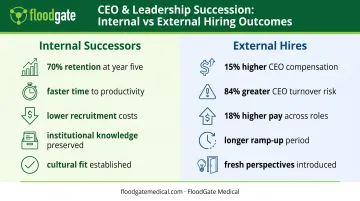
Research from LinkedIn and SHRM involving 32 million profiles found that employees who received a promotion within three years had 70% retention at year five, compared to just 45% for employees with no internal move. While this data shows association rather than causation, it shows why visible career pathways aid retention.
Internal development signals to high-potential employees that they have a future with your organization. In MedTech, specialized expertise is hard to replace, so clear succession pathways keep top performers engaged instead of shopping their skills elsewhere.
Cost Savings: Internal vs. External Recruitment
External executive hires cost more and carry higher risks:
- External CEOs averaged 15% higher pay than internal hires and had an 84% greater chance of turnover within three years
- External hires across roles earned about 18% more, performed worse for their first two years, and had higher exit rates
- Average cost per hire approached $4,700, with total costs often reaching 3-4 times salary when factoring in soft costs like lost productivity
Internal successors already know the people, the products, and the processes, so they reach full productivity faster and usually cost less than a full external search.
Speed is the other payoff. When a new product line needs leadership or a market shift demands a strategy pivot, companies with ready internal talent can move immediately. Competitors stuck in lengthy external searches lose momentum.
How to Create a Succession Plan: 7-Step Framework
Step 1: Identify Critical Roles
Start by analyzing which positions, if vacant, would significantly impact operations, revenue, or compliance. Gartner recommends prioritizing business-critical, hard-to-fill roles rather than defaulting to organizational hierarchy.
Critical MedTech roles often include:
- Regulatory affairs directors (FDA, CE Mark, ISO compliance expertise)
- Quality leaders (QMS oversight, audit readiness)
- R&D heads (product pipeline, clinical validation)
- Clinical affairs managers (trial design, post-market surveillance)
- Commercial leaders with deep customer and reimbursement knowledge
Step 2: Define Core Competencies and Future Requirements
For each critical role, define the competencies required not just today but for future business needs. Only 35% of organizations select successors aligned with future requirements, a costly gap in fast-evolving MedTech sectors.
Include:
- Technical skills – Regulatory submissions, design controls, biocompatibility testing
- Leadership capabilities – Team development, cross-functional collaboration, strategic thinking
- Industry-specific knowledge – Reimbursement landscapes, clinical evidence standards, competitive positioning
Step 3: Assess Current Talent
Use structured tools to evaluate performance and potential across your organization:
- Performance reviews – Track consistent high achievement
- Competency assessments – Measure role-specific technical and leadership skills
- 9-box grids – Plot employees by performance and potential to identify high-potential talent
FloodGate Medical uses behavioral assessments and customized scorecards to help MedTech companies gauge leadership readiness against the competencies defined for each critical role.
Step 4: Identify Skills Gaps
Conduct a structured gap analysis comparing current capabilities to role requirements. Where do high-potential employees fall short? Common gaps in MedTech include:
- Regulatory expertise (moving from R&D into regulatory-facing roles)
- Cross-functional leadership (technical experts transitioning to management)
- Strategic thinking (operational managers stepping into executive roles)
Step 5: Create Individual Development Plans (IDPs)
For each identified successor, build a tailored development roadmap with:
- Specific training – Regulatory certification programs, leadership courses, industry conferences
- Mentorship – Pair successors with current leaders for knowledge transfer
- Stretch assignments – Temporary cross-functional projects that build new competencies
- Timeline milestones – SHRM recommends classifying readiness as "ready now," "1-3 years," or "3+ years"
Step 6: Implement Development Programs
Move each IDP off the page: assign an owner, protect time on the calendar, and fund the work. Deliver development through:
- On-the-job stretch work tied to live commercial, quality, or regulatory problems
- Cohort leadership programs and peer learning—not classroom sessions alone
- Coaching paired with mentorship from current role holders
- Short rotations that broaden exposure beyond a single function
DDI emphasizes targeted development through group experiences, peer learning, coaching, and real-world application rather than classroom training alone.
Step 7: Monitor Progress and Adjust Plans Regularly
Review plans at least quarterly. Track progress with KPIs such as:
- Bench strength – Number of ready successors per critical role
- Internal promotion rates – Percentage of leadership roles filled internally
- Retention of high-potentials – Are identified successors staying?
- Time-to-fill – How quickly do critical roles get filled when vacancies occur?
Gartner data shows 40% of HR leaders struggle to secure ongoing commitment to post-planning development follow-through. Regular executive reviews keep succession planning accountable and adaptive.
Building a Diverse Leadership Pipeline in MedTech
Why Diversity Matters in MedTech Succession Planning
Diverse leadership teams drive better innovation, reflect patient populations more accurately, and improve decision-making. McKinsey research covering 1,265 companies found that top-quartile executive teams for gender and ethnic diversity had a 39% greater likelihood of financial outperformance compared to bottom-quartile teams.
That finding is correlation, not proof of causation—but the business case for diversity remains strong.
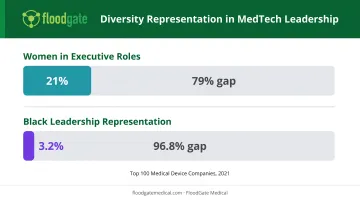
Yet MedTech leadership remains unrepresentative. Women held just 21% of top executive roles at the world's 100 largest medical device companies in 2021, and Black representation in leadership stood at 3.2% in a 2021 AdvaMed survey.
Strategies for Identifying Diverse High-Potential Talent
Building a representative pipeline takes deliberate process changes, not one-off hiring pushes:
- Identify diverse talent early—before traditional leadership pipelines narrow—through professional associations, universities, and STEM/MedTech networks that reach underrepresented groups
- Evaluate potential with structured, objective criteria; SHRM recommends explicit competencies, psychometric testing, and demographic analysis so impressions and personal networks do not favor similarity
- Work with DEI-focused MedTech recruiters such as FloodGate Medical to source leaders who reflect the patients and communities your organization serves
- Require diverse candidate slates for every leadership role, backed by structured interview panels and standardized scoring to limit implicit bias
Best Practices for Effective Succession Planning
Start Early and Make It Ongoing
Succession planning should begin years before anticipated transitions. SHRM recommends developing three to five diverse candidates three to five years before a planned succession. This timeline allows for meaningful development, rather than rushed, superficial training.
Treat succession planning as continuous, not annual. Business needs evolve, talent shifts, and external market conditions change. Quarterly reviews ensure your plans stay relevant.
Ensure Transparency and Communication
SHRM and Gartner both emphasize proactive career conversations. When employees understand they're being developed for future roles, engagement rises and development accelerates.
Share succession plans transparently with identified successors, clarify expectations, and provide regular feedback on progress.
Avoid the trap of secret succession lists. Transparency builds trust and accountability.
Integrate with Broader Talent Management
Succession planning should not exist in isolation. Align it with:
- Performance management – Use performance data to identify high-potential talent
- Learning & development – Connect individual development plans (IDPs) to formal training programs
- Workforce planning – Anticipate future organizational needs and build pipelines accordingly
- Compensation strategy – Reward and retain successors with competitive pay and advancement
FloodGate Medical's talent strategy and advisory services help MedTech organizations tie succession planning directly to organizational design, workforce planning, and go-to-market talent roadmaps.
Measure Outcomes, Not Just Process
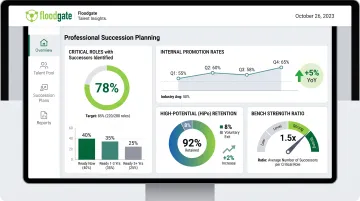
Track meaningful metrics that reflect succession planning effectiveness:
- Percentage of critical roles filled internally – Are you promoting from within?
- Time-to-fill for key positions – How quickly do vacancies get filled?
- Retention rates of high-potentials – Are successors staying long enough to take on leadership roles?
- Bench strength ratios – Do you have at least 2-3 ready successors per critical role?
Tracked well, these numbers show whether your bench is real—and where to invest next.
Balance Internal Development with External Talent
While internal development should be your default, stay open to external candidates who bring fresh perspectives, specialized expertise, or skills you lack in-house.
That mix matters in fast-moving MedTech areas such as digital health, AI-enabled diagnostics, and minimally invasive robotics. Harvard Business Review found that external CEOs typically cost more and fail more often than internal hires—though a small share still outperform when the fit is right. Keep an internal slate, and benchmark externally so every decision is informed.
Common Succession Planning Mistakes to Avoid
Even solid succession programs stall when a few common traps go unchecked. Spot these mistakes early and correct them before plans lose credibility.
The "Clone" Mistake
Many organizations pick successors who mirror current leaders in style, background, and perspective. That approach ignores evolving business needs and diversity goals. According to McKinsey, similarity bias and the representativeness heuristic are frequent traps in succession decisions.
Fix it:
- Define future role requirements before you evaluate people
- Score candidates against those criteria with structured scorecards
- Use diverse interview panels and clear competency frameworks to cut bias
The "Set It and Forget It" Trap
Succession plans should stay living documents that adapt as the business changes—not annual checkbox exercises. Treated as a once-a-year HR task, they go stale and stop guiding real decisions.
Fix it:
- Review succession plans every quarter
- Update them for org changes, new hires, departures, and strategy shifts
The "No Executive Buy-In" Mistake
According to Gartner, 40% of HR leaders struggle to secure ongoing leader commitment to successor development after planning is complete. Without senior sponsorship, modeled development behaviors, and manager accountability, succession work stalls.
Fix it:
- Make succession a board- and executive-team priority with regular updates
- Tie manager performance reviews to successor development
- Have executives personally mentor high-potential talent
Frequently Asked Questions
What is succession planning?
Succession planning is the strategic process of identifying and developing internal talent to fill critical leadership roles, ensuring business continuity and reducing transition risks when vacancies occur.
How do I create a succession plan for my business?
Follow a seven-step framework: identify critical roles, define competencies, assess talent, identify gaps, create development plans, implement programs, and monitor progress with regular reviews.
What are some effective best practices for succession planning?
Start planning 3–5 years before anticipated transitions, with executive commitment and transparency for identified successors. Integrate succession with talent systems and track outcomes such as internal promotion rates and bench strength.
What are the 5 D's of succession planning?
The 5 D's framework includes: Define critical roles and competencies, Discover potential successors through assessment, Develop skills and capabilities via training and mentorship, Deploy successors into roles when ready, and Drive continuous improvement through regular reviews.
What is a manager succession plan?
A manager succession plan focuses specifically on middle management transitions, emphasizing leadership development, team management skills, and technical-to-leadership transitions to ensure continuity at the supervisory and mid-level management tiers.
What are the key trends in succession planning for 2026?
Key trends include DEI-focused leadership pipelines, agility over static competency models, and skills-based succession tied to internal mobility. AI use in HR tasks also jumped from 26% in 2024 to 43% in 2025, reshaping how organizations spot and develop successors.
Building a strong succession pipeline takes years, but the return is real: continuity, lower transition risk, and a ready leadership bench. Start by naming your most critical roles and the people best positioned to fill them.