Introduction
MedTech and healthcare technology companies face a stark reality: 70% of technical workers receive multiple job offers before accepting a role, according to Deloitte's 2024 research. Nearly 90% of technology leaders still view recruiting and retention as a moderate or major challenge.
When every competitor is chasing the same scarce regulatory specialists, software engineers, and clinical affairs leaders, reactive hiring (posting jobs and hoping) fails to secure the talent you need for product timelines, expansion goals, and revenue targets.
A talent acquisition strategy turns frantic role-filling into a proactive system for building the workforce your business goals require. Unlike recruitment, which fills immediate vacancies, a full TA strategy links workforce planning, employer branding, candidate pipelines, selection processes, and measurable outcomes into a competitive advantage.
This guide walks you through the components of an effective talent acquisition strategy, a step-by-step framework for building one, and the metrics that prove it's working.
Key Takeaways
- Treat talent acquisition as proactive hiring tied to long-term business goals, not only open roles
- Cover workforce planning, employer branding, diverse sourcing, candidate experience, and measurement
- Ground the strategy in business objectives, talent-market analysis, ideal profiles, and clear processes
- Embed DEI, ethical tech use, hiring-team training, and ongoing feedback at every stage
- Track quality of hire, time-to-fill, cost-per-hire, candidate experience, source effectiveness, and retention
What Is a Talent Acquisition Strategy?
A talent acquisition strategy is a comprehensive, ongoing approach to identifying, attracting, and hiring talent that aligns with organizational goals and culture. SHRM defines talent acquisition as covering the "strategies, tactics and processes" used to identify, recruit, and retain an organization's human resources, a scope far broader than simply filling open roles.
The distinction matters: recruitment is tactical, short-term, and reactive, focusing on filling specific vacancies as they arise. Talent acquisition is strategic, long-term, and proactive, building systems and pipelines that ensure your organization has access to the right talent before critical needs emerge.
An effective TA strategy encompasses:
- Workforce planning that forecasts future talent needs based on business strategy
- Employer branding that communicates your value proposition to potential candidates
- Diverse sourcing channels and talent pipelines that reduce time-to-hire
- Standardized selection processes that improve quality of hire and reduce bias
- Candidate relationship management and positive experience touchpoints
- Onboarding and retention programs that ensure new hires succeed
Together, these elements build a talent ecosystem that keeps qualified people in reach before roles open.
Why Your Organization Needs a Talent Acquisition Strategy
Talent shortages and skills gaps make strategic talent acquisition a competitive necessity. Deloitte found that shortages in security, machine learning, and software architecture were associated with delayed funded projects.
In MedTech specifically, AdvaMed reports that jobs grew at 3x the pace of overall manufacturing since 2018, with average salaries reaching $97,000. Every hiring delay translates to lost innovation and market opportunity.
The Cost of Poor Hiring
Reactive, inconsistent hiring costs far more than a vacant seat:
- Direct recruiting costs: SHRM's 2025 benchmarking reports show average cost-per-hire of $5,475 for nonexecutive roles and $35,879 for executive positions
- Turnover and replacement expenses when poor hires leave within the first year
- Lost productivity during extended vacancies and slow ramp-up periods
- Damaged employer brand when candidate experience is inconsistent or poor
- Negative team morale when hiring mistakes disrupt workflows or culture
- Customer impact when understaffed teams can't deliver on product or service commitments
The Strategic Advantage
Organizations with strong talent acquisition strategies gain measurable competitive advantages:
- Reduced time-to-hire through pre-vetted pipelines and efficient processes
- Improved quality of hire via structured selection and better candidate-role alignment
- Better cultural fit when employer brand attracts candidates who share your values
- Enhanced employer reputation that makes future hiring easier
- Cost savings from lower turnover and more efficient recruiting operations
- Skills on hand when strategy needs them, so growth plans are not stalled by open reqs
Core Components of an Effective Talent Acquisition Strategy
Workforce Planning & Business Alignment
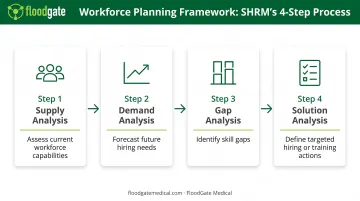
Workforce planning connects current and future talent needs to business strategy. SHRM's framework includes four steps:
- Supply analysis – Assess current workforce capabilities, skills, and capacity
- Demand analysis – Forecast hiring needs based on growth plans, product launches, market expansion, or attrition
- Gap analysis – Identify critical competencies needed and compare them against current capabilities
- Solution analysis – Define targeted actions to close gaps through hiring, training, redeployment, or automation
For MedTech organizations, that means mapping engineering, software, data science, regulatory, quality, and clinical-affairs talent to product pipelines, regulatory milestones, and commercialization timelines.
Deloitte found that while 73% of respondents said human capabilities must keep pace with technology, only 9% reported meaningful progress. That gap is exactly what disciplined workforce planning is meant to close.
Strategic Employer Branding
Employer branding defines and communicates what makes your organization an attractive place to work. Your employee value proposition (EVP) includes:
- Mission and values
- Career development opportunities
- Compensation, benefits, and work environment
- Commitment to diversity, innovation, and meaningful impact
Authentic employer branding, expressed consistently across careers pages, social media, employee testimonials, and job descriptions, helps attract candidates who align with your culture and values.
Research reported by Inc. cited a LinkedIn finding that 94% of candidates were likely to apply when a company actively managed its employer brand. Track career-site conversion, application quality, offer acceptance rates, and review-site sentiment to measure brand effectiveness.
Diverse Sourcing & Talent Pipeline Development
Relying solely on traditional job boards limits your reach. Build diverse sourcing channels:
- Employee referrals (SHRM reported they supplied more than 30% of all hires in 2016)
- Industry events and conferences
- University partnerships and early-career programs
- Social media recruiting (LinkedIn, professional communities)
- Passive candidate engagement (people not actively job-searching)
- Specialized MedTech recruitment firms for regulatory, clinical, and commercial roles
Audit referral programs for diversity so you do not simply replicate existing networks. Talent pipelines (nurtured relationships with candidates before roles open) cut time-to-hire and keep qualified people close when critical needs hit. Building them takes steady communication, market intelligence, and real relationship management.
Candidate Experience Optimization
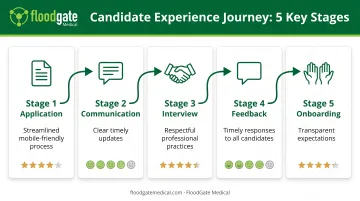
Candidate experience, from first touchpoint through onboarding, affects offer acceptance rates and employer brand reputation. Research summarized by SHRM found that candidates who report a very poor recruiting experience are less likely to apply again, refer others, retain brand affinity, or purchase from the company.
Elements of positive candidate experience:
- Clear, timely communication at every stage
- Streamlined application processes (mobile-friendly, minimal friction)
- Respectful interview practices (punctuality, preparation, professionalism)
- Timely feedback, even for candidates not selected
- Transparent expectations about role, timeline, and next steps
Measure through application completion rates, candidate satisfaction scores, offer acceptance rates, and post-process surveys.
Building Your Talent Acquisition Strategy: Step-by-Step Framework
Step 1: Assess Current State & Define Objectives
Start by auditing your current talent acquisition processes:
- Review metrics: time-to-hire, cost-per-hire, quality of hire, source effectiveness
- Identify pain points: where do candidates drop off? Which roles take longest to fill?
- Gather stakeholder feedback from hiring managers, recruiters, and recent hires
Align with business leaders to understand organizational goals and translate them into specific talent needs:
- Which functions or roles are critical to executing strategy?
- What skills gaps could block product launches, regulatory approvals, or market expansion?
- What hiring volume and timeline does the business plan require?
Step 2: Analyze Your Talent Market
Research labor-market data to understand talent availability, competition, and compensation benchmarks. For MedTech-relevant roles:
- Biomedical engineers earn a median $106,950 annually with 5% projected growth (BLS, 2024)
- Software developers earn a median $133,080, meaning digital-health employers compete with the broader tech market
- Medical scientists earn a median $100,590 with 9% projected growth, highlighting the need to build research pipelines early
Identify market trends affecting your industry: regulatory expertise requirements, technical specialization, clinical versus commercial role dynamics, and geographic talent concentrations.
Step 3: Define Your Ideal Candidate Profiles
Move beyond generic job descriptions. Create detailed candidate personas for key roles:
- Required and preferred skills (technical, regulatory, clinical)
- Experience levels (years, industries, role progression)
- Cultural fit indicators (values, work style, collaboration approach)
- Career motivations (growth, mission-driven work, compensation, flexibility)
Focus on specific competencies, mindsets, and potential that predict success in your organization—not just credentials.
Step 4: Build Your Employer Value Proposition & Brand
Articulate what makes your organization unique as an employer:
- Career development opportunities and learning culture
- Mission-driven work that improves patient outcomes
- Competitive compensation, benefits, and work environment
- Commitment to diversity, equity, inclusion, and innovation
Keep employer brand messaging consistent and authentic across every candidate touchpoint: careers pages, social media, employee stories, and job descriptions.
Specialized positioning helps in crowded markets. FloodGate Medical's "Recruiting Done Differently" focus, for example, frames MedTech hiring around partnership and DEI rather than pure transaction volume.
Step 5: Establish Sourcing & Selection Processes
Design a multi-channel sourcing strategy:
- Job boards (general and industry-specific)
- Social recruiting (LinkedIn, professional communities)
- Employee referrals (with diversity tracking)
- Industry networks and events
- Partnerships with specialized MedTech recruiters
Specialized partners can add permanent placement, contract or interim staffing, fractional leadership, and executive search when you need pipeline flexibility without immediate headcount.
Create standardized selection processes:
- Screening criteria and knockout questions
- Structured interview guides with behavioral and competency-based questions
- Assessments (technical, cultural fit, cognitive)
- Decision-making frameworks and scorecards that reduce bias and ensure consistency
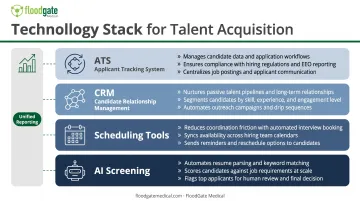
Step 6: Implement Technology & Data Infrastructure
Select and implement technology tools:
- Applicant Tracking Systems (ATS) for managing candidates, workflows, and compliance
- Candidate Relationship Management (CRM) platforms for pipeline nurturing
- Interview scheduling tools to reduce coordination friction
- AI-powered screening solutions (with human oversight)
Establish data collection and reporting so you can track source effectiveness, stage conversion rates, demographic representation, time-to-fill by role, and quality-of-hire. Use those signals to double down on channels that work and fix stages where candidates drop off.
Implementing and Optimizing Your Strategy
Integrate DEI Throughout Your Talent Acquisition Process
Diversity, equity, and inclusion belong in every hiring stage, not as a late-stage add-on.
McKinsey research found companies in the top quartile for ethnic diversity had an average 27% financial advantage. Deloitte reported inclusive organizations were 75% more likely to see ideas become productized.
Integrate DEI through:
- Inclusive job description language (avoid unnecessarily gendered or exclusionary terms)
- Diverse sourcing channels that reach underrepresented talent pools
- Structured interviews and standardized evaluation criteria to reduce unconscious bias
- Diverse interview panels
- Pay-equity reviews and transparent compensation practices
- Representation tracking at every hiring stage
In MedTech, DEI-driven recruitment supports compliance and sharpens innovation by bringing varied perspectives to complex healthcare challenges.
Leverage Technology and AI Strategically
SHRM's 2025 survey of 2,040 HR professionals found 51% of organizations used AI in recruiting, with leading applications including:
- Job descriptions (66%)
- Resume screening (44%)
- Candidate search (32%)
- Job-post customization (31%)
- Applicant communication (29%)
89% of users reported time or efficiency gains.
Bias still matters. HBR explains that bias can enter predictive hiring systems at multiple stages, and SHRM notes that bias audits test whether tools discriminate by race or gender.
Use AI to support talent acquisition, not to run it unsupervised. Keep human oversight, run regular bias audits, and protect data privacy with clear ethical AI practices.
Train and Align Your Hiring Team
Training hiring managers and interviewers on your talent acquisition strategy ensures consistency and accountability. Cover:
- Interviewing best practices and structured evaluation methods
- Unconscious bias recognition and mitigation
- Consistent use of scorecards and decision frameworks
- Employer brand messaging and candidate experience standards
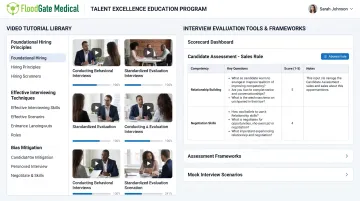
Define roles and responsibilities clearly across HR, hiring managers, and executive leadership. FloodGate Medical's Talent Excellence Education program (14 video tutorials, interview scorecards, and evaluation tools) shows how structured training helps hiring teams move from gut-based decisions to evidence-based assessments.
Continuously Improve Through Feedback Loops
Establish processes to gather feedback from:
- Candidates (regardless of hiring outcome)
- New hires during onboarding
- Hiring managers after each search
- Recruiters and coordinators
Use that input to spot bottlenecks, then run strategy reviews quarterly or biannually so you can adjust to shifting business needs and labor-market conditions.
Measuring Success: Key Metrics and KPIs
Use these talent acquisition metrics to prove ROI and spot where the process needs work:
| Metric | Benchmark | What It Measures |
|---|---|---|
| Time-to-fill | 1.5 months median (SHRM, 2025) | Speed from requisition to offer acceptance |
| Cost-per-hire | $5,475 nonexecutive; $35,879 executive (SHRM, 2025) | Recruiting efficiency and budget management |
| Quality of hire | Only 20% of organizations track it (SHRM, 2025) | Effectiveness measured through performance ratings, retention, hiring manager satisfaction |
Candidate experience metrics:
- Application completion rates
- Candidate satisfaction scores (surveys, NPS)
- Offer acceptance rates
- Employer review site ratings (Glassdoor, Indeed)
Source effectiveness:
- Candidate quality by channel
- Cost and time-to-hire by source
- Diversity representation by source
Long-term outcomes:
- 90-day and one-year retention rates
- New hire productivity ramp-up time
- Performance ratings of new hires after 6-12 months
Segment all metrics by job family, seniority, location, and hiring volume—cross-industry averages provide context, but internal trends drive decisions.
Frequently Asked Questions
What is a talent acquisition strategy?
A talent acquisition strategy is a proactive plan for identifying, attracting, hiring, and retaining people who support long-term business goals. It ties together workforce planning, employer branding, sourcing, selection, and measurement so hiring stays planned instead of reactive.
What are the four pillars of talent acquisition?
Most frameworks group TA into four pillars: workforce planning aligned to the business, employer branding and attraction, selection and assessment, and onboarding with ongoing improvement. Used together, they form a talent system that supports organizational goals.
What does a talent acquisition strategist do?
A talent acquisition strategist designs long-term hiring plans, tracks talent-market trends, strengthens employer brand, and builds candidate pipelines. They improve recruiting processes with data and tools and keep TA work aligned with business objectives.
How long does it take to build a talent acquisition strategy?
An initial strategy usually takes 4–8 weeks, depending on company size, data quality, stakeholder access, and approval cycles. After launch, you keep refining it as the business, market, and performance data change.
What's the difference between a talent acquisition strategy and a recruitment plan?
Recruitment plans are tactical, short-term approaches to filling specific open positions. Talent acquisition strategies are strategic, long-term frameworks for building organizational talent capabilities that align with business goals. Recruitment is an activity within the broader TA system.
How can small companies with limited resources develop effective talent acquisition strategies?
Define a clear employer value proposition, focus on a few strong channels (referrals, LinkedIn, industry networks), and protect candidate experience. Use affordable ATS or CRM tools, and bring in a MedTech-focused recruiting partner for hard-to-fill roles when your team is stretched.
A clear talent acquisition strategy turns hiring from a reactive scramble into a repeatable advantage. Align workforce planning with business goals, strengthen employer brand, diversify sourcing, improve candidate experience, and track results.
Start with Step 1: assess your current state, set clear objectives, and build a talent system you can measure.