For industry stakeholders, though, getting a clear read on the market is surprisingly hard. Research firms disagree on scope, valuations vary by tens of billions of dollars, and CAGR figures shift depending on whose model you're reading. That fragmentation makes strategic planning, especially around hiring and capacity, genuinely difficult.
This report pulls together the numbers that matter: market size, regional dynamics, segmentation trends, competitive positioning, and what all of it means for MedTech talent strategy heading into 2026.
Key Takeaways
- The global clinical diagnostics market is valued at $115.5 billion (2024), growing to $169.2 billion by 2030 at a 6.6% CAGR.
- North America leads by revenue share; Asia-Pacific grows fastest on population scale and infrastructure gains.
- Oncology, neurology, and molecular diagnostics are outpacing the broader market by a wide margin.
- Instruments generate the most revenue today, but software, services, and home-based testing are the fastest-growing categories.
- Talent capacity is becoming a bottleneck for diagnostics companies scaling into these high-growth segments.
Clinical Diagnostics Market Size, Share & Growth Forecast (2026 and Beyond)
Scope matters more than most headlines suggest. Grand View Research values the broader clinical diagnostics market at $115.5 billion in 2024, forecasting growth to $169.2 billion by 2030 at a 6.6% CAGR. Fortune Business Insights, using a narrower in-vitro diagnostics (IVD) product-and-testing definition, pegs 2025 revenue at $77.73 billion with a 6.50% CAGR through 2034.
Neither figure is wrong. They're measuring different things. For planning purposes, roughly 6% annual growth is a fair core-market benchmark, not a segment-wide assumption.
What's driving this growth:
- Rising chronic disease prevalence, particularly cardiovascular disease, diabetes, and cancer
- Growing demand for earlier detection across nearly every disease category
- Structural decentralization: testing is moving out of central labs into pharmacies, retail clinics, and homes
- Post-pandemic infrastructure redeployment
That last point deserves a beat. COVID-19 forced a massive build-out of molecular testing capacity almost overnight. Labs, instruments, and trained staff that once ran SARS-CoV-2 PCR tests are now being redirected toward antimicrobial resistance (AMR) surveillance and multiplex respiratory panels. The infrastructure didn't disappear when the pandemic urgency did; it found new applications.
Regional Market Breakdown
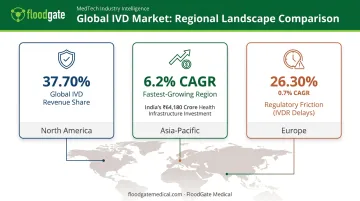
North America remains the largest market, capturing 37.70% of global IVD revenue in Fortune's 2025 model. Three factors explain this dominance:
- Reimbursement policy: CMS covers qualifying NGS tests for advanced cancer when they carry FDA approval as companion diagnostics.
- Faster regulatory pathways: The FDA's 510(k) route allows molecular and AI-based tests to reach market by demonstrating substantial equivalence to a predicate device.
- Concentration of major players: Abbott, Roche, bioMérieux, and Bio-Rad all maintain significant regional operations.
Asia-Pacific is the fastest-growing region, expanding at roughly 6.2% CAGR from a 2023 base of $18.0 billion. India's government has committed ₹64,180 crore to its PM-ABHIM health infrastructure program, with 744 Integrated Public Health Labs approved by March 2026.
That kind of state-backed buildout, combined with population scale and rising chronic disease burden, is why manufacturers are pouring resources into the region.
Europe tells a more complicated story. The EU IVD market sits around $20.46 billion (26.30% share) in 2025, but an older GVR model projected only 0.7% CAGR through 2030.
The culprit is regulatory friction: Regulation (EU) 2024/1860 extended legacy-IVD transition deadlines to 2027-2029 depending on device class, and a European Commission "call for evidence" that closed in March 2025 led to a simplification proposal in December 2025, still not enacted law.
Clinical Diagnostics Market Segmentation Analysis
The market breaks down cleanly along four axes: test type, clinical application, technology platform, and end-user setting. Each reveals a different growth story.
By Test Type and Approach
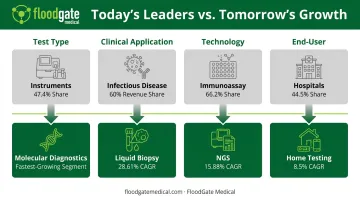
Instruments represented 47.4% of the 2024 clinical diagnostics market, and molecular diagnostics alone are projected at 30.54% of 2026 IVD revenue — the current revenue leaders by a wide margin.
Point-of-care testing shows a different growth pattern: total POC diagnostics are growing at a 7.26% CAGR from 2026 to 2034, while POC molecular diagnostics specifically are climbing even faster at a 10.5% CAGR.
The instruments that dominate today's revenue aren't necessarily the ones generating tomorrow's growth.
By Clinical Application
Infectious disease testing built the volume foundation of this industry, representing 60.0% of molecular diagnostics revenue in 2024. But that's market share, not test-volume share, and the growth momentum has shifted elsewhere.
Oncology and companion diagnostics are forecast to grow fastest. Companion diagnostics alone are projected to jump from $6.31 billion in 2026 to $11.57 billion by 2031, a 12.9% CAGR driven largely by precision oncology and liquid biopsy adoption. Liquid biopsy itself is growing even faster, at a projected 28.61% CAGR through 2034.
Neurology is the sleeper category to watch. In May 2025, the FDA cleared the first blood test to aid Alzheimer's diagnosis, Fujirebio's Lumipulse G pTau217/beta-Amyloid ratio.
In a 499-sample validation study, results agreed with amyloid PET or CSF findings 91.7% of the time for positive results and 97.3% for negative results. This matters because it reduces reliance on expensive PET scans and invasive CSF collection, opening the door to broader Alzheimer's screening infrastructure.
By Technology and End-User
Immunoassay technology still dominates, with reagents and kits holding 66.2% of that market in 2025. Next-generation sequencing is the faster-growing alternative, projected to climb from $11.79 billion in 2026 to $38.34 billion by 2034, a 15.88% CAGR.
On the end-user side, hospitals hold the largest share at 44.5% of IVD revenue in 2025, while self-testing and home-based testing is the fastest-growing channel, climbing from $11.8 billion in 2025 to $21.9 billion by 2033, an 8.5% CAGR.
Volume still flows through hospitals and diagnostic labs. Growth flows toward the patient's kitchen counter.
Key Trends, Growth Drivers & Market Challenges
Growth Drivers Reshaping the Industry
AI-assisted interpretation is moving from pilot project to production workflow. In September 2024, Roche announced the integration of more than 20 AI algorithms from eight collaborators into its digital pathology environment for cancer diagnostics.
Illumina and NVIDIA followed in January 2025, combining sequencing data with computing tools to build biological foundation models. Together, these moves mark a fundamental shift in how pathology and genomic data get read.
Precision medicine and companion diagnostics co-development are increasingly inseparable from drug approval. The FDA's 2024 Oncology Regulatory Review documented 27 IVD actions, including four new IVDs carrying 11 companion diagnostic claims. Targeted cancer therapies now routinely launch alongside the diagnostic test that determines who qualifies for them.
Decentralization keeps expanding its footprint. In March 2025, the FDA authorized Visby Medical's over-the-counter, at-home molecular test for chlamydia, gonorrhea, and trichomoniasis, a prescription-free option offering lab-grade molecular accuracy. Every new home-testing approval creates a follow-on assay market that didn't exist five years ago.
The patient as decision-maker is a genuinely new dynamic. Direct-to-consumer genetic testing is forecast to grow from $3.73 billion in 2026 to $21.9 billion by 2034, a 24.74% CAGR. That growth is blurring the line between regulated clinical diagnostics and consumer wellness products, and regulators haven't fully caught up.
Persistent Market Challenges
Growth doesn't come without friction:
- Platform costs remain high. Illumina's advertised "$200 genome" on its NovaSeq X platform covers consumables only, excluding instruments, labor, and compute infrastructure. Real-world costs run far higher, slowing adoption in cost-constrained settings.
- Regulatory complexity keeps shifting. The FDA's laboratory-developed test rule was finalized in May 2024, then vacated and rescinded within 18 months. Europe's IVDR reform remains unenacted, leaving companies to budget for ongoing uncertainty.
- Reimbursement volatility persists. A 2023 MolDx policy cut frequency limits on transplant-rejection tests, hitting CareDx and Natera until Medicare reaffirmed coverage in August 2024. Strong clinical evidence doesn't guarantee stable payment.
Competitive Landscape: Leading Companies and Consolidation Trends
The clinical diagnostics market is moderately concentrated, dominated by a handful of global players:
| Company | Segment Revenue (FY2025) | Focus Area |
|---|---|---|
| Roche | CHF 13.847B (Diagnostics) | Broad IVD, molecular, digital pathology |
| Labcorp | $10.88B (Diagnostics) | Clinical lab services |
| Quest Diagnostics | $10.79B (Diagnostic Info Services) | Clinical lab services |
| Danaher | $9.94B (Diagnostics) | Instruments, life sciences platforms |
| Abbott | $8.94B (Diagnostics) | Core lab, molecular, rapid/POC |
| Thermo Fisher | $4.68B (Specialty Diagnostics) | Reagents, instruments |
| Siemens Healthineers | €4.35B (Diagnostics) | Lab diagnostics |
Note: figures aren't directly comparable across currencies and segment definitions, but the pattern is clear: no single company controls the market outright.
That fragmentation is fueling consolidation. M&A activity is accelerating as companies race to close capability gaps: Roche's December 2023 agreement to acquire LumiraDx's point-of-care technology business, for $295 million upfront plus up to $55 million in milestones, closed in July 2024.
This deal shows a diversified player buying its way into POC molecular capability rather than building it from scratch.
That same dynamic creates openings for niche, specialized players. Focused clinical evidence and reimbursement expertise let smaller companies compete in specialty lanes that large diversified players tend to move slower on:
- Rare disease whole-genome sequencing
- Transplant monitoring
- Antimicrobial resistance (AMR) surveillance
CareDx's transplant-monitoring coverage reversal in 2023-2024 proves both the demand and the payer risk that comes with operating in these specialty lanes.
What Diagnostics Market Growth Means for MedTech Talent Strategy
Every trend covered above, oncology precision testing, AI-enabled pathology, decentralized home diagnostics, translates into hiring pressure. Diagnostics companies need:
- R&D and bioinformatics talent to build and validate NGS and AI-driven interpretation platforms
- Regulatory affairs specialists who can navigate shifting LDT rules and IVDR transition timelines
- Clinical and commercial sales professionals who understand companion diagnostics and can sell into oncology and neurology accounts
- Operations talent capable of scaling decentralized testing logistics
Here's the catch: consolidation and rapid platform innovation mean multiple companies are chasing the same narrow pool of experienced MedTech professionals at the same time. Speed and quality of hiring have become genuine competitive differentiators, not just HR metrics.
This is where FloodGate Medical fits in. As a MedTech-focused talent acquisition firm, FloodGate Medical works across commercial, clinical, marketing, operations, and leadership functions, helping healthcare device and diagnostics companies build teams fast without cutting corners on fit.
Its approach centers equity, diversity, and inclusion in how candidates are sourced and vetted, on the belief that diverse teams drive better innovation and better healthcare outcomes.
Beyond placement, FloodGate Medical supports hiring managers directly through its Talent Excellence Education program and Hiring for Attitude certification, and publishes an annual MedTech Compensation Guide to help companies build competitive, retention-focused offers.

Are you a diagnostics company scaling into oncology, AI-enabled testing, or decentralized care? Or a MedTech professional eyeing your next opportunity in this expanding market? Either way, connect with FloodGate Medical to start the conversation.
Frequently Asked Questions
What is the current size of the clinical diagnostics market?
Grand View Research values the broader clinical diagnostics market at $115.5 billion (2024), growing to $169.2 billion by 2030. Fortune Business Insights' narrower IVD-only estimate puts 2025 revenue at $77.73 billion, reflecting scope differences rather than disagreement.
What is the projected growth rate (CAGR) for the clinical diagnostics market?
Major research firms report CAGRs ranging from 6.17% to 6.6% through 2030-2034, depending on whether they're measuring broader clinical diagnostics or narrower IVD product categories.
What are the fastest-growing segments in clinical diagnostics?
Liquid biopsy (28.61% CAGR), direct-to-consumer genetic testing (24.74%), NGS platforms (15.88%), and companion diagnostics (12.9%) are outpacing the core market. Neurology, driven by new blood-based Alzheimer's biomarkers, is close behind.
Which companies dominate the clinical diagnostics market?
Roche, Abbott, Danaher, Thermo Fisher, Siemens Healthineers, Quest Diagnostics, and Labcorp lead the market. Concentration is moderate, leaving real room for specialized players in rare disease, transplant monitoring, and antimicrobial resistance (AMR) surveillance.
How is artificial intelligence changing the diagnostics industry?
AI now powers digital pathology, genomic interpretation, and lab workflow automation, as seen in Roche's 20+ algorithm pathology environment and the Illumina-NVIDIA genomics collaboration. Reimbursement for these tools still lags adoption.
What are the biggest challenges facing the diagnostic testing market?
High platform costs (especially NGS and AI systems), unsettled regulatory policy on both sides of the Atlantic, and reimbursement uncertainty for novel, higher-priced tests remain the primary restraints on faster market growth.