

Introduction
MedTech companies operate under pressure that most industries never face. A delayed product launch cuts off patient access, not just revenue. A regulatory misstep can trigger recalls, enforcement actions, or years of remediation work. And finding leaders who understand both the science and the business? That's where many companies stall—or settle for the wrong hire.
Generic leadership approaches don't hold up in this environment. A strong general manager who thrives in consumer goods or software may struggle to earn credibility with a regulatory affairs team, navigate an FDA inspection, or align an R&D function with commercial timelines. MedTech demands something more specific.
This article covers what healthcare leadership actually means in a MedTech context, which leadership models and skills matter most, and how companies can build the leadership pipeline they need to stay competitive—and compliant.
Key Takeaways:
- MedTech leadership spans R&D, regulatory, clinical, and commercial functions—not just the C-suite
- CAPA and management-review failures are among the FDA's most persistent inspection findings
- The right leadership model depends on growth stage—there's no universal formula
- Diverse leadership teams consistently outperform on innovation output
- Proactive pipeline planning separates companies that scale from those that stall
What Is Healthcare Leadership in a MedTech Context?
Healthcare leadership means guiding people, strategy, and innovation toward better health outcomes. In MedTech, that definition gets specific quickly.
MedTech leaders don't just manage teams—they steer product development through multi-year timelines, navigate FDA and international regulatory frameworks, build clinical evidence packages, and align commercial strategy with market access realities. They're responsible for getting safe, effective technologies to patients who need them.
More Than Clinical Management
A Chief Nursing Officer or health system CMO manages care delivery. A MedTech leader manages the creation and commercialization of the tools those clinicians use—bridging engineering, regulatory affairs, clinical evidence, and sales in a single operational model.
That combination is rare by any measure. Few professionals can move from an R&D roadmap discussion in the morning to a reimbursement strategy session in the afternoon while keeping a quality management system audit-ready.
Leadership at Every Level
MedTech leadership isn't a C-suite-only responsibility. It operates across the organization:
- Product managers driving innovation priorities and cross-functional alignment
- Regulatory leads who treat compliance as a strategic asset — one that accelerates timelines rather than stalling them
- Clinical affairs directors translating scientific evidence into commercial relevance
- Quality assurance managers protecting both patient safety and company reputation
Each of these roles requires a leadership mindset, not just functional expertise.
Why Strong Leadership Is Critical for MedTech Companies
The Innovation and Regulatory Stakes
The FDA authorized a record 124 novel devices in 2024, while R&D spending per FDA approval among 20 large MedTech companies rose from $4.7M in 2015 to $15.5M in 2024. More devices are reaching market, but the cost of getting there is climbing steeply.
Strong leaders keep innovation pipelines moving without sacrificing quality. Weak ones create the conditions for the failures that show up in FDA inspection data.
FDA's FY2024 device inspection observations tell a clear story about where leadership gaps surface most visibly:
| FDA Observation Type | FY2024 Count |
|---|---|
| CAPA procedures (21 CFR 820.100(a)) | 318 |
| Complaint procedures (21 CFR 820.198(a)) | 281 |
| Design control procedures (21 CFR 820.30(a)) | 148 |
| Management review (21 CFR 820.20(c)) | 51 |
| Adequate resources (21 CFR 820.20(b)) | 13 |
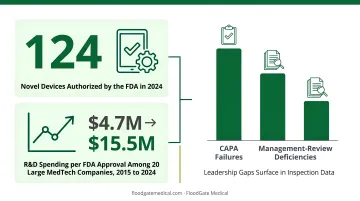
CAPA failures and management-review deficiencies point to a leadership problem, not just a process one. When quality systems aren't treated as a strategic priority at the top, the gaps show up in inspection data across every level of the organization.
The Talent and Change Pressure
McKinsey's 2023 survey of 192 MedTech R&D leaders found that 25% cited team capacity and 23% cited skills as major constraints on software development—a sector where regulated-product expertise is scarce and hard to replace.
MedTech M&A activity adds another layer of pressure. EY tracked 184 deals worth $44.2B in 2023, followed by 61 deals worth $50.5B in 2024. PwC reported $97.6B in 2025 deal activity—described as a decade high.
Every transaction brings integration demands, culture clashes, and leadership transitions that test even well-structured organizations.
Cross-functional coordination compounds these pressures. MedTech leaders must align R&D, clinical affairs, quality, marketing, and sales toward shared milestones—and when that alignment breaks down, it delays the devices patients depend on.
The Healthcare Leadership Model: What MedTech Companies Need to Know
Leadership models aren't academic concepts—they're practical frameworks that shape how decisions get made, how teams develop, and what culture actually looks like day to day. Three models are particularly relevant in MedTech.
Transformational Leadership
Transformational leaders inspire teams to push beyond existing constraints. In MedTech, that means creating the conditions where engineers challenge design assumptions, clinical teams pursue evidence that reshapes care pathways, and commercial leaders redefine market categories.
This model works especially well at early-stage device companies where competitive differentiation depends on breakthrough thinking. A VP of R&D who can articulate a compelling product vision—and make a team of engineers believe they can achieve it—creates real organizational momentum.
Servant Leadership
Servant leadership flips the traditional hierarchy: the leader's job is to remove obstacles so the team can perform at its highest level. This matters most where you have highly specialized talent—regulatory scientists, biomedical engineers, clinical researchers—who need autonomy to do their best work.
Micromanagement kills productivity in these environments. Servant leaders earn trust, provide the right resources, and resist the urge to over-manage — freeing specialists to do what they were hired to do.
Collaborative and Systems Leadership
Where servant leadership operates at the individual level, systems thinking scales that logic across the entire organization. MedTech's cross-functional complexity makes this a genuine competitive advantage. Leaders who understand how regulatory decisions affect commercial timelines, or how manufacturing constraints shape product design, prevent the silo formation that drives costly rework and missed launch windows.
This model fits scaling organizations particularly well—companies moving from startup to commercial stage, where process discipline and cross-functional alignment become as important as raw innovation.
Choosing the Right Model
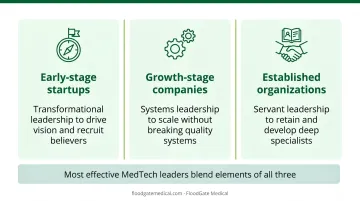
Most effective MedTech leaders blend elements of all three — but company stage shapes which model should dominate:
- Early-stage startups: Transformational leadership to drive vision and recruit believers
- Growth-stage companies: Systems leadership to scale without breaking quality systems
- Established organizations: Servant leadership to retain and develop deep specialists
Key Leadership Skills That Drive MedTech Success
Effective MedTech leadership requires competencies that don't appear on a standard MBA curriculum.
Four competencies consistently separate high-performing MedTech leaders from general managers:
- Clinical and scientific credibility: Leaders who can't hold a substantive conversation with R&D or clinical teams lose credibility quickly — and with it, the ability to make informed resource decisions or advocate effectively with senior leadership.
- Change management: With M&A activity running high across the industry, leaders who can navigate organizational integration, maintain team stability during ownership transitions, and keep quality systems intact through restructuring are genuinely rare assets.
- Inclusive leadership: Women hold 36% of MedTech management roles but less than 25% of executive positions, according to McKinsey's 2023 MedTech data. Cross-industry research across 1,265 companies links top-quartile gender and ethnic diversity to a 39% greater likelihood of financial outperformance. Leaders who build diverse teams aren't just doing the right thing — they're building stronger organizations.
Regulatory and compliance acumen deserves its own emphasis. The FDA's Quality Management System Regulation (QMSR), which took effect in February 2026 and incorporates ISO 13485:2016, sets the current compliance baseline. Leaders who treat these frameworks as strategic guardrails — not just legal obligations — protect their organizations from inspection findings that derail timelines and invite enforcement action.
Building a Strong MedTech Leadership Pipeline
Why Pipeline Planning Is a Strategic Function
Most MedTech companies don't think about leadership succession until they need it urgently—a sudden departure, a regulatory crisis, a new product launch that exposes a capability gap. By then, the options are limited and the timeline is compressed.
Proactive pipeline planning means identifying internal candidates with leadership potential before roles open, mapping competency gaps against growth plans, and building external relationships with talent before there's a specific position to fill. Companies that do this well navigate leadership transitions without losing momentum.
DEI as a Pipeline Strategy
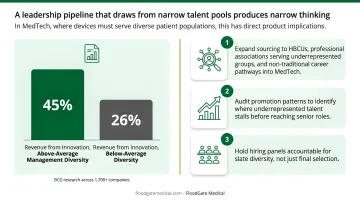
A leadership pipeline that draws from narrow talent pools produces narrow thinking. BCG's foundational research across more than 1,700 companies found that companies with above-average management diversity reported 45% of revenue from innovation, versus 26% for below-average-diversity companies.
In MedTech, where devices must serve diverse patient populations, this has direct product implications. Leaders who reflect a wider range of clinical experiences, cultural backgrounds, and professional perspectives build products that work better for more people.
Practical steps for pipeline diversity:
- Expand sourcing to HBCUs, professional associations serving underrepresented groups, and non-traditional career pathways into MedTech
- Audit promotion patterns to identify where underrepresented talent stalls before reaching senior roles
- Hold hiring panels accountable for slate diversity, not just final selection
The Role of Specialized Recruitment Partners
Generalist recruiters lack the technical vocabulary, regulatory context, and competency signals to evaluate MedTech leadership candidates reliably. Knowing what "good" looks like in a VP of Regulatory Affairs or a Chief Medical Officer for a device company requires direct, sustained experience in that world—not transferable pattern-matching from other industries.
FloodGate Medical operates exclusively in MedTech talent acquisition, with DEI embedded throughout every search—not treated as a checkbox after the shortlist is built. Mission alignment, cultural fit, and domain credibility are evaluated from the first sourcing conversation, not retrofitted at the offer stage.
Named MedTech Recruitment Company of the Year 2025 (USA), FloodGate brings the industry depth and structured inclusion methodology that leadership searches in this space actually require.
Frequently Asked Questions
What is healthcare leadership?
Healthcare leadership is the practice of guiding teams, strategy, and innovation toward better health outcomes. In MedTech specifically, it means aligning R&D, regulatory, clinical, and commercial functions to bring safe, effective technologies to market without compromising quality or compliance.
What is the healthcare leadership model?
Healthcare leadership models—transformational, servant, and systems-oriented—shape how leaders make decisions and develop teams. The right model depends on growth stage: early-stage companies typically need transformational visionaries, while scaling organizations benefit from process-disciplined systems thinkers.
How do you improve leadership in healthcare?
Three practical approaches work consistently in MedTech:
- Invest in development programs built around regulatory and clinical realities
- Build a feedback-rich culture with 360-degree input and transparent post-mortems
- Plan leadership succession proactively — before gaps force reactive decisions
What leadership skills matter most in MedTech?
The core competencies are clinical credibility, regulatory acumen (FDA, MDR, ISO 13485), cross-functional communication, change management, and inclusive leadership. These distinguish effective MedTech leaders from general business managers who lack domain-specific context.
How do MedTech companies attract top healthcare leaders?
Top candidates prioritize mission-driven organizations, competitive compensation, and cultures that genuinely value innovation and inclusion. Partnering with specialized MedTech recruiters—who understand the specific leadership profiles that succeed in device companies—shortens time-to-hire and improves leadership fit from the start.
Why is leadership diversity important in MedTech?
Diverse leadership teams bring a wider range of problem-solving approaches and better reflect the patient populations MedTech devices are designed to serve. This produces more innovative products, stronger team performance, and more equitable health outcomes—which is why DEI belongs in every MedTech leadership strategy.