Introduction
You've probably heard the number: 90% of drugs that enter clinical trials never reach approval. It gets repeated in pitch decks, investor calls, and conference keynotes across pharma and biotech.
But that statistic hides more than it reveals. Many drug programs fail not because the science was wrong, but because of trial design flaws, funding gaps, or a clinical team stretched too thin to execute well.
For pharma, biotech, and MedTech leaders, understanding the real failure data matters more than repeating a rounded-off headline.
This article breaks down what the numbers actually show, the root causes behind failed trials, and the true financial and human cost of failure. It also outlines the practical steps, including talent strategies, that improve the odds of getting a compound to approval.
Key Takeaways
- Phase I-to-approval success rates average 10-14% overall, not the flat 10% often cited.
- Efficacy shortfalls and safety signals cause the majority of documented late-stage failures.
- Poor trial design and staffing gaps can sink even scientifically sound drugs.
- Biomarker-driven selection and adaptive design raise success rates in oncology and beyond.
- An experienced, diverse clinical team reduces execution risk that science alone can't fix.
Understanding the "90%" Myth: What the Data Really Shows
In drug development, "failure" means a compound gets discontinued somewhere between Phase I initiation and regulatory approval, whether from a failed endpoint, a safety halt, or a sponsor simply walking away.
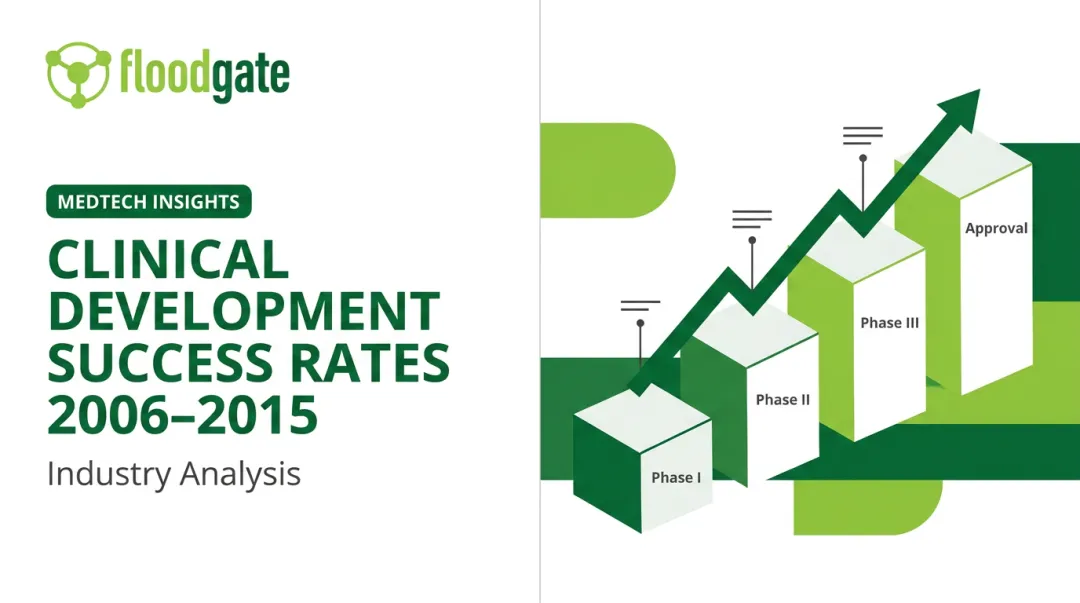
The 90% figure isn't fabricated, but it's a rough shorthand for a much more nuanced picture. A large-scale analysis of nearly 186,000 clinical trials and 21,143 compounds by biostatisticians Wong, Siah, and Lo found that roughly 13.8% of drugs entering Phase I eventually reach approval.
That's closer to "9 in 10 fail," but it's a meaningfully different number than a flat 10% success rate. It also varies enormously by phase, drug type, and disease area.
Where the Drop-Off Actually Happens
Not every phase carries equal risk. According to the Biotechnology Innovation Organization's (BIO) 2011-2020 analysis, transition rates look like this:
| Transition | Success Rate |
|---|---|
| Phase I → Phase II | 52.0% |
| Phase II → Phase III | 28.9% |
| Phase III → Submission | 57.8% |
| Submission → Approval | 90.6% |
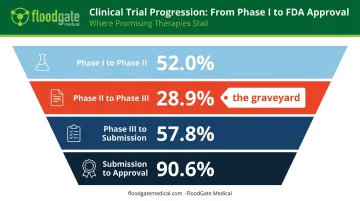
Phase II is the graveyard. It's typically the first real test of whether a drug works in actual patients, not just animal models or healthy volunteers, and that's where optimism meets reality.
Success Varies Wildly by Disease Area and Drug Type
Averages hide the real story. Some fields succeed far more often than others:
- Oncology: roughly 3-8% Phase I-to-approval success, among the lowest of any category
- Infectious disease vaccines: around 33%
- Ophthalmology: around 32%
- Biologics: succeed at approximately 1.6-2x the rate of small molecules
Cancer biology is simply harder to predict from early data than a vaccine's immune response. That gap alone explains why blanket failure statistics mislead more than they inform.
Common Causes of Clinical Drug Development Failure
Trials rarely fail for one clean reason. It's usually a mix of scientific, operational, and strategic problems stacking on top of each other.
Lack of Clinical Efficacy
This is the single largest driver of late-stage failure. A drug that looked promising in preclinical models simply doesn't produce a statistically meaningful benefit over placebo or standard of care once tested in real patients.
Typical scenario: A compound shows strong tumor shrinkage in animal models, then produces marginal, inconsistent results across a diverse human patient population.
Unacceptable Safety or Toxicity Signals
Even a drug with strong early efficacy can be halted by safety concerns that only surface at scale.
In practice: Dose-limiting toxicities appear once a trial expands from a small, controlled Phase I group to a larger, more heterogeneous Phase II or III population.
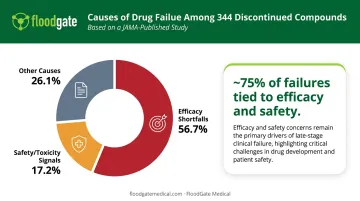
Together, efficacy and safety issues dominate the failure data. A JAMA Internal Medicine study tracking 640 drugs from 1998-2015 found that among the 344 that failed, 56.7% were attributed to efficacy and 17.2% to safety — roughly three-quarters of all documented failures.
Poor Trial Design and Patient Selection
A trial without proper biomarkers, clear endpoints, or patient stratification often produces murky, inconclusive results, even when the drug genuinely works for some people.
Real-world example: A broad, unselected patient population dilutes a drug's real benefit, which only shows up clearly in a specific responsive subgroup that the trial wasn't designed to isolate.
Strategic, Financial, or Talent-Related Missteps
Sometimes the science is fine. The program dies anyway.
- Funding shortfalls or shifting portfolio priorities pull resources mid-trial
- Understaffed or inexperienced clinical operations teams slow enrollment
- Regulatory affairs gaps cause delayed or rejected submissions
- Biostatistics shortfalls lead to underpowered studies
Common pattern: A trial falls behind schedule because of repeated protocol amendments and slow patient recruitment, not because the drug failed a scientific test at all.
The Real Cost of Clinical Trial Failure
A single failed trial reshapes the economics of drug development far beyond the sponsor's budget.
Research estimates vary depending on methodology, but the numbers are staggering either way. A corrected 2022 JAMA analysis of 63 approved drugs found a median capitalized R&D investment of $1.14 billion, with a mean of $1.56 billion.
Other models that fully account for failed compounds and cost of capital put the number closer to $2.6 billion per approved drug.
The "Fail Fast" Principle
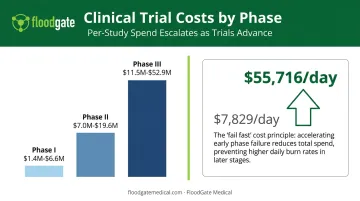
Where a drug fails matters almost as much as whether it fails. Per-study costs escalate sharply by phase:
- Phase I: roughly $1.4M-$6.6M
- Phase II: roughly $7.0M-$19.6M
- Phase III: roughly $11.5M-$52.9M
Tufts CSDD estimates direct trial spending of $7,829 per day in Phase I versus $55,716 per day in Phase III. A failure caught early costs a fraction of a failure caught late, which is exactly why catching problems in preclinical or Phase I work matters so much.
The Human and Innovation Cost
These dollar figures only tell part of the story. Behind every failed trial are patients who volunteered, often as a last resort, and researchers who spent years on a compound that never reached the market.
When a program stalls because of preventable, non-scientific factors like staffing gaps or funding shortfalls, the cost extends beyond the balance sheet: it delays treatment for every patient waiting on the next generation of care.
How to Improve Clinical Trial Success Rates
Better outcomes require progress on three fronts: more predictive science, disciplined execution, and the right people running the trial. No single fix solves this problem alone.
Invest in Better Preclinical and Translational Science
What to do: Adopt more predictive models, such as biomarker-informed testing and organoid-based systems, before advancing to human trials.
How it helps: Catching efficacy or safety problems in the lab is dramatically cheaper than discovering them in an expensive Phase II or III program.
Use Biomarkers and Adaptive Trial Designs
What to do: Build biomarker-based patient selection and adaptive protocols into trial design from the start, allowing real-time modification based on interim data.
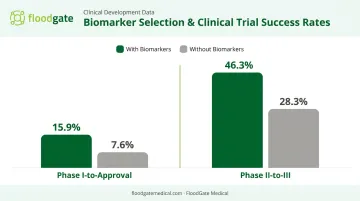
How it helps: The Biotechnology Innovation Organization (BIO) found that programs using patient-preselection biomarkers achieved 15.9% Phase I-to-approval success, compared to 7.6% without them — more than double. The Phase II-to-III gap was even larger: 46.3% with biomarkers versus 28.3% without.
Strengthen Regulatory Strategy and Clinical Operations
What to do: Engage regulators early through pathways like Breakthrough Therapy designation, and build detailed operational execution plans before enrollment begins.
How it helps: Fewer surprises mid-trial means fewer costly protocol amendments. Protocol changes alone cost a median of $141,000 in Phase II and $535,000 in Phase III per amendment. A stronger regulatory strategy helps avoid that lost money and time.
Build High-Performing, Diverse Clinical Development Teams
This is the lever companies underestimate most. Research on clinical trial sites found that prior sponsor-specific team experience was associated with roughly 20% faster cycle times, 10% higher enrollment, and about four fewer weeks of site-activation time. Trial execution ultimately depends on the team running it, not just the science behind it.
That means:
- Prioritizing experienced clinical operations, regulatory affairs, and biostatistics professionals when staffing a program
- Building teams with varied backgrounds and perspectives, which tends to produce more inclusive, representative trial designs and better patient recruitment strategies
- Treating talent strategy as seriously as trial design, not as an afterthought once the protocol is finalized
This is where a specialized recruiting partner earns its place. FloodGate Medical works exclusively within MedTech and life sciences, building its hiring approach around diversity, equity, and inclusion at every stage of sourcing and placement.
Rather than reacting once a role opens and a program is already behind schedule, the firm builds candidate relationships ahead of need. That matters most when a single clinical operations lead or regulatory affairs hire can determine whether a trial hits its enrollment timeline.
Conclusion
Clinical drug development failure isn't random. It comes from identifiable, often overlapping causes across science, strategy, and staffing. A drug can have brilliant chemistry behind it and still stall because a trial was poorly designed or a clinical team was stretched too thin to execute the protocol on time.
Pairing better science (biomarkers, adaptive design, translational models) with stronger, more diverse clinical teams meaningfully shifts the odds. Companies that invest equally in innovation and talent won't eliminate the risk inherent in drug development.
But they'll be far better positioned to beat the historical odds than those betting on science alone. Building that talent advantage starts with the right MedTech staffing partner — which is exactly where FloodGate Medical comes in.
Frequently Asked Questions
What percentage of clinical trials actually fail?
While "90% failure" is commonly quoted, large-scale studies show roughly 13.8% of drugs progress from Phase I to approval overall, with wide variation by therapeutic area and drug type.
What is the biggest reason clinical trials fail?
Lack of demonstrated efficacy is the most common reason, accounting for over half of documented late-stage failures. Unexpected safety or toxicity concerns rank second.
Which phase of clinical trials has the highest failure rate?
Phase II typically sees the steepest drop-off, with success rates around 29%. It is often the first real test of a drug's efficacy in actual patients rather than models or healthy volunteers.
Why does oncology have a lower clinical trial success rate than other therapeutic areas?
Cancer biology is highly heterogeneous, with tumor evolution and treatment resistance that make outcomes harder to predict from early-phase data compared to fields like vaccines.
How can companies reduce the risk of clinical trial failure?
A combination of better preclinical science, adaptive trial design, biomarker use, and building experienced clinical development teams meaningfully reduces execution risk.
Does the quality of a clinical team really impact trial outcomes?
Yes. Experienced clinical operations and regulatory talent directly affects enrollment speed, protocol compliance, and submission quality, all of which are critical to reaching approval on time.