That model hasn't disappeared, but it's no longer enough on its own.
Physicians now research devices online before a rep ever calls. They compare clinical data across browser tabs, watch product demos on their own schedule, and expect self-service access to the information they need. The pandemic didn't create this shift, but it fast-tracked it by several years.
Understanding these digital marketing trends isn't optional anymore. Companies that ignore them will lose ground in three places at once: HCP attention, market share, and the talent needed to compete for both.
Key Takeaways
- MedTech marketing has shifted from relationship-only selling to omnichannel, data-driven engagement
- Five major digital trends now define how companies reach HCPs and patients
- MLR compliance is now built directly into the digital execution process from the start
- Hybrid marketing-technology talent is in short supply, creating new hiring priorities
- Companies that adopted digital-first strategies early report stronger, measurable ROI
Key Digital Marketing Trends Reshaping MedTech
Five shifts stand out across MedTech commercial teams right now. Each one reflects a move away from single-channel, rep-dependent selling toward something more layered and measurable.
Omnichannel Engagement Replacing Rep-Only Selling
Sales reps haven't gone away. But they're now one piece of a bigger puzzle that includes email nurture sequences, targeted digital ads, and self-service content portals HCPs can browse on their own time.
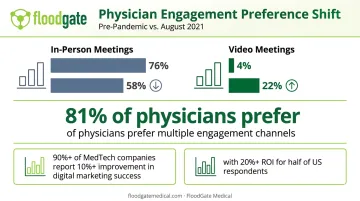
Physician preferences back this up. In a McKinsey survey of 897 device-using physicians, in-person meeting preference dropped from 76% before the pandemic to 58% in August 2021, while video preference jumped from 4% to 22%. More tellingly, 81% of physicians said they now prefer using more than one engagement channel.
Some companies now pair virtual reps with digital content hubs, letting HCPs pull clinical data or product specs whenever they need them, without waiting for a scheduled call.
The payoff shows up in the numbers. More than 90% of surveyed MedTech companies reported at least a 10% improvement in digital-marketing success after shifting budget toward digital channels, with half of US respondents reporting ROI of 20% or higher.
Content Marketing & Thought Leadership
Before a sales conversation ever starts, HCPs are forming opinions based on the content they've already consumed. Whitepapers, case studies, and clinical evidence pieces do the credibility-building work that used to fall entirely on reps.
Gated webinar series are a common tactic here. Medtronic, for example, maintains a surgical education webinar library where HCPs register for live sessions or watch recordings on demand, capturing engagement data along the way.
This approach works because trust transfers. A large-scale B2B study found 73% of decision-makers rated thought leadership as more trustworthy than standard marketing materials, and 60% said they eventually did business with a company after engaging with its content.
That's a cross-industry benchmark, not a MedTech-specific figure, but the direction applies here too: content-led marketing shortens the distance between "I've never heard of you" and "I trust your data."
Data-Driven Personalization & AI-Powered Targeting
Generic outreach is losing ground fast. AI-powered segmentation now lets MedTech marketers target HCPs by specialty, prescribing patterns, or device usage history instead of blasting the same message to every cardiologist on a list.
Predictive analytics is where this gets tactical. In one vendor case study, a diabetes-device brand applied predictive modeling to an existing prescriber list and generated:
- An 8.5% lift in scripts written
- 1,086 new prescribers
- $12.8 million in attributed revenue
That's a single vendor-reported case, not an industry norm, but it illustrates the mechanism: identify high-intent prospects first, then personalize the message around their specific clinical context.
Digital Sales Enablement & Virtual Engagement Tools
Virtual product demos, AR/VR training modules, and remote proctoring have replaced a meaningful share of in-person sales visits, especially for surgical training and case support.
Medtronic's education programs reached 993,000 HCPs over three years using a full mix of channels including VR simulation. Proximie, a remote surgical support platform, logged more than 10,000 surgical interactions across 300+ hospitals in 40+ countries, with usage climbing over 400% during the pandemic's peak months.
Why the growth? It's straightforward math:
- One VR training session reaches surgeons in multiple time zones simultaneously
- Remote proctoring eliminates travel costs for both the rep and the specialist
- Training scales without adding headcount
Social Media, Community & Influencer-Based Marketing
LinkedIn, physician networks, and patient advocacy communities have become genuine marketing channels, not just brand-awareness afterthoughts.
Abbott's HeartMates program, launched in 2023 with NFL player Damar Hamlin, built a community for people living with heart conditions and their caregivers. The platform offers shared patient stories, expert Q&A sessions, and virtual meetups, open to anyone regardless of whether they use an Abbott device.
The community-building payoff extends well beyond any single campaign. Patients and HCPs who feel connected to a brand's community keep coming back organically, long after the paid ad budget runs out.
What's Driving These Digital Marketing Trends in MedTech
These shifts aren't happening in isolation. Several forces are converging at once, and together they explain why digital adoption has accelerated so quickly across the industry.
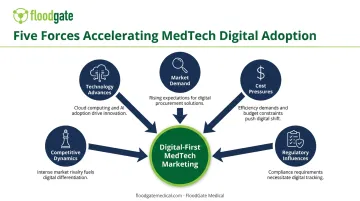
- Technology advances: Cloud-based PIM/PLM platforms and AI content tools now make it possible to produce and manage compliant marketing content at scale, something that used to require far more manual review time.
- Market demand: HCPs got comfortable with self-service research during the pandemic and never went back. They now expect to find answers before they ever talk to a rep.
- Cost pressures: Digital channels generally cost less per interaction than field sales visits and trade show booths, though a precise industry-wide cost-per-lead comparison hasn't been reliably established.
- Regulatory influences: MLR (Marketing, Legal, Regulatory) review is going digital to match faster launch timelines. Veeva reports its optimized workflows cut review-cycle time by 57% and review-meeting time by 55%, per its own vendor data.
- Competitive dynamics: Companies slow to modernize their marketing stack risk losing share to competitors who've already made the shift.
Deloitte's talent research adds another layer: 75% of digital early adopters prioritized hiring digital expertise, compared to just 31% of digitally lagging companies. The gap between leaders and laggards isn't just about tools anymore. It's about who's staffed to use them.
How These Trends Are Impacting the MedTech Industry
This digital shift isn't confined to the marketing department. It's rippling through operations, budgets, and hiring strategy across the entire organization.
Operational Impact
Marketing teams are now getting involved earlier in the product development lifecycle, working alongside R&D and regulatory functions instead of waiting until launch to get briefed.
This has pushed many companies toward centralized digital asset management systems that handle labeling, IFUs, and campaign content inside one compliant workflow, rather than juggling separate systems that don't talk to each other.
Business Impact
Budget allocation is moving. Dollars that used to go toward trade show booths and printed collateral are now funding digital ad spend, content production, and marketing technology platforms.
This reallocation reflects results, not guesswork. Companies that shift more budget toward digital channels often report stronger ROI, which explains why the shift keeps accelerating rather than slowing down.
Workforce Impact
Here's where the strategy meets a real bottleneck. Executing an omnichannel, AI-informed marketing plan requires people who understand both:
- Clinical and regulatory nuance specific to medical devices
- Modern digital marketing tools, from marketing automation to AI-driven segmentation platforms
That combination is rare. Many MedTech companies report struggling to find candidates who genuinely blend both skill sets, rather than checking one box and hoping the other develops on the job.
This is exactly the gap FloodGate Medical was built to close. As a recruitment firm focused exclusively on MedTech, FloodGate Medical works with companies across commercial, clinical, marketing, operations, and leadership functions to build teams equipped for a digitally driven commercial landscape.
Its DEI-driven recruitment methodology and monthly industry newsletter give hiring managers additional insight for evaluating candidates in a market where the required skill set keeps shifting.
Future Signals to Watch in MedTech Digital Marketing
The trends above are already reshaping how MedTech companies compete. A few emerging developments are worth watching over the next one to three years:
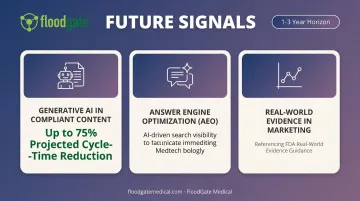
- Generative AI in compliant content creation: Vendors like Veeva are positioning AI to draft and pre-review MLR content, projecting cycle-time reductions of up to 75%. This remains a forecast, not a proven outcome, but the direction is clear.
- Answer Engine Optimization (AEO): As HCPs and patients increasingly turn to AI search tools instead of traditional search engines, optimizing content for how AI surfaces answers is becoming a distinct discipline from classic SEO.
- Real-world evidence integrated into marketing narratives: FDA guidance on evaluating real-world data quality for regulatory decisions is starting to migrate into commercial storytelling, giving marketers a stronger evidence base for HCP-facing content.
None of these are guaranteed to play out exactly as vendors predict. But companies that start testing now will have a head start over those who wait for the trend to become mainstream.
Conclusion
MedTech marketing has moved past the point where relationship-selling alone wins deals. Omnichannel engagement, content-led credibility building, AI-powered personalization, virtual sales enablement, and community-driven social strategies now work together, not as isolated tactics.
Companies adapting early, both in their marketing technology and in the talent they hire to run it, are the ones building a durable edge. The rest are still relying on last decade's playbook.
Strategic foresight in workforce planning matters as much as martech investment; the best strategy stalls without people who can execute it. FloodGate Medical helps MedTech companies close that gap, matching marketing and commercial talent to execute these strategies.
Frequently Asked Questions
What is MedTech marketing?
MedTech marketing refers to the strategies used to promote medical devices and technologies to healthcare providers, patients, and healthcare organizations. It spans the full product lifecycle, from pre-launch clinical education to post-market patient engagement.
What are the segments of the MedTech market?
Major segments include diagnostics, surgical devices, cardiovascular devices, orthopedic devices, and digital health/wearables. These categories often overlap, particularly as connected devices blur the line between hardware and software.
What is the 3-3-3 rule in marketing?
The 3-3-3 rule is an informal framework, not an industry standard, often described as testing 3 channels, 3 content formats, over 3 weeks. Some marketers use it as a lean structure for quick campaign experiments before scaling what works.
How is digital transformation changing MedTech sales roles?
Sales reps are evolving into consultative, digitally equipped advisors rather than being replaced outright. They now supplement in-person visits with virtual tools, data insights, and self-service content that HCPs can access independently.
What skills do MedTech companies need for modern marketing teams?
Teams need a blend of digital marketing execution, data analytics fluency, regulatory awareness, and content compliance management. Because this hybrid skill set is rare, many MedTech companies turn to specialized recruiters like FloodGate Medical to fill these roles.
Is digital marketing replacing sales reps in MedTech?
No. Digital marketing complements reps rather than replacing them, creating a blended omnichannel model. Physicians consistently report preferring multiple engagement channels, not a single digital-only or in-person-only approach.