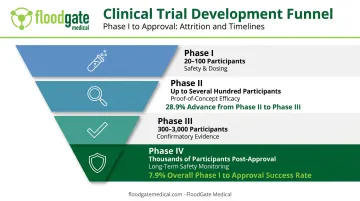
Only 7.9% of drugs that enter Phase I ever reach approval, according to a BIO analysis of nearly 10,000 development programs from 2011-2020. Getting a product across the finish line takes scientific rigor, regulatory precision, and the right people executing at every stage.
This guide breaks down the phases of clinical development, what goes into a development plan, the career paths behind the science, and the challenges reshaping the field today.
Key Takeaways
- Clinical development spans four phases, from small safety studies to large-scale trials and post-market surveillance
- Roughly 1 in 13 drug candidates that begin Phase I testing reach FDA approval
- A strong clinical development plan aligns scientific goals, regulatory strategy, and realistic timelines
- Talent shortages and evolving trial designs are among the field's biggest pressures today
What Is Clinical Development?
Clinical development is the process of testing a drug, biologic, or medical device in humans. It's distinct from drug discovery and preclinical research, which happen earlier in a lab or animal model, before anything touches a patient.
The goal is simple to state and hard to execute: generate enough clinical data to support regulatory approval and inform the product's labeling. That data has to satisfy regulators, convince physicians, and hold up to scrutiny for years after launch.
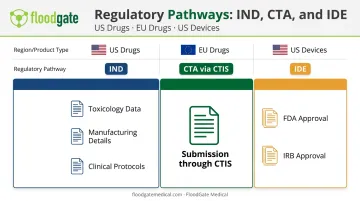
Before that data can be generated, though, sponsors must clear a regulatory gateway:
- United States (drugs): An Investigational New Drug (IND) application, covering toxicology data, manufacturing details, and clinical protocols
- Europe (drugs): A Clinical Trial Application submitted through the EU's Clinical Trials Information System (CTIS)
- United States (devices): An Investigational Device Exemption (IDE), required for significant-risk device studies before FDA and IRB approval
Devices don't follow the same numbered-phase structure as drugs. Instead, MedTech programs typically move through early feasibility, pivotal, and post-approval studies under the IDE framework. It's a related but genuinely different pathway, and treating it as identical to drug development is a common mistake.
Who's Involved
Clinical development is a team sport. Key stakeholders include:
- Sponsors – the company or institution running the overall program
- CROs (Contract Research Organizations) – often handle day-to-day trial execution on the sponsor's behalf
- Regulatory bodies – the FDA in the US, the EMA in Europe, overseeing safety and approval decisions
- Clinical development teams – scientists, operations staff, and medical experts designing and running the studies
The Four Phases of Clinical Development
Historically, drug development moved through four distinct, sequential phases. Modern programs increasingly overlap these stages to save time, but the underlying objectives haven't changed.
| Phase | Typical Size | Primary Goal |
|---|---|---|
| I | 20-100 participants | Safety, dosing, tolerability |
| II | Up to several hundred patients | Proof-of-concept efficacy |
| III | 300-3,000 patients | Confirmatory, pivotal evidence |
| IV | Thousands, post-approval | Long-term safety monitoring |
Phase I: Safety and Dosing
Phase I trials answer one question first: is this safe? Small groups, usually healthy volunteers but sometimes severely ill patients in oncology, receive escalating doses under close observation.
According to the FDA's overview of clinical research, Phase I studies typically enroll 20 to 100 people over several months. Dose-escalation methodology, giving progressively higher doses to small cohorts, helps researchers identify the maximum tolerated dose (MTD), the highest dose that doesn't produce unacceptable side effects.
This approach is especially common in oncology trials, though not every Phase I study is built around finding an MTD.
Phase II: Exploring Efficacy
Once safety is established, Phase II asks: does it actually work? This is the proof-of-concept stage, testing the therapy in a small patient population to see whether it produces the intended clinical effect, and at what dose.
Phase II is where most programs stall. According to BIO's Clinical Development Success Rates report, only 28.9% of programs advance from Phase II to Phase III, making it the single biggest attrition point in the entire development process. Go/no-go decisions made here shape everything downstream, from budget allocation to trial design for Phase III.
Phase III: Confirming Efficacy and Safety
Phase III is where the stakes multiply. These pivotal trials enroll hundreds to thousands of patients across diverse, real-world populations, often using placebo or active comparator designs.
The data generated here forms the backbone of a New Drug Application (NDA) or Biologics License Application (BLA). Phase III also supplies the bulk of pre-approval safety data, since larger, longer trials reveal side effects that smaller studies simply can't catch.
Phase IV: Post-Market Surveillance
Approval isn't the finish line. Phase IV studies track a therapy or device once it's available to the broader public, watching for rare adverse events, long-term effects, and real-world performance that clinical trials couldn't fully capture.
This pharmacovigilance work matters because trial populations are curated. The general public is not. Post-market data often reshapes labeling, prescribing guidance, or, in rare cases, triggers a product withdrawal.
What's in a Clinical Development Plan?
A clinical development plan (CDP) is the strategic backbone of the entire program. It defines the objectives of the clinical effort and sets the criteria for what counts as a positive proof-of-concept.
A solid CDP typically outlines:
- The research question and target patient population
- Eligibility criteria and treatment schedule
- Dosing strategy and comparator design
- Endpoints for Phase I and Phase II studies specifically
- Safety monitoring approach and statistical methodology
The plan has to do more than describe the science. It needs to align scientific ambition with regulatory reality, budget constraints, and a timeline that won't collapse under its own weight. FDA's End-of-Phase 2 meetings exist precisely because dose selection and Phase III design decisions are too consequential to leave to guesswork.
FDA's June 2024 draft guidance introduced a new element: a Diversity Action Plan, which encourages sponsors to build enrollment goals for underrepresented populations directly into their planning. It's draft guidance, not yet binding, but it signals where regulatory expectations are heading.
Careers in Clinical Development: Roles, Skills, and Experience
Behind every successful trial is a team of specialists who rarely get public credit but carry enormous responsibility.
A clinical development scientist's day-to-day work includes:
- Designing study protocols and defining endpoints
- Interpreting incoming trial data
- Coordinating with biostatistics and regulatory affairs teams
- Adjusting strategy based on emerging safety or efficacy signals
They don't work in isolation. The broader clinical development ecosystem includes:
- Clinical research associates (CRAs) – monitor site compliance and data quality
- Clinical project managers – keep timelines, budgets, and vendors on track
- Medical directors – provide clinical and scientific oversight
- Biostatisticians – design analysis plans and interpret trial results
- Regulatory affairs specialists – manage submissions and agency communication
What Counts as Real Experience
"Clinical development experience" gets thrown around loosely. Meaningful experience includes hands-on trial coordination, working knowledge of Good Clinical Practice (GCP) standards, therapeutic area expertise, and direct involvement in a regulatory submission, not just adjacent exposure.
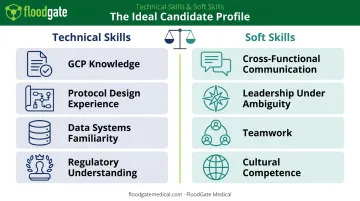
Hiring managers in MedTech and pharma typically screen for a mix of technical and soft skills. On the technical side, that means GCP knowledge, protocol design experience, data systems familiarity, and product-specific regulatory understanding. Equally important are soft skills like cross-functional communication, leadership under ambiguity, teamwork, and cultural competence.
That combination is in short supply. Demand for this talent hasn't slowed, even as the profession struggles to measure itself accurately. ACRP's 2025 white paper describes an ongoing clinical research workforce crisis and notes that the industry only submitted a request for a distinct US occupation code in August 2024.
In other words, the talent gap is real, but it's still not being tracked the way it should be.
Diverse hiring isn't just a values statement here, either. It has a measurable connection to trial quality: research shows patients from underrepresented groups report greater willingness to participate in trials when they see investigators who reflect their own backgrounds.
Teams built with that diversity in mind tend to design trials that better represent the patients the product will ultimately serve. Recruitment firms like FloodGate Medical apply this thinking directly, using DEI-driven placement practices to help MedTech companies build the diverse clinical development teams this research supports.
Common Challenges and Emerging Trends in Clinical Development
Clinical development has always been risky. What's changing is how companies are trying to manage that risk.
High attrition remains the defining challenge. Phase II is the weakest link, with a 28.9% success rate, and terminations aren't always about safety or efficacy. Commercial priorities and portfolio decisions kill plenty of promising programs too.
Trial design is evolving to compensate:
- Adaptive designs let sponsors modify a trial based on accumulating data, within pre-specified limits.
- Regulatory support solidified in 2019, when the FDA finalized formal guidance on adaptive trial design.
- Adoption is accelerating: IQVIA counted nearly 400 adaptive trials in 2020, up from fewer than 200 annually just a few years earlier.
- Decentralized elements (remote visits, local providers, direct-to-participant drug shipments) expanded rapidly during the pandemic and remain common today, even as growth has slowed.
Talent shortages are becoming the real bottleneck. Companies can design a brilliant adaptive trial, but without skilled clinical scientists, CRAs, and regulatory specialists to execute it, the design doesn't matter. Scaling a clinical development program now depends as much on hiring capacity as on scientific strategy. Firms like FloodGate Medical, which specializes in MedTech staffing, help close this gap by placing skilled clinical scientists and regulatory specialists quickly.
Building Your Clinical Development Team with FloodGate Medical
Every phase of clinical development runs on people, and finding the right ones is its own specialized discipline. FloodGate Medical works exclusively within MedTech, connecting companies with vetted clinical development talent, from clinical scientists to regulatory affairs and project management professionals.
Our talent directors partner directly with Clinical Affairs, Medical Affairs, and Research leaders to align hiring with actual product milestones, not generic job descriptions. That means understanding whether a client needs someone who's run an early feasibility study under an IDE or someone with deep PMA submission experience, and sourcing accordingly.
What sets our approach apart:
- A recruitment methodology built around equity, diversity, and inclusion, reflecting our belief that diverse teams strengthen trial design and patient outcomes
- Career resources including a monthly newsletter with industry insights and a hiring-manager training program through FloodGate University
- Coaching programs, including our BootCamp offering, for professionals navigating clinical development career moves

Whether you're a MedTech company scaling a clinical program or a professional looking to grow your clinical development career, connect with our team to talk through what you need.
Frequently Asked Questions
What are the four stages of clinical development?
Phase I tests safety and dosing in small groups. Phase II explores efficacy in a limited patient population. Phase III confirms efficacy and safety at scale for regulatory submission. Phase IV monitors safety after market approval.
What is in a clinical development plan?
A clinical development plan defines program objectives, sets proof-of-concept criteria, and outlines Phase I/II study design, including endpoints, dosing, and target patients. It aligns science with regulatory and budget realities.
What does a clinical development scientist do?
They design study protocols, interpret trial data, and coordinate closely with regulatory affairs and biostatistics teams. Their work shapes both the scientific direction and regulatory viability of a program.
What is clinical development experience?
It means hands-on involvement in trial coordination, working knowledge of Good Clinical Practice (GCP), therapeutic area expertise, and direct exposure to regulatory submissions, not just general familiarity with clinical work.
How long does clinical development typically take?
Across all phases through approval, drug development averages around 10.5 years, based on BIO's 2011-2020 dataset. That excludes discovery and preclinical work, and device timelines can vary widely.
What is the difference between clinical development and clinical research?
Clinical development is the umbrella program a sponsor runs, linking multiple studies and regulatory decisions toward approval. Clinical research, or a clinical trial, refers to the individual studies conducted within that broader program.