Interim general managers solve this exact problem. They are seasoned executives who step into leadership gaps immediately, bringing the operational expertise and strategic thinking needed to stabilize operations, lead through transitions, or drive complex transformation projects. Unlike permanent hires that take months to recruit or consultants who advise from the sidelines, interim GMs take the seat, own the outcomes, and deliver results within tight timeframes.
This guide explains what interim general managers do, when hiring one makes strategic sense, the benefits they deliver, essential skills to look for, and how to find the right interim GM for your MedTech organization.
Key Takeaways
- Interim GMs are temporary executives with full authority to lead units through transitions, crises, or transformations
- They deploy in days or weeks, not the 3–6 months a permanent search usually takes
- Common triggers: unexpected departures, rapid growth, restructuring, coverage gaps, and project-specific needs
- Unlike permanent hires or consultants, they pair hands-on operational leadership with fast strategic execution
- The right hire brings industry expertise (e.g., MedTech regulatory knowledge), emotional intelligence, and proven results under pressure
What Is an Interim General Manager?
An interim general manager is a senior executive appointed temporarily to oversee a business unit, division, or entire company during change, transition, or a defined strategic need. Unlike caretaker leaders who mainly hold the line, interim GMs are hired to fix problems and deliver specific outcomes within a set timeframe.
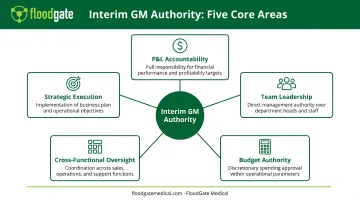
Scope and authority: Interim GMs typically hold full operational responsibility, including:
- Profit and loss (P&L) accountability for the business unit or division
- Direct team leadership and management through subordinate supervisors
- Budget authority for resource allocation, pricing, and investment decisions
- Cross-functional oversight spanning operations, sales, finance, quality, and human resources
- Strategic and tactical execution of business objectives within the engagement timeframe
That breadth sets a general manager apart from functional managers who own a single department or process.
According to the U.S. Department of Labor's O*NET database, general and operations managers coordinate policies and operations across departments or locations and lead through subordinate supervisors. They also work with financial statements, sales data, production, distribution, and budgets—work that mixes strategy with day-to-day execution.
Interim versus acting:
An "acting" general manager is usually an internal employee given expanded duties while keeping most of their original role. The focus is continuity and stability.
Interim GMs are typically external operators hired to drive change: implement new systems, lead a turnaround, or steer a complex transition. They bring outside expertise and enough independence to make hard calls without internal political baggage.
Typical engagement length: Most interim GM assignments last 3-12 months, though duration varies by objective:
- Gap coverage (unexpected departure or medical leave): 2-4 months
- Transformation projects (ERP implementation, restructuring, quality system overhaul): 9-12+ months
- Turnaround or crisis management: 6-9 months
- Growth scaling or M&A integration: 6-12 months
The engagement ends when specific objectives are met, a permanent leader is hired and onboarded, or control transitions back to existing management. Some successful interim GMs convert to permanent roles if both parties see long-term fit, but there is no obligation.
Key Benefits of Hiring an Interim General Manager
Why Speed Matters
Permanent executive searches take time. SHRM's 2026 benchmarking data reports a 45-day median timeline from requisition opening to offer acceptance for executive roles. Add notice periods, relocation, and onboarding, and the real vacancy often stretches 3-6 months. During that gap, decisions stall, teams lose direction, and operational performance suffers.
Interim GMs deploy in days or weeks, not months. Because they are experienced executives accustomed to rapid onboarding, they assess the situation quickly, establish priorities, and begin driving results almost immediately. This speed minimizes disruption during critical business periods: product launches, regulatory submissions, major customer negotiations, or financial closes, when leadership presence directly impacts outcomes.
The cost of executive vacancy extends beyond recruiting expenses. While SHRM reports a $15,000 median cost-per-hire for executive roles (covering agency fees, advertising, and relocation), the operational cost of an empty GM seat (forgone revenue, delayed decisions, team attrition, and lost momentum) can be far greater, especially in fast-moving MedTech markets where timing affects competitive positioning.
Specialized Expertise When You Need It
Interim GMs bring deep functional expertise matched to your specific challenge. Whether you need a turnaround specialist, a regulatory compliance expert, an M&A integration leader, or a growth-scaling operator, interim talent markets offer access to executives who have solved similar problems multiple times.
Hire up for the situation: Organizations can access more senior, experienced talent than their budget or long-term needs justify permanently. A $5M revenue MedTech startup facing an FDA quality system audit can engage a former VP of Quality from a $100M device company—experience they couldn't afford or sustain full-time, but can access for a 4-6 month engagement.
Industry-specific value: In regulated industries like MedTech, industry expertise matters. An interim GM with medical device experience already understands:
- FDA regulations (510(k) pathways, QSR compliance, design controls)
- Quality management systems (ISO 13485, ISO 14971 risk management)
- Healthcare sales cycles, hospital procurement, and clinical language for physicians and cath lab teams
That background eliminates the learning curve and keeps decisions aligned with regulatory, clinical, and commercial realities.
Objectivity and Fresh Perspective
External interim GMs aren't constrained by internal politics, legacy thinking, or cultural blind spots. They enter with no history, no alliances, and no long-term political concerns—freeing them to ask tough questions, challenge assumptions, and make decisions based purely on business merit.
Unbiased assessment: Interim GMs often identify problems and opportunities that internal teams are too close to see. They spot redundant processes, misaligned incentives, underperforming talent, or missed market opportunities that have become invisible through familiarity. Their outsider perspective enables faster root-cause diagnosis and more direct problem-solving.
Decisiveness without political cost: Because interim GMs have defined mandates and limited tenures, they can make difficult decisions—restructuring underperforming teams, sunsetting unprofitable products, renegotiating supplier contracts, or reallocating budgets—without worrying about long-term internal relationships or career implications. This decisiveness accelerates change in situations where permanent leaders might move more cautiously.
Immediate Impact and Results Focus
Interim GMs are measured on outcomes, not tenure. Their success depends on delivering specific, measurable results within tight timeframes, creating strong intrinsic motivation to act quickly and prioritize high-impact initiatives.
Rapid assessment and quick wins: Experienced interim executives use proven diagnostic frameworks to assess situations rapidly—often producing actionable insights within the first 2-4 weeks. They identify quick wins that build momentum and credibility while simultaneously planning longer-term structural improvements. This phased approach delivers early visible results while addressing root causes.
Outcome accountability: According to the Association of Executive Search and Leadership Consultants (AESC), organizations deploy interim executives for transformation, restructuring, M&A, IPO prep, strategic projects, and unexpected vacancies. These situations demand rapid, measurable impact.
The value centers on immediate operating capacity and outcome-driven leadership, not long-term relationship building.
Lower Risk and Flexibility
Hiring a permanent executive involves significant financial and organizational risk. Beyond base salary, companies commit to benefits, equity, bonuses, relocation packages, and potentially costly severance if the hire doesn't work out. If a $250K permanent GM hire fails within 12 months, the total cost, including lost productivity, recruiting expenses, and severance, can exceed $500K.
Interim GMs offer a different risk profile:
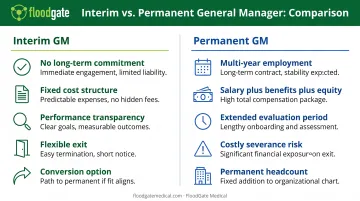
- No long-term commitment: Engagements have defined end dates and scope, with no obligation beyond the agreed term
- Fixed cost structure: Typically paid via daily or monthly rates with clear deliverables, making budgeting straightforward
- Performance transparency: Results become visible quickly, allowing organizations to extend, adjust, or conclude engagements based on demonstrated value
- Flexible exit: If the fit isn't right, engagements can conclude at natural transition points without the legal, financial, and morale costs of terminating a permanent executive
- Conversion option: Successful interim GMs can transition to permanent roles if both parties see long-term fit, effectively providing a high-stakes trial period
This flexibility is especially valuable during uncertain periods—market volatility, ownership transitions, or strategic pivots—when organizations need senior leadership but can't confidently commit to permanent headcount.
When to Hire an Interim General Manager
Unexpected Leadership Departure
The most urgent scenario: your GM resigns without notice, is terminated for cause, suffers a sudden illness, faces a family emergency, or passes away unexpectedly. Operations can't wait 3-6 months for a permanent search to conclude.
Interim GMs provide:
- Immediate operational stability and continuity for teams, customers, and stakeholders
- Leadership presence during emotionally difficult transitions
- Objective assessment of the situation and team capabilities
- Time to conduct a thoughtful, unhurried permanent search process
- Protection against internal political maneuvering or hasty promotion decisions
Temporary Leadership Coverage
Planned absences also create interim needs: extended medical leave, parental leave, sabbaticals, or temporary reassignment of the current GM to a special project or acquisition integration.
Unlike unexpected departures, temporary coverage has a known end date. The goal is continuity without displacing the returning leader. Interim GMs in this context focus on:
- Steady-state management of day-to-day operations
- Protecting team morale during the absence
- Advancing existing initiatives without major redirects
- Ensuring a smooth handoff when the permanent GM returns
Rapid Growth or Scaling Challenges
High-growth scenarios can quickly outpace existing management capabilities: landing a major hospital system contract, launching into new geographic markets, scaling production capacity, or raising significant funding.
Interim GMs provide the operational infrastructure, process discipline, and leadership experience needed to scale successfully:
- Building systems and processes that support higher volume and complexity
- Recruiting and developing the next layer of management talent
- Implementing financial controls, forecasting, and reporting for larger operations
- Establishing quality management systems that meet regulatory and customer requirements
- Creating operational cadence and accountability structures
That support matters most in the window when you need senior operational leadership but cannot yet justify or afford the role permanently. The interim GM builds the foundation, then hands off to a permanent leader once the organization stabilizes at the new scale.
Restructuring or Transformation Projects
Defined change initiatives benefit from interim leaders who have run similar projects before: M&A integration, operational restructuring, digital transformation, ERP implementation, or quality system overhauls.
Common MedTech transformation scenarios:
- Implementing a new quality management system to achieve ISO 13485 certification
- Integrating acquired companies' operations, systems, and teams post-merger
- Restructuring commercial operations to support new channel strategies or product lines
- Leading regulatory submissions (510(k), PMA) while maintaining ongoing operations
- Overhauling supply chain, manufacturing, or distribution infrastructure
Interim GMs deploy proven methodologies, anticipate common pitfalls, and drive disciplined execution while permanent leadership focuses on long-term strategy. The project-based nature fits the interim model: hire the expert, complete the transformation, then move to steady-state management.

Crisis Management or Turnaround Situations
Crisis scenarios demand immediate, experienced intervention: financial distress, major compliance failures, significant customer losses, product recalls, or operational breakdowns.
Interim GMs with turnaround experience bring:
- Calm, disciplined decision-making under extreme pressure
- Rapid triage that separates critical issues from distractions
- Trust maintenance with customers, regulators, investors, and employees
- Stabilization that stops the bleeding, then addresses root causes
- Steady direction when teams are anxious or demoralized
According to the Institute of Interim Management's 2026 survey, 37% of interim assignments in the UK involved change or transformation work, and 13% focused on turnaround or restructuring. Those figures show how often organizations bring in interim leaders for high-stakes, complex work.
Performance Improvement Needs
Sometimes a business unit consistently underperforms, and the existing leadership team lacks the experience, objectivity, or capability to diagnose and fix the problem. Operational metrics miss targets quarter after quarter, customer satisfaction declines, or costs creep upward without clear accountability.
Interim GMs offer:
- Unbiased root-cause analysis free from internal politics or defensiveness
- Clear ownership for improvement with measurable milestones
- Honest evaluation of whether the existing team can execute the turnaround
- Direct leadership of improvement initiatives, not just recommendations
- Tough calls on restructuring, replacing underperformers, or reallocating resources that internal leaders may avoid
Once performance stabilizes and improves, the interim GM either transitions out (leaving the improved operation to the existing or a new permanent leader) or, if successful, may convert to a permanent role.
Essential Skills and Qualities of Effective Interim General Managers
Not every experienced executive succeeds as an interim GM. The role demands a unique combination of strategic thinking, operational execution, emotional intelligence, and adaptability few generalist leaders bring together at once.
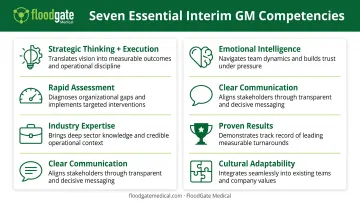
Critical skills and qualities:
Strategic thinking combined with operational execution: Interim GMs must quickly understand the business model, competitive landscape, and strategic priorities, then translate that understanding into actionable operational plans. They balance long-term vision with immediate tactical needs.
High emotional intelligence and change leadership: Leading teams through uncertainty, transition, or crisis requires empathy, clear communication, and the ability to build trust rapidly. Interim GMs must inspire confidence, manage resistance, and motivate teams even when the assignment is temporary.
Rapid assessment and decisive decision-making: Time is limited. Effective interim GMs diagnose situations quickly, prioritize ruthlessly, and make confident decisions with imperfect information. They separate critical issues from noise and act accordingly.
Clear communication and stakeholder management: Interim GMs interact with boards, investors, customers, regulators, employees, and external partners, often at the same time. They must communicate complex situations clearly, manage diverse expectations, and maintain trust across all levels.
Industry-specific expertise and deep functional knowledge: Credibility and speed depend on relevant experience. In MedTech, that means understanding FDA regulations, quality systems (ISO 13485, design controls), clinical workflows, healthcare sales cycles, and reimbursement dynamics. Generic management experience isn't enough.
Track record of delivering results under tight timelines: Look for proof, not promises. The best interim GMs have clear examples of leading turnarounds, managing crises, executing transformations, or scaling operations, with measurable outcomes rather than process improvements alone.
Flexibility and cultural adaptability: Every organization has unique culture, politics, and unwritten rules. Interim GMs must read the room quickly, adapt their leadership style, and work effectively in different contexts without needing perfect conditions.
The best interim GMs balance confidence with humility. They drive change decisively while respecting institutional knowledge, listen to front-line teams, and avoid assuming every legacy practice is wrong. They accelerate progress without dismissing what already works.
Interim General Manager vs Other Options: Key Differences
Interim GMs, permanent hires, consultants, and fractional executives differ in speed, cost, authority, and focus. Match the model to the problem you’re solving.
Comparison Table
| Dimension | Interim General Manager | Permanent General Manager | Management Consultant | Fractional Executive |
|---|---|---|---|---|
| Engagement length | 3-12 months, project-based | Indefinite, long-term employment | Project-based, weeks to months | Ongoing, part-time arrangement |
| Deployment speed | Days to weeks | 3-6 months (search + notice period) | Weeks to months | Weeks |
| Cost structure | Daily/monthly rate, no benefits | Salary + benefits + equity + severance risk | Project fee or hourly rate | Retainer or hourly, part-time |
| Level of authority | Full operational authority, holds the GM seat | Full operational authority, holds the GM seat | Advisory role, does not hold operating seat | Part-time operational authority, shared capacity |
| Implementation responsibility | Directly owns execution and outcomes | Directly owns execution and outcomes | Advises, does not typically execute | Executes within allocated time |
| Primary focus | Rapid impact, defined deliverables, transition readiness | Long-term growth, culture building, sustained performance | Analysis, recommendations, process design | Specific function or project leadership, part-time |
| Best used for | Leadership gaps, transformations, crises, temporary coverage | Ongoing leadership and long-term strategic execution | Strategic analysis, process optimization, specialized advice | Budget-constrained leadership needs, part-time functional roles |
When Each Option Makes Sense
Choose an interim general manager when you need immediate, full-time operational leadership with defined deliverables and a clear end point. Typical triggers include unexpected departures, temporary coverage, transformations, crises, and performance turnarounds. Interim GMs take the seat, own the outcomes, and leave when the job is done.
Choose a permanent general manager when you have time for a thorough search and need long-term leadership focused on sustained performance, culture development, and multi-year strategic execution. Stability and continuity matter more than speed to seat.
Choose a management consultant when you need specialized analysis, process design, or strategic recommendations—but not someone in the GM seat managing the team day to day. Consultants diagnose and advise; they rarely hold line authority or own execution.
Choose a fractional executive when you need senior leadership expertise but can't justify a full-time role. According to SHRM, fractional leaders work part-time, on contract, or project-based—executive capability without long-term employment commitments.
This model fits smaller companies, discrete functional needs (fractional CFO or CMO), and cases where part-time leadership is enough.
How to Find the Right Interim General Manager for Your Organization
The success of an interim GM engagement depends almost entirely on selecting the right person. A poor match wastes time, money, and momentum; the right interim GM transforms the business.
Define Your Requirements and Success Criteria
Before beginning your search, document exactly what you need:
Business challenge or gap Name the specific problem: leadership departure, operational crisis, transformation project, or temporary coverage. "We need a GM" isn't enough. An actionable brief looks like this: "We need an interim GM to stabilize operations, rebuild the quality management system for an upcoming FDA audit, and ready the organization for a permanent hire within six months."
Required expertise
- Industry: MedTech, medical devices, or a therapeutic area such as cardiology, orthopedics, or diagnostics
- Function: operations, quality/regulatory, commercial, turnaround, or M&A integration
- Regulatory: FDA 510(k), PMA, CE Mark, ISO 13485, or QSR compliance as needed
- Scale: startup, growth-stage, or mature; revenue range and geographic scope
Key deliverables and success metrics Define 3–5 measurable outcomes up front—stabilize the team and protect revenue, hit operational targets, finish a system implementation, or pass an audit—so both sides can judge progress objectively.
Cultural fit and leadership style Decide which approach your culture will support: directive and decisive, collaborative, coaching-oriented, or turnaround-focused and willing to make hard calls. Style mismatches sink otherwise strong interim placements.
Share the written brief with the board, executive team, and key employees so everyone is aligned before the search starts.
Source Candidates Through Specialized Networks
The best interim GM candidates rarely appear on job boards. They're working on other engagements, part of specialized networks, or connected to executive search firms and interim management practices.
Primary sourcing channels:
- Specialized interim management firms with vetted executives across industries and functions
- Executive search firms that also run interim practices when speed matters
- Referrals from board members, investors, industry peers, and former colleagues
- MedTech associations, conferences, and professional groups where senior leaders stay visible
Why specialized MedTech recruiters add value
For MedTech and device companies, firms like FloodGate Medical focus on interim general managers who already know the industry, the regulations, and how similar organizations run.
That context matters: FDA requirements, ISO 13485 quality systems, clinical and hospital sales cycles, and the complexity of device manufacturing and distribution. Specialized recruiters can pair that expertise with cultural fit, shorten vetting, and put pre-vetted leaders on the ground quickly.
Selection process best practices:
- Request 2–3 case studies from similar interim assignments: situation, actions, measurable results, and references
- Call former clients, board members, or direct reports; probe speed of impact, decision quality under pressure, team leadership, and how cleanly they exited
- Use behavioral and scenario interviews to test fit with your culture and the specific challenge
- For MedTech roles, confirm hands-on work with FDA regulations, quality systems, device commercialization, or the domain the seat demands
Rigorous evaluation shows up fast. The right interim GM is adding value within weeks; a weak match costs months and can leave the organization worse off than before.

Frequently Asked Questions
What is an interim general manager?
An interim general manager is a temporary senior executive hired to lead a business unit or company through transition, crisis, or change. They hold full operational and P&L authority, deliver defined outcomes in about 3-12 months, then hand leadership back to permanent management.
How long does an interim general manager typically stay?
Most interim GM engagements last 3-12 months. Gap coverage may run 2-4 months, while transformation work often extends 9-12+ months. The assignment ends when objectives are met or a permanent leader is onboarded.
How much do interim general managers cost?
Interim GMs are usually paid daily or monthly rates based on industry, company size, assignment complexity, and travel. Rates vary widely, so request current quotes from specialized recruitment firms or interim management providers.
Is a general manager higher than a manager?
Yes. A general manager is a senior role with broader authority than a functional manager. Per the U.S. Department of Labor, GMs oversee multiple departments or locations and often hold P&L responsibility, while functional managers lead a single department or team.