Introduction
Contract staffing means bringing in a professional through a staffing partner for a defined project or timeframe, rather than hiring them directly as a permanent employee. The staffing agency handles employment; your company directs the work.
Drawing on FloodGate Medical's experience placing contract talent across MedTech organizations, this guide is built for HR leaders, hiring managers, and growing companies in specialized fields where compliance, speed, and cost control aren't negotiable. Get the process wrong and you risk misclassification issues, budget overruns, or a contractor who's gone before the project wraps.
Yet "contract staffing" gets thrown around loosely, and that ambiguity fuels the very risks described above. Many teams use the term without understanding what actually happens behind the scenes, like who legally employs the worker and who's liable when something goes wrong.
This article covers what contract staffing is, how it works step-by-step, where it fits best, and when you should skip it entirely.
Key Takeaways
- The staffing agency employs the talent and handles payroll, taxes, and HR admin for you
- Companies use it to control costs, hire faster, and access specialized skills without permanent headcount
- The process spans seven stages, from defining the need to completion or conversion
- It's not ideal for leadership roles or positions requiring deep institutional knowledge
What Is the Contract Staffing Process?
Contract staffing is a workforce arrangement where a staffing agency employs a worker and assigns them to your company for a specific project or set duration. The agency is the legal employer. You direct the day-to-day work.
The goal is straightforward: get skilled, accountable talent in place fast, without your company carrying full employment liability. The agency handles the paperwork, taxes, and compliance obligations that come with employment.
Contract staffing is often confused with three similar-sounding models. Here's how they actually differ:
| Model | Employer | Intent | Duration |
|---|---|---|---|
| Contract staffing | Staffing agency | Specific project or scope | Defined term, often longer-term |
| Temporary staffing | Staffing agency | Operational coverage (busy periods, vacancies) | Usually shorter, variable |
| Contract-to-hire | Staffing agency, transitioning to client | Trial period before permanent conversion | Fixed trial, then decision point |
| Gig/freelance work | The worker themselves (self-employed) | Task-based, no agency intermediary | Project-based, no formal employment relationship |
The American Staffing Association draws this same distinction: long-term and contract help involves a staffing firm recruiting workers and assigning them to support a client on longer engagements. Temporary help, by contrast, typically covers busy periods or specific short-term gaps.
The line that matters most: without a staffing agency employing the worker, the arrangement becomes freelance or independent contractor work, which carries a completely different set of compliance rules.
Why Companies Use the Contract Staffing Process
Companies turn to contract staffing for three core reasons: cost efficiency, faster time-to-fill, and access to skills that are hard to find on the open market.
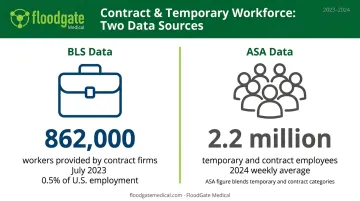
The scale of this workforce is real, even if it's smaller than most people assume. The Bureau of Labor Statistics counted 862,000 workers provided by contract firms in July 2023, representing 0.5% of total U.S. employment. That's a specific, agency-employed population, distinct from the broader temp workforce.
The American Staffing Association reports a much larger blended figure: nearly 2.2 million temporary and contract employees working for U.S. staffing companies during an average week in 2024. That number combines temporary and contract categories, so treat it as a signal of overall staffing-industry scale, not a contract-only metric.
What Business Demands Drive This Choice
Companies lean on contract staffing when they need to:
- Scale a team quickly during a growth phase without permanent headcount approval
- Staff a defined project (a product launch, a system migration, a clinical trial support function) with a clear end date
- Reduce financial exposure compared to the fixed costs of a permanent hire
- Access niche skills, such as a regulatory specialist or a clinical engineer, that aren't needed year-round
What Happens Without a Structured Process
Skip the structure and companies typically see mismatched hires, compliance gaps, budget overruns, or timelines that slip because nobody defined the scope clearly upfront. A poorly scoped contract role often turns into a revolving door of extensions rather than a solved problem.
For most industries, contract staffing is operational best practice: a lever for agility. In regulated sectors like MedTech, it's increasingly a compliance necessity too, especially as roles grow more specialized.
Life-sciences staffing has grown into an established market. Staffing Industry Analysts identified 27 staffing firms generating at least $2.7 billion in 2023 U.S. life-sciences revenue, representing 86% of the segment they measured. That's evidence of a mature market, not a MedTech-specific adoption rate, but it confirms the model has real staying power in this space.
Specialized recruiters, including FloodGate Medical, work with MedTech companies to figure out whether a contract, permanent, or blended staffing model fits a given growth stage or project, particularly when the goal is building diverse, high-performing teams rather than just filling a seat.
How the Contract Staffing Process Works (Step-by-Step)
At a high level, the flow looks like this: a role gets defined, a staffing partner sources and vets talent, a contract gets signed, the worker deploys, and the engagement ends in completion, extension, or conversion.
Going in, you need job scope, budget, duration, and required skills nailed down. Coming out the other side, you should have a fully staffed, managed contractor delivering against outcomes you defined.
Contract terms, KPIs, and the agency's ongoing payroll and performance management keep the whole thing on track throughout.
That said, no single federal or industry body publishes an official "seven-step" standard for this process; what follows is a practical framework built from how staffing agencies and clients actually operate.
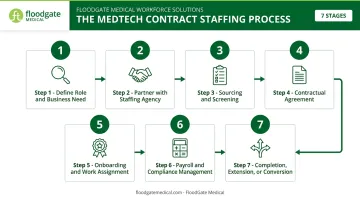
Step 1: Define the Role and Business Need
Before you contact anyone, identify the skill gap, project scope, budget, and expected duration. Vague requests ("we need someone technical for a few months") lead to mismatched placements every time.
Step 2: Partner with a Staffing Agency
Share your requirements with a staffing agency that draws from its own pre-screened talent pool. For MedTech roles specifically, a specialized firm like FloodGate Medical already maintains relationships with vetted regulatory and clinical-affairs talent, cutting the ramp-up time significantly.
This approach is faster than building a candidate pipeline from scratch, and it shifts the recruiting burden off your internal team.
Step 3: Sourcing, Screening, and Candidate Selection
Recruiters vet candidates through interviews, skills assessments, and background checks before presenting a shortlist. This is where the agency's specialization matters most: a generalist staffing firm won't screen MedTech regulatory expertise the way a niche recruiter will.
Step 4: Contractual Agreement
A formal contract gets signed between the agency and the worker, detailing duration, compensation, deliverables, and termination terms. The American Staffing Association's model agreements exist specifically to help formalize these client-agency relationships.
Step 5: Onboarding and Work Assignment
The agency typically manages onboarding and orientation. After that, the contractor starts work under your day-to-day supervision. Both parties share safety and site responsibilities — OSHA guidance makes clear the agency and host company must coordinate on this, not just hand it off.
Step 6: Payroll, Compliance, and Performance Management
The agency handles payroll, benefits, and tax compliance. You evaluate performance against the KPIs you agreed on upfront. This division of labor is the whole point: you get management control without the administrative burden.
Step 7: Contract Completion, Extension, or Conversion
At the end of the term, you have three options: let the contract close, extend the timeline, or convert the contractor to a permanent employee. Conversion terms and fees should be spelled out in the original agreement, not negotiated after the fact.
Where and When the Contract Staffing Process Is Applied
Contract staffing shows up across a wide range of industries and business stages. Common use cases include:
- IT projects with defined scopes and technical skill requirements
- Healthcare and MedTech scale-ups bridging skill gaps during product launches
- Finance teams managing seasonal reporting cycles or system implementations
- Manufacturing operations during shutdowns or retooling periods
- Retail businesses handling seasonal demand surges
Common Triggers
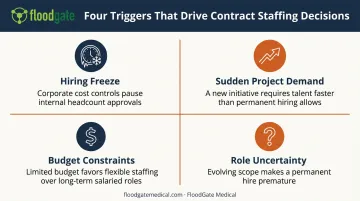
Companies typically reach for contract staffing when facing:
- A hiring freeze that still leaves urgent work unstaffed
- Sudden project demand that outpaces current team capacity
- Budget constraints that make a permanent headcount request impractical
- Uncertainty about whether a role should exist permanently, and a desire to test it first
Recurring vs. One-Time Engagements
Not every contract engagement looks the same:
- Recurring — ongoing project pipelines that need consistent contractor support
- Condition-based — tied to demand spikes, like a product launch window
- One-time — a single, clearly scoped project with a defined end
Effectiveness depends heavily on scale and compliance requirements. A small, short-term IT project has different oversight needs than a MedTech contractor working on a regulated device component.
This scalability explains why the model spans so many industries. The BLS data on contract-firm workers shows management and professional occupations making up 38.6% of this workforce, the largest single category. That share reflects how common this approach has become for skilled, project-based work.
Common Misconceptions and When Contract Staffing Isn't the Right Fit
Common Misconceptions About Contract Staffing
Several myths persist about how this model actually works:
- "Contract work means no long-term security." Not necessarily true. Many contract engagements are structured with conversion in mind from the start, and plenty of contractors move into permanent roles when the fit is right.
- "Contract staffing is basically freelance work." It isn't. Freelancers manage their own taxes and benefits. Contract staffing involves an agency employer handling payroll, compliance, and benefits administration — a meaningful legal distinction, not just semantics.
- "Shorter engagements mean lower-quality talent." Often the opposite. Contractors frequently bring specialized, in-demand expertise that companies need for a specific window, not a permanent role.
When Contract Staffing May Not Be the Right Choice
Contract staffing isn't built for every situation. Skip it when:
- The role is culture-critical or leadership-focused. Continuity and institutional knowledge matter more than flexibility here. Permanent hiring wins.
- The position is highly regulated or deeply specialized, common in senior MedTech roles. FDA's competence requirements apply equally to contractors and full-time staff, so contract status doesn't lower the regulatory bar.
- You're extending contracts repeatedly instead of asking the real question. If a "temporary" role has been renewed three times, that's usually a sign it should have been a permanent hire from the start.
Frequently Asked Questions
What are the 7 steps of the staffing process?
Define the role, partner with an agency, and source and screen candidates. Then sign the contract, onboard the worker, manage payroll and performance, and close out through completion, extension, or conversion.
What are the 5 stages of a contract?
Most contract lifecycle frameworks include negotiation, drafting or execution, signing, performance monitoring, and closure through termination or renewal. Some frameworks label these slightly differently, but the sequence holds.
Can you quit if you are a contract employee?
Yes, typically per the terms in your contract with the staffing agency. Early exit may involve notice periods or specific clauses, so check your agreement rather than assuming standard at-will rules apply.
How is contract staffing different from a staffing agency's temp-to-hire service?
Contract staffing focuses on project-based work driven by specific skill needs. Temp-to-hire starts with an explicit trial period intended to lead toward permanent employment if both sides agree.
Who manages payroll and benefits for contract staff?
The staffing agency (or an Employer of Record) handles payroll, tax withholding, and benefits administration, not the client company. Your company manages the day-to-day work and performance.
Is contract staffing a good way to evaluate talent for MedTech or specialized roles before a permanent offer?
It works well for technical or project-based roles where skills are easy to assess in real time. FloodGate Medical's recruiters can help structure this evaluation as part of a DEI-focused hiring strategy.