Recruitment agencies have become essential for startups because they deliver speed, specialized expertise, and access to passive candidates that job boards and DIY hiring cannot match. This article covers the top 5 recruitment agencies for startups in 2026, how to choose the right partner for your stage, and what to expect in cost and timeline.
Key Takeaways
- Dover, Hunt Club, and Riviera Partners lead with fractional, referral, and executive search models by stage
- Contingency search runs 15–35% of first-year salary; fractional models average $4,000–$7,000 per hire
- Match the model to stage: fractional for seed, specialized agencies for Series A, executive search for Series B+
- Prioritize specialization, startup track record, transparent pricing, 3–6 week hire speed, and cultural fit
- Confirm 30–90 day replacement guarantees and check vetting plus references before you commit
Overview of Recruitment Agencies for Startups in 2026
A startup recruitment agency is a specialized service provider that sources, screens, and places talent specifically for early-stage and high-growth companies. Unlike general staffing firms, these agencies understand the unique constraints startups face:
- Limited budgets that still demand strong hires
- Versatile people who can wear multiple hats
- Culture-fit placements, since every early team member shapes company trajectory
Remote work is now standard, with 35.5 million teleworkers in Q1 2024 (5.1 million more than a year earlier). That shift expands candidate pools nationwide and intensifies competition for top tech talent.
Staffing Industry Analysts projects the total US staffing market at $180.2 billion in 2026, with specialized IT staffing generating $27.4 billion in technical roles.
The section below ranks the top agencies by their strengths, pricing models, and ideal startup fit, evaluated based on verified client reviews, placement track records, and specialization that addresses startup-specific needs.
Top 5 Recruitment Agencies for Startups in 2026
Top 6 Recruitment Agencies for Startups in 2026
Agencies were selected on startup track record, review strength on major platforms, pricing transparency, speed to hire, and specialization that fits how startups actually staff.
1. FloodGate Medical: Best MedTech-Specialized Recruitment with DEI-Driven Methodology
FloodGate Medical recruits exclusively for the medical technology industry. It connects MedTech companies with permanent, contract, fractional, and executive talent through a consultative search process and a proprietary Talent Portal.
The firm brings more than 30 years of combined MedTech recruiting experience and a database of over 150,000 MedTech candidates. Equity, diversity, and inclusion sit at the center of its hiring methodology.
What stands out for startup teams:
- Functional depth across executive, regulatory, QA, sales, marketing, clinical, and R&D roles
- Cultural-fit screening via the Hiring for Attitude methodology
- DEI-centered recruiting aimed at building stronger, more diverse MedTech teams
- Flexible options: fractional executives, interim leaders, and project-based pros
FloodGate reports 2,500+ placements annually, an 87% 12-month retention rate, and a 9.4 Net Promoter Score. It serves clients nationwide, with offices in Tampa, Minneapolis, San Diego, Sacramento, Raleigh, and Tulsa.
| Criteria | Details |
|---|---|
| Best For | MedTech startups (seed through Series B+) hiring executive, regulatory, quality, sales, clinical, or R&D roles where industry knowledge and cultural fit matter |
| Pricing Model | Not public; contingency, retained search, and fractional/contract options—consultation required |
| Average Time to Hire | Not public; one case study placed six sales reps in 21 business days across five U.S. locations |
Limitations: MedTech-exclusive focus means FloodGate is not suitable for startups in general tech, SaaS, FinTech, or other non-healthcare verticals. Pricing requires direct consultation.
2. Dover: Best All-in-One Platform with On-Demand Fractional Recruiters
Dover pairs a free applicant tracking system (ATS) with a marketplace of fractional recruiters. It was built for startups that want flexible hiring help without traditional agency overhead.
The free core product includes sourcing tools and AI resume scoring, plus access to vetted fractional recruiters with published performance data. Dover's marketplace model averages $4,000–$7,000 per hire, well below typical 20–25% contingency fees, and recruiters work inside your system rather than as outside vendors.
Differentiators include transparent recruiter performance metrics, no upfront costs or retainers, and room to scale when hiring volume spikes. The platform earns a G2 rating of 4.4/5 from 28 reviews. Fractional recruiters charge $75–$125 per hour per Dover's pricing, which suits seed to Series B teams hiring across functions without a full-time recruiter.
| Criteria | Details |
|---|---|
| Best For | Seed to Series B startups needing flexible, cost-effective hiring across multiple functions without committing to full-time recruiter or high agency fees |
| Pricing Model | Free ATS platform; fractional recruiters at $75-$125/hour or ~$4,000-$7,000 per hire; no upfront costs or retainers |
| Average Time to Hire | 3-5 weeks for most roles; recruiter marketplace allows quick scaling when hiring volume increases |
Limitations: Best suited for companies comfortable with a tech-first approach; may not be ideal for executive search or highly specialized niche roles where white-glove service is required.
3. Hunt Club: Best for Referral-Driven Executive and Senior Hires
Hunt Club runs a referral-network model with more than 20,000 industry experts who open warm paths to passive candidates. The goal is senior talent that never shows up on job boards.
Instead of cold outreach, the firm relies on trusted referrals, with AI-powered matching to speed identification. It is especially strong for VP and C-suite searches where relationships matter, and it draws frequent recommendations from top VC firms. Hunt Club raised a $40 million Series B and has placed over 1,000 leaders.
Differentiators include deep VC and founder networks, a solid record with investor-backed growth companies, and a G2 rating of 4.6/5 from 74 reviews. It offers retained and contingency executive search, with placements such as CodeSignal CRO, G2 leadership roles, Thinkific GTM leaders, Lucra backend engineering, and Vitally VP Engineering.
| Criteria | Details |
|---|---|
| Best For | Series A-B startups hiring senior leadership (VP of Engineering, Head of Product, CTO) where passive candidate access justifies premium pricing |
| Pricing Model | Traditional percentage-of-salary or flat fee (not publicly listed but typically 20-30% range); retained or contingency depending on role |
| Average Time to Hire | 6-8 weeks for most searches; complex executive roles may extend to 8-12 weeks |
Limitations: Premium pricing makes it less accessible for early-stage startups with tight budgets; not designed for high-volume or junior/mid-level hiring.
4. Riviera Partners: Best for Tech Executive Search
Riviera Partners is an executive search firm with a two-decade record placing CTOs, VPs of Engineering, and product leaders at venture-backed startups. Rooted in Silicon Valley and expanded to NYC and London, it focuses only on tech and product leadership.
Internal databases and ML models help surface domain-specific expertise. Search teams stay close on role definition and vetting, backed by a strong VC and founder network. Riviera reports 1,800+ clients, 850+ unicorn placements, and 60% repeat clients. It also states that more than 40% of placements are women or professionals of color—20% more women than the current industry makeup.
Differentiators include a tech/product-only focus, a proprietary database built over 20 years, and high-touch support on mission-critical hires. Case studies include Lottie CTO, Rad AI VP Engineering, Cohere Health CTO/CDO, and Vimeo technology/product leadership roles.
| Criteria | Details |
|---|---|
| Best For | Series B+ startups (or well-funded Series A) hiring C-suite or VP-level tech/product leaders where mis-hire carries significant organizational risk |
| Pricing Model | Retained search at 25-30% of first-year compensation, paid in thirds (on engagement, shortlist delivery, placement) |
| Average Time to Hire | 6-8 weeks for well-run searches; more complex roles may take 8-12 weeks |

Limitations: Retained fees and executive focus make Riviera too expensive for most seed-stage startups; not designed for non-executive or high-volume hiring.
5. Toptal: Best for On-Demand Elite Freelance Talent
Toptal is a global freelance talent network that accepts only the top 3% of applicants after technical assessments, live coding, and soft-skills evaluation. It serves 25,000+ clients in 140+ countries across developers, designers, product managers, and finance consultants.
Matching is fast—as quick as 48 hours, often under 24 on average—with multistage screening aimed at senior-level quality. A two-week trial means you pay nothing if the fit is wrong, and Toptal reports a 98% trial-to-hire success rate.
Differentiators are speed (24–48 hour initial match), selective screening, and flexibility for project or fractional work when a full-time seat is not justified yet. The platform holds a Clutch rating of 4.8/5 from 53 verified reviews. Case studies include Big Sur AI ($6.9 million raised), Authentia, and Cal.net.
| Criteria | Details |
|---|---|
| Best For | Startups needing senior technical specialists, designers, or consultants quickly for project-based or fractional work; ideal when full-time hire not yet justified |
| Pricing Model | Hourly rates typically $60-$200+/hour depending on role and seniority; $79/month platform fee; premium pricing reflects top-tier talent |
| Average Time to Hire | 24-48 hours for initial matching; two-week trial before commitment |
Limitations: Premium pricing not suitable for budget-constrained early-stage startups; designed for project/fractional work rather than long-term full-time hires; not ideal for entry-level or junior roles.
6. Robert Half: Best Established Generalist with Broad Coverage
Robert Half is a long-running staffing firm (founded 1948, NYSE: RHI) with national reach across finance, IT, marketing, administrative, and operations. It is built for reliable matching at scale rather than niche startup branding.
Pipelines are deepest in finance and administrative roles that many tech-focused agencies skip. That breadth makes Robert Half a practical one-stop option when a growth-stage startup is hiring across several functions at once.
Differentiators include wide geographic and functional coverage, strength in finance and operations, and decades of brand recognition. The firm's 2025 annual report describes limited permanent-placement guarantees, generally 30–90 days.
| Criteria | Details |
|---|---|
| Best For | Growth-stage startups (Series A-B) needing reliable, fast placement across finance, operations, IT, marketing, and administrative functions |
| Pricing Model | Contingency fees typically 20-25% of first-year salary; higher than fractional models but lower risk (only pay on successful hire) |
| Average Time to Hire | 3-4 weeks for most roles; faster for administrative and finance positions where they have deepest pipelines |
Limitations: Higher cost than fractional agencies; less specialized in emerging tech or niche startup roles; may lack the startup-specific cultural fluency of boutique firms. Trustpilot shows a 1.8/5 rating from 150 reviews, though reviewer relationship is not consistently identified.
How We Chose the Best Recruitment Agencies
We scored agencies on verified client reviews (minimum 4.5/5 on established platforms), startup placement track records, transparent pricing, average time-to-hire, and specialization fit for common startup needs.
Key evaluation factors tied to business outcomes:
- Startup-specific experience that accounts for culture fit and role versatility
- Transparent pricing that prevents surprise costs and budget overruns
- Time-to-hire speed, using SHRM's 2026 benchmark median of 39 days for nonexecutive roles and 45 days for executive roles—every extra week costs productivity
- Specialization in tech, GTM, executive, or industry verticals for stronger match quality and network depth
- Replacement guarantees (typically 30-90 days) that signal confidence in vetting
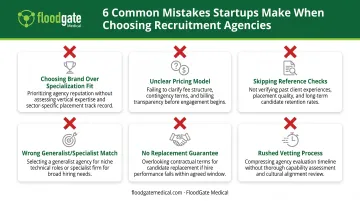
Common mistakes startups make when choosing agencies:
- Selecting based on brand name rather than specialization fit
- Not clarifying pricing model upfront (contingency vs. retained vs. flat fee)
- Failing to check references from similar-stage companies
- Choosing generalist when specialist is needed (or vice versa)
- Not negotiating replacement guarantee terms before contract signing
- Underestimating recruiting workload and rushing vetting (A16z's 2025 list flags rushed vetting and weak candidate experience)
When to Use a Specialized vs. Generalist Recruitment Agency
Stage-Based Decision Framework
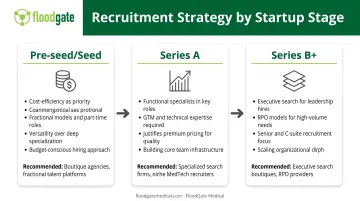
Pre-seed/Seed startups should prioritize cost-efficiency and speed, making fractional models like Dover or specialized agencies with flat fees ideal. At this stage, budget constraints are severe and versatility matters more than narrow specialization.
Series A companies need functional specialists. GTM-focused agencies excel at sales and marketing hires. Tech-focused firms understand engineering team dynamics, while product recruiters grasp roadmap priorities. Series A is where specialization begins to justify its premium.
Series B+ companies can justify executive search firms like Riviera Partners or Hunt Club for leadership roles. They should also consider Recruitment Process Outsourcing (RPO) when hiring 10-15+ people a year across functions.
Specialization Trade-Offs
Specialist agencies bring deep domain expertise, existing candidate networks, and familiarity with niche compliance or certification needs. A MedTech-only firm like FloodGate Medical, or a FinTech-focused agency, can reach industry-specific talent pools generalists rarely match—especially for technical or regulated roles.
Specialists usually cost more and can be overkill for general startup hires.
Generalist agencies provide broader coverage and flexibility across functions. That makes them practical when you are building foundational teams or hiring across sales, operations, and admin at once. They typically cost less than boutique specialists but may lack network depth and domain knowledge for specialized roles.
Decision Criteria
Use specialists when:
- Domain expertise is critical to role success (regulated industries, deep technical knowledge required)
- You're hiring in tight-knit professional communities where relationships matter
- The role requires specific certifications, compliance knowledge, or technical credentials
- A mis-hire carries significant organizational or regulatory risk
Use generalists when:
- Hiring across multiple functions simultaneously
- Speed and cost matter more than niche expertise
- Building foundational teams where versatility trumps specialization
- Budget constraints rule out premium specialist fees
Conclusion
The right recruitment agency depends on startup stage, hiring urgency, budget, and role specialization. Matching the model—fractional, contingency, retained, or referral-driven—to those factors matters more than picking a single "best" agency on reputation alone.
Evaluate agencies on:
- Proven startup experience
- Transparent pricing
- Speed to hire
- Cultural fit assessment
Get references from similar-stage companies and negotiate replacement guarantees before you sign. Insight Partners notes that agencies fit rapid growth or urgent hiring when you need an existing network. In-house recruiting fits teams with the budget to hire and train a recruiter—and enough ongoing volume to keep them busy.
For most startups hiring general tech, GTM, or ops roles, flexible fractional models like Dover offer a strong cost-to-value ratio.
If you operate in a specialized field like medical technology—where domain expertise and regulatory knowledge matter—niche firms such as FloodGate Medical bring deep industry networks, DEI-driven methodology, and a clear read on that talent market.
Schedule consultations with 2–3 agencies that match your stage and needs, compare approaches, then commit.
Frequently Asked Questions
How do I recruit people for a startup?
Startups typically combine founder networks, employee referrals, job boards, and recruitment agencies. For specialized skills or fast hires, a startup-focused agency reaches passive candidates and handles screening founders rarely have time for.
How much do recruitment agencies typically charge startups?
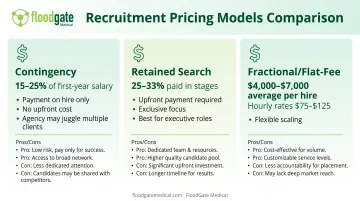
Three common models: contingency (15-25% of first-year salary, paid on hire), retained (25-33%, paid in stages), and fractional/flat-fee ($4,000-$7,000 per hire on average). Fractional models often give seed and Series A startups the best cost efficiency.
What's the difference between contingency and retained search for startups?
Contingency means no upfront fee; you pay only if you hire, though the agency may juggle other clients or roles. Retained search requires upfront payment and exclusivity for focused attention, so it fits critical executive hires where a miss is costly.
How long does it take to fill a role through a recruitment agency?
Most startup-focused agencies fill mid-level roles in 3-6 weeks, and fractional models often share first candidates in 3-5 days. Executive searches usually take 6-12 weeks, with speed also tied to role specificity, pay competitiveness, and interview pace.
When should a startup hire a recruitment agency vs. recruiting in-house?
Use an agency when you need hires in 4-6 weeks, lack recruiting expertise or HR bandwidth, need specialized skills, or must fill several roles at once. In-house recruiting usually pays off once you hire 10-15+ people a year with repeatable processes.
What should I look for in a recruitment agency for my startup stage?
Pre-seed and seed startups should prioritize cost and flexibility (fractional models, low or no upfront fees). Series A companies need proven strength in core functions like tech, GTM, and product. Series B+ can use executive search and should weigh guarantees, time-to-hire, similar-stage references, and cultural fit assessment.