

Introduction
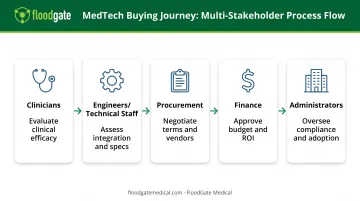
MedTech companies face a unique challenge: designing sales compensation that attracts specialized talent while protecting margins on complex, high-value deals. Unlike consumer products, medical device sales involve multiple stakeholders, including clinicians, procurement, finance, and technical staff, across buying cycles that can stretch months.
Research across 24 studies in 12 countries confirms that high-cost medical device purchasing involves clinical, technical, procurement, financial, safety, and administrative decision-makers. That mix makes revenue credit and incentive design far more complex than transactional sales.
The cost of getting compensation wrong is steep. SHRM reports that replacing an employee costs 50%–200% of annual salary, depending on role level.
This guide walks through plan types, core terminology, design steps, and role-specific examples. Use it to build a compensation strategy that aligns seller behavior with business goals and reduces costly turnover.
Key Takeaways
- A well-designed plan aligns rep behavior with company goals and cuts costly turnover.
- Most MedTech plans use hybrid base-plus-variable models with pay mixes ranging from 57/43 to 70/30.
- Clear goals, territory-informed quotas, cost modeling, and regular review keep plans effective and affordable.
- Multi-stakeholder MedTech sales demand explicit credit rules and role-specific measures.
What Is a Sales Compensation Plan?
A sales compensation plan is the structured pay framework that defines how reps earn money, including base salary, commission, bonuses, and incentives. WorldatWork defines pay-for-performance sales compensation as pay tied directly to measurable individual goals so pay tracks business results and separates performance levels.
A complete plan spells out eligibility, pay mix, performance measures, payout thresholds, accelerators, measurement periods, and crediting rules.
Why it matters more in MedTech:
- Multi-party buying pulls in clinicians, engineers, procurement, finance, and administrators
- Longer cycles stretch across evaluations, evidence reviews, and trials
- Technical depth requires clinical knowledge to engage users and support adoption
- Higher stakes raise scrutiny when device failures create patient-safety and financial risk
Those dynamics make plan design harder to get right without solid market context. FloodGate Medical helps MedTech companies build competitive offers through compensation benchmarking, market intelligence, and talent mapping. With over 25 years in MedTech and an 89% one-year retention rate, the team supplies real-time salary data and guidance so packages attract specialized sales talent.
Key Sales Compensation Terms to Know
These terms show up in every plan design conversation. Get them straight before you set quotas, pay mixes, or payout rules.
Sales Quota
The minimum sales target a rep must hit in a defined period. Quotas should be stretch but achievable, based on territory potential, so they drive performance without fueling burnout or turnover.
On-Target Earnings (OTE)
Projected total annual pay when a rep hits 100% of quota. Formula: base salary + commission at target attainment. OTE sets clear expectations and helps candidates compare offers across companies.
Accelerators and Decelerators
- Accelerators: Higher commission rates above set performance thresholds that reward overachievement.
- Decelerators: Lower earning rates when performance falls below defined levels. Triggers must be explicit to avoid confusion or resentment.
Clawbacks and SPIFs
- Clawback: Right to recover commission after events like early cancellation or churn—for example, reclaiming $7,500 on a $150,000 deal if the customer cancels within four months.
- SPIF (Sales Performance Incentive Fund): A short-term incentive for a specific goal: new-product launch, beating a target, or closing priority-segment deals. Awards may be cash or gifts.
Types of Sales Compensation Plans
Plan structure should match your business goals, budget, and the complexity of the sales role. A WorldatWork survey of 472 organizations found that hybrid plans dominate across industries, with pay mixes varying by role type and customer focus.
Salary Only and Straight Commission
Salary only: Reps receive a fixed wage with no variable pay. Best for roles with little control over outcomes (technical support or long-cycle advisory work), but offers weak performance incentives.
Straight commission: Pay is 100% variable, tied to sales results. Works for transactional, high-volume roles but creates income volatility and high turnover risk, especially in MedTech where cycles are long and deals involve multiple stakeholders.
Salary Plus Commission
The most common hybrid model. WorldatWork benchmarks show base/variable mixes from 57/43 to 66/34 across named seller and first-line-manager roles:
- Field new-account seller: 57/43
- Field current-customer seller: 60/40
- Inside outbound seller: 59/41
- Field first-line manager: 63/37
Typical ratios:
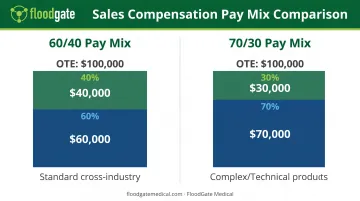
- 60/40: Standard cross-industry split; balanced motivation and stability
- 70/30: Common for complex or technical products; more predictable income supports longer sales cycles and consultative selling
In practice, a 70/30 split on $100,000 OTE means $70,000 base and $30,000 target variable pay (commission or bonus) at 100% of quota.
Tiered and Territory-Based Commission
Tiered commission: Rates increase as reps exceed thresholds. Salesforce illustrates with 5%, 8%, and 12% bands. Rewards top performers but can spike costs if quotas are set too low.
Territory-based (team) commission: Applies a rate to the entire region's results, shared among team members. Supports collaboration in multi-role sales (field, clinical, technical) but can dilute individual accountability.
Other Notable Models
- Profit-sharing pays on deal margin rather than revenue, so sellers protect profitability—not just top-line volume
- Equity (stock or options) suits startups and executive roles when you want retention tied to long-term company value
- Set-rate commission pays a flat dollar amount per unit or contract: simple to run, but inflexible when deal size or product mix shifts
How to Design a Sales Compensation Plan
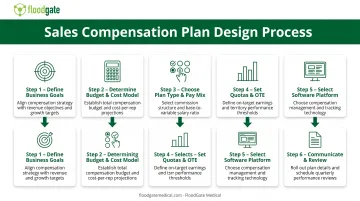
Follow these six steps to build a plan that drives behavior, fits your budget, and minimizes disputes.
Step 1: Define business goals and desired behaviors
Identify what you need sellers to do: acquire new accounts, expand existing relationships, launch a product, or penetrate a new segment. WorldatWork recommends linking pay directly to measurable goals that align with business performance.
Step 2: Determine your compensation budget and cost model
Calculate compensation cost of sales (CCOS): all sales base salaries, bonuses, commissions, and SPIFs divided by revenue or bookings. WorldatWork cites a B2B benchmark of 7.9%, though it varies by industry and company size. Model payouts at 50%, 100%, and 150% attainment to ensure the plan is affordable at every performance level.
Step 3: Choose the right plan type and pay mix
Match plan structure to role control and cycle length:
- Higher variable (57/43 or 60/40): For roles with direct control over bookings
- Balanced (50/50): For mixed hunters/farmers who both close new business and expand accounts
- Higher base (70/30): For technical, consultative, or multi-stakeholder MedTech roles where cycles are long and outcomes depend on collaboration
McKinsey research shows that 81% of physicians and 89% of procurement professionals prefer multiple engagement channels. MedTech plans should use distinct measures for field, inside, and hybrid roles.
Step 4: Set realistic, data-informed quotas and OTE
Use territory-level data (past performance, market potential, growth targets) to set quotas that are challenging but attainable. WorldatWork's modified-fair-share method applies top-down growth expectations to projected territory performance. Quotas set too low create cost overruns; quotas set too high demotivate sellers and raise turnover, according to WorldatWork.
Step 5: Select compensation management software
Gartner defines sales performance management (SPM) as applications that automate incentive-plan administration, territory and quota management, and CRM integration. Prioritize tools that handle crediting rules, real-time dashboards, and CRM sync. Common platforms include Xactly, Salesforce Spiff, CaptivateIQ, Anaplan, and Varicent.
Step 6: Communicate clearly and review regularly
Document the plan in plain language before the period starts:
- Eligibility and pay mix
- Measures, thresholds, and crediting rules
- Payout timing and exception handling
Share it with reps early and give them real-time dashboards to track earnings. Review performance quarterly and adjust annually based on attainment distribution, cost, and business priorities.
Sales Compensation Plan Examples by Role
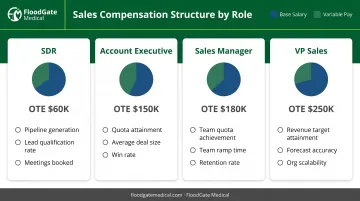
Below are example structures for four common sales roles. Pay mixes (base/variable) are drawn from WorldatWork benchmarks; salary ranges reflect broad market data and should be validated against your region and company economics.
Sales Development Representative (SDR)
Pay mix: 65/35 (based on inside outbound seller benchmark)
Sample OTE (on-target earnings): $60,000 ($39,000 base + $21,000 variable)
Measures: Qualified leads generated, meetings booked, pipeline created
Rationale: Lower base with activity-based bonuses keeps costs predictable while rewarding top-of-funnel productivity. MedTech SDRs often need technical fluency to engage clinical buyers, which may justify a slightly higher base.
Account Executive (AE)
Pay mix: 57/43 (field new-account seller benchmark)
Sample OTE: $150,000 ($85,500 base + $64,500 commission)
Measures: New bookings, quota attainment, deal close rate
Rationale: Higher variable pay aligns with direct revenue ownership. In MedTech, AEs coordinate clinical evaluations, procurement, and contracting across multiple stakeholders, so commission should reflect deal complexity and cycle length.
Sales Manager
Pay mix: 63/37 (field first-line manager benchmark)
Sample OTE: $180,000 ($113,400 base + $66,600 bonus/commission)
Measures: Team quota attainment, rep development, territory growth
Rationale: Higher base recognizes coaching and administrative duties. Variable pay ties manager success to team results, encouraging pipeline discipline and skill development.
VP of Sales
Pay mix: 70/30 (estimated for senior leadership)
Sample OTE: $250,000 ($175,000 base + $75,000 bonus)
Measures: Revenue, bookings, cost of sales, retention, strategic initiatives
Rationale: Majority-base structure provides stability for long-term planning and reflects accountability beyond individual deals. Annual or quarterly bonuses tie to company-level performance.
MedTech-specific considerations: Technical complexity, regulatory knowledge, and long sales cycles often require higher base pay than transactional sales. Partnering with a specialized recruiter like FloodGate Medical helps you benchmark compensation packages against MedTech industry standards so your offers stay competitive.
Frequently Asked Questions
What are the key elements of a sales compensation plan?
Base salary, commission or variable pay, performance quotas, bonuses, and any accelerators or SPIFs. A complete plan also documents eligibility, crediting rules, payout timing, and administrative processes.
What are the main types of sales incentive plans?
Salary only, commission only, salary plus commission (hybrid), tiered commission (rates increase with performance), territory or team-based plans, and profit-sharing or equity models. Hybrid plans are most common in MedTech.
Is 1% a good commission rate?
It depends on industry, deal size, margin, and role influence. WorldatWork warns that larger deals can make a fixed rate cost-inappropriate. Check gross margin, expected payout dollars, and sales-cycle effort before locking in any rate.
What does a 70/30 split in sales compensation mean?
70% of OTE is base salary; 30% is variable pay earned at quota. Xactly describes 70/30 as common for complex or technical products, where stability supports consultative sales. For MedTech, validate it against role control and cycle length.
What are the best sales compensation tools?
Gartner's SPM category includes Xactly, Salesforce Spiff, CaptivateIQ, Anaplan, SAP, Varicent, Oracle, Performio, and Optymyze. These platforms automate commission calculations, provide rep dashboards, integrate with CRM, and support territory and quota management.
What are examples of sales compensation plans?
See the role-based examples earlier in this guide: SDR with 65/35 mix and activity bonuses, AE with 57/43 mix and commission on bookings, sales manager with 63/37 mix and team-based variable pay, and VP of Sales with 70/30 mix and strategic bonuses.