Total Quality Management (TQM) offers a way through this pressure. It's a system-wide, continuous-improvement philosophy that treats quality as everyone's job, not a checkbox handled by a compliance office. This guide walks through TQM's core principles, the research-backed factors that determine whether it succeeds, and the practical steps hospitals use to make it stick.
Key Takeaways
- TQM drives continuous, organization-wide improvement beyond mere regulatory compliance
- Five factors predict success: staff education, quality improvement, patient focus, leadership, and teamwork
- Hospitals adopting TQM report measurable gains in patient satisfaction and performance
- Cultural resistance and staffing gaps remain the toughest barriers to lasting implementation
What Is Total Quality Management in Healthcare?
From Statistical Process Control to Hospital Wards
TQM didn't originate in hospitals. It grew out of manufacturing, built on the work of Walter Shewhart, who introduced statistical process-control charts in 1931, and later refined by W. Edwards Deming and Joseph Juran through the mid-20th century. Healthcare adapted these industrial quality methods into continuous quality improvement (CQI) programs starting in the early 1980s.
That said, concern for care quality in medicine goes back much further. Florence Nightingale used mortality statistics to argue for sanitation reform in army hospitals in the 1850s, long before "quality management" was a formal discipline. TQM builds on that same instinct: measure outcomes, then act on what the data shows.
TQM vs. QA, Six Sigma, Lean, and CQI
What makes TQM different from older quality assurance models is the shift from reactive inspection to proactive, organization-wide improvement. Traditional QA checked outcomes after the fact. TQM asks every department, from admissions to discharge planning, to continuously refine how work gets done.
TQM also differs from adjacent frameworks used inside healthcare organizations:
- Six Sigma focuses on reducing process variation using statistical analysis
- Lean targets waste elimination in workflows
- CQI refers to the ongoing improvement cycles used inside a broader system
TQM is the umbrella philosophy; Six Sigma, Lean, and CQI are tools that often operate underneath it.
A large-scale study of 1,290 professionals across HCAC-accredited Jordanian hospitals found a strong association between TQM adoption and overall hospital effectiveness, reporting a beta coefficient of 0.818 and R² of 0.669. That's a notable association, though it reflects correlation from a single national context rather than proof that TQM alone drives performance everywhere.
Core Principles of TQM in Healthcare
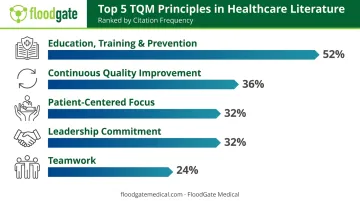
TQM rests on five interconnected principles. A 2019 systematic review of 25 healthcare studies tracked how often most of these principles appeared as a success predictor in the literature:
- Patient-Centered Focus: Every clinical and operational decision should trace back to patient needs, shaping scheduling, discharge planning, and intake design. This principle appeared as a success factor in 8 of 25 studies (32%).
- Continuous Quality Improvement (CQI): Quality isn't a one-time project. Hospitals must constantly evaluate wait times, diagnostic accuracy, and discharge workflows, often through structured cycles like FOCUS-PDCA. CQI appeared in 9 of 25 studies (36%), the second-most-cited predictor.
- Data-Driven Decision-Making: Statistical tools identify where bottlenecks actually occur, rather than where staff assume they occur. Facilities that build data collection into daily operations gain clearer visibility into what's working and what isn't.
- Leadership Commitment and Teamwork: TQM requires buy-in from the boardroom to the bedside. Top-management commitment showed up in 8 of 25 studies (32%), and teamwork in 6 of 25 (24%); without both, improvement efforts tend to stall after the initial rollout.
- Education, Training, and Prevention: The single most cited predictor in the research, appearing in 13 of 25 studies (52%), more than double the next-closest factor. The underlying logic is prevention: catching errors before they happen costs less than fixing them afterward.
Critical Success Factors for TQM Implementation
The same systematic review that identified education as the top predictor ranked all five factors by frequency of appearance across the literature:
| Rank | Predictor | Studies Citing It | Occurrence |
|---|---|---|---|
| 1 | Education and training | 13/25 | 52% |
| 2 | Continuous quality improvement | 9/25 | 36% |
| 3 (tie) | Patient focus/satisfaction | 8/25 | 32% |
| 3 (tie) | Top-management commitment | 8/25 | 32% |
| 5 | Teamwork | 6/25 | 24% |
That same review documents a real-world example: one Iranian hospital's total quality score rose from 38% at baseline to 73.7% after a sustained improvement initiative involving 517 employees. It's a strong before-and-after signal, though it reflects one facility's local baseline rather than a universal benchmark.
Patient and provider perceptions don't always move together. A comparative study at Al-Mouwasat University Hospital surveyed physicians, nurses, and patients on TQM quality dimensions using a three-point scale. Patients rated overall quality at 2.633, compared to 1.904 among physicians and 2.289 among nurses.
Doctors and nurses also disagreed sharply on how readily they accepted scientific improvement methods. This perception gap matters: if frontline providers rate quality lower than the patients they serve, leadership may be getting an incomplete picture from satisfaction scores alone.
That same incomplete picture helps explain why TQM often stalls: management commitment is inconsistent. Short-term enthusiasm followed by budget cuts or leadership turnover tends to undo months of progress. Two other patterns add useful context:
- Cross-sectional study designs made up 56% of the reviewed literature, meaning most evidence captures a single point in time rather than long-term trends
- Iran and Jordan together supplied 48% of the studies, so findings may not generalize cleanly to every healthcare system
- The rankings themselves are drawn from just 25 studies total, a modest evidence base for drawing firm, universal conclusions
Benefits and Challenges of TQM in Healthcare
Key Benefits
TQM's payoff shows up across clinical and operational metrics:
- Improved patient outcomes through fewer errors and better chronic disease management
- Higher patient satisfaction and stronger organizational reputation
- Increased operational efficiency, including cost savings through reduced waste
- Better alignment with accreditation standards, since Joint Commission and NCQA requirements closely mirror TQM's structure
A quasi-experimental study at a military emergency department found patient satisfaction improved by 20% after TQM practices were introduced, a meaningful gain even accounting for the single-site design.
Common Implementation Challenges
The obstacles are just as real as the benefits:
- Cultural resistance to moving from hierarchical, top-down decision-making toward collaborative, data-informed practice
- Time and resource intensity required for staff training and redesigning existing workflows
- Skills and staffing gaps, where hospitals struggle to find leaders and quality professionals ready to champion the work
That last point is often underestimated. TQM doesn't just need willing staff; it needs people in leadership and quality roles who can drive the initiative forward. This is where specialized MedTech and healthcare recruitment partners, such as FloodGate Medical, come in.
When leadership talent is scarce, building diverse, quality-minded teams often determines whether TQM adoption sticks past year one.
Steps to Implement TQM in Your Healthcare Organization
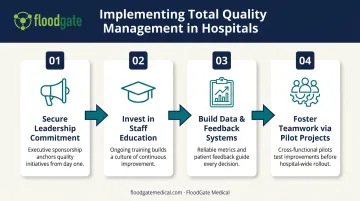
There's no single validated protocol every hospital must follow, but the research points to a consistent sequence:
- Secure visible, sustained leadership commitment. Set clear, measurable quality goals and make sure executives stay engaged past the launch phase.
- Invest in continuous staff education. Tailor training to clinical and administrative roles separately, since their process pain points differ.
- Build data collection and feedback systems. Patient surveys and statistical monitoring keep progress objective instead of anecdotal.
- Foster teamwork and shared accountability. Start with a bounded pilot project, such as reducing discharge delays in one unit, before scaling hospital-wide.
Joint Commission performance-improvement guidance reinforces this same pattern: measure a baseline, monitor variation, then build in mechanisms to sustain the gains once they appear.
Frequently Asked Questions
What are the core principles of TQM in healthcare?
TQM rests on patient-centered focus, continuous quality improvement, data-driven decisions, leadership commitment paired with teamwork, and ongoing staff education and prevention. Each principle reinforces the others rather than working in isolation.
What is an example of TQM in healthcare?
A common example is a hospital using continuous improvement cycles, such as FOCUS-PDCA, to reduce emergency department wait times or lower infection rates. Progress gets tracked against a baseline and adjusted over multiple cycles.
How is TQM different from Continuous Quality Improvement (CQI)?
TQM is the broader organizational philosophy covering leadership, culture, and patient focus. CQI is one of the ongoing, iterative practices used inside that philosophy to test and refine specific processes.
What are the critical success factors for TQM implementation in hospitals?
Research consistently points to five predictors: staff training, continuous quality improvement, patient focus, top-management commitment, and teamwork. Education and training appear most frequently across the literature.
What role does staff training play in TQM success?
Training is the most frequently cited predictor of TQM success, appearing in 52% of reviewed healthcare studies. It supports the prevention-focused mindset that TQM depends on.
How can hospitals overcome resistance to TQM adoption?
Leadership needs to model the behavior it expects, starting with small pilot programs rather than a full rollout. Building the right team, including quality-oriented leaders and staff, also makes adoption far more sustainable.