Without a formal headcount planning strategy, you're flying blind—overhiring during optimistic quarters, scrambling to backfill critical roles when attrition spikes, and watching your compensation budget drift as you discover mid-year that market rates have moved 17% above your assumptions. This guide provides the formulas, step-by-step frameworks, and MedTech-specific best practices to build a resilient, DEI-driven headcount plan that aligns hiring with your business strategy, budget constraints, and the actual availability of specialized talent.
Key Takeaways
- Align hiring volume, roles, and timing with goals, budget, and competitive pay data—not headcount alone
- Collaborate across HR, finance, and hiring managers while tracking time-to-fill, cost-per-hire, and budget variance
- Partner early with specialized MedTech recruiters for niche talent availability and current compensation benchmarks
What Is a Headcount Plan?
A headcount plan projects how many employees your organization needs by role, department, location, and timing. It ties those needs to business objectives over a set period, typically 12 to 36 months.
Unlike a simple employee count, it folds in financial constraints, attrition forecasts, and market availability. The plan answers: Which positions do we need to fill, when, at what cost, and with which capabilities?
Headcount vs. FTE: Understanding the Difference
These terms are often used interchangeably, but they measure different things:
- Headcount counts each person once, whether full-time, part-time, or fractional—best for positions, spans of control, recruiting demand, and diversity tracking
- Full-Time Equivalent (FTE) converts hours into full-time capacity; two people at 20 hours each equal one FTE on a 40-hour week
Per the U.S. Bureau of Economic Analysis, FTE combines full-time schedules with part-time hours converted against average weekly full-time hours.
Why it matters: When you're building a compensation budget, FTE tells you how much productive capacity you're buying. When you're planning recruiting pipelines, headcount tells you how many people your team needs to interview, onboard, and manage. Confusing the two can lead to under-budgeting or over-hiring.
Headcount Planning vs. Workforce Planning
Headcount planning is a quantitative discipline focused on the numbers—how many people, in which roles, at what cost, and when. SHRM defines workforce planning as the broader strategic process of analyzing staffing needs, addressing skill gaps, and aligning talent strategy with long-term business goals.
Key distinctions:
| Discipline | Primary Focus | Typical Outputs |
|---|---|---|
| Headcount Planning | Positions, hires, exits, vacancies, costs, timing | Opening/ending headcount by department, approved requisitions, monthly budget reconciliation |
| Workforce Planning | Skills, capabilities, development, strategic talent decisions | Supply/demand analysis, skill-gap assessments, build-buy-borrow strategies, succession plans |
| Financial Workforce Planning | Budget alignment, cost scenarios, variance tracking | Compensation forecasts, hiring-cost models, actual-versus-plan reconciliation |
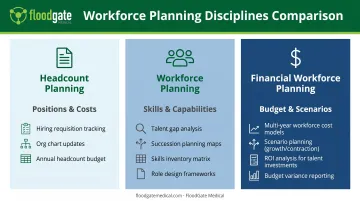
In practice: Headcount planning is your execution layer: the approved positions and budget you track month to month. Workforce planning is the strategic layer that decides which capabilities you need and how to get them (hire, train, redeploy, or partner). Headcount planning turns that strategy into hiring decisions you can fund and measure.
Key Components and Formula for Headcount Planning
Every headcount plan rests on four foundational inputs:
- Current workforce analysis – headcount by role, department, location, performance level, and cost
- Forecasted business demand – revenue targets, product launches, regulatory workload, manufacturing scale, and commercial expansion plans
- Attrition rates – historical and predicted turnover by function, seniority, and criticality
- Budget constraints – total compensation dollars available, allocated by quarter and department
The Basic Headcount Calculation Formula
The basic headcount requirement formula is:
Required Headcount = (Projected Workload or Revenue Target ÷ Output per Employee) + Attrition Replacement
Example: If your revenue target is $50 million, your average sales rep generates $1.5 million annually, and you expect 15% attrition, you need:
- Base reps: $50M ÷ $1.5M = 33.3 → 34 reps
- Attrition buffer: 34 × 0.15 = 5.1 → 6 replacements
- Total hiring need: ~40 reps (if starting from zero, or net additions if you already have a team)
This formula applies across functions (engineering, quality, regulatory, clinical support) by substituting role-specific productivity or capacity metrics.
Factoring in Total Rewards and Role-Based Planning
Total rewards cover base salary, bonuses, equity, benefits, payroll taxes, and recruiting costs. In MedTech, specialized roles command premium pay and talent pools are narrow, so underestimating total rewards quickly drives budget drift.
MD+DI's 2025 Medtech Salary Survey collected data from 385 medical-device and diagnostics professionals. Average compensation rose year over year—outdated salary assumptions can derail hiring.
Role-based planning means defining positions independently of current employees. Instead of planning around "Sarah's job," you define "Senior Regulatory Affairs Manager" with specific responsibilities, qualifications, and compensation ranges. This clarifies structural needs, supports succession planning, and enables objective compensation benchmarking.
Cost-Per-Hire and Time-to-Fill Benchmarks
According to SHRM's 2025 benchmarking data, which surveyed 2,371 US organizations across industries:
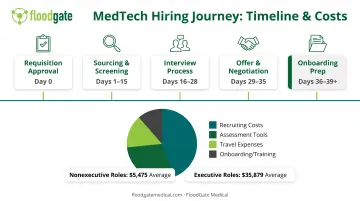
- Nonexecutive cost-per-hire: $5,475
- Executive cost-per-hire: $35,879
- 2026 median time-to-fill (nonexecutive): 39 calendar days
These are cross-industry comparators, not MedTech-specific benchmarks. Specialized regulatory, clinical, and engineering roles in medical devices often need longer searches and higher costs because of niche skills and compliance requirements.
Budget for that gap, and track your own metrics to build company-specific baselines.
How to Build a Strategic Headcount Planning Process: Step-by-Step
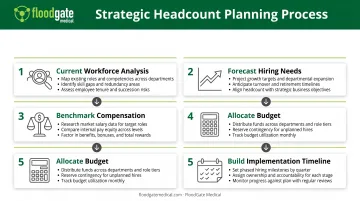
Step 1: Conduct a Current Workforce Analysis
Start by inventorying your existing team:
- Demographics: Headcount and FTE by department, role, location, employment type (full-time, part-time, contractor)
- Capabilities: Skills, certifications, proficiency levels, and training gaps
- Performance: High performers, flight risks, succession candidates
- Cost: Total compensation by individual and department, including benefits and equity
This analysis identifies where you have capacity, where you're overstaffed, and which skill gaps threaten upcoming initiatives.
Step 2: Forecast Hiring Needs Based on Business Objectives
Translate your operating plan into workforce demand:
- Revenue and growth targets: How many sales reps, customer success managers, or field application engineers do you need to hit numbers?
- Product roadmap: Which R&D, regulatory, and quality roles are required for upcoming submissions or launches?
- Manufacturing scale: What production, quality control, and supply chain capacity is necessary?
- Turnover predictions: Which roles historically see high attrition, and when do departures cluster?
Cross-functional input is critical here. Finance owns the budget, HR owns the process, but hiring managers own the demand forecast. Without their input, your plan will be a spreadsheet exercise disconnected from operational reality.
Step 3: Benchmark Compensation Against Market Data
Compensation benchmarking ensures your offers are competitive enough to attract and retain talent. In MedTech, where talent pools are narrow and regulatory expertise is non-negotiable, outdated salary assumptions guarantee failed offers and extended vacancies.
Key benchmarking sources:
- Industry salary surveys (such as MD+DI and specialized MedTech compensation studies)
- Real-time market intelligence from specialized recruiters
- Peer company data (when available through networks or advisors)
- Geographic adjustments for cost of living and local supply/demand
Real-time MedTech compensation data makes this step faster and more accurate. FloodGate Medical provides updated salary ranges by job title and function, plus competitive hiring insights drawn from a network of more than 150,000 MedTech professionals and 450+ placements a year.
That context helps you set pay packages that win talent in the current market.
Step 4: Allocate Budget Factoring in Total Rewards and Recruiting Costs
Once you know your hiring needs and market rates, build your budget:
- Base compensation for each role
- Bonuses and variable pay (especially for sales and commercial roles)
- Equity or stock options (common in startups and growth-stage companies)
- Benefits and payroll taxes (typically 25-35% of base salary)
- Recruiting costs (agency fees, job ads, assessment tools, travel)
- Onboarding and training (especially for complex technical or regulated roles)
Early visibility into realistic compensation and talent availability reduces budget drift. FloodGate Medical brings that visibility into the planning cycle before numbers are locked.
Companies hiring five or more employees can use FloodGate's Expansion Roadmap, which covers planning, targeting, activation, and execution. The result is clearer hiring and compensation decisions before approvals finalize.
Step 5: Build an Implementation Timeline and Assign Accountability
Your headcount plan is only as strong as its execution discipline:
- Quarterly hiring targets by department
- Owners for each requisition (hiring manager, recruiter, approver)
- Milestones (requisition approval, candidate slate, offer, start date)
- Decision checkpoints (monthly or quarterly plan reviews)
Assign cross-functional accountability: HR drives the process, finance monitors budget, and hiring managers own delivery. Without clear owners and deadlines, even the best plan will drift.
Tracking, Monitoring, and Adjusting Your Headcount Plan
Headcount plans are not "set it and forget it" documents. Market conditions shift, business priorities change, and attrition surprises derail even the best forecasts. Monthly or quarterly reviews are essential to catch variance early and adjust before small gaps become structural problems.
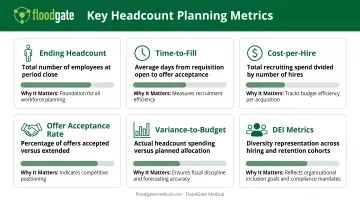
Key Metrics to Track
| Metric | What It Measures | Why It Matters |
|---|---|---|
| Ending Headcount | Actual headcount vs. planned headcount by department | Reveals execution gaps and over/underhiring |
| Time-to-Fill | Days from requisition approval to accepted offer | Identifies bottlenecks in sourcing, interviewing, or approvals |
| Cost-per-Hire | Total recruiting costs ÷ number of hires | Flags budget overruns and recruiting efficiency issues |
| Offer Acceptance Rate | Accepted offers ÷ total offers extended × 100 | Signals compensation competitiveness and candidate experience quality |
| Variance-to-Budget | Actual compensation spend vs. budgeted spend | Prevents payroll surprises and informs reforecasting |
| DEI Metrics | Representation by level, function, and demographic group; equitable offer and promotion rates | Ensures diversity goals aren't lost during rapid scaling |
Choose Tools That Support Recalibration
Fragmented spreadsheets are error-prone and hard to maintain. Centralized HRIS platforms or dedicated headcount planning software support bottom-up planning, forecast reconciliation, scenario modeling, and approval workflows.
Alternatives like Visier add collaborative planning, future-workforce forecasting, and actual-versus-plan tracking so you can reforecast when variance shows up.
Track DEI as a Core Metric
Diverse, equitable hiring should be tracked with the same rigor as cost and time-to-fill. During rapid scaling, review these signals quarterly:
- Representation by level and function
- Equitable slate composition and offer outcomes
- Attrition differences across demographic groups
FloodGate Medical builds this into sourcing with job-criteria-based AI searches that exclude demographic characteristics, race, and age. That reduces bias in the pipeline and keeps DEI embedded in execution instead of bolted on later.
When and How to Adjust
Act on the variance, not the plan in isolation. Freeze or reopen reqs by priority, reallocate open headcount across teams, and revisit compensation bands if offer acceptance drops. Document each change so the next forecast starts from current reality.
Sales Capacity Planning and Its Connection to Headcount Strategy
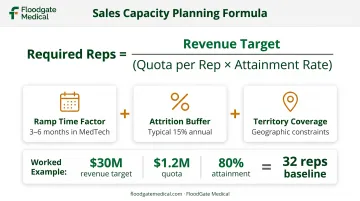
Sales capacity planning is a specialized application of headcount planning focused on one question: How many sales reps do we need to hit our revenue target, given quota, productivity, ramp time, and attrition?
The core formula:
Required Reps = Revenue Target ÷ (Quota per Rep × Attainment Rate)
Adjusted for:
- Ramp time – new reps take 3-6 months (or longer in complex MedTech) to reach full productivity
- Attrition – turnover requires backfilling before capacity erodes
- Territory constraints – geographic coverage, hospital access, or regulatory boundaries
Example: Your revenue target is $30 million. Each rep has a $1.2 million quota and achieves 80% on average. You need:
- $30M ÷ ($1.2M × 0.80) = 31.25 → 32 fully productive reps
If ramp time is 4 months and you expect 15% annual attrition, you'll need to hire earlier and over-hire slightly to maintain 32 productive reps year-round.
For commercial-stage MedTech companies, sales capacity planning feeds directly into overall headcount strategy. McKinsey's 2025 MedTech operating-model work notes that commercial performance requires upskilling sales forces with digital and AI-enabled capabilities.
Your capacity model should distinguish field reps, remote/hybrid reps, clinical-support specialists, and digitally enabled roles. Not every commercial employee is a fully productive quota carrier.
Common Headcount Planning Mistakes to Avoid in 2026
Over-Hiring Too Quickly Without Aligning to Actual Growth
MedTech Dive tracked more than 14,000 announced or completed US device-industry layoffs from January 2023 through June 2024. Cuts included companies like Masimo (75 employees in Irvine, California) and Baxter (59 employees in Massachusetts).
Many of those reductions stemmed from cost cuts, facility closures, and restructuring rather than over-hiring alone. They still show what happens when roles get approved without downside scenarios or alignment to the facility and product roadmap.
To stay ahead of that risk:
- Build conservative, moderate, and aggressive hiring scenarios
- Approve the conservative plan while prepping the pipeline for moderate growth
- Hold full budget and headcount commitment until growth signals confirm the trajectory
Using Poor-Quality or Fragmented Workforce Data
Decisions are only as good as the data behind them. Fragmented spreadsheets, inconsistent role definitions, and unverified attrition assumptions produce headcount plans that fail within weeks.
Tighten the foundation before you plan:
- Centralize data in a single HRIS or workforce-planning platform
- Verify headcount and attrition figures quarterly
- Audit role definitions annually
Undervaluing Critical or In-Demand Roles
Specialized MedTech positions—regulatory affairs, quality assurance, clinical specialists, field application engineers—often command compensation above general industry averages. Budget shortfalls occur when finance applies generic benchmarks to niche roles.
FloodGate Medical observed compensation rising 17% on average in its largest-ever salary-guide increase. Outdated assumptions make both hiring and retention harder.
Budget specialized roles separately with MedTech-specific compensation data, and revisit those benchmarks quarterly.
Excluding Recruiting Partners from Early Strategic Planning
When recruiting partners join only after requisitions are approved, timelines slip and compensation or availability assumptions break down fast. Specialized recruiters who enter earlier surface live talent-supply data, competitive pay ranges, and hard market constraints before the plan is locked.
That early input prevents surprises and speeds execution. FloodGate Medical works with MedTech teams on workforce planning, role definition, and compensation benchmarking so headcount plans match what the market can actually deliver.
Frequently Asked Questions
How do you create a headcount planning strategy?
Start by analyzing your current workforce, then forecast hiring needs based on business objectives and turnover predictions. Benchmark compensation against market data, allocate budget for total rewards and recruiting costs, and build an execution timeline with clear accountability across HR, finance, and hiring managers.
What are the main steps in the headcount planning process?
The core steps are data gathering (current-state workforce analysis), demand forecasting (translating business goals into roles and timing), gap analysis (comparing supply with demand), budget allocation, and ongoing evaluation and revision through monthly or quarterly reviews.
What is a headcount plan?
A headcount plan is a structured roadmap projecting the number of employees needed by role, department, location, and timing to meet business goals, integrated with budget constraints, attrition forecasts, and market compensation data.
What is the formula for calculating headcount?
The basic formula is: Required Headcount = (Projected Workload or Revenue Target ÷ Output per Employee) + Attrition Replacement. Adjust for productivity ramp time, planned growth, and role-specific capacity factors.
What is headcount vs FTE?
Headcount counts each individual employee once, regardless of schedule. FTE (Full-Time Equivalent) standardizes part-time hours into full-time equivalents to measure total labor capacity. Two part-time employees may equal one FTE, but they count as two headcount.
What is the best way to track headcount?
Use centralized HR software or dedicated workforce-planning platforms instead of fragmented spreadsheets. Track key metrics (time-to-fill, cost-per-hire, offer acceptance rate, variance-to-budget, and DEI outcomes) and review them monthly or quarterly with cross-functional stakeholders.