
Introduction
Ask three people in a hospital what "ROI" means, and you might get three different answers. A compliance officer thinks records disclosure, while a finance director pictures profit margins and an HR recruiter calculates cost-per-hire.
That's the problem. ROI is one of the most overloaded acronyms in healthcare, and it carries two completely unrelated meanings depending on who's talking.
MedTech professionals, hospital administrators, and recruiters can easily talk past each other when they assume the wrong definition. A finance team member says "ROI" and means dollars. A medical records clerk says "ROI" and means paperwork requests.
This article breaks down both meanings, plus what ROI specifically means when you're evaluating a medical representative's performance or hiring decision.
Key Takeaways
- ROI in clinical settings usually means Release of Information for medical records and PHI.
- In finance, HR, and hiring conversations, ROI means Return on Investment.
- Meaning depends on the department: HIM/compliance versus finance/HR/sales.
- MedTech companies use ROI to guide equipment, technology, and talent decisions.
- Medical rep roles almost always mean the financial ROI tied to sales performance.
The Two Meanings of ROI in Medical Settings: Why Context Matters
ROI is a genuinely overloaded term in healthcare. Its meaning shifts entirely based on which team you're standing in front of.
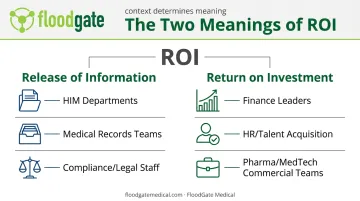
These teams primarily use Release of Information:
- Health information management (HIM) departments
- Medical records teams
- Compliance and legal staff processing disclosure requests
These teams primarily use Return on Investment:
- Hospital finance leaders and executives
- HR and talent acquisition teams
- Pharma and MedTech commercial teams evaluating spend
Here's where it gets tricky. When ROI comes up around medical representatives, it typically leans toward the financial definition. Companies evaluate reps and their hires on profitability, not paperwork.
Rule of thumb: always check the department or conversation context before assuming which "ROI" applies. This single point of ambiguity trips up even experienced healthcare professionals moving between departments.
ROI as "Release of Information": The Compliance-Driven Meaning
Release of Information (RoI) is the regulated process healthcare organizations use to disclose medical, billing, and imaging records to authorized requestors. It's an operational workflow, not a financial metric.
The abbreviation stuck because HIM departments and medical records teams have used it for decades. Long before "ROI" meant anything financial in a hospital hallway, it meant the records-release desk.
Who Requests Records, and Why
Several groups routinely submit RoI requests:
- Patients exercising their right to access their own health information
- Providers coordinating ongoing care or referrals
- Attorneys handling malpractice, injury, or estate cases
- Insurers processing claims or conducting audits
- Government auditors verifying compliance or billing accuracy
The Regulatory Backbone
RoI doesn't operate on guesswork. HIPAA sets firm rules:
- 30-day deadline: Covered entities must act on an access request no later than 30 days after receipt, under 45 CFR 164.524.
- One extension allowed: A single 30-day extension is permitted, but the entity must notify the patient in writing before the original deadline expires.
- Minimum necessary standard: Entities must limit PHI disclosed to what's needed for the purpose, though this standard doesn't apply to a patient's own access request.
- Reasonable, cost-based fees only: No padding copying or postage costs beyond actual expense.
HIM departments feel real strain trying to meet these deadlines. A 2023 AHIMA-commissioned workforce survey found that 66% of health information professionals reported persistent staffing shortages at their organizations over the prior two years.
That shortage directly affects how fast records requests get processed.
This is a distinct operational process, separate entirely from financial ROI. But once you cross into finance, hiring, or sales conversations, "ROI" means something completely different.
ROI as "Return on Investment": The Financial and Talent-Driven Meaning
Return on Investment is the standard financial ratio used to evaluate whether spending money was worthwhile. The formula is simple:
ROI = (Net Gain / Investment Cost) x 100
Net gain equals benefits minus costs. This applies whether you're buying equipment, software, or making a hire.
A Quick Example
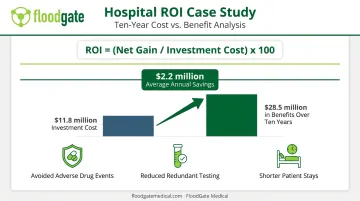
Imagine a hospital invests in computerized physician order entry. AHRQ's hospital ROI toolkit documents a real case: $11.8 million in investment costs over ten years, against $28.5 million in financial benefits. Those benefits came from avoided adverse drug events, reduced redundant testing, and shorter patient stays, That works out to roughly $2.2 million in annual savings.
Not every ROI calculation is that large, but the logic scales down to smaller purchases and staffing decisions too.
Beyond Dollars: Non-Financial ROI
Healthcare organizations don't measure success purely in cash. A 2022 systematic review outlined a broader ROI framework that includes:
- Patient outcomes, safety, and experience
- Staff capability, motivation, and retention
- Organizational efficiency and innovation
In fact, an HFMA poll of 92 healthcare finance executives found 60% named improving patient experience as a 2024 priority, just behind revenue growth at 70%.
Talent as the Biggest ROI Lever
One of the largest strategic investments any MedTech or healthcare organization makes is talent. Hiring ROI isn't just about salary versus output. It includes:
- Retention (does the hire stay?)
- Productivity (do they perform?)
- Time-to-fill (how fast did you get them in seat?)
- Innovation contribution from diverse teams
The 2024 NSI National Health Care Retention Report, covering 400 hospitals and over 723,000 employees, found average bedside-RN turnover costs of $56,300 per departure. The average hospital loses $4.82 million annually to RN turnover.
A bad hire in a MedTech commercial role carries similar downstream costs, even without a standardized industry benchmark. Specialized MedTech recruiters like FloodGate Medical target this exact risk, using retention-focused, DEI-driven placement practices to help hiring managers get the right person in the seat the first time.
What Does ROI Mean for a Medical Representative?
When someone searches for "the full form of ROI in medical representative," they're almost always asking about Return on Investment applied to a sales rep's performance. It's about revenue and relationships generated relative to salary, training, and territory costs, not medical records.
Commercial and sales leadership calculate rep-level ROI using metrics like:
- Quota attainment against revenue targets
- Territory profitability
- Engagement quality (IQVIA's BrandImpact framework tracks 11 KPIs here, from meeting duration to prescribing intent)
- Downstream outcomes, such as new-patient starts tied to specific outreach
This calculation is entirely separate from the records-disclosure meaning. No overlap, no shared vocabulary. Just the same three letters.
Compensation adds another layer. MedReps data shows a median base salary of $104,649 and average total compensation of $172,527 for medical sales reps. Every dollar in that package needs to generate enough return to justify the investment.
Here's the part that gets overlooked: hiring the right medical representative directly shapes this ROI calculation. A rep with the right clinical expertise, established physician relationships, and cultural fit ramps faster and produces sooner. Recruitment quality isn't a soft consideration here. It's a financial lever. Specialized MedTech recruiters, like FloodGate Medical, focus on exactly this—matching reps with the clinical background and relationships that shorten ramp time.
Maximizing MedTech ROI Through Strategic, DEI-Driven Hiring
Regardless of which ROI definition applies to your role, the underlying goal stays the same: getting the most value out of limited resources.
For MedTech companies, that value increasingly ties back to who you hire and how you build your teams. McKinsey's analysis of 1,265 companies across 23 countries found that companies in the top quartile for executive-team gender diversity were 39% more likely to financially outperform bottom-quartile companies. Ethnic diversity showed the same 39% gap.
This isn't proof of direct causation (McKinsey is clear about that), but the association is hard to ignore when you're deciding how to build a sales force or product team.
This is where FloodGate Medical's approach comes in. We built our recruitment process around equity, diversity, and inclusion because better-fit hires drive better outcomes:
- Faster time-to-fill: One case saw us fill six sales representative positions across five nationwide locations in 21 business days, beating a 30-day target during the height of the pandemic.
- Better candidate reach: Our network taps both active job seekers and passive candidates who aren't currently looking, widening the qualified talent pool available to you.
- Stronger candidate experience: We track a Net Promoter Score of 9.4 among the professionals we place.

Every hire carries measurable ROI, and building your team through a DEI-driven process is one concrete way to tilt those numbers in your favor.
Ready to improve the ROI of your next MedTech hire? Schedule a conversation with Joe McClung, FloodGate Medical's President & Chief Commercial Officer, or explore our blog for more MedTech hiring insights.
Frequently Asked Questions
What does ROI mean in healthcare?
ROI most commonly means Release of Information in clinical and compliance contexts, referring to disclosing medical records. In finance and hiring conversations, it means Return on Investment. The correct meaning depends entirely on context.
What is the full form of ROI for a medical representative?
In this context, ROI stands for Return on Investment. It refers to the value a medical rep's sales performance generates relative to their salary, training, and territory costs.
Is ROI in medical settings always about medical records?
No. The meaning shifts based on department. HIM and compliance teams mean Release of Information, while finance, HR, and sales teams mean Return on Investment.
How is ROI calculated in a healthcare business context?
The basic formula is net gain divided by investment cost, often expressed as a percentage. For example, a hospital comparing equipment savings against purchase and maintenance costs would use this ratio.
Why do healthcare organizations track non-financial ROI?
Outcomes like patient satisfaction, quality of care, and staff retention matter even when they can't be reduced to dollars. These factors influence long-term financial performance too.
How does hiring the right talent impact ROI for MedTech companies?
Quality, well-fitted hires improve retention and productivity, which directly raises the return on a company's hiring investment. FloodGate Medical's equity-driven recruitment approach helps MedTech companies secure these high-impact hires.