
Introduction: The Hidden Risk in Your Workforce Strategy
Imagine your lead regulatory affairs specialist submits her resignation on Monday morning, and suddenly your Class III device submission, scheduled for FDA review in 60 days, is at serious risk.
The cybersecurity documentation she was finalizing sits incomplete, and your technical screening deadline is approaching fast. Now imagine discovering you never formally identified this position as critical to business continuity.
This scenario plays out more often than MedTech leaders admit. Most companies lack a clear, documented answer to a fundamental question: which roles would cause material damage to operations, compliance, or revenue if they became vacant tomorrow?
Without that clarity, you manage talent reactively, scrambling to fill gaps rather than protecting the business proactively.
The stakes are particularly high in MedTech, where FDA submission timelines leave no room for talent-related delays and a single compliance gap can halt an entire product launch.
According to McKinsey's 2025 R&D study, the average MedTech product takes more than four years to reach market, with R&D spending growing 10% annually. Every day of talent continuity matters.
This article provides a practical, step-by-step framework for identifying which roles truly deserve "critical" designation in your MedTech organization, and what to do once you know.
Key Takeaways:
- Critical roles are defined by business impact if vacant, not by seniority or salary
- MedTech regulatory and patient-safety dependencies make some technical roles unexpectedly critical
- Score strategic impact, replacement difficulty, and regulatory exposure to surface real vulnerabilities
- Designate only 5-15% of roles as critical so focus stays meaningful
What Is a Critical Role? Understanding the Definition
A critical role is a position where vacancy or sustained underperformance would cause material, near-term damage to your organization's ability to execute strategy, deliver products, or maintain regulatory compliance.
Three characteristics define true criticality:
- Strategic necessity – The role directly enables a core business capability or competitive advantage
- Time-sensitive impact – Vacancy creates tangible problems within 30-90 days, not eventually
- Limited substitutability – The work cannot easily be absorbed, automated, or restructured in the short term
This designation applies to the role itself, not the person currently filling it. A position can be critical even if you have a strong performer today, and a role can lose criticality as business priorities shift.
Common Misconceptions About Critical Roles
"Critical" doesn't automatically mean C-suite. While executive roles often carry strategic weight, operational and technical positions (regulatory specialists, quality engineers, field service technicians) can be equally or more critical when measured by immediate business continuity.
Scarcity alone doesn't equal criticality. Hard-to-fill roles deserve attention, but hiring difficulty is a talent-market constraint, not proof of strategic necessity. A niche data scientist might take six months to recruit yet have minimal near-term impact if the role stays open.
Conversely, a quality assurance director may be easier to hire and still be critical. An open seat can stall CAPA closure, weaken inspection readiness, and delay product releases.
Critical Roles in the MedTech Context
MedTech companies face distinct talent dependencies driven by regulatory timelines and patient-safety obligations. Typical critical roles include:
Regulatory and Compliance Functions:
- Regulatory affairs specialists who own FDA submissions and maintain agency relationships
- Quality assurance directors responsible for QMS integrity and CAPA management
- Clinical research managers who design studies and coordinate investigator relationships
Technical and Engineering Roles:
- Field service engineers who maintain installed base uptime and customer relationships
- Design verification engineers who execute V&V protocols for device approvals
- Cybersecurity specialists who manage FDA-required vulnerability monitoring and SBOM documentation
Emerging Critical Roles:
- AI/ML specialists developing algorithm-driven diagnostics and therapeutic devices
- Digital health product managers who bridge clinical workflows and software development
- Data scientists analyzing real-world evidence for reimbursement and post-market surveillance
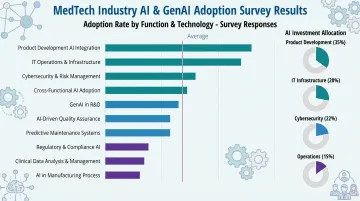
Deloitte's 2024 survey of 85 MedTech leaders found 42% reporting AI/GenAI benefits in product development and 35% in IT and cybersecurity. Those figures signal that these capabilities now carry strategic weight alongside traditional regulatory and quality functions.
Why Identifying Critical Roles Matters for MedTech Companies
Regulatory timelines don't pause for talent gaps. FDA performance goals under MDUFA V require 510(k) decisions within 90 FDA days for 95% of submissions, with total time-to-decision targets of 108 calendar days for FY2026-2027. Original PMAs follow a statutory 180-day review period. When your regulatory affairs manager gives notice two weeks before a submission deadline, you're not just hiring: you're protecting a multi-million-dollar launch timeline.
Compliance exposure accumulates quickly. In MedTech, quality and regulatory roles sit at the center of how the business operates. An unfilled QA director position means delayed CAPA closures, incomplete design history files, and potential warning-letter exposure. Cybersecurity roles carry similar weight: incomplete cybersecurity documentation triggers FDA technical screening holds, freezing your entire submission.
Customer relationships depend on technical continuity. Field service engineers and clinical specialists build trust with surgeons and hospital systems over years. When these roles turn over without succession plans, you risk losing technical coverage and institutional knowledge about customer preferences, procedural nuances, and competitive positioning.
Knowing your critical roles turns talent acquisition from firefighting into strategy. You can:
- Build pipelines before vacancies occur
- Develop internal successors with enough lead time
- Negotiate retention packages that reflect true business risk
That approach beats discovering a role's importance only when someone resigns.
Step-by-Step Process to Identify Critical Roles in Your Organization
Step 1: Assemble a Cross-Functional Team
HR cannot and should not make criticality determinations alone. Assemble a working group of 5-7 leaders who understand both strategic direction and operational reality:
- Chief Human Resources Officer or VP of Talent – facilitates the process and provides workforce data
- CFO or VP of Finance – contributes revenue-impact and cost-of-vacancy perspective
- VP of Quality/Regulatory – identifies compliance and submission dependencies
- VP of Operations or R&D – maps product-development and manufacturing dependencies
- Business unit leaders – provide market and customer-facing role insights
This cross-functional lens prevents blind spots. Roles that seem optional to finance may be mission-critical to operations, and vice versa.
Step 2: Define Your Evaluation Criteria
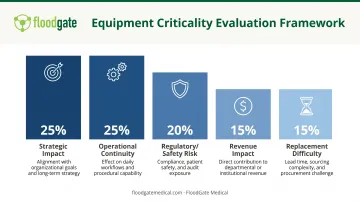
Criticality is multidimensional. Score each role across these core criteria, weighting each dimension based on your strategic priorities:
| Criterion | Weight | What to Assess |
|---|---|---|
| Strategic Impact | 25% | Does this role enable a top-3 strategic initiative or competitive differentiator? |
| Operational Continuity | 25% | Would vacancy disrupt daily operations, customer deliveries, or product quality within 60 days? |
| Regulatory/Safety Risk | 20% | Does this role own FDA submissions, quality systems, or patient-safety controls? |
| Revenue Impact | 15% | Does this role directly generate, protect, or enable significant revenue streams? |
| Replacement Difficulty | 15% | How long would it realistically take to source, hire, and onboard a qualified replacement? |
Customize weights for your context. Early-stage companies may emphasize strategic impact and replacement difficulty; mature commercial organizations may weight regulatory risk and revenue impact more heavily.
Step 3: Map All Roles Against Criteria
Start with your current org chart, but don't stop there. Include contractor-dependent functions, single-person departments, and roles that report into broader teams but carry distinct responsibilities.
Score each position on a consistent 1-5 scale across all criteria:
- 5 = Critical / Severe impact
- 4 = High impact
- 3 = Moderate impact
- 2 = Low impact
- 1 = Minimal impact
Calculate a weighted total score for each role. This quantitative baseline creates consistency and reduces bias.
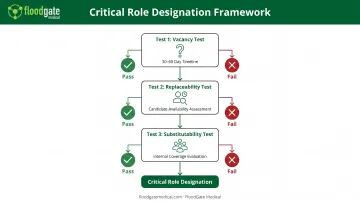
Step 4: Apply the Three Critical Tests
Numbers tell part of the story; qualitative tests reveal the rest. For each high-scoring role, ask:
Vacancy Test: What specifically breaks within 30-60 days if this role is empty with no notice?
- Can you name the deliverable, submission, customer relationship, or system that fails?
- Is the damage immediate and material, or merely inconvenient?
Replaceability Test: How long would it realistically take to find someone capable, internally or externally?
- Do candidates with the required MedTech regulatory, quality, or technical expertise exist in your geography?
- What's the true time-to-fill including sourcing, interviewing, offer negotiation, and onboarding?
Substitutability Test: Can the work be absorbed, automated, or restructured in the short term?
- Could another team member cover 80% of responsibilities for 90 days?
- Is the role a single point of failure, or part of a resilient team structure?
Roles that fail all three tests (high vacancy impact, long replacement time, no short-term substitute) are definitively critical.
Step 5: Create Your Shortlist and Document
Keep the list focused. Most organizations should designate 5-15% of total roles as critical. A 200-person MedTech company should have 10-30 critical roles, not 80. SHRM's 2025 guidance recommends starting with the top 5-10 positions and expanding through a phased approach.
Document your rationale. For each critical role, record:
- The specific business impact if vacant
- Regulatory or compliance dependencies
- Estimated time-to-replace
- Current succession readiness (covered, partially covered, or uncovered)
This documentation justifies investments in succession planning, retention packages, and proactive recruiting. It also protects against recency bias when a vocal leader leaves.
Step 6: Align with Future Strategy
Criticality isn't static. Review your strategic plan, growth roadmap, and digital transformation initiatives to identify roles that will become critical over the next 12-24 months:
- Are you launching connected devices that will require ongoing cybersecurity management?
- Is your commercial strategy shifting toward value-based contracting, requiring health economics expertise?
- Are you investing in AI-driven diagnostics that depend on data science and algorithm validation?
Build these future-critical roles into your talent pipeline now, before competitive urgency drives up hiring costs and timelines.
Critical Role Assessment Framework: A Practical Matrix
The Impact vs. Replaceability Matrix
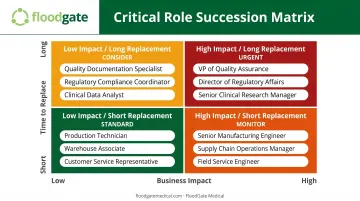
Plot each role on a 2×2 matrix with Business Impact (low to high) on the x-axis and Time to Replace (short to long) on the y-axis. Use it to decide where succession planning and pipeline development deserve real investment.
High Impact / Long Replacement (Upper Right Quadrant):
- Action: Immediate succession planning, retention focus, proactive pipeline development
- Examples: VP of Regulatory Affairs, Principal Clinical Research Manager, Lead Cybersecurity Engineer
Low Impact / Long Replacement (Upper Left Quadrant):
- Action: Consider role redesign, skill development for internal candidates, or process automation
- Examples: Specialized legacy-system administrator, niche compliance analyst for discontinued product line
High Impact / Short Replacement (Lower Right Quadrant):
- Action: Maintain active talent pipeline, strong onboarding process, knowledge documentation
- Examples: Regional Sales Director in competitive geography, Senior Field Service Engineer
Low Impact / Short Replacement (Lower Left Quadrant):
- Action: Standard hiring practices, no special succession investment
- Examples: Administrative support, junior analyst roles, general procurement
Scoring Criteria Template
Use this weighted framework as a starting point, then adjust based on your organization's strategic priorities:
| Criterion | Weight | Score Definition |
|---|---|---|
| Strategic Value | 25% | 5 = Enables top-tier strategic initiative; 1 = No strategic connection |
| Operational Impact | 25% | 5 = Operations fail within 30 days; 1 = No operational dependency |
| Regulatory/Safety Risk | 20% | 5 = Owns critical FDA/quality obligations; 1 = No regulatory exposure |
| Revenue Impact | 15% | 5 = Directly controls $10M+ revenue; 1 = No revenue linkage |
| Replacement Difficulty | 15% | 5 = 6+ months realistic time-to-fill; 1 = Filled within 30 days |
Multiply each score (1-5) by its weight, then sum for a total weighted score out of 5.0. Roles scoring 4.0+ warrant immediate critical designation and succession focus.
Example: Regulatory Affairs Manager in MedTech
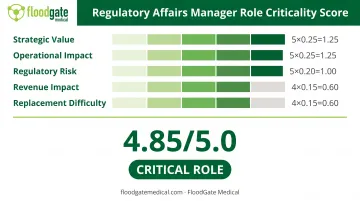
Let's apply the framework to a Regulatory Affairs Manager responsible for 510(k) submissions and FDA correspondence at a $50M cardiovascular device company:
- Strategic Value (25%): Score 5: Directly enables new product launches and label expansions that drive 30% of growth plan
- Operational Impact (25%): Score 5: Vacancy would halt all active submissions; no backup regulatory expertise on staff
- Regulatory/Safety Risk (20%): Score 5: Owns all FDA interactions, QMS regulatory interface, and post-market surveillance reporting
- Revenue Impact (15%): Score 4: Delayed submissions risk $8M in first-year launch revenue for pipeline products
- Replacement Difficulty (15%): Score 4: Cardiovascular device regulatory expertise is scarce; realistic time-to-fill is 4-5 months
Weighted Total: (5×0.25) + (5×0.25) + (5×0.20) + (4×0.15) + (4×0.15) = 4.85 / 5.0
Determination: This role is clearly critical. The company should immediately identify an internal successor, document regulatory procedures, and maintain an active pipeline of external candidates.
Building Role Profiles for Critical Positions
Once a role clears the criticality threshold, capture it in a one-page profile so succession work stays concrete. Include:
- Core Responsibilities: The 5-7 deliverables or accountabilities that define success
- Required Competencies: Technical skills, certifications, and experience thresholds
- Business Impact if Vacant: Specific risks—submission delays, customer attrition, compliance gaps
- Current Succession Status: Ready successor (green), developing successor (yellow), or no successor (red)
Use each profile to drive successor development plans, critical-hire recruiting briefs, and knowledge-transfer protocols.
Review and Maintenance Schedule
Critical designations drift as strategy, regulation, and org design change. Build a simple review cadence so the matrix stays current.
Quarterly Updates:
- Review succession pipeline status for all critical roles
- Update red/yellow/green succession readiness ratings
- Adjust retention strategies for at-risk critical incumbents
Annual Full Reassessment:
- Re-score all roles using updated strategic priorities
- Add newly critical roles driven by business evolution
- Remove roles that no longer meet criticality thresholds
Trigger Events Requiring Immediate Review:
- Major strategic pivot (new product line, market expansion, M&A)
- Regulatory landscape shifts (new FDA guidance, EU MDR changes)
- Significant unexpected resignation in a critical or adjacent role
- Organizational restructuring or leadership changes
Common Mistakes to Avoid When Identifying Critical Roles
Mistake 1: Confusing high performers with critical roles. Your star regulatory affairs lead may be exceptional, but that doesn't automatically make the role critical. Ask: if this person left and we hired someone competent but not outstanding, would the business still function? If yes, the role isn't critical. The person is just very good. Critical designation must survive turnover.
Mistake 2: Focusing only on senior leadership. Gartner's 2025 research found 61% of HR leaders say succession plans are too senior-level focused. Operational linchpins often carry more near-term continuity risk than a VP with a strong leadership team beneath them. Think field service engineers with 15 years of customer relationships, or quality specialists who are the sole CAPA subject-matter expert.
Mistake 3: Creating too broad a list. If 40% of your roles are "critical," you've diluted the entire concept. SHRM's 2024 succession planning survey found 56% of organizations have no succession plan at all; only 21% have formal plans. The main barrier? Lack of time and resources. A focused list of 10 truly critical roles is far more actionable than a theoretical list of 60.
FloodGate Medical's Approach to Critical Role Talent Strategy
Once you've identified your critical roles, the next challenge is building resilient talent pipelines before vacancies create business risk.
FloodGate Medical partners with MedTech companies to turn critical-role frameworks into proactive recruitment strategies. The work draws on deep regulatory, quality, and commercial expertise, paired with a methodology that prioritizes diversity and inclusion.
FloodGate maintains relationships with specialized talent across:
- Regulatory affairs
- Clinical research
- Quality systems
- Emerging functions such as AI/ML and cybersecurity
That network helps organizations fill critical positions with qualified, culture-aligned candidates, often before competitors even post the role.
Frequently Asked Questions
What's the difference between a critical role and a hard-to-fill role?
A hard-to-fill role reflects talent-market scarcity: few qualified candidates, high competition, and long time-to-fill. A critical role reflects business impact: vacancy causes material operational, regulatory, or revenue damage within 30-90 days. A role can be hard-to-fill without being critical, or critical without being hard-to-fill.
How many critical roles should an organization have?
Most organizations should designate 5-15% of total roles as critical. A 100-person company might have 5-15; a 500-person company, about 25-75. If more than 20% of roles are labeled critical, the list likely lacks real prioritization.
Can entry-level positions be considered critical roles?
Yes. Criticality is determined by business impact, not seniority. A junior field service engineer covering a territory with no backup can be critical if vacancy causes immediate operational damage. Ask what breaks if the role is vacant, and how quickly.
How often should we reassess which roles are critical?
Run a full reassessment annually with strategic planning, plus quarterly updates for succession pipelines and known departures. Trigger an immediate reassessment after a major strategy shift, restructuring, new regulatory requirements, or an unexpected critical-role resignation.
Who should be involved in the critical role identification process?
Assemble a cross-functional team of 5-7 stakeholders: HR/talent leadership, finance, operations, quality and regulatory (for MedTech compliance risk), and business unit leaders. That mix captures strategic, operational, and regulatory impact—not HR intuition alone.
What should we do once we've identified our critical roles?
Take four immediate next steps:
- Develop succession plans and name internal successors for each critical role
- Create retention strategies so pay, growth, and recognition match strategic value
- Build proactive talent pipelines with specialized MedTech recruiters before vacancies hit
- Prioritize development investments for people in or preparing for critical roles
Conclusion: Building a Future-Ready Talent Strategy
Critical role identification is a business-continuity and strategic-enablement discipline, not a side HR project. In MedTech, where regulatory timelines are unforgiving and patient safety is non-negotiable, knowing which roles protect your ability to execute is foundational to resilient workforce planning.
The framework outlined here—cross-functional assessment, weighted scoring, qualitative tests, and ongoing review—transforms vague intuition into documented, defensible talent priorities. It tells you where to invest in succession, where to build pipelines proactively, and where to focus retention energy.
FloodGate Medical helps MedTech companies move from critical-role identification to actionable talent strategy, including diverse pipelines for regulatory, quality, clinical, and emerging AI and cybersecurity functions. With deep MedTech recruiting expertise and equitable hiring practices, FloodGate helps you staff those roles before a resignation threatens your next product launch.
Start your critical role assessment today. Assemble your cross-functional team, map your exposure, and build the proactive talent strategy your continuity plan needs.