Introduction
A bad hire doesn't just cost money. It costs time, momentum, and team morale.
In a Robert Half survey of more than 2,100 CFOs, 95% said a poor hiring decision hurts team morale. Supervisors also spent an average of 17% of their time managing underperformers, according to SHRM's report on hiring mistakes.
That's nearly one full day a week lost to a decision made too fast, or without the right structure.
Here's the catch: most hiring managers never receive formal training for the role. They step in because someone left or a team scaled up, then find themselves figuring out where their job ends and the recruiter's begins.
In specialized fields like MedTech, where technical vetting matters as much as culture fit, that gap gets even harder to close.
This guide breaks down the hiring manager's role, walks through a practical five-step framework, and includes ready-to-use templates you can put to work today.
Key Takeaways
- Bad hires drain 17% of a supervisor's time and damage morale for the whole team
- Hiring managers own the final decision; recruiters own sourcing and screening
- A structured five-step framework reduces bias and speeds up quality decisions
- Standardized scorecards and question banks prevent inconsistent, unfair comparisons
- Diverse hiring panels correlate with stronger financial and innovation outcomes
What Is a Hiring Manager?
A hiring manager is typically a team lead, department head, or executive who identifies a staffing need, drives the process forward, and makes the final call on who gets hired. This role rarely shows up as an official job title.
Instead, it's a temporary responsibility activated by attrition, growth, or a sudden vacancy, then set aside again once the seat is filled.
That distinction matters. Many first-time hiring managers assume the role comes with built-in expertise. It doesn't. The skills that made you a great engineer or clinical specialist aren't the same skills that make you great at evaluating candidates.
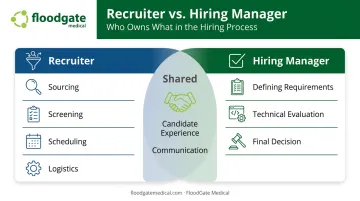
Hiring Manager vs. Recruiter: Where Responsibilities Split
Confusion between these two roles causes more hiring delays than almost anything else. Here's the clearest way to separate them:
| Responsibility | Owned By | Measured By |
|---|---|---|
| Sourcing, screening, scheduling, logistics | Recruiter | Time-to-fill, pipeline volume |
| Defining requirements, technical evaluation, final decision | Hiring Manager | Quality-of-hire, retention |
| Candidate experience and communication | Shared | Offer acceptance rate |
The recruiter builds and manages the pipeline. The hiring manager evaluates fit and owns the outcome, according to Indeed's breakdown of the two roles. Quality-of-hire, in particular, isn't a pure recruiter metric. It combines post-hire performance, productivity, and retention, none of which a recruiter fully controls once the offer is signed.
In specialized fields like MedTech, this partnership carries even more weight. A hiring manager evaluating a clinical affairs specialist or a field sales rep with cath lab experience needs subject-matter vetting that a generalist recruiter simply can't provide alone.
That's where a niche partner familiar with the industry, like FloodGate Medical, adds value. Instead of explaining basic terminology to a recruiter, hiring managers get a partner who already understands the technical landscape and can pressure-test candidates before they reach an interview.
Best Practices: A Step-by-Step Hiring Manager Framework
Preparation before the first interview determines the quality of every hire that follows. Rushing straight to a job posting is the single most common mistake hiring managers make.
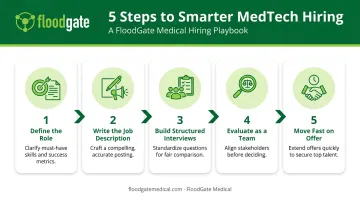
Step 1: Define the Role Before Writing a Job Description
Before you write a single line for a job board, build a short vision document. Cover three things:
- Purpose: How this role impacts the team and the broader business
- Outcomes: The specific results you expect in the first 6-12 months
- Competencies: The skills, experience, and traits required to hit those outcomes
Skip this step and you'll end up with a job description that reads like a wish list instead of a role.
Step 2: Write a Job Description That Attracts the Right Talent
Your job description is a marketing document, not a legal disclaimer. Include company context, the role's real impact, and language that welcomes a wide range of candidates.
Word choice matters more than most hiring managers realize. A 2025 field study of more than 3,500 applicants found that replacing masculine-coded wording with gender-neutral language increased the proportion of female applicants by about 4%.
That translates to roughly seven additional women applying per month for a single posting. That's not a rounding error; it's a wider, stronger applicant pool from one editing pass.
Step 3: Build a Structured, Consistent Interview Process
Assemble a diverse interview panel, and assign each interviewer a specific competency to probe. Nothing wastes candidate goodwill faster than five interviewers asking the same three questions.
- Assign competencies per interviewer to avoid redundant coverage
- Use a standardized scorecard so every candidate is rated against the same criteria
- Share the scorecard with panelists before the interview, not after
This structure alone eliminates most of the inconsistency that leads to unfair, hard-to-defend hiring decisions.
Step 4: Evaluate Objectively and Decide as a Team
Write your evaluation immediately after each interview, while details are still fresh. Gut feeling fades. Notes don't.
Back every opinion with a specific fact from the conversation, not a vague impression. And when weighing team dynamics, favor "culture add" over "culture fit." Culture fit tends to reward sameness. Culture add asks what new perspective or strength this person brings that your team doesn't already have.
Step 5: Move Fast on the Offer
Speed matters more in healthcare and MedTech hiring than most managers assume. Skilled talent in this space doesn't sit on the market long, and drawn-out approval chains are one of the fastest ways to lose a strong candidate to a competing offer.
When it's time to negotiate, remember base salary isn't your only lever:
- Sign-on bonuses
- Flexible or remote work arrangements
- Extra PTO or a delayed start date
- Accelerated review timelines for promotion
Essential Hiring Manager Templates & Tools
Templates turn good intentions into a repeatable process. Here are four you should have on hand before your next search opens.
Job Description Template
Structure every posting around three core sections:
- Role purpose, stated in two or three concrete sentences
- Must-have skills separated from nice-to-have skills, so you don't filter out strong candidates over criteria that were never actually essential
- An inclusive-language checklist to catch biased phrasing before the posting goes live
Interview Scorecard Template
A scorecard rates every candidate against the same competencies, on the same scale, closing the door on the "halo effect," where one likable trait inflates a candidate's entire evaluation. FloodGate Medical's Interview ScoreCard, available through its hiring manager resource library, is built specifically for this kind of structured comparison.
Interview Question Bank Template
Organize your questions by category, such as technical skill, behavioral, and team-fit, and distribute them across your panel. This keeps interviewers from unintentionally duplicating coverage and leaves no competency unexamined.
Offer Approval Checklist Template
Capture the essentials in one place:
- Job title and level
- Salary band
- Start date
- Approver sign-off
A simple checklist here shaves days off your internal approval process, which matters when a strong candidate has other offers on the table.
Common Hiring Mistakes to Avoid
Even experienced hiring managers fall into the same handful of traps. Watch for these three.
- Trusting the halo effect over structure. SHRM identifies this bias as letting a candidate's likability or appearance override objective, competency-based evaluation.
- Asking inconsistent questions across candidates. If Candidate A gets a technical deep-dive and Candidate B gets small talk, you have no fair basis for comparison.
- Getting caught off guard by compensation or growth questions. Candidates ask about salary bands, promotion timelines, and culture fit constantly. Have your talking points ready, and loop in HR or a recruiting partner like FloodGate Medical when questions exceed your scope.
Building Diverse, High-Performing MedTech Teams
Diverse teams deliver a measurable performance advantage backed by data across industries.
McKinsey's analysis of more than 1,000 companies found that firms in the top quartile for executive-team gender diversity were 25% more likely to show above-average profitability. That figure climbs to 36% for ethnic and cultural diversity. These are associations, not guarantees, but the pattern holds across industries including healthcare and technology.
You don't need a massive DEI program to start applying this. Three tactics work immediately:
- Build diverse interview panels so no single perspective dominates the evaluation
- Use structured or blind resume screening to reduce unconscious bias before the interview stage
- Bias-check your job descriptions using tools or a second reviewer before posting
FloodGate Medical built its recruitment methodology around exactly this kind of equity-first approach, treating diversity as a design principle from the first candidate search rather than an afterthought. Hiring managers can put these same tactics into practice through FloodGate's hiring-manager training programs, which walk teams through structured screening and bias-reduction methods.
Frequently Asked Questions
What are the 5 C's of hiring?
Firms define this differently, but it commonly refers to Competency, Character, Culture Fit or Add, Communication, and Career Direction. Use it as a checklist to evaluate candidates holistically, not just on skills.
What is the 70/30 rule in hiring?
There's no single universal definition. One common version, from Workable, suggests moving forward with a candidate once you have roughly 70% confidence they'll succeed, rather than waiting for a perfect match that may never appear.
What is the 80/20 rule in interviewing?
Applied to interviews, this means the interviewer should talk about 20% of the time and listen for the remaining 80%, letting the candidate do most of the talking so you actually learn something.
What is the 30-60-90 rule in an interview?
This usually refers to a new hire's first 30-60-90 day plan, mapping out goals and check-ins at each milestone. SHRM recommends structured onboarding conversations at these intervals.
What's the main difference between a hiring manager and a recruiter?
Recruiters source, screen, and manage the candidate pipeline. Hiring managers define the role's requirements, run technical evaluations, and make the final hiring decision.
How can hiring managers reduce bias during interviews?
Use standardized scorecards, ask every candidate the same core questions, and build diverse interview panels. These three tactics address most of the common bias points in a typical hiring process.