Understanding the distinction between contract and temporary staffing isn't just an HR technicality—it's a strategic imperative. Misclassifying workers can trigger IRS penalties, back wages, and Equal Employment Opportunity Commission investigations. Choosing the wrong staffing model can inflate costs, compromise FDA compliance, or leave your team without the specialized expertise critical projects require.
This guide breaks down the legal, financial, and operational differences between contract and temporary staffing in the MedTech context, helping you make confident decisions that support both compliance and business growth.
Key Takeaways
- Temporary workers are W-2 employees you supervise; contract workers are independent 1099s who control their own methods
- IRS control tests—not contract labels—decide classification; misclassification risks back taxes, penalties up to $2,515 per violation, and liquidated damages
- FDA Quality Management System rules apply to all personnel doing regulated work, W-2 or 1099
- MedTech staffing partners supply pre-vetted talent with regulatory and quality-system experience
- Blended staffing (permanent, temporary, and contract) scales capacity for launches, trials, and regulatory milestones
Understanding Contract and Temporary Staffing: Key Definitions
What is Temporary Staffing?
Temporary staffing places short-term W-2 employees into your organization for defined periods—typically weeks to 12 months. These workers receive wages through a staffing agency or directly from your company, with all payroll taxes withheld and reported on Form W-2. The staffing agency acts as the legal employer, recruiting, screening, hiring, paying wages and benefits, withholding taxes, and managing termination or reassignment.
Temporary workers operate under your direct supervision. You set their schedules, provide training, manage their daily tasks, and evaluate performance just as you would for permanent employees. That day-to-day control is what legally separates temporary W-2 arrangements from independent contractor relationships.
MedTech-specific temporary roles include:
- Clinical research assistants supporting enrollment surges during pivotal trials
- Laboratory technicians during product validation and launch phases
- Regulatory affairs coordinators preparing 510(k) submissions or CE Mark applications
- Quality auditors conducting pre-inspection readiness assessments
- Territory managers covering medical leave or expansion into new geographies
Temporary arrangements work well when you need immediate capacity, direct oversight, and integration with your existing team—without the long-term commitment of permanent headcount.
What is Contract Staffing?
Contract staffing engages independent contractors—typically 1099 workers—who operate as separate business entities (sole proprietors or LLCs). Unlike temporary employees, contractors control how, when, and where they complete agreed-upon deliverables. The IRS generally treats independent contractors as self-employed; payers do not withhold income, Social Security, or Medicare taxes on contractor payments.
Contractors set their own hours, use their own tools and systems, and control their work methods. You define the project scope and deliverables; they determine how to achieve those outcomes. That independence keeps the arrangement compliant—and frees your team from managing daily execution.
MedTech-specific contract roles include:
- Regulatory consultants preparing FDA 510(k) or PMA submissions
- Medical device design engineers developing prototypes for new product lines
- Biostatisticians designing and analyzing clinical trial data
- Medical writers drafting clinical evaluation reports or technical documentation
- Quality-system consultants implementing ISO 13485 or FDA QMSR compliance programs
Contract arrangements bring specialized expertise for discrete projects without adding permanent overhead or requiring daily supervision.
Contract vs. Temporary Staffing: The Critical Differences
Employment Classification and Legal Status
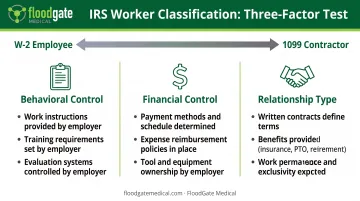
The fundamental distinction is legal status: temporary workers are W-2 employees; contract workers are 1099 independent contractors. Classification depends on three IRS common-law categories:
Behavioral control: Does the company control what the worker does and how the work is performed?
Financial control: Does the company control payment methods, expense reimbursement, tools, and supplies?
Type of relationship: Do written contracts, employee-type benefits, work continuity, and the nature of the work indicate an employment relationship?
No single factor determines status; the IRS evaluates the totality of the relationship. Contract labels and tax forms do not override actual working conditions.
The Department of Labor applies a separate economic-reality test under the Fair Labor Standards Act: is the worker economically dependent on the employer, or in business for themself? Factors include:
- Opportunity for profit or loss
- Investments by the worker and the employer
- Permanence of the relationship
- Degree of employer control
- Whether the work is integral to the business
- Worker skill and initiative
Why classification matters:
Misclassifying an employee as a contractor exposes your company to:
- Back payment of federal employment taxes (Social Security, Medicare, unemployment)
- Civil penalties up to $2,515 per repeated or willful minimum-wage or overtime violation
- Back wages plus equal liquidated damages under the FLSA
- State tax penalties and interest
- In December 2024, two healthcare staffing companies were ordered to pay more than $2.4 million to 341 employees for misclassifying housekeepers, laundry workers, and dietary staff and denying overtime
Treat classification as a compliance decision up front—retroactive tax, wage, and penalty exposure is far harder to unwind later.
Control and Supervision
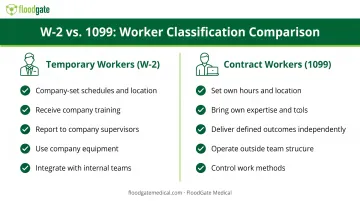
Temporary workers:
- Follow company-set schedules and work locations
- Receive company training on systems, processes, and quality standards
- Report to company supervisors who assign tasks, monitor progress, and evaluate performance
- Use company-provided equipment, software, and tools
- Integrate with internal teams and attend company meetings
Contract workers:
- Set their own hours and work location (on-site only if truly required by the project)
- Bring their own expertise, tools, and methods
- Deliver defined project outcomes without daily task-level supervision
- Operate independently, not as part of the internal team structure
- Control the means and methods of achieving the agreed deliverables
If you find yourself managing a "contractor" the same way you manage employees—setting their daily schedule, providing detailed instructions, evaluating their work process rather than just results—you likely have an employee relationship regardless of what the contract says.
Duration and Work Arrangement
Temporary positions typically address short-term operational needs: seasonal demand spikes, employee medical or parental leave, project surges, and trial periods before permanent offers. Assignments usually last a few weeks to several months, and sometimes up to a year.
Important: No federal law automatically converts a temporary worker to permanent status after a set duration. The IRS and DOL treat permanence as one classification factor, but there is no safe-harbor cutoff at 90 days, six months, or one year.
Some states still impose pay or benefit rules after threshold hours. Illinois requires covered temporary workers exceeding 720 hours in 12 months to receive comparator pay and benefits or cash equivalents.
Temp-to-hire arrangements allow companies to evaluate workers for 60 to 180 days before extending permanent offers. This "try before you buy" approach reduces hiring risk, though agencies typically charge a conversion fee if the worker moves to direct employment.
Contract arrangements are project-specific, tied to defined scopes of work, deliverables, and completion timelines. A regulatory consultant might be engaged for a single 510(k) submission spanning three months, or a biostatistician contracted for the statistical analysis plan and final report of a clinical trial. Duration depends on project complexity, not on arbitrary time limits.
Cost Structure and Financial Implications
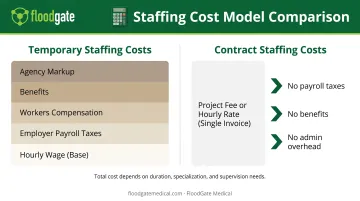
Temporary staffing costs include:
- Hourly wage paid to the worker
- Employer payroll taxes (Social Security, Medicare, federal and state unemployment)
- Workers' compensation insurance
- Any benefits the worker qualifies for (health insurance, paid time off) under company or agency policy
- Staffing agency markup covering recruiting, screening, onboarding, payroll administration, and profit margin
Staffing agencies bear wages, benefits, employment taxes, unemployment insurance, workers' compensation, recruiting, screening, and orientation costs. Because temporary staffing involves high turnover, unemployment-tax costs can be comparatively elevated.
Contract staffing costs include:
- Negotiated project fee or hourly rate
- No employer payroll taxes (contractor pays self-employment tax)
- No benefits, insurance, or unemployment costs
- No recruiting, onboarding, or HR administration burden
Contractors typically charge higher hourly rates than comparable W-2 workers because they cover their own taxes, health insurance, retirement contributions, liability insurance, and business expenses.
Total company cost can still be lower on short, specialized projects when you avoid benefits, employment taxes, and administrative overhead.
Which model costs less depends on duration, specialization, and how much day-to-day supervision you need. A three-month regulatory project may cost less with a contractor who delivers the 510(k) independently. A 12-month laboratory technician role that needs daily direction and team integration often costs less as a W-2 temporary placement.
Hiring Process and Onboarding
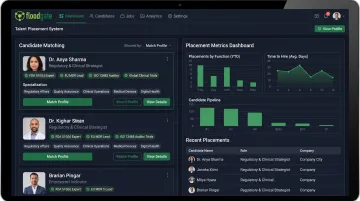
Temporary staffing moves quickly. MedTech-focused staffing firms maintain pre-vetted pools with regulatory knowledge, clinical trial experience, and quality-system familiarity. You define the role, required skills, and start date; the agency presents qualified candidates within days.
Once selected, temporary workers can often start immediately. The agency handles employment paperwork, benefits enrollment, and payroll setup.
Your internal onboarding focuses on role-specific training: facility access, system logins, quality procedures, and team introductions. Because temporary workers operate under your supervision, onboarding mirrors your process for permanent employees.
Contract staffing involves more upfront scoping. You define project deliverables, timelines, required expertise, and success criteria. Proposals are evaluated based on contractor qualifications, approach, timeline, and fee structure. Negotiation centers on scope, milestones, payment terms, and intellectual property ownership rather than employment conditions.
Once contracted, onboarding is minimal. Contractors bring their own tools, processes, and expertise. Your role is to provide access to necessary data, clarify deliverables, and establish communication checkpoints—not to train or supervise daily work.
Benefits of Temporary Staffing for MedTech Companies
Temporary staffing gives MedTech companies flexibility permanent hiring rarely matches. Four advantages show up most often in regulatory, quality, clinical, and commercial teams.
Rapid scalability without long-term commitment
Product launches, clinical trial enrollment surges, and FDA submission deadlines create intense but time-limited staffing needs. Temporary workers let you scale up during peak demand and scale down when projects end, without permanent headcount obligations.
A company facing a six-month 510(k) sprint can add regulatory coordinators and quality documentation specialists right away, then release them once the submission is filed. No severance, unemployment claims, or reorganization costs.
Cost predictability and budget control
Temporary staffing delivers transparent hourly rates with no surprise expenses. You know what each week will cost and can adjust headcount by project phase, regulatory milestone, or budget. That predictability matters during product development, when timelines and funding often shift.
Access to specialized MedTech talent pools
Finding candidates with FDA regulatory experience, ISO 13485 knowledge, or clinical trial coordination skills takes time most internal HR teams do not have. Specialized MedTech staffing firms like FloodGate Medical maintain networks of pre-vetted professionals ready for immediate placement.
Those candidates already understand GxP requirements, quality management systems, and medical device regulations, which cuts ramp-up time and compliance risk. FloodGate Medical places more than 450 MedTech professionals annually, with an 89% one-year retention rate, and curates MVP candidates through its Talent Spotlight Program.
Support for diversity and inclusion initiatives
Diverse teams drive better innovation and healthcare outcomes. Staffing partners committed to equity, diversity, and inclusion help you build teams that reflect the patients your devices serve. FloodGate Medical puts DEI at the center of its recruiting methodology, connecting companies with diverse talent across executive, regulatory, quality, sales, marketing, clinical, and R&D roles.
Benefits of Contract Staffing for MedTech Organizations
Specialized expertise without permanent overhead
Regulatory consultants, biostatisticians, and medical writers command premium salaries as full-time employees, often $150,000 to $250,000 annually plus benefits. Contract staffing lets you engage this expertise for discrete projects without adding permanent headcount.
A regulatory consultant might prepare your 510(k) submission in three months. Hiring that same expert as an employee would cost a full year's salary plus benefits for work that ends when the submission is complete.
Project-based flexibility
MedTech product development rarely follows a straight line. Clinical trials extend, regulatory strategies pivot, and funding timelines shift. Contract staffing aligns talent costs with those project phases.
Engage a biostatistician for statistical analysis plan development, pause during trial enrollment, then re-engage for final analysis and reporting. Pay only for the deliverables you need, when you need them.
Common MedTech contract projects include:
- 510(k), PMA, or De Novo submissions
- CE Mark technical documentation and clinical evaluation reports
- Clinical study design and statistical analysis
- Design verification and validation protocols
- Quality-system gap assessments and remediation
- Medical writing for regulatory dossiers and scientific publications
Reduced administrative burden
Contractors manage their own taxes, insurance, business licenses, and professional development. Your finance team issues payment against invoices tied to deliverables, with no payroll setup, benefits administration, or HR compliance tracking.
That keeps internal teams on core business work while contractors deliver against defined scopes.
How to Choose Between Contract and Temporary Staffing
Assess Your Business Needs and Project Requirements
Start with these questions:
Is this an ongoing operational need or a one-time project?
Ongoing operational work (laboratory testing, clinical trial coordination, regulatory documentation) suggests temporary W-2 staffing. Discrete projects with defined start and end dates, such as a single FDA submission or a clinical study statistical analysis, fit contract arrangements.
Do we need direct supervision and team integration?
Roles requiring daily collaboration, real-time direction, and cultural alignment belong in the W-2 category. If the work demands independence, specialized expertise, and deliverable-focused accountability, contract staffing works better.
What's the expected duration and scope?
Projects under three months with narrow, well-defined deliverables often cost less with contractors. Assignments extending beyond six months that require ongoing supervision, training, and integration typically favor temporary employees.
How specialized is the required expertise?
Highly specialized skills (FDA regulatory strategy, advanced biostatistics, complex medical device design) are often accessible only through independent consultants who command premium rates. Broader operational skills such as clinical coordination, laboratory techniques, and quality documentation are readily available through temporary staffing at lower total cost.
Consider Regulatory and Compliance Factors in Healthcare
MedTech operates under strict regulatory oversight. FDA's Quality Management System Regulation (QMSR), which took effect February 2, 2026, requires finished-device manufacturers to establish and follow quality management systems incorporating ISO 13485:2016.
The QMSR applies to all personnel performing regulated work, with no exemption based on W-2 or 1099 status.
Key compliance considerations:
- Facility access and system training: Temporary W-2 staff onboard into company systems, GxP training, and validated accounts more easily; independent contractors still must meet quality and data-integrity rules
- Quality management accountability: You remain accountable for all work affecting device quality and compliance, whether done by employees or contractors
- Signature authority and regulatory submissions: FDA does not require 510(k) preparers to be employees, but your QMS must define roles, responsibilities, and qualifications for everyone who affects product quality
Roles that need deep QMS integration, ongoing compliance training, and daily facility access (laboratory technicians, quality auditors, clinical coordinators) generally fit temporary W-2 arrangements better.
Specialized consultants delivering independent work products such as regulatory submissions, statistical reports, or design documentation can work well as contractors when you manage them inside your quality system.
Evaluate Control, Integration, and Company Culture Fit
Choose temporary staffing when:
- The role requires daily collaboration with internal teams
- You need to set schedules, assign tasks, and manage work processes
- Cultural alignment and team dynamics matter
- The worker will represent your company to customers, investigators, or regulatory authorities
- Ongoing training, supervision, and performance feedback are necessary
Choose contract staffing when:
- The project has clear, measurable deliverables
- You're buying a work product, not ongoing labor
- The contractor's independence and specialized expertise are priorities
- Team integration is minimal or unnecessary
- You need to avoid the administrative burden of employment
Culture fit matters more for temporary workers who will spend months embedded in your team. Contractors operate at arm's length, focused on delivering results rather than fitting into your organization's social fabric.
Build a Strategic Staffing Approach
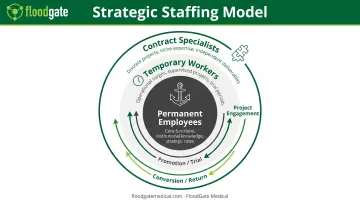
The most effective MedTech talent strategies blend all three staffing types:
- Permanent employees: core functions, institutional knowledge, and long-term strategic roles
- Temporary workers: operational surges, supervised project phases, and trial periods before permanent offers
- Contract specialists: discrete projects that need niche expertise without ongoing supervision
FloodGate Medical supports this blended model with permanent placement, contract staffing, and fractional leadership. Its January 2025 partnership with Talencio expanded contract and fractional capacity so MedTech teams can scale during demand spikes and fill niche project or critical-role gaps.
FloodGate also helps translate growth plans into a hiring roadmap through workforce planning, role definition, and compensation benchmarking, so classification choices stay consistent across the organization.
Document your classification decisions clearly. Maintain written justification for why each role is classified as employee or contractor, referencing the IRS behavioral and financial control factors. Consistent documentation protects you during audits and ensures that managers across your organization apply classification rules uniformly.
Frequently Asked Questions
What's the main difference between temporary and contract staffing?
Temporary workers are W-2 employees (either of your company or a staffing agency) under your direct supervision with set schedules and training. Contract workers are independent 1099 contractors who control their own work methods, schedules, and processes to deliver agreed-upon results.
How much do temporary staffing agencies charge?
Agencies charge for the worker's hourly wage plus employer payroll taxes, benefits, workers' compensation insurance, recruiting, administration, and profit margin. Total cost depends on industry specialization, skill level, assignment duration, and regional market rates. Request detailed quotes to understand the full cost breakdown.
How long can an employee be on a temporary staffing contract?
Temporary contracts typically range from a few weeks to 12 months, depending on business needs and project timelines. No federal law automatically converts temporary workers to permanent employees after a set duration, though some state laws impose pay or benefit requirements after threshold hours worked.
How do temporary workers get paid?
Temporary workers receive hourly wages through the staffing agency (if agency-placed) or directly from your company. Taxes are withheld from each paycheck, and W-2 forms are issued at year-end. Payment frequency follows the employer's standard payroll schedule: weekly, biweekly, or semi-monthly.
Can temporary workers become permanent employees?
Yes. Temp-to-hire arrangements let you evaluate workers for 60 to 180 days before making a permanent offer, confirming skills, culture fit, and performance first. Conversion fees may apply when moving agency-placed workers to direct employment.
When should MedTech companies use temporary vs. contract workers?
Use temporary workers for operational needs requiring direct supervision and team integration: laboratory technicians, clinical trial coordinators, quality documentation specialists. Use contract workers for specialized projects requiring independent expertise: regulatory consultants preparing FDA submissions, biostatisticians analyzing trial data, medical device design engineers developing prototypes.
Ready to build a flexible, compliant staffing strategy for your MedTech organization? FloodGate Medical combines more than 25 years of MedTech recruiting expertise with permanent placement, contract staffing, and strategic workforce planning services.
Whether you need regulatory specialists for a 510(k), temporary lab support during product validation, or help scaling your team, FloodGate delivers pre-vetted MedTech talent and practical workforce guidance.