Clinician burnout keeps climbing, and traditional staffing agencies often can't move fast enough to fill the gaps. That's pushed facility leaders to look beyond the phone tree and toward staffing technology built for real-time coverage.
Healthcare staffing apps get marketed with words like "flexibility" and "efficiency." Those terms sound nice in a sales deck, but they don't mean much on a Tuesday night when a med-surg unit is short two nurses. The real value shows up in fewer canceled shifts, lower overtime spend, and steadier patient care.
This article breaks down how a healthcare staffing app actually helps facilities thrive, day to day, not just in theory.
TL;DR
- Staffing apps connect facilities directly with vetted clinicians for real-time PRN and per diem shifts
- Facilities gain faster shift fill rates, lower staffing costs, and steadier patient coverage
- The biggest gains come from daily, consistent use, not emergency backup during crises
- Apps handle short-term coverage well for per diem and PRN needs
- Permanent or specialized technical roles often still need dedicated recruitment support
What Is a Healthcare Staffing App
A healthcare staffing app is a mobile or web platform where facilities post open shifts and pre-vetted clinicians claim them directly. No phone tree. No waiting on an agency recruiter to call back.
Facilities typically use these platforms for:
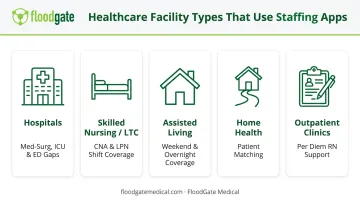
- Hospitals covering med-surg, ICU, or ED gaps
- Skilled nursing and long-term care facilities filling CNA and LPN shifts
- Assisted living communities managing weekend and overnight coverage
- Home health agencies matching clinicians to patient visits
- Outpatient clinics needing per diem RN or allied health support
Facilities don't adopt these platforms for the technology itself. They want consistent patient coverage, controlled labor costs, and a workforce that isn't running on fumes.
Key Advantages of a Healthcare Staffing App
The advantages below tie directly to metrics facilities already track: fill rate, cost per shift, and patient or staff outcomes. Not abstract "innovation" claims. Each advantage also compounds: facilities that treat the app as a core scheduling tool, not a last-resort backup, see the biggest returns.
Faster, More Reliable Shift Fill Rates
When a nurse calls out at 5 a.m., a facility using manual outreach starts working the phone tree: unit manager calls the charge nurse, charge nurse calls per diem staff, most don't answer. Hours pass.
A staffing app flips that process. Open shifts post instantly to a pool of pre-credentialed clinicians who can claim them within minutes. Geo-filtering and specialty matching mean the app only notifies nurses who are qualified, nearby, and available.
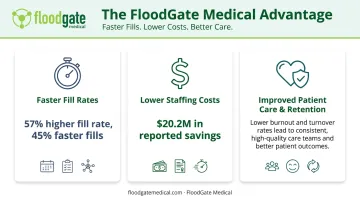
Henry Mayo Newhall Hospital saw this play out directly. After adopting CareRev's Smart Rates technology, the hospital reported a 57% higher fill rate and 45% faster shift fills compared to its prior manual process.
Faster fills matter because unfilled shifts don't just disappear. They get absorbed. Existing staff get pulled into mandatory overtime, or units run short-staffed, both of which raise safety risk. That predictability also lets managers plan schedules with confidence instead of bracing for chaos every weekend.
KPIs this advantage moves:
- Shift fill rate
- Time-to-fill
- Unplanned overtime hours
- Call-out coverage rate
This advantage matters most during flu season, holiday weekends, and night shifts, whenever call-out volume spikes and manager bandwidth is already stretched thin.
Lower Staffing Costs and Reduced Agency Dependency
Traditional agencies charge a markup on top of the clinician's pay rate, sometimes substantial, though the exact percentage varies too much by market and specialty to quote a single number. Staffing apps remove that middle layer. Facilities set their own pay rates and pay clinicians directly, and many platforms handle payroll and timecard approval automatically.
That shift adds up. SSM Health's experience with ShiftMed shows what's possible at scale: the health system filled 71,203 shifts, converted 182 clinicians to permanent roles, and reported $20.2 million in 2025 savings tied to its on-demand staffing program.
Automated scheduling and timecard approval also cut the administrative grind. Managers stop spending hours each week chasing signatures and reconciling agency invoices, time that goes back into unit management instead.
Lower agency spend and lower admin overhead free up budget facilities can redirect toward patient care or retention programs instead of emergency coverage.
KPIs this advantage moves:
- Cost per shift
- Agency spend
- Admin hours spent on scheduling
- Overtime spend
Budget-constrained facilities feel this advantage most, particularly during stretches of heavy per diem use or when scaling coverage across multiple units or locations.
Improved Patient Care Quality and Staff Retention
Skill matching sounds like a back-office detail until it isn't. An app that automatically checks credentials and specialty certifications before a clinician can claim a shift means an ICU opening doesn't get filled by someone whose last ICU rotation was three years ago.
That precision matters because the link between burnout, turnover, and inconsistent patient outcomes is well documented. Research consistently links nurse burnout to a worse patient safety climate, more medication errors, and lower patient satisfaction scores.
Scheduling flexibility addresses part of that burnout equation directly. When clinicians can pick shifts that fit their lives instead of being assigned whatever's left, they report more control over their work-life balance, one of the biggest drivers of intent to stay in a role.
Better matching and more schedule control tend to show up in fewer errors, steadier morale, and stronger continuity of care for patients who see familiar, appropriately skilled staff rather than a rotating cast of mismatched fill-ins.
KPIs this advantage moves:
- Patient satisfaction scores
- Staff turnover rate
- Clinician engagement and burnout indicators
- Incident and error rates
Specialized units like ICU and med-surg feel this advantage most, where precise skill matching isn't optional, along with facilities actively working to bring turnover numbers down.
What Happens When a Staffing App Is Missing or Ignored
Skip the app, and facilities lose real control over staffing, not just convenience.
Common consequences show up fast:
- Inconsistent coverage from relying on manual phone calls and outdated spreadsheets, where open shifts sit unfilled for days
- Heavier reliance on costly last-minute agency or travel staff, often at premium rates negotiated under pressure
- A reactive, firefighting culture where managers spend hours daily just plugging gaps instead of planning ahead
- Rising per-shift and overtime costs that creep up quietly until they show up as a budget problem nobody can explain
- Difficulty scaling per diem programs or handing scheduling tasks to junior staff, since the process depends on institutional knowledge and personal relationships
None of this is hypothetical. It's the default state for facilities still running staffing through group texts and shared spreadsheets, and it's exactly the pattern staffing apps were built to break.
How to Get the Most Value from a Healthcare Staffing App
A staffing app delivers the most value when it's a standing part of the scheduling workflow, not an emergency-only tool pulled out during a crisis. Facilities that treat it as core infrastructure see steadier fill rates than those that only log in when things go wrong.
A few practices separate facilities that get real value from those that don't:
- Review app-generated data weekly, not quarterly. Fill rates, cost trends, and clinician ratings show where posted rates or shift patterns need adjusting.
- Adjust pay rates based on demand, not guesswork. Night and weekend shifts often need a higher rate to fill reliably, and the data shows exactly where.
- Set clear credentialing standards up front so skill matching stays accurate as your per diem pool grows.
- Use the app as your default, not your backup, so managers build habits around it instead of falling back to phone calls under pressure.
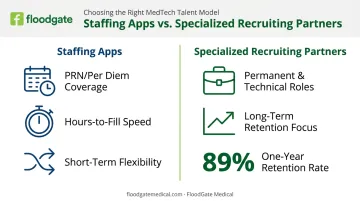
Staffing apps solve short-term PRN and per diem gaps well. But some hiring needs fall outside what any shift-based app is built to handle: permanent roles and specialized clinical technology positions that require long-term investment, not a shift to fill.
Facilities working with advanced interventional or diagnostic technology, for example, sometimes need to fill roles that sit at the intersection of clinical care and device expertise. That's a different hiring problem than covering a Tuesday night shift, and it calls for a different kind of recruiting partner.
This is where firms like FloodGate Medical fit in. FloodGate focuses exclusively on connecting talent with medical device and healthcare technology companies, using a recruiting approach built around long-term retention rather than shift-by-shift coverage.
Its placements carry an 89% one-year retention rate, a very different metric than a fill rate. That gap is a reminder: permanent, specialized hiring usually deserves dedicated recruitment expertise, not an app built for PRN coverage.
Conclusion
A healthcare staffing app earns its real value through the control, predictability, and consistency it brings to facility scheduling. Faster fills, lower costs, and better patient outcomes don't happen from a single emergency login. They compound when a facility uses the app consistently, week after week, as part of how it runs staffing.
That's the shift worth making: treat healthcare staffing technology as an ongoing operational practice, not a stopgap, and pair it with sound scheduling policy and, where specialized roles demand it, dedicated recruitment expertise. Facilities that make this shift move from reacting to staffing emergencies to running a workforce strategy resilient enough to handle them before they escalate.
Frequently Asked Questions
What healthcare staffing app lets nurses pick up shifts?
Platforms like ShiftMed, ShiftKey, IntelyCare, Nursa, and CareRev all let nurses browse open shifts by location, specialty, and pay rate. Clinicians claim shifts directly in the app once they're credentialed on the platform.
How much does a healthcare staffing app cost for facilities?
Pricing models vary. Some charge per-shift fees or a percentage markup, while others use subscription pricing. Compare the total cost against what you're currently paying in agency markups before choosing a platform.
Are healthcare staffing apps safe and compliant with regulations?
Reputable apps verify licenses, run background checks, and maintain HIPAA-compliant data handling. Still, confirm each platform's specific compliance credentials before onboarding, since standards vary by state and facility type.
Can healthcare staffing apps fully replace traditional staffing agencies?
Apps handle short-term PRN and per diem needs well, but many facilities still use agencies or specialized recruiters for hard-to-fill permanent or highly technical roles.
What's the difference between W-2 and 1099 clinicians on staffing apps?
W-2 clinicians are employees of the platform, with taxes withheld and sometimes benefits included. 1099 clinicians work as independent contractors and handle their own taxes.
How quickly can a facility fill an open shift using a staffing app?
Many apps fill shifts within hours, sometimes minutes, of posting. That's a sharp contrast to the days it can take through manual phone outreach.