Many aspiring forensic professionals mix up "medical examiner" with "coroner" or "crime scene investigator." The roles are not interchangeable. A medical examiner is a licensed physician who has completed years of specialized medical training, not an elected official or a scene technician.
This guide breaks down what medical examiners actually do day to day, the skills the job demands, the education path required, and what the role pays in today's market.
Key Takeaways
- Medical examiners are licensed physicians who investigate unexplained deaths and certify cause of death
- The full training path runs 12 to 13 years past high school, sometimes longer
- National salary data places pay between roughly $74,220 and $270,560+ annually
- The U.S. faces a documented shortage of board-certified forensic pathologists
- Roughly 46% of states use medical examiner systems rather than coroners
What Does a Medical Examiner Do?
A medical examiner is a licensed physician, typically board-certified in forensic pathology, who investigates deaths that are unexplained, violent, or suspicious. Their central task is determining and legally certifying the cause and manner of death.
Core Duties and Responsibilities
The job centers on the autopsy, but the paperwork and courtroom work matter just as much. Daily responsibilities include:
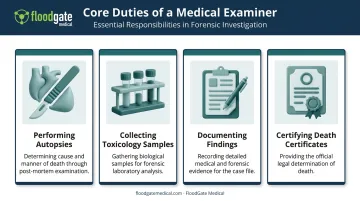
- Performing autopsies to examine organs, tissues, and wounds for signs of trauma or disease
- Collecting toxicology samples and ordering histology, radiology, or microbiology testing when the cause isn't obvious on the table
- Documenting findings in detailed reports that become permanent legal records
- Certifying death certificates, including whether the death was natural, accidental, homicide, suicide, or undetermined
Medical examiners also support active criminal investigations. That can mean visiting a crime scene, maintaining strict chain-of-custody documentation for evidence, and later testifying in court as an expert witness on wound patterns, toxicology results, or time of death.
There's an administrative layer too, one that rarely makes it into TV portrayals of the job. Examiners help maintain death records, oversee lab supplies and autopsy equipment, and coordinate closely with police departments, funeral homes, and public health agencies.
The National Association of Medical Examiners' 2020 autopsy standards require this kind of careful record-keeping so evidence handling holds up if a case ends up in court.
Where Medical Examiners Work
Most medical examiners work out of county, city, or statewide ME offices rather than hospitals. Some offices are affiliated with academic medical centers and host fellowship training programs alongside their casework.
A standard schedule usually runs a 40-hour week, Monday through Friday. But death doesn't keep office hours. Because bodies can arrive at any time, physicians typically rotate through on-call coverage for evenings, weekends, and holidays. Dedicated investigators often staff the office around the clock, receiving reports and dispatching to scenes.
Medical Examiner vs. Coroner: Key Differences
This is where the confusion usually starts. A medical examiner is an appointed physician with medical and pathology training. A coroner, in many jurisdictions, is an elected official who may have no medical background at all.
State law decides which system applies, and the split is real. A peer-reviewed 2024 analysis of the national census of death investigation offices found:
| System Type | Share of States |
|---|---|
| Medical examiner (state or local) | ~46% |
| Coroner | ~26% |
| Mixed | ~28% |
That means nearly a quarter of the country still relies on elected coroners for death investigation, a fact that surprises most people outside the field.
Essential Skills and Qualities for Success
Technical knowledge gets you through medical school. It's not what gets you through your first year on the job.
Medical examiners need sharp analytical skills to piece together scene evidence, medical history, and lab results into a coherent conclusion. But the softer skills matter just as much:
- Communication: writing reports precise enough for a jury and testifying clearly under cross-examination
- Emotional resilience: delivering difficult news to families while staying objective on the case
- Composure under pressure: working a decomposed body or a child's death without losing focus
- Attention to detail: a missed detail in an autopsy can change a legal outcome
- Independent judgment paired with teamwork: collaborating with toxicologists, police, and forensic scientists while reaching conclusions free of outside pressure
Objectivity is non-negotiable here. The National Association of Medical Examiners (NAME) standards explicitly call for investigations to stay medically independent from law enforcement, even while working alongside it.
Education, Training and Certification Requirements
Becoming a medical examiner takes longer than almost any other path in medicine. Here's the full sequence:
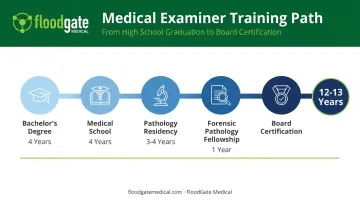
- Bachelor's degree (4 years) : biology, chemistry, or a related science, plus a competitive GPA and MCAT score for medical school admission
- Medical school (4 years) : earning an MD or DO from an accredited program
That's eight years before residency even starts.
Residency and Fellowship Training
After medical school, candidates complete an anatomic and clinical pathology (AP/CP) residency, which runs 3 to 4 years depending on the track. This is where they build the foundational pathology skills (reading tissue under a microscope, understanding disease processes) that later support forensic work.
Next comes a one-year forensic pathology fellowship, accredited through ACGME. This is the specialized training that actually teaches death investigation: courtroom testimony, gunshot wound analysis, toxicology interpretation, and scene work.
Board Certification
The final step is board certification through the American Board of Pathology. Candidates need a qualifying medical degree, completed accredited residency and fellowship training, and a full, unrestricted medical license before they can practice independently as a medical examiner.
Total timeline: Adding it up, most candidates spend 12 to 13 years past high school before they're fully certified. Longer residency tracks or research years can push that closer to 18.
Requirements aren't uniform everywhere, though. Some smaller or rural jurisdictions have looser qualification standards for the "medical examiner" title, and offices serving populations of 45,000 or fewer often struggle to attract fully fellowship-trained staff.
A 2024 peer-reviewed analysis of national office data documented exactly this kind of resource gap between large and small jurisdictions.
Medical Examiner Salary and Job Outlook
Pay varies more than you'd expect for a role requiring this much training.
The Bureau of Labor Statistics tracks "Physicians, Pathologists" as the closest national category to forensic pathology, and this classification explicitly includes medical examiners. As of May 2023 BLS wage data, the national mean sits at $270,560 per year, with:
- 10th percentile: $74,220
- 25th percentile: $181,090
- Median: $239,200+
Where you work shapes the number:
- Local government offices: $213,290 average
- State government offices: $217,810 average
- Medical/diagnostic laboratories: $297,330 average
- Physicians' offices: $285,530 average
Experience, jurisdiction size, and whether you're working county, state, or federal level all factor in too. A chief medical examiner overseeing a statewide office typically earns more than an entry-level associate examiner in a small county.
The bigger story here is scarcity. A recent STAT investigation put the number of practicing U.S. forensic pathologists at roughly 850, about 400 short of what the system actually needs. That shortage translates directly into job security for anyone entering the field, but it also means overworked offices and families waiting months, sometimes years, for final autopsy answers.
How to Become a Medical Examiner: Step-by-Step Career Path
If you're mapping this out from scratch, here's the sequence:
- Earn a bachelor's degree in biology, chemistry, or another science-heavy major, and keep your GPA competitive for medical school admissions.
- Complete medical school and earn an MD or DO degree over four years.
- Finish a pathology residency, then a one-year forensic pathology fellowship, for the specialized training death investigation requires.
- Obtain board certification through the American Board of Pathology, along with any state-specific medical licensure.
- Apply for open positions at county, state, or federal medical examiner offices.
That final step is often underestimated. Job openings in forensic pathology are limited and geographically scattered, so knowing how to search, negotiate, and position yourself matters.
A specialized recruiter can sharpen that search. Typical support includes:
- Resume coaching tailored to medical career transitions
- Interview preparation for hiring committees and panels
- Negotiation guidance on salary, benefits, and relocation
FloodGate Medical's core placement work centers on MedTech companies, but the same resume and interview coaching it offers job seekers applies just as well to a forensic pathology search.
Frequently Asked Questions
How do medical examiners determine the cause of death?
They combine autopsy findings with tissue and fluid analysis, toxicology screening, and a review of the decedent's medical history and case circumstances. Together, these sources point to a specific medical cause and legal manner of death.
What is the difference between a medical examiner and a coroner?
Medical examiners are appointed physicians with pathology training, while coroners are frequently elected officials without a medical background. Which system applies depends entirely on state law.
How long does it take to become a medical examiner?
The full path runs about 12 to 13 years after high school: a bachelor's degree, medical school, a pathology residency, and a forensic pathology fellowship. Extended residency tracks can push that timeline closer to 18 years.
What is the average salary for a medical examiner?
National data places pay between roughly $74,220 and $270,560+ per year, depending on experience, jurisdiction, and employment setting. Government offices tend to pay less than private labs or physician group practices.
What skills are most important for a medical examiner?
Analytical thinking and precise written communication top the list, alongside unwavering attention to detail. Emotional resilience matters just as much when working with grieving families and difficult cases.
Is there a shortage of medical examiners in the United States?
Yes. Estimates put the number of practicing forensic pathologists around 850, roughly 400 fewer than the field needs. This shortage contributes to longer case backlogs and delayed answers for families and investigators alike.