

Introduction
MedTech companies face a recurring challenge: securing specialized talent quickly for FDA submissions, clinical trials, or product launches without committing to permanent headcount. Regulatory clocks tick regardless of internal capacity.
CDRH received 21,780 medical-device submissions in 2025, with strict review timelines: 95% of 510(k)s decided within 90 FDA Days and 90% of PMAs without advisory input within 180 FDA Days. Missing those windows can delay revenue by months.
Staff augmentation consulting offers a flexible way to fill these time-bound, high-stakes gaps. This guide clarifies what staff augmentation is, how it differs from staffing, outsourcing, and consulting, and when MedTech organizations should deploy it. Whether you're bridging a regulatory capacity gap or scaling for a launch, understanding this model will help you move faster without sacrificing control.
Key Takeaways
- Staff augmentation integrates external specialists into your team while you retain full direction over their work.
- Faster than permanent hiring, more control than outsourcing, and flexible enough to scale up or down.
- MedTech teams gain the most during FDA crunches, product launches, and niche regulatory, clinical, or quality gaps.
- A partner with deep MedTech expertise and a proven talent network matters as much as the model itself.
What Is Staff Augmentation Consulting?
Staff augmentation consulting is a hiring model in which a specialized firm supplies pre-vetted external professionals who join your team and work under your direct management. You own the work, the process, and the priorities. The augmented talent brings the specific skill or capacity you need for a defined period.
Core mechanics:
- Client control: You assign tasks, set deadlines, and oversee day-to-day work
- Skill targeting: The partner sources professionals with the exact expertise you lack, such as regulatory affairs, quality assurance, or clinical research
- Flexible engagement: You scale the arrangement up, down, or off as project demands change
- Integration: The professional operates inside your existing team structure, attending stand-ups, using your tools, and following your processes
This differs from a fully outsourced project team, where a vendor owns delivery and you receive a finished work product. With augmentation, the professional is embedded in your workflow.
Market Context
The broader life-sciences staffing market is substantial. Twenty-five firms generated $2.5 billion in combined US life-sciences staffing revenue in 2024, representing 77% of the estimated market. That figure covers diagnostics, pharma, biotech, and MedTech, reflecting sustained demand for flexible talent across healthcare technology.
MedTech Example
A Class II implantable device company receives a 90-day FDA clock on a 510(k) substantial equivalence determination. Its single regulatory affairs manager is already handling two other submissions. Hiring a full-time RA specialist can take 8–12 weeks, so the company brings in a contract regulatory affairs professional with 510(k) experience instead.
The contractor prepares the response under the manager's direction, meets the deadline, and disengages when the submission clears.
Staff Augmentation vs. Staffing, Outsourcing, and Consulting
Staff augmentation gives you direct control and flexible capacity while targeting specific skills. Knowing how it differs from staffing, outsourcing, and consulting helps you choose the right model.
Staff Augmentation vs. Temporary Staffing
Temporary staffing places staffing-firm employees at your site to cover absences, seasonal volume, or general short-term needs. The staffing agency handles recruiting, hiring, pay, benefits, and taxes. You supervise the worker's daily tasks and provide site safety, but the employment relationship remains with the agency.
Staff augmentation is more targeted. You're not filling a general labor gap. You're acquiring a specific skill set for a defined project or deadline. The professional integrates into your team structure and works alongside permanent staff, rather than functioning as a temporary fill-in.
Staff Augmentation vs. Outsourcing
Outsourcing transfers responsibility for a process, function, or service to an external supplier. The vendor assumes delivery accountability, manages the work, and often provides the result as a finished product. You define requirements and measure outcomes, but you don't direct the vendor's internal operations.
With staff augmentation, you retain process ownership. The contractor works under your management, follows your SOPs, and contributes to a deliverable you own. There's no handoff, just additional capacity inside your existing workflow.
Staff Augmentation vs. Consulting
Consulting engagements focus on delivering advice, strategy, or a defined work product. A Statement of Work (SOW) typically outlines activities, deliverables, and project timing, with payment structured as fixed-price, milestone-based, or capped time-and-materials. The consultant brings judgment, frameworks, and recommendations, not ongoing execution capacity.
Staff augmentation brings execution capacity. You're hiring hands and expertise to do the work, not to tell you how to do it. The professional may offer tactical input, but their primary role is to execute tasks you assign.
Comparison Table
| Model | Control & Accountability | Cost Structure | Best Use |
|---|---|---|---|
| Staff Augmentation | Client directs work; contractor executes under client management | Typically billed by time worked; flexible duration | Filling niche skill gaps, meeting project deadlines, scaling quickly |
| Temporary Staffing | Agency employs; client supervises daily work; shared obligations | Hourly or weekly billing | Covering absences, seasonal volume, general short-term roles |
| Outsourcing | Vendor owns service delivery; client owns vendor relationship | Varies (transformation or efficiency-driven pricing) | Transferring entire functions (payroll, IT support, manufacturing) |
| SOW Consulting | Contractor owns deliverable; accountability tied to milestones | Fixed-price, milestone, or capped time-and-materials | Strategy, audits, defined projects, advisory work |
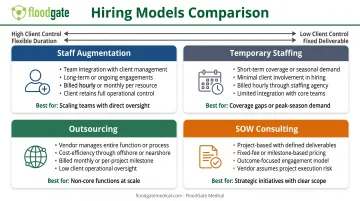
Many companies blend models. You might outsource manufacturing while augmenting your regulatory team and consulting on market-access strategy. The key is matching the model to the level of control, duration, and type of work you need.
When MedTech Companies Should Consider Staff Augmentation
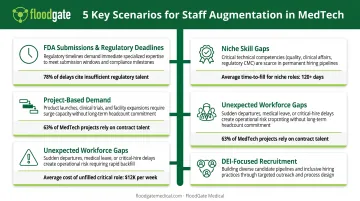
Staff augmentation makes the most sense when you need specialized expertise fast, for a defined period, without permanent-hire overhead or timelines. Here are the scenarios where it delivers the highest value.
Scaling for FDA Submissions and Regulatory Deadlines
MDUFA V performance goals target 95% of 510(k)s within 90 FDA Days and 90% of PMAs without advisory input within 180 FDA Days. Pre-Submission feedback is expected within 70 calendar days. These are fixed clocks. Your internal capacity doesn't change the timeline.
If your regulatory affairs or quality assurance team is already stretched across multiple submissions, augmenting with a contractor who has FDA submission experience lets you meet deadlines without sacrificing quality or burning out your core staff.
Filling Niche Skill Gaps
MedTech roles like regulatory affairs specialists, clinical research associates, biostatisticians, and quality engineers require domain-specific knowledge. Permanent candidates are scarce, and searches can take months. Staff augmentation gives you immediate access to professionals with the exact certification, therapeutic area experience, or regulatory pathway expertise you need—without waiting for a full hiring cycle.
Example: A startup preparing its first De Novo submission needs someone who has navigated the pathway before. A contract regulatory specialist with De Novo experience can guide the submission, train internal staff, and roll off once the device is authorized.
Managing Project-Based or Seasonal Demand
Clinical trials have enrollment waves. Product launches require territory build-outs. Audits and inspections demand surge capacity in quality and compliance. These are predictable, time-bound spikes.
Staff augmentation lets you scale capacity up during the surge and down when demand normalizes, avoiding the cost and disruption of layoffs or the risk of understaffing during critical windows.
Bridging Unexpected Workforce Gaps
Key technical or compliance staff leave. A VP of Quality departs mid-audit. Your lead clinical research associate accepts another role three months before trial close-out. These departures create immediate risk.
Interim or fractional professionals can step in within days, maintain continuity, and give you time to conduct a thorough permanent search without compromising timelines or compliance.
Strengthening Outcomes Through DEI-Focused Recruitment
Diversity, equity, and inclusion are strategic advantages in hiring outcomes. Research has shown that top-quartile ethnic and racial management diversity is associated with a 35% greater likelihood of above-industry-mean financial returns, while top-quartile gender diversity correlates with 15%.
Diverse teams bring broader perspectives, challenge assumptions, and often solve problems more effectively. In MedTech, where Black leadership representation sits at just 3.2%, intentional DEI practices also widen the talent pool.
What strong DEI-focused augmentation tends to improve:
- Access to qualified candidates outside traditional networks
- Faster shortlists without narrowing for sameness
- Better problem-solving mix on regulatory, clinical, and quality workstreams
- Stronger team fit when cultural alignment is screened up front
Partners with deep MedTech networks and DEI-driven sourcing—such as FloodGate Medical, which treats equity, diversity, and inclusion as core recruitment values—can surface professionals you might miss through usual channels. In augmentation, speed and fit both matter; diverse slates help you fill roles quickly without weakening team performance.
Key Benefits and Risks to Weigh
Benefits
Speed to deployment: Contract professionals can start within days or weeks, compared to 8–12 weeks for permanent hires. When you're facing an FDA clock or a launch date, that speed is the difference between meeting the deadline and missing the window.
Cost efficiency: You pay only for the time and skill you need. No benefits, no long-term salary commitment, no severance if the project ends early. That model fits niche expertise you only need intermittently. A premium rate for three months often costs less than carrying a permanent salary for a skill you use twice a year.
Access to specialized MedTech talent: Top-tier regulatory, clinical, and quality professionals often work as independent contractors or through specialized firms, preferring project variety over permanent roles. Augmentation gives you access to talent you couldn't hire full-time.
Risks
Internal management burden: You own the work, which means you also own onboarding, task assignment, and performance management. If your team is already stretched, adding a contractor without clear ownership can create confusion rather than relief.
Knowledge-transfer gaps: Contractors leave when the project ends. If you don't build in documentation, cross-training, or knowledge handoff, critical expertise walks out the door. Plan for knowledge capture from day one.
Misclassification concerns: The IRS requires assessment of behavioral control, financial control, and the type of relationship when determining worker classification. Misclassifying an employee as a contractor can trigger employment-tax liability.
The contract label does not control the outcome; the actual working relationship does. If you direct how the work is performed, set the schedule, and provide the tools, the IRS may treat the worker as an employee anyway.
The DOL has proposed a new independent-contractor test focused on worker control and opportunity for profit or loss. It is still proposed, not final. Review both tax and FLSA status with legal counsel before engaging contractors, especially in long-term or highly integrated roles.
Best practice: Use a staffing partner that runs payroll, benefits, and compliance. That path lowers classification risk and takes the admin load off your internal team.

How to Choose the Right Staff Augmentation Partner
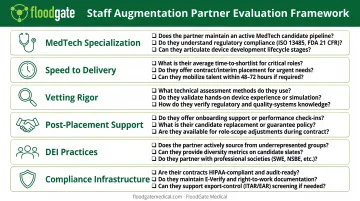
Not all staffing firms understand MedTech. Regulatory pathways, quality systems, clinical trial protocols, and FDA compliance are specialized domains. A generalist recruiter won't know the difference between a 510(k) and a PMA, let alone spot a candidate who has navigated both.
Prioritize MedTech Specialization
Look for a firm with deep healthcare technology expertise. Ask:
- How many MedTech placements have you completed in the past 12 months?
- Do you recruit for regulatory, clinical, and quality roles specifically?
- Can you provide references from MedTech companies in similar stages (startup, growth, or enterprise)?
A partner with a MedTech-focused network will source faster and deliver candidates who understand your regulatory environment, compliance obligations, and product development timelines.
Evaluate Speed, Vetting, and Support
Press on three operational areas before you sign:
- Speed — How quickly can they deliver a shortlist? Days matter when you're on an FDA clock.
- Vetting rigor — What screening, assessments, and interviews do they run? Do they verify certifications, check references, and gauge cultural fit?
- Post-placement support — Do they check in after start, troubleshoot issues, and replace the contractor if the fit isn't right?
Look for Diversity and Cultural Alignment
Prioritize partners who build diverse candidate slates and match on values, not only skills. Those hires tend to integrate faster and strengthen team culture over time.
FloodGate Medical is one example of a MedTech-only firm built around DEI-driven recruiting. With a network of more than 150,000 MedTech candidates, the team places 450+ professionals a year and reports an 89% one-year retention rate—useful proof points when you weigh speed against long-term fit.
Additional Selection Criteria
- Industry specialization and client references
- Recruiting methods, candidate databases, and skills testing
- Background checks, drug-testing practices, and compliance support
- After-hours emergency access and workforce-planning assistance
- Account executive stability and responsiveness
Request a site visit or detailed presentation for major engagements. Strong partners invest time upfront to learn your culture, team dynamics, and long-term goals. They do more than fill an open req.
Frequently Asked Questions
What is staff augmentation in consulting?
Staff augmentation is a hiring model in which external skilled professionals join your existing team and work under your direction, delivering execution capacity rather than advisory recommendations. Unlike traditional consulting, you retain full control over the work and process.
Can you provide an example of staff augmentation?
A MedTech company preparing a 510(k) submission brings in a contract regulatory affairs specialist for the four-month submission window. The specialist works alongside the internal RA manager, prepares the filing under the manager's direction, and disengages once FDA clearance is received.
What is the difference between staffing and staff augmentation?
Temporary staffing fills general labor gaps with agency-employed workers for absences or seasonal volume. Staff augmentation targets specific skill shortages, integrating specialized professionals into your team structure for defined projects or deadlines under your management.
Is staff augmentation considered outsourcing?
No. Staff augmentation keeps process ownership and day-to-day management in-house—you direct the work. Outsourcing transfers service-delivery responsibility to a vendor, who manages the process and delivers a finished result. Augmentation adds capacity; outsourcing shifts accountability.