
Introduction
A patient can wait months for a specialist appointment. A hospital across town treats the same diagnosis with wildly different costs and outcomes. Medical breakthroughs sit in journals for years before reaching everyday practice.
These are systemic delivery failures, not gaps in medical science, and they cost billions each year.
Federal agencies spent roughly $2.5 billion on health services research in FY2017, just 0.3% of total U.S. health-care spending (National Academies Press). That's a tiny sliver dedicated to answering a massive question: how do we get good care to the people who need it?
Health services research (HSR) is the field built to answer that question. It studies how care is organized, financed, accessed, and delivered, not how diseases work at the cellular level.
This article breaks down what HSR is, the methods researchers use, the policy changes it's produced, and where the career paths lead.
Key Takeaways
- HSR studies access, cost, quality, and outcomes of care, not disease biology
- It's distinct from clinical research, which tests whether treatments work in trials
- Common methods span claims data analysis, comparative effectiveness research, and mixed-methods designs
- Medicare's DRG payment system and national quality measurement standards trace back to HSR findings
- Demand for HSR-trained talent is growing across government, academia, and MedTech roles
What Is Health Services Research? Definition & Scope
The Institute of Medicine defined HSR back in 1979 as inquiry that produces knowledge about "the structure, processes, or effects of personal health services" (1979 National Academies report). That definition still holds up.
In practice, HSR examines how financing, organizational structure, social factors, and human behavior affect access, quality, cost, and health outcomes. It draws on economics, epidemiology, biostatistics, sociology, and political science.
The field didn't emerge in a vacuum. As federal investment in health programs grew through the 1960s, President Johnson proposed a National Center for Health Services Research and Development in 1967. It was established within the Public Health Service the following year.
That early investment helped shape a research agenda that keeps expanding. HSR's scope is genuinely wide, covering:
- One-on-one patient-provider interactions and communication
- Hospital and clinic operational decisions
- Insurance design and reimbursement structures
- State and federal health policy
Who Contributes to the Field
HSR pulls talent from multiple disciplines, each bringing a distinct lens:
- Biostatistics: designs and analyzes large-scale health data
- Economics: models cost, incentives, and resource allocation
- Epidemiology: tracks disease patterns across populations
- Sociology: examines how social factors shape health behavior
- Political science: analyzes policy formation and implementation
- Nursing and health policy: connects frontline care delivery to systemic change
How HSR Differs From Biomedical Research
Here's the clearest way to separate the two: biomedical and clinical research develop and test treatments. HSR studies whether those treatments actually reach patients, and what happens when they do.
A clinical trial might prove a drug reduces heart attack risk by 30%. HSR asks a different question: are low-income patients getting prescribed that drug at the same rate as everyone else? If not, why?
Why Health Services Research Matters: Goals & Real-World Impact
HSR organizes its work around six quality domains the IOM outlined in Crossing the Quality Chasm (AHRQ). Care should be:
- Safe — free from preventable harm
- Effective — grounded in reliable evidence
- Patient-centered — responsive to individual needs and values
- Timely — delivered without harmful delays
- Efficient — free of waste in resources and time
- Equitable — consistent regardless of patient characteristics
The field's core goal is straightforward: figure out the most effective ways to organize, finance, and deliver care while cutting down on medical errors.
A Case Study in Policy Change
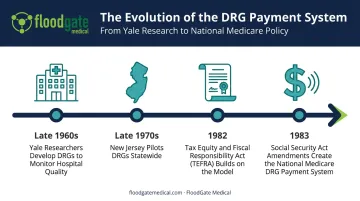
One of the clearest examples of HSR reshaping national policy is diagnosis-related groups (DRGs). Yale researchers began developing DRGs in the late 1960s to monitor hospital quality and connect case mix to resource use.
New Jersey tested the approach at scale in the late 1970s. Congress built on that work through the 1982 Tax Equity and Fiscal Responsibility Act, and by 1983, Social Security Act amendments created a national DRG-based Medicare hospital payment system.
That's HSR moving from a hospital-monitoring tool to the backbone of how Medicare pays hospitals today.
The Evidence-Practice Gap
Even with strong research, getting evidence into practice remains hard. A landmark study led by McGlynn and colleagues found that U.S. adults received just 54.9% of recommended care across 439 quality indicators in 12 metropolitan areas (NEJM). That's a historical benchmark, not a current figure, but it illustrates why implementation research exists: closing the gap between what studies prove and what patients actually receive.
Where Federal Priorities Sit Now
Comparative effectiveness research (CER) became a major federal priority after 2009, when the American Recovery and Reinvestment Act allocated $1.1 billion for CER, split among NIH, AHRQ, and the HHS Secretary's office (NIH). Health equity research has followed a similar trajectory, becoming a defining priority area for the field.
Methods & Approaches Used in Health Services Research
HSR operates at three levels, and understanding them clarifies what kind of question a given study is actually answering.
- Macro level: health systems and national policy, such as evaluating how a Medicaid expansion affects statewide coverage rates
- Meso level: organizations and interventions, such as testing whether a new care coordination program reduces hospital readmissions
- Micro level: individual patient-provider decisions, such as studying how shared decision-making tools affect treatment choices
Quantitative and Qualitative Methods
The level a study targets also shapes its toolkit. Researchers mix quantitative and qualitative methods depending on the specific question:
- Quantitative tools: claims data analysis, econometrics, statistical modeling, regression analysis
- Qualitative tools: structured interviews, ethnographic observation, case studies
Neither approach works alone for complex systems questions. A researcher might run statistical models on claims data, then interview clinicians to understand why the numbers look the way they do. This mixed-methods approach shows up throughout HSR: a hospital readmission study might pair regression analysis of insurance claims with focus groups exploring discharge-planning gaps, capturing both the scale of a problem and the reasons behind it.
Key Data Sources
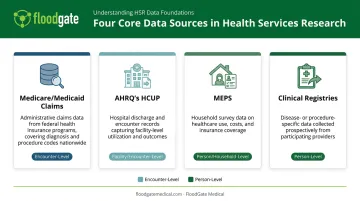
Most HSR studies lean on a handful of major datasets:
| Data Source | What It Covers |
|---|---|
| Medicare/Medicaid claims | Billing and utilization records tied to specific patients and providers |
| AHRQ's HCUP | The largest longitudinal U.S. hospital-care database, covering inpatient stays, ER visits, and ambulatory surgery |
| MEPS | National survey on how Americans use and pay for care, including insurance and out-of-pocket costs |
| Clinical registries | Condition-specific patient tracking, often used for outcomes comparisons |
HCUP works at the encounter and facility level. MEPS works at the person and household level. Researchers choose (or link) between them depending on whether the unit of analysis is a hospital visit or a person's overall spending pattern.
Framing the Question
HSR questions generally fall into two buckets. Evaluative or normative questions ask what works, such as which treatment protocol produces better outcomes. Exploratory or explanatory questions ask why, such as why uptake of a proven intervention varies by region.
Comparative effectiveness research sits squarely in the evaluative camp, comparing real-world interventions across diverse patient populations rather than the controlled conditions of a clinical trial.
Emerging tools are pushing the field further. Implementation science frameworks help researchers study how to get evidence adopted, not just whether it works. Health informatics tools now support real-time clinical decision support, feeding HSR findings directly into the point of care.
Types of Research in Healthcare: Where HSR Fits
Healthcare research spans a spectrum, from basic biology to how care actually gets delivered. Knowing where each type sits clarifies what HSR contributes.
| Research Type | Core Question |
|---|---|
| Basic/biomedical | What biological or disease mechanisms are at play? |
| Clinical | Does this treatment work in human subjects? |
| Translational | How do discoveries move from the lab toward patient benefit? |
| Implementation | What methods drive adoption of evidence-based practices? |
| Health services research | How do financing, access, and delivery affect outcomes? |
Translational and implementation research act as bridges. They move discoveries from biomedical research into everyday clinical practice, and HSR is often the field evaluating whether that transition actually worked.
Adjacent fields overlap heavily with HSR:
- Health economics shares its focus on cost and financing
- Epidemiology shares its population-level analytical methods
- Public health research shares its concern with access and equity
The lines blur, and that's fine. What matters is that HSR's defining focus stays on the delivery system itself, not the drug, device, or disease mechanism.
Who Conducts Health Services Research? Careers, Workforce & Talent Trends
HSR's workforce doesn't come from one training pipeline. Most researchers arrive from another primary discipline, then apply it to health services questions.
AcademyHealth data on its participant base (2016-2020) found a mix of 21.8% PhD or equivalent, 8.2% MPH, 6.5% MD or equivalent, 5.5% MA/MS, and 2.6% nursing degrees, though degree information was missing for roughly 30% of the sample. This partial snapshot still confirms the field's interdisciplinary reality.
Where HSR Professionals Work
- Federal agencies: AHRQ, CDC, CMS, and the VA all fund or conduct HSR directly
- Academic medical centers: universities running large-scale outcomes studies
- Private research firms: organizations like RAND and Mathematica
- Health systems and insurers: internal analytics and quality teams
- Health technology companies: data and outcomes roles supporting product evidence
A Growing Demand Signal
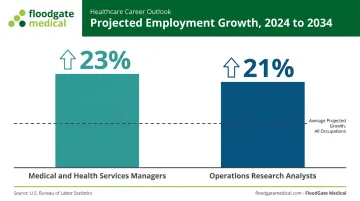
Direct HSR employment data is limited, but adjacent occupations point toward real growth. The Bureau of Labor Statistics projects 23% growth for medical and health services managers and 21% growth for operations research analysts between 2024 and 2034. These aren't HSR-specific forecasts, but they signal rising demand for the analytical and management skills HSR training builds.
That demand is showing up inside MedTech specifically. As device manufacturers and health technology firms build out pharmacoeconomics, quality measurement, and health data functions, they need talent that understands both clinical context and delivery-system evidence.
Recruitment firms specializing in MedTech, including FloodGate Medical, help these companies connect with skilled professionals for roles spanning clinical affairs, quality, regulatory, and data-driven functions. Their hiring approach is grounded in equity, diversity, and inclusion.
Frequently Asked Questions
What is health services research?
Health services research is a multidisciplinary field studying access, cost, quality, and delivery of healthcare. Its goal is improving outcomes for individuals and populations rather than testing biological treatment mechanisms.
What types of research are there in healthcare?
Healthcare research falls into four categories: basic/biomedical (disease mechanisms), clinical (treatment testing), translational (applying discoveries into practice), and health services research (delivery, access, and outcomes).
How is health services research different from clinical research?
Clinical research tests whether a treatment works, usually through controlled trials. HSR studies how that treatment gets delivered, financed, and accessed once it reaches real-world healthcare settings.
What methods do health services researchers use?
Researchers combine quantitative methods, such as claims data analysis and statistical modeling, with qualitative approaches like interviews and case studies. The mix depends on whether the question is about what works or why.
What careers are available in health services research?
Common paths include roles at federal agencies (AHRQ, CMS, VA), academic institutions, private research firms like RAND, and increasingly within MedTech and health technology companies working on outcomes and quality data.
Who funds health services research?
Major funders include AHRQ, NIH, CDC, CMS, and the VA at the federal level, alongside private foundations such as the Robert Wood Johnson Foundation and the Commonwealth Fund.