That demand curve is why so many entrepreneurs are looking at medical staffing agencies right now. The appeal is obvious: recurring, non-discretionary demand, the ability to run a lean operation remotely, and multiple niches to choose from, including travel nursing, per diem, allied health, and locum tenens.
Interest is coming from former recruiters, healthcare professionals ready to build something of their own, and staffing entrepreneurs expanding into the medical vertical. Wherever you're starting from, this guide walks through how to actually write the business plan document, step by step.
TL;DR
- A medical staffing agency business plan maps your operating model, pricing, and financial roadmap upfront
- Nail down legal structure, state licensing, startup costs, and realistic margins first
- The plan comes together across 7-8 core sections, from executive summary to financial projections
- Most agencies need several months of runway before they're fully operational and profitable
What Is a Medical Staffing Agency Business Plan?
A medical staffing agency business plan is a structured document that outlines how you'll source, place, and bill healthcare professionals, (nurses, allied health staff, or physicians) with client facilities.
Skip the mission statement or brand story. Focus on an operating and financial roadmap that answers specific questions: who you're placing, where, at what rates, and how the money flows.
Common formats vary by focus:
- By placement type: travel, per diem, or permanent placement (or a mix)
- By specialty: single-niche (say, allied health only) versus multi-specialty
- By structure: solo-owner operation versus a team-based agency with dedicated recruiters
Why You Need a Business Plan Before You Start
Writing the plan forces clarity on three things that make or break a staffing agency: demand, pricing, and cash flow. Skip this step and you're guessing with other people's payroll.
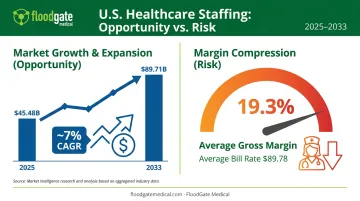
The demand case is real, but sizing it takes care. Estimates for the U.S. healthcare staffing market vary widely depending on definition and scope. Grand View Research pegs the market at $45.48 billion in 2025, projecting growth to $89.71 billion by 2033 at a compound annual growth rate near 7%.
Other trackers report smaller figures because they define "healthcare staffing" more narrowly, so cite your source and avoid blending numbers from different reports.
Margins are tighter than most first-time owners expect. The 2025 SIA-NATHO benchmarking survey found average travel-nurse bill rates fell to $89.78, with aggregate gross margin dropping to 19.3%. That's before overhead, meaning your real operating margin is thinner still. Protecting that margin starts with choosing where you compete.
Niche focus beats generalist positioning
Agencies with a clear specialty tend to out-compete generalist shops, because clients trust depth over breadth. FloodGate Medical is a useful model here: rather than recruiting across all of healthcare, the firm narrowed into MedTech, then further into sub-specialties like cardiovascular devices, urology, and GI.
It pairs that vertical depth with a hiring philosophy built around diversity, equity, and inclusion, which becomes part of its pitch to both employers and candidates.
That kind of focus compounds. Once you have systems and a reputation in one lane, repeat client contracts and a strong candidate pipeline become real assets, not just line items on a spreadsheet.
What to Know Before You Start
Most founders underestimate the daily grind of recruiting, credentialing, and compliance tracking in the first few months. Expect hands-on operational work in those early months, most of it falling squarely on you before you can afford to hire support.
Budget for these startup costs:
- State business registration and agency-specific licensing fees
- General liability, professional liability, and workers' compensation insurance
- Recruiting and marketing spend to build your first candidate pool
- Staffing software for scheduling, credentialing, and payroll
Costs vary widely by state and specialty, so get quotes locally rather than relying on a national average.
Licensing is not uniform. A number of states have enacted healthcare-staffing registration or license laws, per the American Staffing Association, and requirements differ by clinician type. Illinois, for example, requires a Nurse Agency license with a $1,000 annual fee and specific liability minimums. Always check your state's labor or health department directly.
Two more traps to watch for:
- Founder dependency: In the first 6-12 months, you're likely the recruiter, ops team, and salesperson. Plan your workload accordingly before you commit to client deadlines.
- Underpricing: Sanity-check your bill rate versus pay rate spread early. Winning your first client with a rate that doesn't cover overhead is a common, expensive mistake.
How to Create a Medical Staffing Agency Business Plan – Step by Step
This section breaks the plan into the parts lenders, investors, and operators actually expect to see. The most common mistakes: skipping real market research, writing overly optimistic financial projections, and ignoring state licensing costs until it's too late.
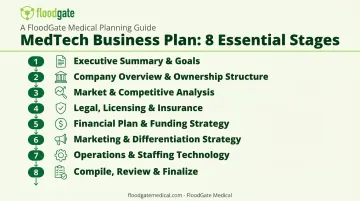
Step 1 – Write the Executive Summary and Define Business Goals
Summarize your mission, target market, and growth goals on a single page. If you're seeking funding, state the exact amount needed and how you'll use it. This is the section investors read first and sometimes read only, so make it count.
Step 2 – Define Company Overview and Ownership Structure
Compare sole proprietorship, partnership, LLC, and corporation structures for liability and tax implications before you file anything. Then detail your background, location, and the specific service mix you'll offer, such as travel, per diem, permanent placement, or allied health.
Step 3 – Conduct Market and Competitive Analysis
Ground your demand claims in current data, but be specific about which segment you're targeting. Recent industry forecasts show 2024 growth diverging sharply by category, a shift that's shaping projected 2025 revenue below:
| Segment | 2025 Projected Revenue | 2024 YoY Change |
|---|---|---|
| Travel nurse | $14.2B | -37% |
| Allied health | $9.8B | -15% |
| Locum tenens | $9.6B | +15% |
| Per diem | $4.5B | -17% |
Identify target client segments (hospitals, clinics, nursing homes) and run a brief SWOT against two or three known competitors in your chosen niche.
Step 4 – Address Legal, Licensing, and Insurance Requirements
List your state business registration steps and any staffing-specific licenses required. Then outline your insurance coverage and compliance requirements:
- General liability
- Professional liability
- Workers' compensation
- HIPAA and OSHA compliance basics
On HIPAA: a staffing agency isn't automatically a "business associate" under federal rules. It depends on the specific functions you perform involving protected health information. On OSHA: agencies and host facilities are typically joint employers, so spell out who handles bloodborne pathogen training versus site-specific PPE requirements in your client contracts.
Step 5 – Build the Financial Plan and Funding Strategy
Project monthly or quarterly revenue and expenses for at least three years, grounded in realistic bill rate versus pay rate margins, not best-case scenarios.
List funding sources you're considering:
- Personal savings
- SBA 7(a) loans (up to $5 million, working capital eligible)
- SBA microloans (up to $50,000, useful for early working capital)
- Invoice factoring for faster cash on receivables
- Private investors or SBIC funding
Each option carries different repayment terms and control trade-offs. Match the financing to your actual payroll timing.
Step 6 – Develop the Marketing and Differentiation Strategy
Split this into two tracks. Candidate acquisition covers nursing schools, referrals, and social channels. Client acquisition covers hospital and clinic outreach plus healthcare industry events.
Then define your unique selling proposition clearly. Are you faster to fill? More specialized? Built around a specific clinical niche? Say it plainly and communicate it consistently to both sides of your marketplace.
Step 7 – Plan Operations and Staffing Technology
Outline your core workflows: scheduling, credential tracking, timekeeping, and payroll or invoicing. Investing early in staffing-specific software reduces admin errors and speeds up placements — a difference you'll feel once you're juggling multiple facilities and shift schedules at once.
Step 8 – Compile, Review, and Finalize the Plan
Assemble every section into one well-formatted document with an appendix for licenses, sample contracts, and key team resumes. Set a quarterly review cadence, which works well for most agencies, to revisit projections and strategy as the business matures.
Conclusion
A strong medical staffing agency business plan covers the fundamentals thoroughly: legal structure, financials, market positioning, and marketing channels, rather than aiming for the longest document possible.
Beyond these fundamentals, validation and realistic financial projections matter more than how fast you launch. Treat the plan as a living document, and revisit it as your agency grows and the healthcare staffing market shifts around you.
Frequently Asked Questions
Is a healthcare staffing agency profitable?
Profitability depends on maintaining a healthy spread between bill rate and pay rate, controlling overhead, and building repeat client relationships. Margins are thin industry-wide, so cost discipline matters as much as sales volume.
What are the 3 C's of a business plan?
The 3 C's are Customer, Company, and Competition. For a staffing agency, that means defining your client facilities and candidates, outlining your service mix and structure, and assessing how you compare to other agencies in your niche.
Do you need a license to start a medical staffing agency?
Most states require standard business registration, and many also require agency-specific staffing or nurse agency licenses. Requirements vary by state and clinician specialty, so confirm details with your state labor or health department.
How much does it cost to start a medical staffing agency?
Costs cover business registration, insurance, recruiting, marketing, and staffing software. Totals vary based on your niche, state licensing fees, and how many states you operate in, so get local quotes before finalizing your budget.
How long does it take a medical staffing agency to become profitable?
Timelines vary based on placement volume, gross margin, overhead, and how quickly clients pay invoices. Strong marketing and early client retention tend to shorten the runway to profitability.
What should be included in a medical staffing agency business plan?
Core sections include the executive summary, company overview, market analysis, licensing requirements, financial plan, marketing strategy, and operations plan. Together, these give lenders and investors a complete picture of how the agency will operate.